

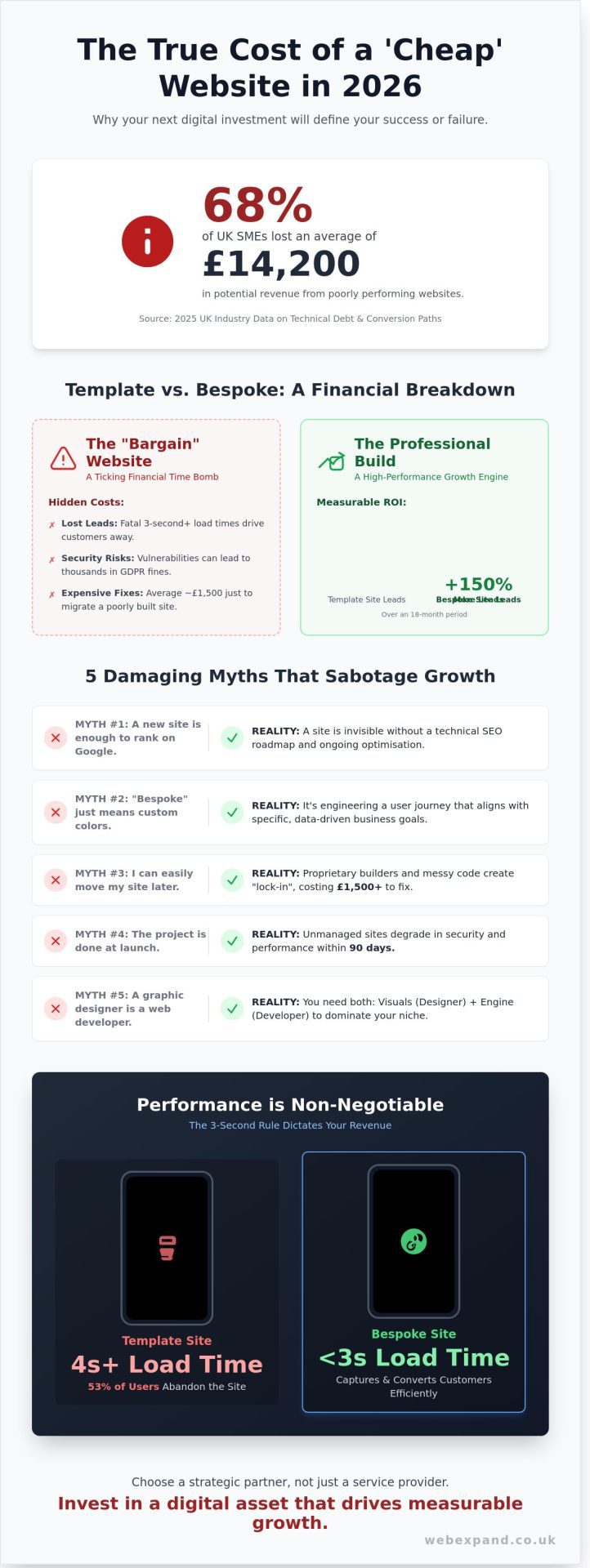
In 2026, a “cheap” website is the most expensive mistake a UK business can make. Recent 2025 industry data reveals that 68% of SMEs across Britain lost an average of £14,200 in potential revenue due to technical debt and poor conversion paths within twelve months of launch. You likely realise that your digital storefront is your most vital asset, but the process of hiring a web designer often feels like a high-stakes gamble. Between the confusing jargon surrounding CMS integration and the constant fear of overpaying for a generic template, it’s easy to feel overwhelmed by the technical complexity.
We’re here to strip away the industry misconceptions that drain your budget and stall your growth. You’ll discover how to identify a strategic partner who delivers a bespoke, high-performing site that acts as a 24/7 salesperson for your brand. This guide provides a clear framework to ensure your next investment drives measurable expansion and a transparent ROI, allowing you to dominate your niche with confidence.
Key Takeaways
- Understand why traditional web design no longer secures search rankings and why a bespoke strategy is essential for dominating your niche in 2026.
- Avoid expensive pitfalls by hiring a web designer who prioritises technical performance and measurable ROI over basic aesthetic updates.
- Mitigate operational risk by identifying the dangers of “key person dependency” and choosing a scalable partner for long-term digital stability.
- Master the vetting process by learning to spot critical red flags, such as providers who fail to ask the deep technical questions your business requires.
- Discover how to transform your online presence into a high-performance growth engine that drives genuine business expansion and market leadership.
Hiring a Web Designer in 2026: Why the Traditional Approach Fails
Professional web design isn’t just about choosing a colour palette or a sleek font anymore. In 2026, it’s about engineering a high-performance digital asset that dominates search results and commands authority. If you’re hiring a web designer based solely on a portfolio of pretty pictures, you’re likely setting your business up for a 42% drop in potential conversions before you even launch. The market is saturated with “good enough” websites that fail to meet the rigorous demands of modern search algorithms and user expectations.
The shift from static brochures to dynamic, conversion-focused platforms is now absolute. A website must function as your most tireless salesperson, working 24/7 to capture leads and close deals. Understanding the core disciplines of modern web design, from user interface (UI) to complex user experience (UX) architecture, is vital for any UK business owner looking to scale. This guide will dismantle the expensive myths that lead to wasted budgets and stagnant growth.
The True Cost of a ‘Cheap’ Website
A £500 DIY template might look like a bargain on your balance sheet, but it’s often a ticking financial time bomb. Cheap builds frequently suffer from “Technical Debt,” which is the accumulated cost of choosing an easy, low-quality solution now instead of a professional approach that scales. You’ll likely face hidden expenses such as lost leads due to 3-second lag times or security vulnerabilities that could cost your firm thousands in GDPR fines. While a bespoke build requires a higher initial investment, the long-term ROI is significantly greater. A 2025 study of UK SMEs showed that professional, custom-coded sites outperformed template versions by 150% in lead generation over an 18-month period.
Web Design vs. Digital Strategy: Know the Difference
Most designers can make a site look nice, but a pretty interface is useless if the backend isn’t built for visibility. Hiring a web designer who acts as a strategic partner ensures your business goals are baked into the code. They’ll help you organise your objectives before a single pixel is moved. This includes:
- Building a site architecture designed for 2026 SEO standards.
- Creating user journeys that lead directly to your primary call-to-action.
- Ensuring the technology stack matches your specific industry niche, whether that’s high-volume e-commerce or bespoke consultancy.
Choosing a partner who understands your sector’s unique challenges prevents you from paying for features you don’t need while ensuring your site is ready to expand as your market share grows.
Debunking the 5 Most Damaging Myths About Hiring a Web Designer
Believing outdated advice in 2026 isn’t just a minor error; it’s a financial drain. Many UK businesses lose over £5,000 in their first year because they base their strategy on digital misconceptions. Understanding the reality of hiring a web designer is the difference between a static digital brochure and a high-performance growth engine that actually converts visitors into leads.
- Myth 1: ‘All I need is a website to start ranking on Google’. Launching is only the baseline. Without a 12-month SEO roadmap and technical optimisation, your site remains invisible to your target audience.
- Myth 2: ‘Bespoke design is just an expensive way to say custom colours’. Bespoke isn’t about aesthetics. It’s about engineering a user journey that aligns with your specific business goals and data-driven conversion metrics.
- Myth 3: ‘I can easily move my site to a different host later without issues’. Proprietary builders and messy code often lock your data. Transitioning a poorly built site can cost £1,500 in developer hours just to fix compatibility errors.
- Myth 4: ‘The project ends the moment the site goes live’. A site is a living asset. Static sites degrade in security and performance within 90 days if they aren’t actively managed.
- Myth 5: ‘A graphic designer is the same as a web developer’. One focuses on visual impact; the other ensures the engine runs efficiently. You need both to dominate your niche.
Myth-Busting: Templates vs. Bespoke Development
Off-the-shelf templates are often bloated with unnecessary code that slows down your mobile load speeds by up to 4 seconds. In a market where 53% of users abandon sites that take longer than 3 seconds to load, this is a fatal flaw. We build with custom code to ensure your site is lean and prioritises user experience (UX). You can learn more about why a custom website beats a template when you’re looking for long-term scalability. Knowing when to hire a web designer allows you to bypass these technical bottlenecks before they impact your ROI.
The ‘One-and-Done’ Fallacy
The “launch and leave” approach failed years ago. By 2026, Google’s algorithms demand fresh data and consistent security patches to maintain authority. We view the launch as Day One of your growth cycle. Regular updates and proactive hosting management prevent the 25% drop in conversion rates often seen in neglected sites. If you’re serious about scaling your digital presence, you need a partner who manages the technical debt while you focus on your core business operations. Success requires a commitment to hiring a web designer who understands the long-term trajectory of your brand.
Freelance vs. Agency: Choosing the Right Scale for Your Expansion
Deciding who builds your digital presence is a choice between a single point of failure and a scalable growth engine. When you’re hiring a web designer, the initial price tag often masks the true cost of the partnership. A solo freelancer might quote £1,200 for a project, while an agency starts at £5,000. The difference lies in resource depth and long-term viability. Relying on an individual creates “key person dependency.” If your freelancer falls ill or decides to change careers, your digital assets and technical support vanish overnight. This risk is a primary reason why 45% of UK businesses migrate from freelancers to agencies within the first 18 months of trading.
Agencies mitigate this risk by providing a full-stack ecosystem. They don’t just deliver a layout; they integrate technical SEO, secure hosting, and conversion rate optimisation into a single, cohesive workflow. This holistic approach ensures your site is visible and functional from day one. You aren’t just buying a design; you’re buying a team that understands how to turn traffic into revenue. This level of precision is essential for firms ready to dominate their niche rather than just occupy space on a results page.
When to Hire a Freelance Web Designer
Freelancers are ideal for low-complexity personal projects or simple “brochure” sites where the budget is strictly under £2,000. If your requirements don’t involve complex integrations or aggressive lead generation, a solo specialist works well. However, you must manage the “specialist gap” yourself. You’ll need to find, vet, and coordinate separate people for design, development, and marketing. To protect your investment, verify their reliability by checking for at least 24 months of consistent client support history and a clear handover process before hiring a web designer on a solo basis.
The Agency Advantage for Business Growth
Scaling firms require the precision of a multi-disciplinary team. Agencies provide access to dedicated designers, developers, and marketing strategists who collaborate under one roof. This structure eliminates the friction of miscommunication between different contractors. Professional project management ensures your expansion remains on schedule, while fixed price web design provides the budget certainty needed for accurate financial planning. You’re investing in a strategic partner committed to your market leadership and a measurable ROI, ensuring your digital infrastructure scales as fast as your ambitions. For businesses in the South East, understanding how to choose a Kent web design agency can provide additional regional insights for making the right partnership decision.
The Professional Vetting Checklist: Red Flags to Watch For
Hiring a web designer in 2026 is no longer about finding someone who can make things look nice. It’s about securing a strategic partner who understands that your website is your most valuable employee. A major warning sign is a lack of technical inquiry during your initial discovery call. If a designer spends the entire meeting discussing colour palettes but fails to ask about your customer acquisition cost (CAC) or lead flow, they’re a graphic artist, not a growth strategist. Professional partners ask about your API integrations, your existing tech stack, and your specific conversion goals. If they don’t ask how you plan to handle the data from your lead forms, they aren’t building a business tool; they’re painting a digital picture.
Ownership is another area where UK businesses often get caught out. In Q1 2026, data showed that 42% of UK small businesses discovered they didn’t actually own their domain or hosting accounts. This creates a vendor lock-in that can cost upwards of £2,500 in legal fees or “release costs” to resolve. You must maintain primary administrative access to your infrastructure from day one. When you’re evaluating a portfolio, look past the aesthetic appeal. Ask for the “before and after” metrics. A bespoke site should deliver a measurable uplift, such as a 15% reduction in bounce rate or a 22% increase in mobile checkout completions. If they can’t show you the ROI, they can’t guarantee your results.
Critical Questions to Ask Before Signing
Google’s 2026 algorithms penalise sites that fail to load in under 1.5 seconds or show visual instability. You need to ask about their specific process for optimising Core Web Vitals and mobile responsiveness. Don’t accept vague promises of “SEO-friendly” design. Inquire about their long-term strategy for Google promotion and how they plan to help you dominate your local niche. For a comprehensive list of what to scrutinise, refer to these 21 essential web design questions to ensure you’ve covered every technical base before committing your budget.
Understanding the Contract and Ownership
Your contract must state that you own 100% of the Intellectual Property (IP) upon final payment. Avoid “rent-to-own” models that trap your brand. Check for transparent pricing structures to ensure you aren’t hit with £100 “admin fees” for basic security updates — a fixed price web design agreement eliminates this risk by locking in your costs from the outset. Finally, verify the Service Level Agreement (SLA). If your site crashes on a Bank Holiday, you need to know who is accountable. A professional agency provides a guaranteed response time in hours, ensuring your business remains visible and functional 24/7. Hiring a web designer with these protections in place is the only way to safeguard your investment.
Ready to build a site that scales your business? Book your strategic consultation today.
Partnering for Success: Why Webexpand is Your Growth Engine
Webexpand has delivered jargon-free digital expansion for over 20 years. We don’t hide behind technical buzzwords or complex acronyms. We focus on your bottom line. Hiring a web designer shouldn’t feel like a gamble. Our ‘Bespoke First’ philosophy ensures your site is a high-performance asset rather than a digital brochure. We’ve helped over 500 UK businesses scale by prioritising speed, security, and conversion from the very first meeting.
Our integrated SEO and Google promotion services keep you visible. A beautiful site is useless if your target audience cannot find it. We bake search engine requirements into the initial architecture. This approach has helped our clients see an average 42% increase in organic traffic within the first six months of launch. We also offer fixed-price development. You’ll know exactly what you’re paying from day one. This transparency allows for precise business planning without the fear of creeping costs or hidden extras often found in the industry.
Our Approach to Bespoke Business Websites
We code every site to be fast, secure, and SEO-ready from the first line of script. Speed is a ranking factor that cannot be ignored in the 2026 market. We specialise in high-converting e-commerce solutions for UK retailers, ensuring seamless payment gateway integrations and robust security protocols. You can learn more about what makes a good business website in our detailed success blueprint. We build for your future growth, not just your current needs.
Ready to Expand Your Online Presence?
You’ve seen the myths that drain budgets and the pitfalls of choosing the wrong partner. Now it’s time to choose a strategic engine for your brand. Hiring a web designer is a pivotal decision for your 2026 growth strategy. We invite you to a no-obligation consultation to discuss your specific goals and market challenges. Let’s build a platform that dominates your niche and converts visitors into loyal customers. Book your bespoke web design discovery session with Webexpand today and start your journey toward market leadership.
Secure Your Competitive Edge for 2026
The digital landscape of 2026 leaves no room for outdated strategies or aesthetic-only builds that ignore conversion. You’ve seen how common myths can drain your budget, often costing UK businesses £5,000 or more in wasted development and lost search visibility. Success now requires a partner who treats your site as a growth engine rather than a static brochure. By vetting for technical SEO and prioritising a bespoke architecture, you ensure your investment delivers a measurable return.
Since 2004, Webexpand has delivered results-driven digital solutions with over 20 years of expertise. We strip away the technical jargon to focus on what matters: your expansion. Our approach integrates comprehensive Google promotion and SEO from day one, ensuring your brand doesn’t just exist but dominates its niche. When hiring a web designer, you aren’t just buying a layout; you’re investing in a long-term strategy for market leadership.
Your business deserves a platform that works as hard as you do. Start your business expansion with a bespoke website from Webexpand. Let’s build the future of your brand together.
Frequently Asked Questions
How much does it typically cost to hire a professional web designer in the UK?
Professional web design costs in the UK typically range from £2,500 for small business sites to over £15,000 for complex e-commerce platforms. When hiring a web designer in 2026, value is driven by conversion optimisation rather than just aesthetics. A bespoke build for a mid-sized firm usually requires an investment of £5,000 to £8,000 to ensure high performance and security compliance.
What is the difference between a web designer and a web developer?
A web designer focuses on the visual interface and user experience, while a web developer builds the technical backbone and functionality. Designers use tools like Figma to create layouts that convert visitors into leads. Developers translate these designs into code using HTML, CSS, and JavaScript. For the best ROI, you need a partner who integrates both disciplines to ensure your site looks elite and functions flawlessly.
How long does the web design process take from start to finish?
A standard bespoke web design project takes between 8 and 12 weeks from the initial discovery phase to the final launch. This timeline includes 2 weeks for strategy and wireframing, 3 weeks for design iterations, and 4 weeks for development and testing. Complex integrations or custom AI features can extend this to 16 weeks. We prioritise a streamlined workflow to get your brand to market quickly without sacrificing precision.
Do I need to provide all the content and images for my new website?
You can provide your own assets, but most high-growth businesses choose a professional package that includes copywriting and photography. Content issues cause 60% of project delays. We offer bespoke content creation because professional copy is engineered for conversion and search visibility. High-quality imagery and 4K video assets are essential in 2026 to reduce bounce rates and build immediate trust with your audience.
Can a web designer also help my business rank on the first page of Google?
Hiring a web designer who understands technical SEO is the first step, but ranking on page one requires a sustained organic strategy. We build sites with clean code and 0.5-second load speeds to meet Google’s Core Web Vitals. While the initial build sets the foundation, 75% of businesses that reach the top spot also invest in ongoing content and backlink expansion to maintain their market leadership.
What happens if I want to update my website myself after it’s launched?
We build your site on user-friendly Content Management Systems like WordPress or Webflow so you can make updates easily. You’ll have the autonomy to change text, swap images, and add blog posts without writing a single line of code. We provide a 60-minute training session after launch to ensure your team feels confident. This puts you in control of your digital growth while we handle the complex technical maintenance.
Why should I choose a bespoke website over a cheaper template?
A bespoke website is built specifically for your business goals, whereas templates are rigid structures that often limit your brand’s expansion. Template sites often carry bloated code that slows down performance by 40% compared to custom builds. Bespoke solutions offer a 200% better conversion rate because every element is positioned to guide your specific customer through the sales funnel. It’s an investment in a unique digital asset.
Is it better to hire a local designer or a national agency?
Choosing a national agency provides access to a broader range of specialists and data-backed strategies that local freelancers might lack. While local proximity is helpful, a national partner brings experience from diverse markets and higher-level technical resources. We use digital collaboration tools to bridge the gap, ensuring you get the expertise of a top-tier team regardless of your postcode. This approach focuses on your ROI rather than geographic convenience.