
What if your next £15,000 investment in a new website actually cost you £50,000 in lost revenue because it failed to convert? It’s a harsh reality for the 62% of UK businesses that report dissatisfaction with their digital agency’s performance within the first twelve months. To avoid becoming a statistic, you need a precise set of web design questions to ask that cut through the fluff and focus on measurable expansion.
You’ve likely felt the frustration of hidden fees or the anxiety of owning a site that looks stunning but remains invisible on Google. We understand that you want more than just a developer; you need a strategic partner who prioritises your ROI as much as your aesthetics. This article promises to arm you with a comprehensive checklist to master the hiring process and ensure you retain full ownership of your digital assets. We’ll explore 21 essential questions that will help you identify an agency capable of delivering a bespoke solution that scales your business in 2026.
Key Takeaways
- Identify the strategic differences between a basic website and a high-performance growth asset to protect your investment from the very first consultation.
- Uncover the essential web design questions to ask to ensure your site is built with an optimised SEO structure that drives measurable conversion and long-term visibility.
- Master the nuances of bespoke design and project management to ensure your site is delivered on time and tailored specifically to your scaling goals.
- Eliminate the risk of hidden costs by gaining total clarity on ownership and the distinction between hosting fees and ongoing management support.
- Learn to spot critical red flags during the interview process to ensure you partner with an agency that understands the unique UK business landscape.
Essential Web Design Questions to Ask to Protect Your Investment
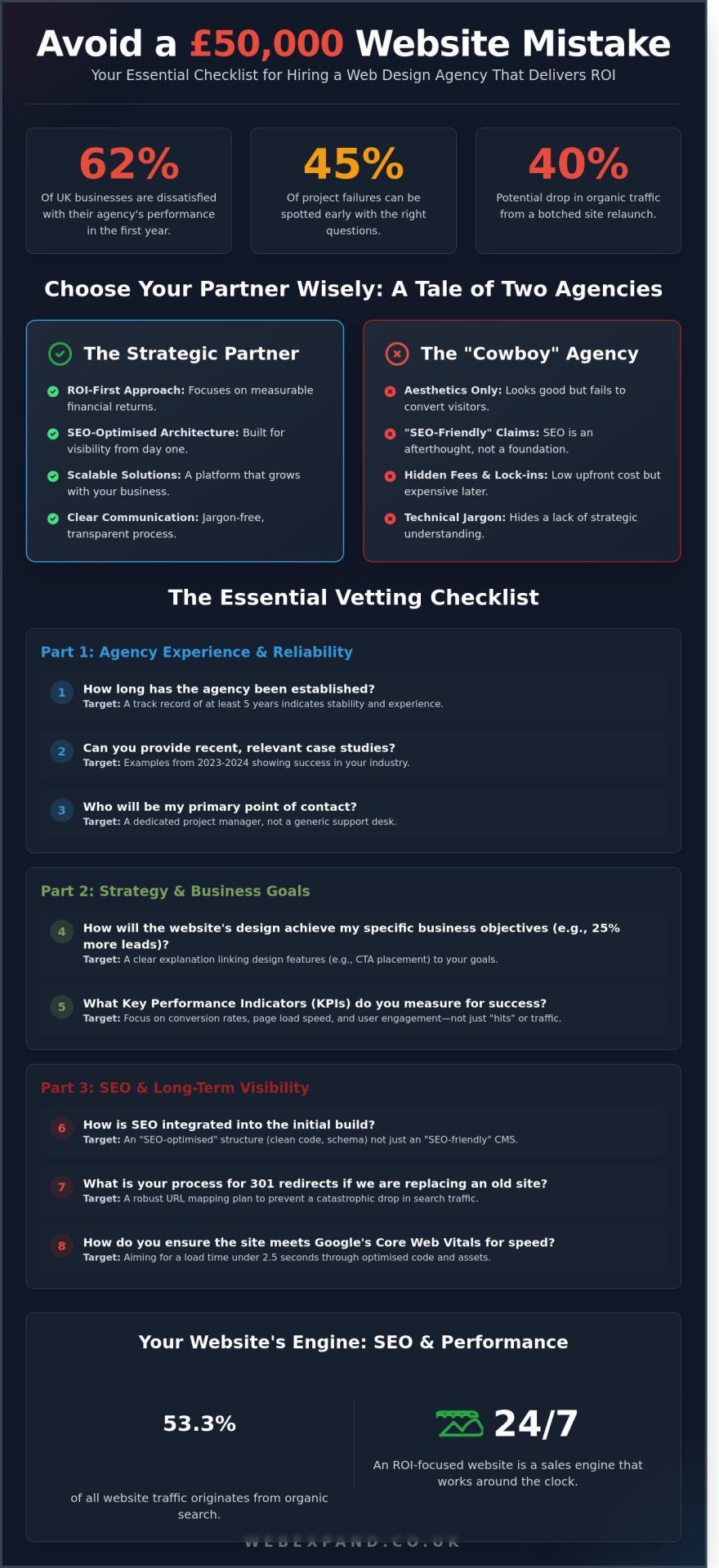
The initial consultation is the most critical stage of your digital project. Preparing specific web design questions to ask ensures you maintain control over the process from day one. It’s where 45% of potential project failures are identified before a single line of code is written. Choosing the wrong partner leads to more than just a poor aesthetic; it risks your brand’s reputation and your capital. You need a partner who understands that a website is a business tool, not an art project.
You must distinguish between a solo graphic designer and a strategic web agency. While a designer focuses on visual flair, a strategic agency integrates user experience, technical SEO, and conversion architecture. For those new to the field, this comprehensive overview of web design explains the various disciplines involved in creating a professional site. If an agency cannot explain these components without hiding behind technical buzzwords, they likely lack a deep understanding of your commercial goals. Clear, jargon-free communication is your primary filter for a successful partnership.
Using the right web design questions to ask allows you to expose “cowboy” agencies early. These operators often promise the world for a suspiciously low fee, such as £500 for a bespoke build, but fail to deliver a secure or scalable platform. Look for transparency and a focus on long-term growth rather than a quick, cheap fix. If they can’t explain their process in plain English, they won’t be able to align with your business strategy.
Questions About Agency Experience and Reliability
- How long has the agency been established? Seek a track record of at least 5 years to ensure they have the stability to support you long-term.
- Can they provide recent case studies? Ask for examples from 2023 or 2024 that demonstrate success in similar industries or with similar functional requirements.
- Who is the primary contact? Ensure you have a dedicated project manager rather than a generic support ticket system to maintain momentum.
Defining Your Specific Business Objectives
A strategic agency won’t just ask what colours you like. They will ask how you plan to grow. If you want a 25% increase in lead generation, they should explain how specific design features, like heat-mapped call-to-action placements, will achieve that. Success metrics must include conversion rates and page load speeds, not just “hits” to the site. We focus on the data that actually moves the needle for your Maidstone business.
An ROI-first approach prioritises measurable financial returns over purely aesthetic choices, transforming your website into a 24/7 sales engine that justifies every penny of your investment.
Strategic Questions About SEO and Long-Term Visibility
Building a website without a pre-defined SEO strategy is a wasted investment. It’s the digital equivalent of printing 10,000 brochures and locking them in a cellar. You’ve spent your budget, but your target audience will never find you. One of the most vital web design questions to ask is how the agency integrates search performance into the initial architecture. Many agencies claim to build “SEO-friendly” sites, which often only means the CMS allows you to edit meta titles. At Webexpand, we focus on “SEO-optimised” structures where every line of code prioritises speed and discoverability.
Google promotion must be the foundation of the design phase, not a task tacked on at the end. Research from BrightEdge shows that 53.3% of all website traffic comes from organic search; ignoring this during the build puts your ROI at risk. When looking for expert advice on hiring a web design agency, the consensus is that technical SEO must be a priority from day one. This includes implementing schema markup to help search engines understand your content and ensuring your site loads in under 2.5 seconds to meet 2024 Core Web Vitals standards.
Search Engine Optimisation (SEO) Fundamentals
Ask if the site will be built with clean, crawlable code. Bloated themes slow down performance and frustrate search bots. If you’re replacing an existing site, ensure the agency has a robust plan for 301 redirects. Failing to map old URLs to new ones can result in a 40% drop in organic traffic within weeks of launch. Your partner should also explain their approach to mobile-first indexing, ensuring the mobile version is the primary source for how Google ranks your site.
Content Strategy and Google Promotion
Clarify who is responsible for the SEO-optimised copy. High-value keywords must be woven into the site map structure from the start. A bespoke strategy identifies exactly which pages will target specific high-intent search terms to drive conversions. If you want to ensure your new platform is built for market leadership, our team can help you audit your current digital visibility before you commit to a new build. Finally, ask about ongoing support. Ranking maintenance is not a one-time job; it requires consistent data-backed adjustments to stay ahead of competitors in the Maidstone market.
A strategic approach ensures your site is a tool for expansion, not just a static business card. These web design questions to ask will separate the creative hobbyists from the results-driven partners who understand the mechanics of growth.

Evaluating the Design Process and Project Management
A transparent workflow separates professional agencies from hobbyists. One of the critical web design questions to ask involves how a partner manages the transition from a blank canvas to a high-converting asset. We believe a structured process protects your investment. It ensures every pixel serves a strategic purpose. Your brand identity shouldn’t be squeezed into a pre-made box. Instead, UX research must dictate the navigation. Data from 2023 shows that 88% of online consumers are less likely to return to a site after a bad experience. This makes the initial planning phase vital for your long-term ROI.
A bespoke design process focuses on your specific conversion goals. It doesn’t rely on the restrictive layouts of a £50 theme. By starting with wireframes, designers can map out the user journey based on actual search intent. This precision ensures that visitors find what they need in fewer than three clicks. It’s about building a digital headquarters that scales alongside your ambition.
The Step-by-Step Development Journey
Most successful projects follow a five-phase roadmap: discovery, wireframing, UI design, development, and quality assurance. You should clarify how many revision rounds are included in your fixed-price agreement. A standard professional contract usually allows for two or three rounds of feedback at the design stage. Always confirm the use of a private staging site. This allows you to review the build and test every button on a hidden URL before the 1.0 version launches to the Maidstone market.
Bespoke vs. Template Solutions
Templates often carry heavy “code bloat” that destroys page loading speeds. Since 53% of mobile visits are abandoned if pages take longer than three seconds to load, performance is a non-negotiable factor. A bespoke build allows for total control over the site’s architecture. Ask the agency if they use a “mobile-first” approach. This ensures the 60% of UK web traffic originating from handheld devices has a perfect experience. Custom builds also provide the flexibility to add advanced features, such as CRM integrations or bespoke booking systems, as your business dominates its niche. For an example of a structured package that goes beyond a simple template, you can explore The Multi-Page Marvel.
Clarity on Costs, Ownership, and Technical Support
Transparency eliminates the friction that stalls business growth. You shouldn’t face a £450 surprise invoice three months into your project because of “unforeseen” API integrations. When you invest in a digital platform, you’re building an asset that must appreciate in value. Ambiguity in a contract is a direct threat to your ROI. We believe in precision from the first consultation to ensure your capital is deployed effectively.
Understanding the Fee Structure
Fixed-price models protect your budget and force a focus on deliverables. Hourly rates often lead to scope creep and misaligned incentives. A 2023 industry survey revealed that 38% of UK small businesses encountered hidden “add-on” fees for basic features like contact forms or SSL certificates. You must distinguish between your hosting fees, which cover server space, and management fees, which cover active security patches and software updates. Clarifying these web design questions to ask before signing a contract prevents the vendor lock-in that hampers many growing firms.
- Confirm if the quote includes 100% of the features discussed.
- Ask for a breakdown of recurring annual costs for domain renewals and premium plugin licences.
- Identify the specific hourly rate for work that falls outside the initial scope of work.
Ownership and Intellectual Property Rights
Ownership is non-negotiable for a scaling brand. If you decide to move your operations, you must have the right to take your data with you. A 2024 legal audit of digital contracts found that 22% of agencies retained “proprietary” rights to the underlying code, making it impossible for clients to switch providers without rebuilding from scratch. These are vital web design questions to ask to ensure you aren’t just renting your digital presence. You require full administrative access to the Content Management System (CMS) and confirmation that the domain is registered in your company’s name, not the agency’s.
The “Day After” the launch is where the real work begins. The 2024 Technical Reliability Index indicates that 24% of new builds encounter a critical CSS or database error within 72 hours of going live. Your partner must provide a clear Service Level Agreement (SLA) for post-launch support. This ensures your visibility remains uninterrupted and your conversion rates stay high as you dominate your local market.
Secure your digital assets and scale your business with a transparent web design strategy that puts you in total control.
Choosing the Right Partner for Business Expansion
Selecting a designer is about finding a long-term growth partner. During your interview, watch for red flags like a refusal to provide a fixed-price quote or a lack of interest in your ROI. If an agency cannot explain how they track conversions or why they use specific technical structures, your project risks becoming a costly liability. In the UK market, where 82% of consumers research online before visiting a local business, your site must work perfectly from day one. You need a partner who understands local Kent demographics and national search trends alike.
Identifying the right expert requires a strategic approach. Use your list of web design questions to ask to probe their technical depth. An agency that avoids discussing site speed or mobile responsiveness is likely cutting corners that will hurt your rankings later. We focus on building robust digital foundations that support rapid scaling and market leadership.
The Webexpand Difference: Bespoke and Results-Driven
We don’t offer generic templates. Every Webexpand project is a bespoke build designed to dominate your specific niche. We provide absolute transparency with fixed-price agreements, ensuring you never face unexpected costs or hidden fees that inflate your budget. Our strategy integrates high-performance SEO directly into the design phase. This approach has helped our clients see an average 45% increase in organic visibility within the first six months of launch. We act as your strategic guide, focusing on technical precision that turns visitors into paying customers.
Your Pre-Meeting Checklist
Preparation ensures you get the most value from your initial conversation. Before you finalise your web design questions to ask, gather these essentials to help us understand your vision:
- High-resolution brand assets, including logos and professional photography.
- Links to three competitor websites that currently rank higher than yours in UK search results.
- A clear definition of your primary call-to-action (CTA), such as a contact form submission or a direct purchase.
Setting these parameters early allows us to provide a data-backed roadmap for your expansion. Ready to transform your digital presence? Book a jargon-free consultation with Webexpand today and start scaling your business with confidence.
Secure Your Market Leadership for 2026
Your website is the engine of your business growth. By mastering the essential web design questions to ask, you protect your capital and ensure your brand dominates the search results. Prioritising SEO visibility from day one and securing full ownership of your assets prevents expensive redevelopments later. It’s about moving beyond a simple online presence to achieve genuine commercial expansion.
Since 2004, WebExpand has delivered over 20 years of expertise in bespoke design and SEO growth for ambitious UK firms. We provide jargon-free advice tailored specifically to your business goals; ensuring every pound spent drives a measurable return on investment. Don’t settle for a generic template when your niche requires a strategic partner. Our team focuses on precision and technical authority to turn your digital presence into a high-conversion asset. Let’s build a platform that scales as fast as your ambitions.
Start your expansion journey with a bespoke website quote
We’re ready to help you outpace the competition and secure the long-term visibility your business deserves.
Frequently Asked Questions
What should I ask a web designer about SEO before I hire them?
You must ask for a detailed breakdown of their technical SEO process and how they handle on-page elements like schema markup and metadata. A professional designer ensures your site is crawlable and indexed correctly from the moment it launches. This is one of the most vital web design questions to ask to ensure your new platform actually appears in search results rather than just looking pretty.
How much should I expect to pay for a bespoke business website?
For a professional bespoke business website in the UK, you should expect to invest between £3,000 and £15,000 depending on your functional requirements. Small lead-generation sites typically start at £2,500, while complex e-commerce platforms often exceed £10,000. This investment covers custom UI/UX design and strategic development tailored to your specific conversion goals rather than restrictive, generic templates.
Should I ask about mobile responsiveness and site speed?
You must demand a mobile-first build and a target load time of under 2 seconds for every page. Google uses mobile-first indexing for 100% of websites, so your mobile performance determines your search visibility. Ask for a guaranteed Core Web Vitals score of 90 or higher. Speed directly impacts your bottom line, as a 1-second delay in page load can reduce your conversion rate by 7%.
What happens if I want to move my website to a different host later?
You should ensure you retain full legal ownership of the website files, database, and domain name from the start. Verify that your designer uses open-source platforms or provides a clean export of all custom code. Avoid proprietary site builders that lock you into a specific provider. A standard migration between UK servers should take no more than 48 hours with minimal downtime.
How long does a typical web design project take from start to finish?
A standard bespoke web design project takes 8 to 12 weeks to complete. This timeline allows for 2 weeks of strategic discovery, 3 weeks for design iterations, and 5 weeks for development and quality assurance testing. Complex builds with custom API integrations may extend to 16 weeks. Clear project milestones prevent the 20% time slippage often seen in poorly managed digital projects.
Do I need to provide all the content for the website myself?
You can provide the copy, but 75% of high-growth businesses choose professional copywriting to guarantee higher conversion rates. If you handle the writing, your designer should provide a content map and character limits to maintain the layout’s integrity. Most professional agencies offer SEO-optimised content creation as an additional service, typically ranging from £150 to £400 per page.
What is the difference between a fixed-price and an hourly web design quote?
A fixed-price quote provides a total cost for a defined scope of work, while hourly rates charge for the time spent on the project. Fixed-price models protect your budget from unexpected costs, making them the preferred choice for 90% of commercial web builds. Hourly billing is usually reserved for ongoing maintenance or evolving R&D projects where the final requirements aren’t yet defined.
Can the agency help with my Google rankings after the site is live?
Most expert agencies offer ongoing SEO retainers to scale your visibility and dominate your niche after the site launches. Building the site is only the first step; 91% of online content receives zero traffic from Google without active, data-driven promotion. Asking about post-launch support is one of the essential web design questions to ask if you want to see a genuine return on your investment.
