
Did you know that 43% of UK businesses reported a cybersecurity breach in the last 12 months? For many Maidstone business owners, the sight of a “Not Secure” warning on their own homepage is a wake-up call that they can’t afford to ignore. You likely realise that digital security is vital, yet the technical jargon often makes it feel like an uphill battle. If you’re asking yourself, what is ssl and why does my website need it, you’re already taking the first step toward dominating your sector and protecting your digital assets.
We’ll bridge the gap between complex encryption and your business’s bottom line. In this 2026 guide, you’ll discover how SSL certificates protect your data, boost your Google rankings in Kent, and build the customer trust required to scale. We’ll provide a clear breakdown of the latest TLS 1.3 standards, the mandatory 199-day certificate lifespans, and how to ensure your site remains compliant with the newest UK data laws.
Key Takeaways
- Understand exactly what is ssl and why does my website need it to maintain a professional digital presence and secure sensitive customer data.
- Learn how HTTPS serves as a critical ranking signal that can give your business a competitive edge in local search results across Maidstone and Kent.
- Discover the difference between data encryption and business authentication to protect your clients from sophisticated cyber threats like “man-in-the-middle” attacks.
- Identify the specific type of SSL certificate—from Domain Validation to Organisation Validation—that aligns with your firm’s size and credibility requirements.
- Recognise the importance of professional management to avoid the reputational damage caused by expired certificate warnings and automated renewal failures.
Understanding SSL: The Invisible Security Guard for Your Website
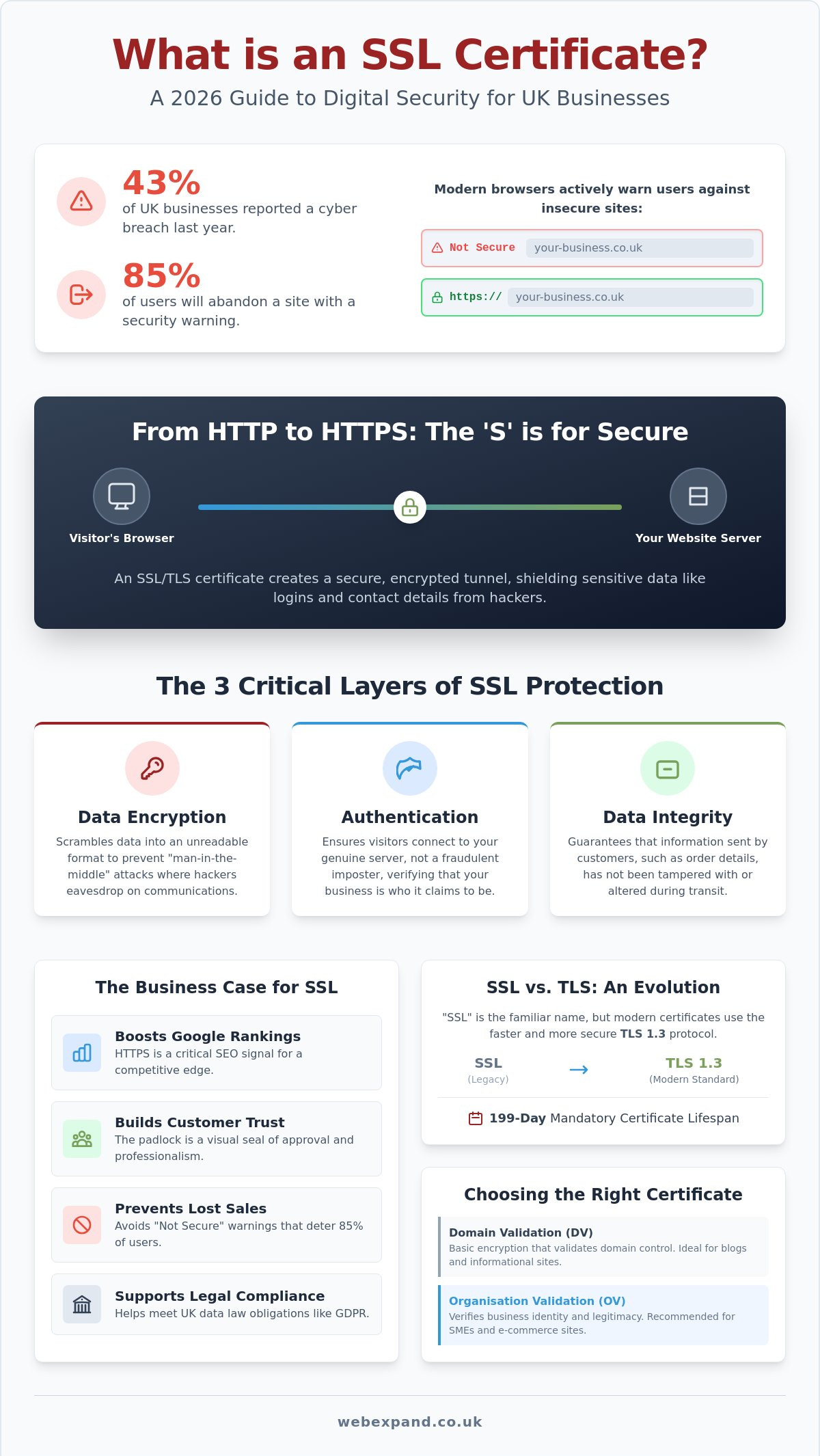
Think of an SSL certificate as a digital passport for your website. It provides a cryptographic handshake that verifies your business identity to every visitor who lands on your page. When you ask yourself, what is ssl and why does my website need it, the answer lies in the fundamental shift from traditional HTTP to the modern HTTPS standard. That “S” stands for Secure. It signifies that every piece of data moving between a visitor’s browser and your Maidstone business server is protected by a robust, encrypted tunnel. This ensures that sensitive information, such as login credentials or contact details, remains private and shielded from prying eyes.
In 2026, the visual cues of security are unmistakable and non-negotiable. Modern browsers display a prominent padlock icon in the address bar. This isn’t just a technical detail; it’s a badge of legitimacy that signals your site is safe for interaction. Without this certificate, your site lacks the basic credentials required to operate in a professional digital landscape. It’s the difference between a high-street shop with a locked, secure door and one with a broken window. Understanding what is ssl and why does my website need it is no longer just for developers; it’s a critical decision for any business leader ready to dominate their sector.
The “Not Secure” Warning: A Business Killer in 2026
Browsers no longer stay silent about missing security protocols. Chrome and Safari now flag non-SSL sites with aggressive red “Not Secure” warnings that often appear before a user even views your content. For a potential customer in Sevenoaks or West Malling, this creates immediate friction and distrust. Industry data suggests that 85% of users will abandon a site if they encounter a security warning. This isn’t just a bounce rate issue; it’s a direct hit to your brand’s reputation and your web design in Maidstone strategy. If your site triggers these alarms, you aren’t just losing a click; you’re handing your local competitors an advantage.
SSL vs TLS: What is the Difference?
Whilst most people still use the term “SSL”, the technology has evolved significantly. The original Secure Sockets Layer protocol was actually replaced by Transport Layer Security (TLS) years ago. In 2026, when you invest in a modern certificate for your bespoke website design in Kent, you’re actually receiving the latest TLS 1.3 protection. We keep the old name because it’s familiar to business owners, but the technology under the bonnet is much faster and more secure. This ensures your site remains compatible with the highest cybersecurity standards whilst providing the rapid load times that modern search engines demand.
Why Every UK Business Website Requires an SSL Certificate
Operating a business in 2026 requires more than just a great product; it demands a commitment to digital integrity. When you delve into what is ssl and why does my website need it, you quickly realise it serves as the backbone of secure internet communication. Without it, the data exchanged between you and your clients is vulnerable to interception. SSL provides three critical layers of protection that are essential for any growth-oriented firm in Kent.
- Data Encryption: It scrambles information into an unreadable format, preventing “man-in-the-middle” attacks where hackers eavesdrop on sensitive communications.
- Authentication: This ensures your visitors are actually connecting to your genuine server rather than a fraudulent imposter. Understanding Website Certificates is vital for verifying that your business is exactly who it claims to be.
- Data Integrity: It guarantees that the information sent by your customers, such as order details or personal enquiries, hasn’t been tampered with or altered during transit.
Building Instant Trust with Kent Customers
For local tradesmen and professionals in Maidstone, the padlock icon is far more than a technical graphic. It’s a seal of approval that influences consumer behaviour. When a potential client in Sevenoaks visits your site, they look for those subtle cues of professionalism. If they don’t see them, they’ll likely abandon the session. There is a direct correlation between perceived security and conversion rates. By securing your digital presence, you position your brand as an authoritative entity that respects user privacy and data safety.
Legal Obligations: GDPR and Beyond
The legal landscape for UK firms is becoming increasingly stringent. Under the UK GDPR and the Data Protection Act 2018, businesses must implement “appropriate technical and organisational measures” to secure personal data. In 2026, failing to use an SSL certificate is often viewed as a failure of this duty, especially if your site features a contact form or login area. With the new Cyber Security and Resilience Bill strengthening domestic laws, regulatory oversight is expanding. Ensuring your site is encrypted isn’t just a best practice; it’s a requirement for staying compliant with UK law and protecting your firm from potential litigation. Navigating the complexities of digital law starts with a simple answer to the question: what is ssl and why does my website need it? It is the foundation of your legal and ethical commitment to your customers. If you’re ready to solidify your security posture, we can help you organise a robust security strategy for your digital presence.
The SEO Advantage: How SSL Boosts Your Rankings in Maidstone and Kent
Visibility is the lifeblood of any growing Kent business. Whilst we’ve established that encryption protects your data, its impact on your search engine visibility is equally transformative. Google confirmed HTTPS as a ranking signal as far back as 2014, and in 2026, it’s a non-negotiable baseline for any site hoping to reach the first page. When you ask what is ssl and why does my website need it from a growth perspective, you’re really asking how to stay ahead of local competitors who may be neglecting their technical foundations. One of the primary benefits of having an SSL certificate is the “tie-breaker” effect. If two businesses in Maidstone offer similar services and have comparable content, Google will almost certainly prioritise the secure site over the one lacking a certificate.
User experience signals are now a core component of how search engines evaluate your brand. If a searcher clicks your link only to be met with a security warning, they’ll bounce back to the search results immediately. This high bounce rate sends a clear signal to Google that your site is either untrustworthy or irrelevant, leading to a rapid decline in your rankings. Additionally, with Google’s mobile-first indexing, performance on mobile devices is paramount. Most Maidstone residents search for local services on their smartphones, where browsers like Chrome and Safari are even more aggressive in flagging insecure connections. A secure site ensures a smooth, uninterrupted journey from search query to conversion.
SSL and Local SEO Strategy
Your security protocol is a fundamental pillar of our SEO services in Kent. Local SEO relies heavily on signals of authority and proximity. If you’re investing in Google Promotion to drive traffic to a landing page, that investment is wasted if the page is flagged as insecure. Google’s algorithms are designed to protect their users, meaning they’re unlikely to feature a non-HTTPS site in the coveted “Local Map Pack” for Maidstone searches. Secure sites aren’t just safer; they’re more likely to be seen by the people who matter most to your business development.
The 2026 Search Landscape
As we move further into 2026, AI-driven search engines (SGE) are becoming the standard for how information is consumed. These systems prioritise secure, authoritative sources when generating answers for users. Secure sites are significantly more likely to be featured in “People Also Ask” snippets and AI overviews because encryption is viewed as a hallmark of a legitimate organisation. In 2026, an SSL certificate serves as a direct contributor to your domain authority by validating your site’s technical integrity and commitment to user safety. By securing your connection, you aren’t just following a trend; you’re future-proofing your digital presence against the next generation of search technology.
Choosing the Right SSL Certificate: A Comparison for UK Firms
Selecting the right certificate starts with understanding what is ssl and why does my website need it in the context of your specific business model. Whilst the fundamental encryption remains consistent across all tiers, the level of identity verification varies significantly. In 2026, the industry offers several distinct options designed to match your organisational scale and the sensitivity of the data you handle. Choosing the correct one is a strategic step toward establishing your brand as a market leader.
- Domain Validation (DV): This is the standard entry point. It verifies that you own the domain but doesn’t vet your business as a legal entity. It’s the most common choice for local service providers and brochure websites.
- Organisation Validation (OV): This tier involves a manual check of your business’s legal status. It’s often favoured by charities and medium-sized firms that want to project a higher level of authenticity.
- Extended Validation (EV): This provides the highest level of assurance. It requires a rigorous background check and is essential for high-profile brands and platforms handling significant transaction volumes.
- Wildcard SSL: If you operate multiple subdomains, such as a separate blog or customer portal, a Wildcard certificate secures your main domain and all subdomains under a single umbrella.
Which SSL Does Your Business Need?
A simple decision framework can help you navigate these options. If you run a local brochure site for a trade in Maidstone, a DV certificate is usually sufficient to remove security warnings and protect contact forms. However, if you’re building a growth engine through bespoke website design in Kent, you might opt for an OV or EV certificate to instil maximum confidence in your users. The goal is to align your security level with your brand’s authority. For most businesses, the right choice is the one that balances cost-effectiveness with the specific trust signals your audience expects.
The Cost of SSL: Free vs. Paid
The rise of automated providers like Let’s Encrypt has made free SSL certificates widely available. These are excellent for basic encryption, but they often come with a hidden cost: management time. In 2026, with certificate lifespans dropping to 199 days, the risk of a manual renewal failing is higher than ever. Professional management ensures your site never goes dark due to an expired certificate. We include this technical oversight within our website hosting in Maidstone, allowing you to focus on scaling your business whilst we handle the precision of your security. If you’re unsure which certificate fits your current growth stage, contact our team for a tailored security assessment.
Securing Your Digital Growth with Professional Management
Professional management is the final piece of your digital puzzle. Whilst you now understand what is ssl and why does my website need it, the ongoing maintenance of that security is where many firms stumble. In 2026, the industry has mandated shorter certificate lifespans to enhance global security standards. With the maximum validity for certificates now capped at just 199 days, the margin for error has vanished. If an automated renewal script fails, your site will immediately trigger “Not Secure” warnings, stalling your lead generation and damaging your reputation overnight.
Local businesses in Maidstone and Sevenoaks often find that “set and forget” solutions are no longer sufficient for high-growth objectives. A managed approach provides a layer of expert oversight that ensures your technical foundations remain solid. We view security as a strategic asset rather than a checkbox. We provide jargon-free advice and technical precision, ensuring your SSL fits seamlessly into your broader digital marketing strategy. This proactive stance prevents the reputational damage associated with expired security warnings and keeps your brand’s momentum moving forward.
- Managed certificates eliminate the risk of manual renewal errors.
- Continuous monitoring ensures your site stays compliant with evolving UK data laws.
- Professional installation prevents “mixed content” errors that can break your site’s layout.
Beyond the Padlock: Total Website Health
An SSL certificate is just one component of a successful business website. True digital growth requires a holistic view of your site’s health. This includes regular software updates, secure Website Hosting, and continuous threat monitoring. For Kent firms, this level of care is essential for maintaining industry leadership. We monitor these technical variables in the background, allowing you to focus on your core operations whilst we protect your stakeholders’ interests and broaden your digital horizons.
Next Steps for Your Kent Business
If you’re still questioning what is ssl and why does my website need it, start by checking your current configuration. Look for the padlock icon in your browser and verify the expiry date of your certificate. If you’re still running on an insecure HTTP connection, the migration to HTTPS must be handled with precision to avoid losing your existing SEO rankings. This involves implementing server-side 301 redirects and updating all internal links to ensure a seamless transition for both users and search engines.
Ready to dominate your sector with a secure, high-performance site? Contact our Maidstone team today for a comprehensive security and SEO audit. We’ll help you ensure your digital presence is a powerful, protected tool for long-term success.
Future-Proof Your Digital Presence with Strategic Security
In the fast-paced landscape of 2026, security is no longer a technical afterthought but a core driver of organisational growth. By now, the answer to what is ssl and why does my website need it is clear: it’s the essential foundation for building customer trust, securing local SEO rankings, and ensuring full compliance with UK data laws. Whether you’re a local trade or a scaling firm, the padlock icon serves as a vital signal of your brand’s integrity and commitment to excellence. It’s the difference between a site that converts and one that drives visitors away.
We’ve been helping businesses dominate their sectors since 2004. As Maidstone-based experts, we pride ourselves on delivering fixed-price web design and jargon-free SEO advice that translates technical complexity into measurable financial performance. Don’t let an expired certificate or a security warning stall your momentum. We’re ready to act as your strategic partner in navigating these technological shifts and protecting your stakeholders’ interests.
Get a Secure, High-Ranking Website – Contact Webexpand Today to secure your digital future and broaden your business horizons. Your journey toward industry leadership starts with a secure and authoritative online presence.
Frequently Asked Questions
Does an SSL certificate make my website 100% unhackable?
No, an SSL certificate doesn’t offer total immunity from all cyber threats. Its primary role is to encrypt the data moving between a visitor’s browser and your server, preventing eavesdropping. You still need to maintain secure passwords, update your plugins, and choose robust hosting to protect your site from other vulnerabilities like malware or server-side attacks.
How much does an SSL certificate cost for a small business in Kent?
Investment levels vary based on the depth of verification your business requires. Whilst basic domain-validated certificates are often cost-effective, premium options like Extended Validation involve higher fees due to the manual legal checks involved. We focus on providing tailored solutions that align with your growth goals and security needs without unnecessary complexity.
What happens if I let my SSL certificate expire?
Allowing your certificate to expire triggers immediate “Not Secure” warnings in all modern browsers. This causes a rapid drop in traffic and erodes the trust you’ve built with your Maidstone audience. Because search engines prioritise secure sites, an expired certificate can also lead to a swift decline in your local search rankings.
Do I need SSL if I don’t sell products on my website?
Yes, every professional site requires encryption to remain competitive and compliant. If you’re asking what is ssl and why does my website need it for a brochure site, consider your contact forms. UK data laws require you to protect any personal information submitted by users. Furthermore, Google uses HTTPS as a baseline requirement for all indexed pages. If you are considering moving into online retail, you can visit ShopUp Ghana to see how they enable Ghanaian sellers to launch secure storefronts in minutes.
How do I know if my SSL certificate is working correctly?
You can verify your security status by looking for the padlock icon and the “https://” prefix in your browser’s address bar. For a deeper technical check, you can use online SSL labs to confirm that your TLS 1.3 protocol is correctly configured. This ensures there are no “mixed content” errors that might compromise your site’s integrity.
Is SSL the same thing as HTTPS?
They are closely related but represent different things. SSL, and its modern successor TLS, is the security protocol that encrypts the data. HTTPS is the secure communication channel that appears in your browser when that protocol is active. Essentially, HTTPS is the visible result of having a correctly installed SSL certificate on your server.
Can SSL help my business rank higher in Maidstone Google searches?
Yes, security is a confirmed ranking signal that helps search engines identify authoritative and trustworthy businesses. By answering the question of what is ssl and why does my website need it, you’re addressing a key part of your local SEO strategy. A secure site often acts as a tie-breaker, pushing you ahead of non-secure competitors in Kent search results.
How long does it take to install an SSL certificate?
Installation times depend on the type of certificate you choose. A standard Domain Validation certificate can often be active within minutes through automated systems. However, Organisation or Extended Validation certificates require manual verification of your business’s legal status, which typically takes several business days to complete through the official certificate authorities.