

Did you know that a minor slip in your cookie consent could now trigger a fine of up to £17.5 million or 4% of your global turnover? With the Data (Use and Access) Act 2025 now in full effect, the stakes for GDPR compliance for uk business websites have never been higher. You’ve likely felt the pressure of keeping up with these shifting rules whilst worrying that strict privacy measures might clutter your website design or damage your SEO rankings. It is a common concern, but compliance doesn’t have to come at the expense of growth.
We’re here to help you turn these regulatory requirements into a strategic advantage that builds genuine user trust. This 2026 guide provides a clear roadmap to secure your digital presence, covering everything from the new 30-day complaint acknowledgement deadline to the recognised legitimate interest processing basis. You’ll learn how to satisfy the newly renamed Information Commission without sacrificing the sleek, high-performing user experience your brand relies on to dominate the market. We will break down the technical complexities into actionable steps so you can focus on scaling your business with total peace of mind.
Key Takeaways
- Master the evolved 2026 standards of UK GDPR to ensure your data processing remains transparent, lawful, and aligned with current statutory requirements.
- Implement essential technical safeguards, such as dynamic cookie consent banners and SSL encryption, to protect user data whilst maintaining high website performance.
- Execute a rigorous data audit by mapping every collection point and vetting third-party plugins to eliminate hidden regulatory vulnerabilities.
- Discover how to achieve robust GDPR compliance for uk business websites by integrating “Privacy by Design” into your digital architecture from the outset.
- Transform complex data responsibilities into a strategic asset that enhances brand authority and secures your path toward industry leadership.
What is UK GDPR Compliance for Business Websites in 2026?
UK GDPR is the fundamental framework that dictates how your organisation handles personal data through its digital presence. While the original General Data Protection Regulation (GDPR) established the global benchmark, the UK landscape has shifted significantly following the Data (Use and Access) Act 2025. This legislation refined the Data Protection Act 2018 to ensure our standards remain modern and digitally native. For any ambitious brand, achieving GDPR compliance for uk business websites is no longer just about avoiding a penalty; it’s about demonstrating a commitment to transparency and precision that sets you apart from less diligent competitors.
The regulatory body formerly known as the ICO has been renamed the Information Commission, reflecting its broader role in a data-driven economy. They monitor how businesses collect, store, and process information, ensuring that every user interaction respects individual privacy rights. In 2026, compliance is a baseline requirement for every firm, from local tradesmen in Kent to major corporations in London. If your website is active, you are accountable for the data it touches.
Who Needs to Comply?
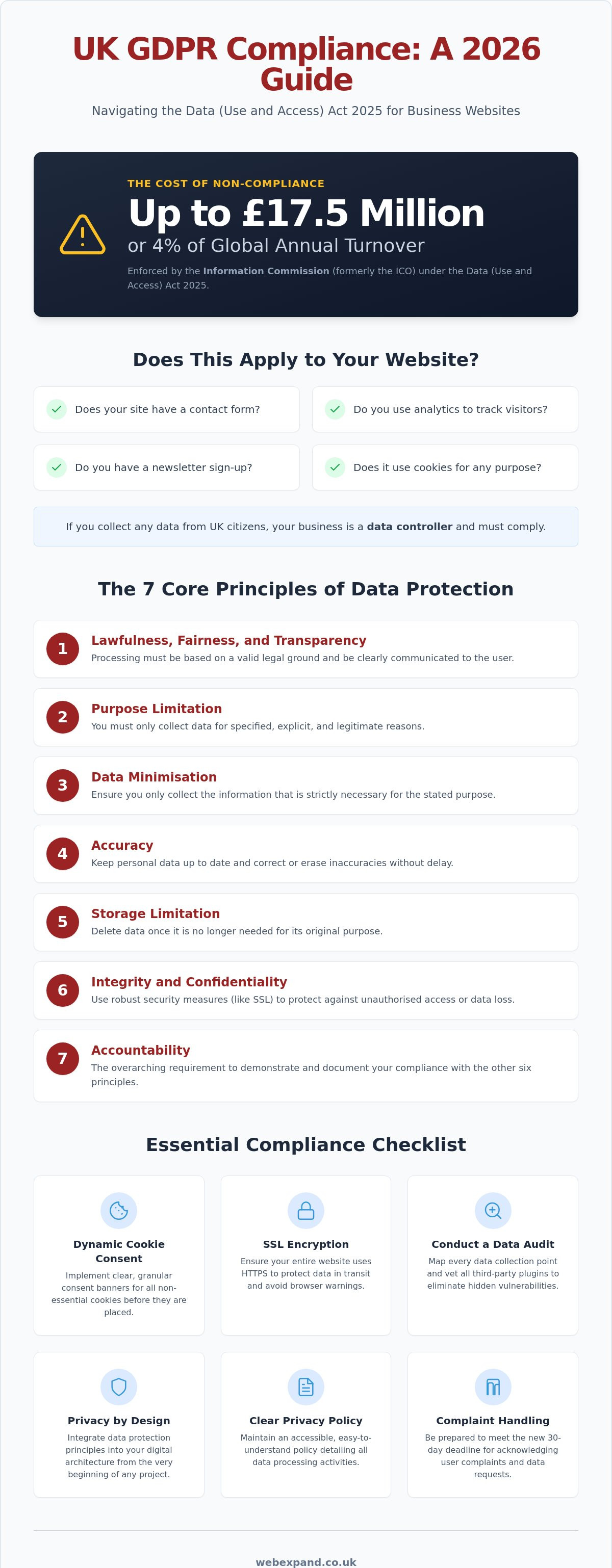
The rules apply to any business that collects data from UK citizens, regardless of the company’s size or sector. Many owners mistakenly believe that because they don’t run an e-commerce store, they’re exempt. This is a dangerous assumption. Even a basic contact form or a newsletter sign-up constitutes data collection. If you use analytics to track visitor behaviour or offer bespoke SEO solutions that involve user tracking, you are a data controller. Every digital touchpoint is a point of responsibility that requires a clear, lawful basis for processing.
The Risks of Non-Compliance
Ignoring these standards carries severe financial and operational risks. The Information Commission now has the power to issue fines of up to £17.5 million or 4% of your global annual turnover, whichever is greater. This alignment of PECR and GDPR penalties highlights how seriously the government treats data privacy. Beyond the financial hit, non-compliant sites face technical hurdles. Modern browsers often flag insecure or non-compliant websites, which can decimate your search rankings and trigger “Not Secure” warnings. These warnings kill conversion rates instantly, as users will naturally favour competitors who provide a safe, transparent environment for their information. Protecting your business from these risks is essential for long-term growth and industry leadership.
The 7 Core Principles of Data Protection for Websites
The bedrock of any high-performing digital presence is a clear adherence to the seven core principles of data protection. These are not just legal hurdles; they’re blueprints for building a credible, expert brand. When we talk about GDPR compliance for uk business websites, we’re referring to a framework that ensures every byte of user data is handled with precision and purpose. These principles include:
- Lawfulness, fairness, and transparency: Processing must be based on a valid legal ground and communicated clearly to the user.
- Purpose limitation: You must only collect data for specified, explicit, and legitimate reasons.
- Data minimisation: Ensuring you only collect the information that’s strictly necessary.
- Accuracy: Keeping personal data up to date and erasing inaccuracies without delay.
- Storage limitation: Deleting data once it’s no longer needed for its original purpose.
- Integrity and confidentiality: Using robust security measures to protect against unauthorised access or loss.
- Accountability: The overarching requirement to demonstrate that you’re following the other six principles.
The Accountability principle is particularly vital in 2026. It requires you to maintain clear records of your processing activities. You can find deep dives on these requirements in the official UK GDPR guidance, which serves as a vital resource for staying ahead of regulatory shifts whilst scaling your operations.
Transparency and User Consent
Consent is no longer a passive exercise. To meet modern standards, your website must secure active, granular consent. This means users must take a positive action to opt-in to specific types of processing; pre-ticked boxes are a thing of the past. Your privacy notice should be a bridge, not a barrier. We believe that bespoke website design kent should always feature human-centric language that explains data usage without the stifling weight of legal jargon. Clarity builds authority, and authority drives growth.
Data Minimisation in Practice
Precision in data collection is a hallmark of a mature business. Data minimisation dictates that you only collect what is strictly necessary for your stated goal. If you’re offering a simple service quote, do you really need a home address or date of birth? Probably not. Streamlining your contact forms doesn’t just help with GDPR compliance for uk business websites; it also removes friction. Shorter, more relevant forms often result in higher conversion rates as users feel more comfortable sharing their details. Hoarding old customer data is a liability you don’t need. If it’s no longer serving its purpose, secure deletion is the only logical step. If you’re unsure whether your current forms are over-reaching, we’re ready to help you audit your website’s data collection points for maximum efficiency.
Essential Compliance Features Every UK Website Needs
Managing data access requests is another critical operational feature. Under the Data (Use and Access) Act 2025, users have a statutory right to lodge complaints and request the deletion of their information. Your site needs a clear protocol for the “right to be forgotten,” ensuring you can identify and erase personal data across your entire database within the required 30-day window. Using a comprehensive GDPR compliance checklist can help you audit these technical touchpoints to ensure nothing is overlooked as you scale your digital presence.
The 2026 Approach to Cookies
The era of “implied consent” is officially over. In 2026, UK business websites must use dynamic cookie consent banners that allow users to opt-in or out by specific category. You can’t simply assume consent because a user continues to browse. A compliant preference centre should clearly distinguish between “strictly necessary” cookies, which are essential for site functionality, and “marketing” or “analytical” cookies. We’ve found that integrating these centres thoughtfully doesn’t just keep the regulators happy; it actually supports your long-term growth. When users feel in control of their data, they’re more likely to engage with your brand. This level of transparency is a core component of high-quality SEO services kent, as it reduces bounce rates and improves overall user signals.
Privacy and Terms Documentation
Your Privacy Policy is the most important document on your website. In 2026, it must include specific clauses regarding the “recognised legitimate interest” processing basis and clear instructions on how users can complain directly to your organisation. If you use third-party tools like Google Analytics or Mailchimp, you’re responsible for telling your users exactly how those platforms handle their data. We recommend regular policy audits to ensure your documentation stays aligned with your evolving business model. As you introduce new features or e-commerce solutions, your privacy terms must reflect those changes to maintain your GDPR compliance for uk business websites and protect your reputation.
Step-by-Step GDPR Audit for Your Business Website
Performing a thorough audit is the only way to verify that your digital infrastructure actually meets the standards we’ve discussed. Theory is fine, but regulatory risk is mitigated through action. To secure GDPR compliance for uk business websites, you must begin by mapping your data flow. This involves identifying every touchpoint where personal information enters your ecosystem, from newsletter sign-ups to complex e-commerce checkouts. If you don’t know where the data is, you can’t protect it.
Next, audit your third-party plugins. Many tools harvest data silently in the background, which can leave you liable for breaches you didn’t even know were happening. Following this, review your infrastructure. Confirm that your website hosting kent uses servers that are either UK-based or fully compliant with the Data (Use and Access) Act 2025. Data residency is a critical factor in maintaining a legally sound presence and ensuring the free flow of data continues without interruption.
Testing your forms is equally vital. Verify that no personal data is stored in plain text or sent via unencrypted email. Finally, update your notices. Your website footer must link to the most recent version of your legal documents to ensure total transparency. A professional audit doesn’t just tick a box; it provides the precision needed to scale your business with confidence.
To ensure your broader technical infrastructure is as robust as your compliance measures, you can discover Dugnad Solutions and their integrated software services.
Technical Security Checks
Security is the foundation of privacy. Start by verifying that your SSL certificate is valid and correctly configured across all subdomains. Outdated software is a primary target for data breaches, so ensure your CMS and all active plugins are updated to their latest secure versions. We also recommend implementing strong password policies for all website administrators to prevent unauthorised access to your backend systems. These technical safeguards are essential for protecting your stakeholders’ interests and maintaining your brand’s authority.
User Rights Management
You need a streamlined process for handling Subject Access Requests (SARs). In 2026, you must acknowledge receipt of a data protection complaint or request within 30 days. The Right to Erasure is a mandatory 2026 requirement that grants users the power to demand the permanent deletion of their personal data from your systems without undue delay. Speed and accuracy are paramount here. If you’re ready to ensure your site is bulletproof, we invite you to book a professional compliance audit with our expert team today.
Future-Proofing Your Digital Presence with Webexpand
At Webexpand, we don’t treat data protection as an afterthought. We integrate “Privacy by Design” into the very fabric of every bespoke project we undertake. This proactive stance ensures that GDPR compliance for uk business websites is baked into your site’s DNA from day one. Whether you’re a local tradesman in Maidstone or a large firm in the heart of London, you deserve a digital partner that understands the technical nuances of the Data (Use and Access) Act 2025. We position ourselves as your strategic partner, ensuring your growth is never hindered by regulatory oversights.
We provide fixed-price web design solutions that include essential compliance features as standard. This approach means you won’t face hidden costs for dynamic cookie banners or secure SSL configurations. Our goal is to provide measurable outcomes and a digital presence that stands up to the most rigorous regulatory scrutiny. By choosing our team to manage your technical SEO and security, you’re investing in a partnership that values transparency and precision. We cut through the jargon to deliver clear, actionable strategies that protect your business whilst driving consistent growth.
Strategic Growth Through Trust
A fast, secure, and compliant website is a powerful competitive tool. In 2026, users are highly sensitive to how their data is handled. When your site functions perfectly and respects privacy, you build a level of authority that non-compliant competitors simply cannot match. This trust is a fundamental component of what makes a good business website in the current market. By prioritising the human element of data protection, you create a seamless user journey that naturally leads to higher conversion rates and long-term customer loyalty.
Get a Professional Compliance Review
Don’t leave your regulatory standing to chance. Our Kent-based experts are ready to perform a comprehensive audit of your existing digital assets to identify potential GDPR red flags before they become costly liabilities. Choosing professional website design kent management gives you the peace of mind to focus on scaling your operations. We ensure your site remains a strategic asset that broadens your horizons rather than a source of legal risk. Ready to secure your digital future? Contact our Maidstone team today to start your transformative journey toward industry leadership.
Secure Your Competitive Edge for 2026 and Beyond
Maintaining GDPR compliance for uk business websites is a continuous journey of precision and transparency. By moving beyond basic privacy policies and adopting dynamic consent tools, you don’t just avoid penalties; you cultivate a brand that stakeholders can trust. Your website should be a high-performing engine of growth, not a liability waiting to be flagged by regulators. We’ve seen throughout this guide how technical precision in data mapping and hosting can directly impact your market authority.
As a professional web design agency based in Kent, Webexpand has been delivering technical excellence since 2004. With over 20 years of expertise, we specialise in jargon-free, results-driven development and SEO that keeps your business ahead of the curve. We’re ready to help you navigate the complexities of the Data (Use and Access) Act 2025 whilst ensuring your site remains fast, secure, and authoritative. Our team acts as your strategic partner, turning complex requirements into seamless digital experiences that protect your interests.
Secure your Kent business with a compliant, high-performance website—Contact Webexpand today.
It’s time to transform your data responsibilities into a strategic advantage that broadens your horizons and secures your place as an industry leader. We look forward to scaling your digital presence together.
Frequently Asked Questions
Do small UK businesses really need to be GDPR compliant?
Yes, every UK business that collects or processes personal data must adhere to these regulations regardless of their size. If your website features a contact form, tracks visitor behaviour, or processes payments, you are legally responsible for that information. Failing to meet these standards leaves you vulnerable to the Information Commission’s enforcement actions and can severely damage your professional reputation amongst your target audience.
What is the difference between a Privacy Policy and a Cookie Policy?
A Privacy Policy is a comprehensive document explaining how your organisation handles all personal data, whilst a Cookie Policy specifically details the trackers used on your site. The Privacy Policy covers everything from email storage to third-party sharing. In contrast, the Cookie Policy explains what each cookie does and how users can manage their preferences. Both are essential components for maintaining GDPR compliance for uk business websites.
Can I just copy a GDPR policy from another website?
You shouldn’t copy a policy from another site because it won’t accurately reflect your unique data processing activities. Every business uses different plugins, hosting providers, and marketing tools, meaning a generic document likely misses critical disclosures. Using an inaccurate policy is often viewed as a failure of transparency, which can lead to regulatory scrutiny. It’s much safer to have a tailored document that matches your specific digital architecture.
How much does it cost to make a website GDPR compliant in 2026?
The cost of achieving compliance depends entirely on the complexity of your website and the volume of data you handle. A simple brochure site requires fewer technical safeguards than a large-scale e-commerce platform with multiple third-party integrations. Rather than viewing this as an expense, ambitious businesses see it as a vital investment in brand authority and risk mitigation. We recommend a professional audit to determine the specific technical requirements for your project.
Does GDPR compliance affect my website’s Google ranking?
Yes, compliance indirectly influences your search performance through security signals and user behaviour. Google prioritises secure websites (HTTPS), which is a core requirement for protecting data. Additionally, a transparent and easy-to-use cookie preference centre reduces bounce rates by building user trust. When visitors feel safe on your site, they stay longer and engage more, sending positive signals that can improve your overall Google promotion results.
What happens if a user asks to see the data I have on them?
You must respond to a Subject Access Request (SAR) without undue delay and at the latest within one month. You are required to provide the individual with a copy of their personal data and an explanation of how it’s being used. In 2026, having a clear, internal protocol for data retrieval is essential to meet these statutory deadlines. Efficiently handling these requests demonstrates a level of professional accountability that strengthens customer loyalty.
Is Google Analytics compliant with UK GDPR in 2026?
Google Analytics can be used compliantly, but only if you’ve configured it to respect user consent and data minimisation principles. You must ensure that no personal data is tracked until the user has actively opted in via your cookie banner. Following the EU-UK data adequacy renewal in late 2025, data flows remain permissible, but you must still disclose this third-party processing clearly within your updated Privacy Policy.
Do I need a Data Protection Officer (DPO) for my small business?
Most small businesses don’t need a formal DPO unless they carry out large-scale systematic monitoring or process sensitive “special category” data. However, even if a DPO isn’t a legal requirement for your firm, you must still designate someone to take responsibility for data protection. Ensuring your organisation has a clear understanding of its data responsibilities is a core part of achieving GDPR compliance for uk business websites and protecting your long-term growth.