

Did you know the average value of fines issued by the Information Commissioner’s Office has surged by 370% since 2023, hitting nearly £3.2 million so far in 2026? This staggering figure proves that website maintenance is no longer just about keeping the lights on; it’s the proactive defence of your search engine dominance. Most UK business owners feel the weight of this risk, alongside the constant pressure to maintain lightning-fast loading speeds and top-tier Google rankings. You’ve worked hard to build your digital presence, so it’s natural to feel anxious about technical vulnerabilities. Implementing a robust small business website security checklist is now a fundamental requirement for any company looking to protect its growth whilst navigating the complexities of the modern digital landscape.
We’ve developed this guide to transform that technical anxiety into a strategic advantage for your organisation. You’ll learn exactly how to master the essential tasks required to keep your business website secure, fast, and ranking at the top of Google in 2026. This roadmap covers everything from the UK Data (Use and Access) Act 2025 to the latest WordPress 7.0.1 updates, ensuring you have the precision tools needed for sustained ROI. We’ll move quickly from identifying these market challenges to presenting data-backed solutions that keep your digital presence ahead of the curve and ready to dominate your sector.
Key Takeaways
- Implement a robust small business website security checklist to safeguard your digital assets and ensure total compliance with the latest UK data regulations.
- Learn to manage daily off-site backups and systematic software updates to create a resilient disaster recovery plan that protects your organisation from unexpected downtime.
- Optimise your search presence by using Core Web Vitals as a recurring monthly benchmark to maintain a competitive edge and high visibility on Google.
- Structure your maintenance routine into clear weekly, monthly, and annual tasks to ensure your website remains a high-performing engine for business growth.
- Recognise the long-term financial value of professional maintenance to avoid the false economy of DIY approaches whilst leveraging specialist expertise in Kent and London.
Why Ongoing Website Maintenance is Non-Negotiable for UK Businesses in 2026
Website maintenance is often misunderstood as a simple technical chore; however, in 2026, it represents a holistic fusion of technical precision, security protocols, and content optimisation. Your website has evolved from a static digital brochure into a dynamic growth engine. This shift requires constant tuning to remain effective. Modern search algorithms now prioritise technical perfection and content freshness above almost all else. For any ambitious organisation, especially those seeking professional web design in Kent, adopting a partner mindset is essential. Professional oversight doesn’t just fix bugs. It protects your brand’s reputation and ensures your digital assets continue to perform at their peak. By following a rigorous small business website security checklist, you ensure that your site remains a reliable tool for lead generation rather than a liability.
Beyond Keeping the Lights On: The Growth Factor
Regular updates do more than patch holes; they signal to Google that your business is active, reliable, and relevant. There’s a direct correlation between your site’s technical health and your conversion rate optimisation. A site that loads instantly and functions flawlessly builds the trust necessary to turn a visitor into a client. By treating your computer security principles and technical upkeep as a core strategy, you broaden your digital horizons. You aren’t just maintaining a site; you’re outstripping local competitors who treat their digital presence as an afterthought. This proactive approach ensures your investment delivers a sustained return as you scale your operations.
The High Cost of Digital Neglect
Neglect carries a heavy price tag. For a Kent-based e-commerce site, even a single hour of downtime can lead to significant lost revenue and eroded customer loyalty. Security is a primary concern here. Outdated plugins remain the most common gateway for cyber attacks in the UK, making a comprehensive small business website security checklist an absolute requirement for modern trade. Beyond the immediate threat of a breach, ignored broken links and persistent 404 errors cause long-term SEO damage. Google’s crawlers interpret these errors as a sign of poor management. This leads to a steady drop in search rankings that can take months of expensive recovery work to reverse.
Consider the specific risks associated with digital abandonment:
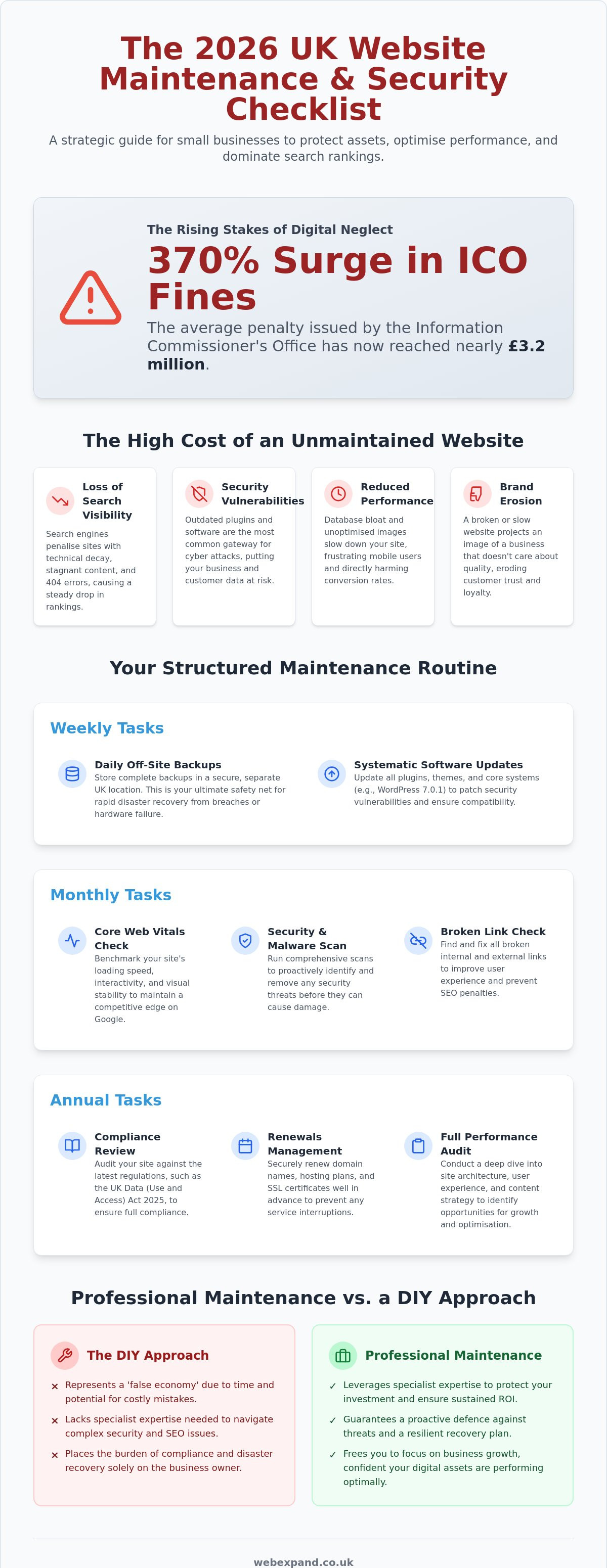
- Loss of Search Visibility: Search engines penalise sites that show signs of technical decay or stagnant content.
- Security Vulnerabilities: Every day a plugin goes unpatched is another day your customer data is at risk.
- Reduced Performance: Database bloat and unoptimised images slow down your site, frustrating mobile users and killing conversions.
- Brand Erosion: A broken or slow website suggests a business that doesn’t care about the finer details of its service.
We view maintenance as a transformative journey toward industry leadership. It’s about precision and measurable outcomes. When you prioritise the health of your digital presence, you aren’t just preventing problems. You’re building a foundation for aggressive growth and sector dominance in an increasingly competitive UK market.
The Essential Technical and Security Checklist for Small Business Owners
A robust small business website security checklist serves as the foundation of your digital resilience. Daily off-site backups are your ultimate safety net. We recommend storing these backups in a separate, secure UK-based location to comply with data residency expectations. Rapid disaster recovery depends on having a clean, recent version of your site ready to deploy the moment a hardware failure or breach occurs. Unlike standard hosting backups, off-site storage ensures that even if your primary server is compromised, your data remains untouched and recoverable.
SSL certificate monitoring has become significantly more complex in 2026. The industry has shifted toward a 200-day validity limit, meaning you can no longer “set and forget” your encryption for years at a time. If your certificate expires, Google will immediately flag your site as unsafe. This destroys visitor trust in seconds and triggers a sharp decline in search rankings. Automated monitoring and renewal protocols are now essential to maintain the encrypted connection your customers expect.
Server-side health requires technical precision. Ensure your hosting environment runs the latest stable PHP version, such as PHP 8.5.8 or 8.4.23, to benefit from the most recent security patches. Regular database optimisation is equally vital. Removing overhead and cleaning up expired transients keeps your site responsive for your customers whilst reducing the strain on your server resources. Integrating FCC cybersecurity tips into your weekly routine provides a solid baseline for protecting sensitive customer data and maintaining operational integrity.
Hardening Your Digital Defences
Malware scans and integrity checks must be automated and frequent. These tools identify malicious code or unauthorised file changes before they can escalate into a full-scale breach. Review your user access levels monthly. Redundant administrative accounts amongst your team are a major liability; if an old staff member’s account is compromised, your entire organisation is exposed. We also recommend monitoring for brute-force login attempts and implementing strict IP blocking for suspicious behaviour to stop attackers at the gate.
Software and Plugin Governance
Optimising for Search: The 2026 SEO Maintenance Checklist for Kent Firms
Whilst the foundation of your digital presence rests on a robust small business website security checklist, your visibility on Google depends on continuous performance tuning. We view SEO maintenance as a dynamic growth process rather than a static repair job. In 2026, search algorithms demand technical excellence alongside content relevance. Monthly benchmarking of your Core Web Vitals, specifically Largest Contentful Paint (LCP), First Input Delay (FID), and Cumulative Layout Shift (CLS), is now a standard requirement for Kent firms aiming to dominate local search results. These metrics directly impact how Google perceives your site’s user experience, making them vital for long-term rankings. Adhering to FTC small business cybersecurity guidelines ensures your technical foundation remains secure, which is the first step toward building high search authority.
Validation of your XML sitemap and robots.txt files is another critical monthly task. These files serve as the primary maps for search engine crawlers; if they contain errors, your latest updates or new service pages may never be indexed. Content decay is also a silent ranking killer. We recommend a quarterly review of older blog posts to refresh data, update links, and ensure the information remains accurate for 2026 standards. For organisations ready to move beyond basic upkeep, our SEO services Kent provide the deep strategic analysis required for industry leadership.
AI-Search Readiness and Structured Data
AI-search readiness is the new frontier for digital growth. Verifying that your Schema markup is valid and error-free ensures your business appears in AI Overviews and SGE results. Schema markup acts as the essential translator between your website’s content and search engine algorithms. Additionally, your images must be compressed and equipped with descriptive, keyword-rich alt text. This captures traffic from visual search queries, which has become a major driver of engagement in the 2026 search landscape.
Technical SEO Hygiene
Technical SEO hygiene involves running monthly crawls to spot redirect loops or 404 errors. These issues frustrate users and waste your crawl budget, signalling to Google that your site is poorly managed. We also monitor Google Search Console for indexation warnings or manual actions that could derail your progress. Checking mobile responsiveness against the latest 2026 device standards is equally critical. Mobile-first indexing remains the primary way Google evaluates your digital presence, so ensuring a flawless experience on every screen size is non-negotiable for sustained search success.
Organising Your Routine: Weekly, Monthly, and Annual Maintenance Tasks
Organising these tasks into a structured rhythm ensures that your digital growth engine never stalls. A chaotic approach leads to missed updates and security vulnerabilities. By following a tiered schedule, you integrate your small business website security checklist into your standard operations, making protection a habit rather than a reaction. This methodical approach allows you to identify minor issues before they escalate into costly failures that could damage your brand’s reputation amongst Kent’s competitive business landscape.
Weekly checks should be swift and focused. We recommend a visual site walk-through on multiple devices to ensure everything renders correctly. Verify that your daily off-site backups are completing successfully. Review your security logs to identify any blocked IP addresses or failed login attempts that might signal a targeted attack. These quick pulses keep you informed of your site’s immediate health without consuming excessive time.
Monthly maintenance shifts focus toward performance and data. This is when you should perform comprehensive speed testing and execute plugin updates in your staging environment. Analytics reporting during this phase helps you understand how users interact with your brand, providing the precision needed to adjust your strategy for measurable outcomes.
The Monthly Deep Dive
During your monthly review, dive into Google Analytics to examine traffic sources and user behaviour patterns. Spotting anomalies early can alert you to bot traffic or tracking errors before they skew your data. Testing every contact form and checkout flow is vital; even a minor script conflict can silently kill your lead generation. This is also the perfect time for an internal link audit. Identify new blog posts and link them back to your high-value bespoke web design Kent pillars. This strengthens your site’s architecture and distributes link equity effectively across your domain, ensuring your most important pages continue to rank well.
Annual Compliance and Strategy
Annual tasks are about long-term sustainability and legal safety. You must ensure your privacy policy and cookie banners remain fully compliant with the latest UK-GDPR standards for 2026. Lapses here can lead to the heavy ICO fines mentioned earlier in this guide. Review your entire domain portfolio and track SSL expiry dates to prevent accidental site outages. Finally, take a step back and assess if your current Kent web design still aligns with your 2026 business ambitions. As your company scales, your digital presence must evolve to meet new market demands and technological shifts. This strategic review ensures your digital investment continues to deliver a high ROI.
Strategic maintenance is the difference between a website that merely exists and one that dominates its sector. If you need assistance setting up a professional maintenance schedule to protect your growth, contact our expert team to secure your digital future today.
Why Professional Maintenance Beats the DIY Approach for Kent and London Organisations
DIY maintenance often appears to be a cost-saving measure, yet it frequently results in a false economy. Every hour a director spends navigating a small business website security checklist is an hour lost to high-level business development and strategic scaling. Professional support replaces the anxiety of unpredictable emergency repair bills with the confidence of fixed-price peace of mind. We position ourselves as your strategic partner, lifting the technical weight so you can focus on dominating your sector. Our team is deeply invested in your data and the human element of your business development, ensuring that every technical adjustment serves your broader organisational goals.
For tradespeople such as builders and pavers, partnering with a specialist like Dragon Driving Gypsy Webdesign ensures that your website and hosting are managed professionally, allowing you to focus on your core business activities.
Tailored Solutions for Kent Organisations
Generic, one-size-fits-all hosting packages rarely offer the depth of protection required for ambitious UK enterprises in 2026. Our bespoke maintenance plans are far superior, specifically designed for the unique requirements of organisations in Maidstone, Sevenoaks, and West Malling. Having a local expert who understands the Kent market provides a significant competitive advantage. This technical upkeep integrates perfectly with our Google Promotion and SEO management. We don’t just keep your site online; we ensure it remains a high-performance engine for growth that outpaces your local competitors.
Your Next Steps for Digital Security
Transitioning from a reactive fix-it mindset to a proactive growth strategy is essential for industry leadership. We recommend starting with a jargon-free audit to identify vulnerabilities that a standard small business website security checklist might overlook. Our team breaks down complex technical concepts into logical, actionable steps. This ensures your value proposition remains front and centre whilst we harden your digital defences against evolving 2026 threats. We move quickly from identifying challenges to implementing data-backed solutions, mirroring the fast-paced nature of the professional landscape you inhabit.
Your progress is the ultimate measure of our own performance. We’re ready to partner with you to secure your digital future and protect your stakeholders’ interests through precise, measurable outcomes. Our approach is modern and digitally native, yet grounded in traditional professional values like reliability and transparency. Contact Webexpand today for a professional maintenance review and begin your transformative journey toward industry leadership.
Securing Your Competitive Edge in 2026
The digital landscape of 2026 demands more than just occasional updates; it requires a relentless commitment to technical precision and security. By integrating a comprehensive small business website security checklist into your operations, you move beyond mere survival to proactive sector dominance. We’ve explored how consistent speed optimisation, data compliance, and technical SEO hygiene form the foundation of sustained digital ROI. These aren’t just maintenance chores; they’re the building blocks of a transformative journey toward industry leadership.
At Webexpand, we’ve spent over 20 years since our establishment in 2004 refining our technical expertise to protect our stakeholders’ interests. As a Kent-based agency, we provide jargon-free, professional advice that turns complex technical burdens into clear growth strategies. Our fixed-price solutions ensure predictable business budgeting whilst providing the peace of mind you need to focus on scaling your organisation. We’re invested in your data and your development, acting as the ambitious guide your business deserves.
Don’t leave your digital future to chance. Secure your 2026 growth with a Webexpand maintenance plan and let us help you broaden your horizons with confidence. We’re ready to partner with you for mutual success and long-term security.
Frequently Asked Questions
How often should I realistically update my website plugins?
You should check for plugin updates at least once a week to maintain system stability and performance. Critical security patches require immediate attention the moment they are released to prevent vulnerabilities. Delaying these updates leaves your site exposed to known exploits that cybercriminals use to target UK businesses, potentially compromising your entire digital infrastructure.
Is website maintenance necessary if my site is not an e-commerce store?
Website maintenance is essential for every business site, regardless of whether you sell products online. Your website acts as your digital storefront; if it is slow, broken, or insecure, you lose credibility and potential leads. Even a brochure site must follow a small business website security checklist to protect visitor data and prevent being blacklisted by search engines for technical neglect.
What is the difference between website hosting and website maintenance?
Website hosting provides the physical server space where your files live, whilst maintenance is the proactive service that keeps those files updated, fast, and secure. Think of hosting as the land and maintenance as the ongoing gardening and structural repairs. Most hosting packages don’t include software updates or performance tuning, which is why separate maintenance is vital for organisational growth.
Can I do my own website maintenance to save money?
You can perform your own maintenance, but it often represents a false economy for ambitious directors. One wrong update can break your entire site, leading to expensive emergency repair costs and significant downtime. Professional oversight ensures technical precision and allows you to focus your energy on scaling your organisation rather than troubleshooting complex code or server errors.
How does regular maintenance actually improve my Google ranking?
Regular upkeep improves your Google ranking by ensuring your site consistently meets technical benchmarks like Core Web Vitals. Search engines prioritise sites that are fast, mobile-responsive, and free from broken links. By refining your technical health, you signal to algorithms that your business is active and provides a superior user experience, which is rewarded with higher search visibility.
What happens if I forget to renew my SSL certificate?
Forgetting to renew your SSL certificate causes browsers to display a “Not Secure” warning to every visitor. This destroys user trust instantly and leads to a sharp decline in your search engine visibility. Google treats valid encryption as a primary ranking signal, so an expired certificate can undo months of strategic SEO progress in just a few days of neglect.
Is UK-GDPR compliance part of a standard maintenance checklist?
UK-GDPR compliance is a fundamental part of a professional small business website security checklist. Maintenance includes auditing your cookie banners, privacy policies, and data collection forms to ensure they meet the latest ICO standards. Staying compliant protects your organisation from the significantly increased fines that the ICO has been issuing for data failures throughout 2026.
How much time should a business owner spend on website upkeep each week?
A business owner should expect to spend between three and five hours per week on thorough website upkeep if they choose the DIY route. This time includes verifying backups, testing contact forms, and reviewing security logs for suspicious activity. Most professionals find this time is better invested in core business activities, making a managed maintenance plan a more efficient choice for long-term growth.