

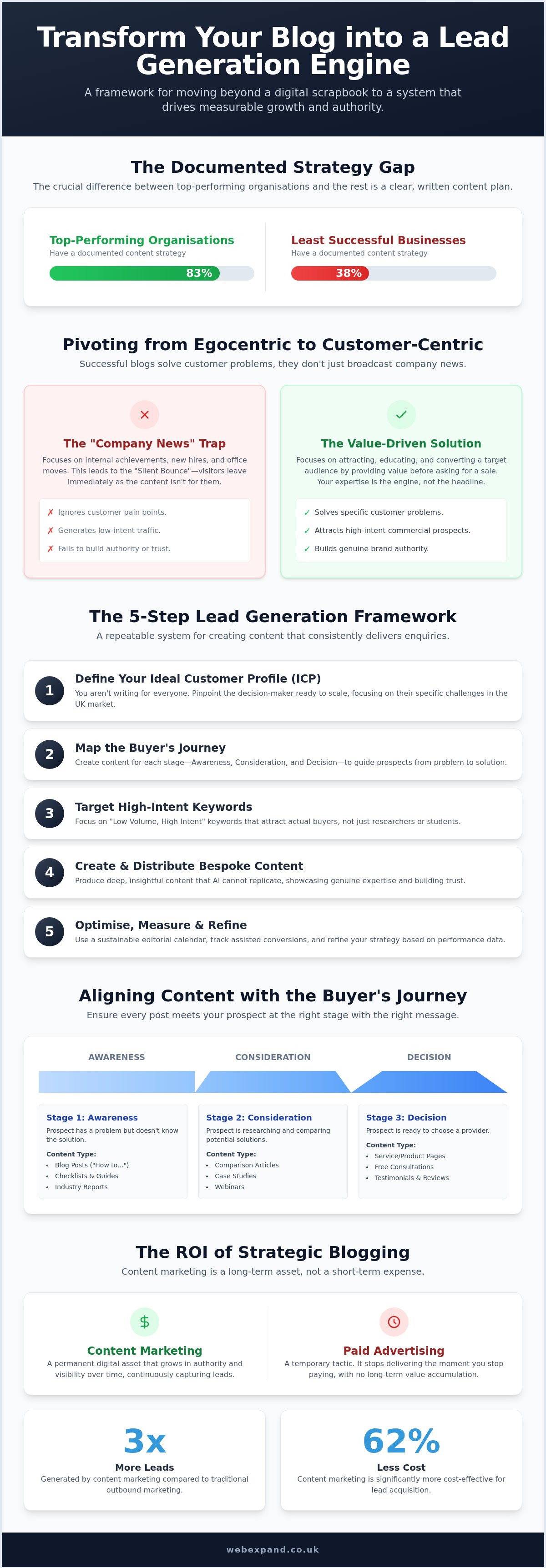
Did you know that 83% of top-performing organisations have a documented content strategy, whilst only 38% of the least successful businesses do? If you are currently spending hours crafting posts that no one reads, the issue isn’t your expertise; it’s likely the lack of a precise framework for creating a blog strategy for lead generation. We understand the frustration of seeing high bounce rates and a total lack of enquiries despite your team’s hard work. It often feels like shouting into a void whilst your competitors across Kent and London seemingly dominate the organic search results.
We’re here to change that narrative. This guide will transform your business blog from a quiet archive into a high-performance lead-capture engine that drives measurable growth throughout 2026. You will learn how to implement a repeatable system for content creation that builds genuine brand authority and delivers consistent monthly leads. We’ll move quickly from identifying your market challenges to presenting data-backed solutions, ensuring your digital presence finally reflects the ambitious scale of your organisation and your commitment to precision.
Key Takeaways
- Move beyond the “Company News” trap by shifting your focus toward a deliberate plan designed to attract, educate, and convert your target audience.
- Understand how to map the buyer’s journey for Kent and London markets, ensuring every post aligns with specific search intent.
- Master our 5-step framework for creating a blog strategy for lead generation to build authority around your core services and solve your prospect’s primary challenges.
- Learn how to combine bespoke website design with strategic “F-Pattern” layouts to place call-to-action elements where readers naturally look.
- Establish a sustainable editorial calendar that prioritises quality and tracks measurable growth through assisted conversions and direct enquiries.
Why Most Blog Strategies Fail to Generate Leads
Many directors believe they have a functional blog strategy simply because they publish a post once a month. However, most corporate blogs fall into the “Company News” trap. They highlight office moves, new hires, or internal awards that mean very little to a prospective client. If your content focuses on your own achievements rather than your customer’s pain points, you aren’t blogging for business; you’re maintaining a digital scrapbook. This approach fails because it ignores the primary goal of modern lead generation, which is to provide value before asking for a sale.
Successful growth requires a fundamental shift in perspective. Instead of broadcasting, you must focus on attracting, educating, and converting. Creating a blog strategy for lead generation means building a deliberate roadmap that targets specific commercial intent. In 2026, where AI-powered search provides instant answers, your content must offer deep, bespoke insights that generic AI tools cannot replicate. High-performance blogs are 20% writing and 80% architectural intent, merging your expertise with conversion-centred design.
The 2026 search landscape has changed the definition of success. High traffic numbers are vanity metrics if those visitors have no intent to buy. When creating a blog strategy for lead generation, you need to distinguish between “informational” seekers and “commercial” prospects. Whilst AI-generated filler content has flooded the internet, bespoke content that reflects genuine expertise is what builds trust. For businesses in Kent and London, this local authority is the key to dominating your sector and ensuring your blog isn’t just a quiet archive.
For example, global logistics organisations like Warenous demonstrate this by providing highly specialised, location-based resources that address the precise needs of businesses seeking 3PL warehouse solutions.
The Problem with Egocentric Content
Readers don’t visit your site to celebrate your latest industry award. They visit because they have a problem they can’t solve. When your blog is egocentric, you experience the “Silent Bounce.” This happens when a user lands on your page, realises the content is all about you, and leaves without ever clicking a call-to-action. To fix this, you must pivot from “We do X” to “How you can solve Y.” Your expertise should be the silent engine behind the advice you give; it shouldn’t be the headline itself.
The ROI of Strategic Blogging in 2026
Strategic blogging acts as a permanent digital asset that grows in authority and visibility over time, unlike the temporary nature of paid advertising. Unlike pay-per-click campaigns that stop delivering the moment you stop paying, a well-optimised blog continues to capture leads for years. Research indicates that content marketing generates three times more leads than outbound marketing whilst costing 62% less. By positioning your Maidstone or London firm as the expert, you shorten the sales cycle and build a foundation of trust before the first enquiry even arrives.
Building Your Foundation: ICP and Search Intent
A high-performance lead engine cannot function without a precise target. For directors across Kent and London, the cornerstone of creating a blog strategy for lead generation is the Ideal Customer Profile (ICP). You aren’t writing for everyone; you’re writing for the decision-maker who is ready to scale. This requires mapping the buyer’s journey across three distinct stages: Awareness, Consideration, and Decision. Each stage demands a different tone and specific information to move the prospect closer to an enquiry.
Understanding search intent is where technical expertise meets commercial reality. In the 2026 search environment, Google prioritises content that matches what the user actually wants to achieve. We categorise this into informational, commercial, and transactional intent. A successful blog strategy ensures you aren’t just attracting students or competitors, but actual buyers. For local firms, the secret often lies in “Low Volume, High Intent” keywords. These phrases might only get 20 searches a month, but those searchers are highly likely to convert into paying clients.
Defining Your UK Target Audience
Your persona must reflect the unique pressures of the South East market. Kent business owners often prioritise reliability and long-term partnership over the cheapest quote. We recommend analysing where your audience spends their time; for B2B sectors, this is almost exclusively LinkedIn. Tailor your vocabulary to match their professional standing. Avoid over-explaining basic concepts whilst ensuring your technical depth proves you’re a strategic partner rather than just a service provider.
Keyword Research for Lead Generation
Move beyond broad, competitive terms. Instead, focus on long-tail phrases that include local modifiers like “Maidstone” or “Sevenoaks”. These modifiers help you dominate the local search results without feeling forced. By 2026, tools have evolved to identify “content gaps” where your competitors are silent. Identifying these gaps allows you to position your firm as the only logical choice for a specific problem. If you’re ready to refine your targeting and start seeing real results, it might be time to speak with our team about your digital presence.
The 5-Step Lead Generation Content Framework
Success in 2026 requires more than just good writing; it demands a structural approach that turns readers into prospects. When creating a blog strategy for lead generation, we follow a rigorous five-step framework designed to maximise every visit. This system ensures your blog isn’t just an expense but a strategic asset that contributes directly to your bottom line. We move beyond guesswork to implement a repeatable system that prioritises precision and measurable outcomes. For organisations looking to scale these efforts, Marketing Angels offers specialised outsourced marketing support that complements this strategic framework.
- Step 1: Topic Selection. Start by identifying the #1 burning question your ICP is asking. Use real sales data and search trends to find the friction points that keep your prospects awake at night.
- Step 2: Content Pillars. Organise your content around core service areas. This builds topical authority and signals to search engines that you are an expert in your field.
- Step 3: The Lead Magnet. Offer high-value content upgrades that solve the immediate problem discussed in your post. This is the bridge between a casual reader and a known lead.
- Step 4: Internal Linking. Use strategic links to guide readers from educational blog posts to your commercial service pages. This passes SEO authority and keeps users on your site longer.
- Step 5: The Conversion Layer. Implement clear, persuasive Calls to Action (CTAs) that make the next step in the journey obvious and effortless.
Creating High-Value Content Pillars
A pillar post is a comprehensive guide that serves as the “hub” for a specific topic. By structuring your blog this way, you can rank for multiple keywords whilst providing an exhaustive resource for your audience. For example, if you are looking to scale your digital presence, integrating SEO services Kent into your pillar content allows you to build authority around local search expertise. You should then link smaller, supporting articles back to this main page. This hub and spoke model is the most effective way to boost the visibility of your core service pages in a crowded market.
Content Upgrades and Lead Magnets
In 2026, the phrase “Subscribe to our newsletter” is effectively dead. Prospects are protective of their inboxes and require a significant value exchange before they share their contact details. Instead, focus on specific content upgrades like checklists, templates, or bespoke “Kent Business” guides. These magnets must solve the immediate problem your blog post addresses. If your post explains how to reduce bounce rates, your lead magnet should be a “5-Minute UX Checklist.” This relevance is what drives conversion rates from the average 5.9% toward the top-tier 11.4% seen by industry leaders. When creating a blog strategy for lead generation, remember that the goal is to provide a solution that feels like a natural extension of the article.
Optimising Blog UX: Where Web Design Meets Strategy
Your content might be world-class, but if the user experience (UX) is poor, your prospects will vanish before the first paragraph ends. When creating a blog strategy for lead generation, the technical environment is just as vital as the editorial one. A slow-loading blog is a lead-generation killer in the UK market. Research suggests that even a one-second delay can significantly reduce conversion rates. If your site feels sluggish, you aren’t just losing traffic; you’re actively damaging your brand authority before you’ve even made your pitch.
Visual hierarchy is equally critical. We utilise the “F-Pattern” layout, which mirrors how eyes naturally scan a page from left to right and top to bottom. By placing your most important calls to action where readers’ eyes land, you increase the likelihood of a click. This isn’t about cluttering the page; it’s about strategic placement. For businesses looking to scale, investing in bespoke web design Kent ensures that your blog functions as a high-performance growth engine rather than a static archive.
Mobile-first design is no longer optional. Your Maidstone clients are often researching on the go, and a blog that breaks on a smartphone is an immediate red flag. We ensure every element is responsive, providing a seamless transition from desktop to mobile. This ensures that whether a prospect is in a London boardroom or on a train through Kent, they can engage with your content and convert effortlessly.
The Technical Side of Blog Conversion
Core Web Vitals are the benchmark for a healthy digital presence. These metrics track loading speed, interactivity, and visual stability. If your blog fails these tests, Google will penalise your rankings, and your users will feel the frustration. We recommend implementing “sticky” CTAs or subtle slide-in captures. These provide a constant path to conversion without interrupting the reading experience. It’s also essential that your blog matches the visual identity of your main web design Maidstone pages. Inconsistency creates doubt, whilst a unified look builds professional trust.
Trust and Authority Signals
Google’s E-E-A-T guidelines place a heavy emphasis on who is writing your content. Detailed author bios prove that your insights come from genuine experts, which is a key component when creating a blog strategy for lead generation in an AI-saturated market. Don’t just state your expertise; show it by integrating local case studies and testimonials directly into your blog posts. This local proof is incredibly persuasive for prospects across the South East. Finally, swap generic stock photos for professional, original imagery. Authentic photos of your team or projects build a human connection that stock visuals simply cannot match.
If your current blog feels like a relic of the past, it’s time to book a technical audit with our experts to see exactly where you’re losing leads.
Executing and Measuring Your 2026 Roadmap
Planning is only half the battle. To see a genuine return on your investment, you must move into a disciplined execution phase. Creating a blog strategy for lead generation is not a one-off project; it is a continuous cycle of publishing, measuring, and refining. In 2026, the rise of AI-assisted search (SGE) has made thin, repetitive content invisible. Your editorial calendar must prioritise quality over quantity. Publishing four high-impact, expert-led articles a month will drive more commercial value than daily AI-generated filler that fails to provide new insights or “information gain.”
Maintaining your rankings requires a robust “Refresh” strategy. Search engines now favour content that is demonstrably current. We recommend auditing your top-performing posts every six months to update statistics, refine CTAs, and ensure your advice remains accurate. This prevents your most valuable assets from decaying. If your internal team lacks the technical capacity to manage this level of precision, partnering with a Kent web design agency can provide the strategic oversight needed to scale your digital presence effectively.
Tracking What Actually Matters
In 2026, “hits” and “page views” are considered vanity metrics. They don’t pay the bills. You must focus on growth metrics by setting up specific conversion goals in Google Analytics 4 (GA4). This allows you to track assisted conversions, where a blog post might not be the final click but serves as a vital touchpoint in the buyer’s journey. Attributing a phone enquiry to a specific post is now possible through dynamic number insertion or by simply asking prospects where they first encountered your expertise. This data proves the direct financial performance of your content efforts.
The Continuous Growth Loop
Your blog should act as a listening post. Analysing your top-performing articles often reveals “spin-off” topics that your audience is hungry for. If a post about e-commerce security gets significant engagement, follow it up with a deep dive into specific payment gateways or local compliance. Use reader comments and the questions your sales team hears daily to fuel your roadmap. Consistent Google promotion Kent ensures your blog remains relevant and visible amongst your local competitors, turning your digital presence into a self-sustaining lead engine. By staying ahead of technological shifts and industry trends, you protect your stakeholders’ interests whilst broadening your commercial horizons.
Building Your 2026 Growth Engine
A high-performance blog is no longer about volume; it’s about the precision of your intent and the technical strength of your platform. By moving away from egocentric content and focusing on the burning questions of your ICP, you position your brand as a strategic partner. We’ve explored how the 5-step framework and conversion-centred UX turn casual readers into measurable enquiries. Creating a blog strategy for lead generation is your most powerful tool for long-term organic growth in an AI-saturated market.
Webexpand has been driving Kent business growth since 2004. With over 20 years of experience, we provide fixed-price bespoke web design solutions and expert Google promotion and SEO management to ensure your digital presence dominates your sector. We focus on measurable outcomes that reflect the ambitious scale of your organisation and your commitment to precision.
Book a Free SEO & Content Audit with Webexpand today to transform your blog into a high-performance lead-capture engine. Your journey toward industry leadership starts with a single, data-driven step.
Frequently Asked Questions
How often should I publish a blog post to see results in 2026?
Consistency is vital, but you should prioritise quality over sheer volume. In 2026, publishing one high-impact, expert-led post per week is far more effective than daily AI-generated filler. Search engines now look for “information gain,” meaning your content must provide new insights or data that isn’t already available elsewhere. A disciplined, weekly schedule allows you to maintain depth whilst keeping your audience engaged and your brand authority high.
Does my blog need to be on the same domain as my business website?
Yes, your blog should ideally reside on a subfolder of your main domain, such as yoursite.co.uk/blog. This structure ensures that all the SEO authority and “link juice” you build through your content efforts benefit your commercial pages directly. Keeping everything under one roof makes it much easier to track user journeys and assisted conversions within your analytics platform, ensuring your data remains precise and actionable.
How long should a blog post be for lead generation?
There is no fixed word count, but you must cover the topic comprehensively enough to solve the reader’s problem. Whilst pillar posts often reach 2,000 words or more to rank for competitive terms, a 1,000-word post can be highly effective if it targets a specific, high-intent query. Focus on delivering value rather than hitting a target; if you’ve answered the question fully and provided a clear path to the next step, you’ve written enough.
Can I use AI to write my blog strategy and content?
AI is an excellent tool for data analysis and outlining, but it shouldn’t replace your brand’s unique voice. When creating a blog strategy for lead generation, the goal is to project genuine authority. AI often lacks the nuanced local expertise and personal anecdotes that build trust with Kent and London business owners. Use technology to accelerate your research and workflow, but ensure a human expert provides the final strategic layer and creative polish.
What is the best way to capture leads on a blog without being annoying?
The most effective method is using contextually relevant “content upgrades.” Instead of generic pop-ups that interrupt the reading experience, offer a specific resource that complements the article, such as a downloadable checklist or a bespoke template. This feels like a natural extension of the value you’ve already provided. When the lead magnet directly solves a problem discussed in the post, the reader perceives the exchange as a helpful suggestion rather than an intrusive advertisement.
How long does it take for a blog strategy to start generating enquiries?
You should expect to see measurable results within three to six months of consistent execution. SEO is a long-term investment that compounds over time. Whilst paid advertising provides instant traffic, creating a blog strategy for lead generation builds a permanent asset that reduces your cost-per-lead as your authority grows. The leads you generate through organic search are often better informed and closer to a buying decision because you’ve already educated them.
Should I focus on local Kent keywords or go national?
We recommend a “local-first” approach to build a foundation of authority. Competition for national keywords is fierce and often requires a significant budget to see a return. By dominating high-intent, local phrases related to Kent and London, you can capture a loyal audience and see a faster return on your investment. Once you have established a strong local presence and proven your model, you can strategically broaden your horizons to target national markets.
What is the difference between a blog post and a landing page?
A blog post is designed to educate and attract users at the awareness or consideration stages of their journey. Its primary role is to build trust and prove your expertise by solving problems. In contrast, a landing page is a purely transactional environment with a single focus: conversion. Whilst a blog post guides the reader through a challenge, a landing page provides the final solution and a direct call to action to begin a commercial relationship.