
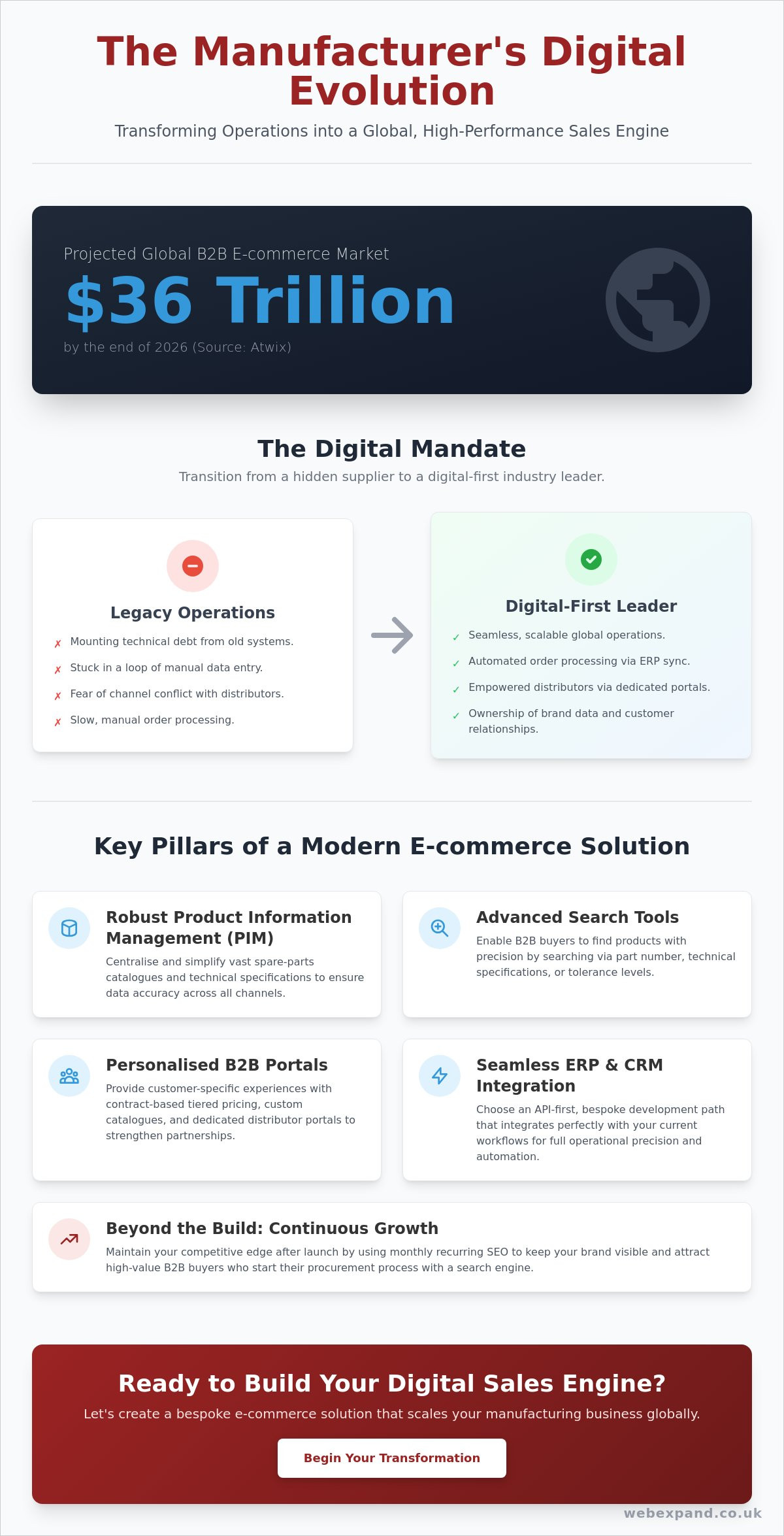
By the end of 2026, the global B2B e-commerce market is projected to reach a staggering $36 trillion according to data from Atwix. This isn’t just a minor shift in how goods move; it’s a complete reimagining of the industrial sales cycle. You likely feel the pressure of technical debt from legacy systems and the constant worry that launching a digital storefront will trigger conflict with your existing distributors. It’s frustrating when complex product configurations feel too difficult to sell online, keeping your team stuck in a loop of manual data entry. Adopting modern e-commerce solutions for manufacturers is no longer a luxury; it’s a requirement for survival.
We understand these roadblocks because we’ve helped ambitious brands move past them. This guide promises to show you exactly how to transform your operations into a high-performance digital sales engine that scales globally. We’ll explore how to build seamless B2B portals and automate order processing through deep ERP integration. You’ll gain a clear roadmap to increase your market share and stay ahead of the latest 2026 regulatory shifts, ensuring your business is ready to dominate your sector and broaden your professional horizons.
Key Takeaways
- Transform your identity from a hidden supplier into a digital-first industry leader by treating your storefront as a comprehensive sales ecosystem.
- Simplify vast spare-parts catalogues and technical specifications using robust Product Information Management (PIM) and advanced search tools.
- Scale your global operations with e-commerce solutions for manufacturers that offer customer-specific portals and contract-based tiered pricing.
- Ensure operational precision by choosing an API-first, bespoke development path that integrates perfectly with your current ERP and CRM workflows.
- Maintain your competitive edge after launch by using monthly recurring SEO to keep your brand visible to high-value B2B buyers.
The Evolution of Manufacturing Sales: Why E-commerce is Non-Negotiable in 2026
For decades, manufacturers operated as the silent engines of the global economy, tucked away behind layers of distributors and wholesalers. In 2026, that invisibility is a liability. Modern e-commerce solutions for manufacturers have evolved far beyond a simple “buy now” button. Today, we define these solutions as comprehensive digital sales and management ecosystems. They serve as the central nervous system for your business, connecting production schedules, inventory levels, and customer relationships in one unified interface. Transitioning from a “hidden manufacturer” to a digital-first industry leader isn’t just about sales; it’s about claiming ownership of your brand’s digital presence and data.
Waiting to digitalise is no longer a cautious risk-management strategy. It’s a gamble with your market share. As global retail e-commerce sales hit a projected $6.88 trillion this year, the gap between digital leaders and laggards is widening. Businesses that delay this transition face mounting technical debt and a loss of visibility in a market where procurement starts with a search engine. We see 2026 as the year of the hybrid model. You don’t have to choose between your loyal distributors and a direct digital presence. Instead, you can use technology to support both, creating a resilient, multi-channel strategy that scales.
The Shift from Traditional to Digital Distribution
The days of relying on faxed purchase orders and manual phone checks are over. These legacy processes are too slow for the modern supply chain. Today’s B2B e-commerce environment demands real-time data transparency. Buyers from the “Amazon generation” now hold decision-making roles in industrial procurement. They expect the same speed and ease they find in their personal lives. If your system can’t provide instant stock levels or automated order tracking, they’ll find a competitor who can. Digital platforms provide the agility needed to react to market shifts instantly, ensuring your operations remain lean and responsive.
Overcoming the Fear of Channel Conflict
One of the biggest hurdles we help manufacturers clear is the fear of upsetting existing distribution networks. The right e-commerce solutions for manufacturers actually empower your partners rather than replacing them. By implementing dealer locators and distributor-specific ordering portals, you provide your network with better leads and more efficient tools. You’re not competing with them; you’re providing a high-performance platform that makes it easier for them to sell your products. This collaborative approach increases lead generation across your entire network, ensuring that your digital growth translates into mutual success for every stakeholder in your supply chain.
Core Components of High-Performance E-commerce Solutions for Manufacturers
Building a digital distribution engine requires more than a generic storefront. High-performance e-commerce solutions for manufacturers must handle the weight of thousands of SKUs while maintaining the precision of an engineering firm. At the heart of this system lies a robust Product Information Management (PIM) tool. It ensures that every technical specification, from thread count to voltage, is accurate across every channel. This isn’t just about display; it’s about providing the eCommerce Resources for Businesses need to compete in a global market where technical accuracy is the baseline for trust. We’ve seen that when data is fragmented, sales suffer. Centralising your product data is the first step toward a scalable digital future.
Your search functionality must be equally precise. B2B buyers often search by part number, tolerance levels, or specific certifications rather than generic product names. If your search engine doesn’t understand these nuances, you’re losing revenue to competitors who’ve prioritised findability. Combining this with secure, scalable website hosting ensures that your global operations never experience a second of downtime. Reliability is the silent partner of every successful manufacturer, and your digital presence should be no different.
Technical Specifications and Custom Product Data
Manufacturing catalogues are often massive and highly technical. You aren’t just selling products; you’re selling solutions that require technical drawings, CAD files, and multi-language manuals. A high-performance platform treats these assets as essential data points. By centralising this information, you eliminate the risk of a customer ordering a part based on outdated specifications. This level of precision protects your reputation and reduces costly returns. It’s about giving your buyers the confidence to make high-value decisions without needing a phone call to verify details.
For instance, specialised material providers like Industrial Plastic Supply, Inc. exemplify this approach by maintaining detailed technical catalogues for performance plastics, allowing engineers and procurement teams to verify specifications before purchase.
Performance-Driven User Experience (UX)
Off-the-shelf templates rarely survive the complexity of a manufacturing workflow. We believe bespoke website design is the only way to ensure intuitive navigation through vast catalogues. For a buyer on a noisy factory floor, a mobile-first interface is a necessity, not an option. They need to find a specific component and place a “Quick Order” in seconds. Integrating high-quality imagery and 360-degree product views helps bridge the gap between physical and digital, allowing buyers to inspect components with the same scrutiny they’d use in person. If you’re ready to build a platform that matches the quality of your engineering, it’s time to discuss your bespoke requirements with our team.
Navigating B2B Complexity: Portals, Pricing, and Personalisation
B2B manufacturing relationships aren’t built on one-off transactions. They’re forged through years of contract negotiations and specific pricing agreements. A common objection we hear is that manufacturing pricing is simply too complex to automate. We disagree. Modern e-commerce solutions for manufacturers are built specifically to handle these intricacies. By digitising your contract terms, you don’t lose the personal touch; you gain the precision of error-free execution. Automated systems can calculate tiered discounts, bulk rates, and complex shipping logistics in milliseconds. This level of accuracy builds trust and ensures your margins remain protected.
Implementing these systems allows you to move beyond manual spreadsheets and legacy hurdles. You can integrate your ERP directly with the storefront, ensuring that a customer sees their specific negotiated price the moment they log in. This isn’t just about convenience. It’s about scalability and global reach. Leveraging e-commerce resources for manufacturers helps you navigate these technical shifts while staying compliant with international trade standards. When your pricing logic is baked into your digital engine, you’re free to focus on broadening your market share rather than double-checking invoices.
Customer Portals and Self-Service Tools
Providing a dedicated portal transforms how you interact with your clients. Instead of calling your sales team for an invoice or a tracking number, your customers gain 24/7 access to their entire order history. They can manage their own credit limits and sub-accounts, giving them the autonomy they crave. This shift significantly reduces your administrative overhead. Your team stops answering routine enquiries and starts focusing on high-value business development. It’s a collaborative approach that respects your customer’s time and your staff’s expertise.
Personalised B2B Buying Journeys
Personalisation in manufacturing means more than just a welcome message. It means showing different product ranges based on user permissions or geographical regions. For high-value machinery, you can implement custom quote-to-order workflows that bridge the gap between digital discovery and human negotiation. We also recommend using automated re-order triggers based on previous purchasing cycles. If a client typically buys replacement filters every six months, your system should remind them. This proactive service keeps your brand at the forefront of their operations without requiring a single manual email.
Implementing Your Digital Strategy: From Bespoke Design to Seamless Integration
Manufacturers often fear that a new digital storefront will become another isolated island of data. To prevent this, we prioritise an API-first approach. This architecture ensures your e-commerce solutions for manufacturers talk directly to your existing software. Whether you use SAP, Microsoft Dynamics, or Sage, the flow of information must be bi-directional and instantaneous. This connectivity eliminates the manual data entry that slows down your growth and creates unnecessary room for error. We don’t just build websites; we create integrated systems that broaden your professional horizons.
Successful implementation also requires financial transparency. We manage project risk by offering fixed-price website design and development fees. This approach provides you with budget certainty, allowing you to focus on the strategic rollout rather than worrying about creeping costs. A typical manufacturing e-commerce project follows a structured timeline, often spanning four to six months from initial discovery to global launch. This period allows for the rigorous testing and data mapping required for a high-performance industrial engine.
Integrating with Your Existing Tech Stack
Connecting your storefront to your core systems allows for real-time inventory updates and automated order processing. When your CRM data flows seamlessly into your digital platform, you can create highly personalised marketing efforts that resonate with specific buyer personas. ERP integration serves as the essential backbone of every successful manufacturing e-commerce platform. Without this link, your digital store is just a catalogue; with it, it’s a fully automated distribution hub.
A well-integrated system provides several key advantages:
- Inventory Accuracy: Sync stock levels across your warehouse and digital storefront instantly.
- Order Efficiency: Eliminate manual entry by pushing orders directly to your accounting software.
- Customer Loyalty: Use CRM data to offer tailored promotions based on previous purchase history.
The Bespoke Advantage for Manufacturers
Off-the-shelf templates are built for simple retail, not the complex workflows of industrial procurement. Choosing bespoke website design allows you to tailor the checkout process to match your specific business rules. You can build custom configurators for made-to-order products, ensuring that every selection is technically viable before the order is even placed. This level of customisation protects your production team from impossible requests and provides your customers with a frictionless buying experience. If you’re ready to secure your digital future with a fixed-price roadmap, get in touch with our team today to discuss your project.
Beyond the Build: Driving Growth and Market Leadership
Launching your platform is a significant milestone, but it isn’t the finish line. A website only functions as a growth engine if it’s visible to your target audience. In the competitive industrial sector, relying solely on your existing network limits your potential and leaves you vulnerable to more digitally aggressive competitors. High-performance e-commerce solutions for manufacturers must be paired with proactive visibility strategies to deliver a true return on investment. By dominating search results, you ensure that when a procurement officer in a new territory starts their search, your brand is the first one they encounter.
Strategic growth in 2026 requires more than just a static presence. You need to leverage data analytics to refine your product development and sales strategies. The information gathered through your digital storefront provides a direct window into buyer behaviour, revealing which technical specifications are in high demand and which regions are underserved. This intelligence allows you to make precision-based decisions about where to allocate resources, ensuring your organisation stays ahead of industry trends and protects its market share.
SEO and Google Promotion for Manufacturers
Many manufacturers overlook the power of high-intent B2B keywords, leaving a massive gap for ambitious brands to exploit. We focus on identifying the specific technical terms and part-number queries your buyers actually use during the research phase. Technical SEO is particularly critical when managing large-scale product catalogues; your site structure must allow search engines to crawl and index thousands of technical specifications without friction. To maintain these rankings against global competitors, monthly recurring SEO services are essential. This ongoing optimisation ensures your digital presence evolves alongside search engine algorithms and shifting market demands.
Broadening Your Horizons with Strategic Partnerships
We view our role not just as a service provider, but as a strategic growth partner invested in your long-term success. Our team provides continuous monitoring and performance reporting, turning raw data into actionable intelligence. This collaborative relationship ensures that your digital strategy remains aligned with your broader organisational goals as you scale. We’re committed to transparency and measurable outcomes, helping you navigate the fast-paced nature of the professional landscape with confidence. If you’re ready to dominate your sector and turn your digital presence into a high-performance sales engine, enquire about our e-commerce solutions for manufacturers to start your transformative journey today.
Secure Your Industrial Future in the Digital Market
Success in 2026 requires more than just manufacturing excellence; it demands a digital presence that matches the precision of your engineering. We’ve explored how transitioning to integrated e-commerce solutions for manufacturers allows you to automate complex B2B workflows and eliminate the friction that holds back global scaling. By prioritising bespoke design and seamless ERP connectivity, you ensure your operations remain lean and responsive to a fast-paced global market. Visibility is the final piece of the puzzle, turning your technical expertise into a visible, high-performance sales engine.
Established in 2004, our team brings decades of technical expertise to every project. We provide jargon-free, professional advice focused entirely on your organisational growth. As specialists in bespoke, high-performance web development, we’re ready to help you broaden your horizons and claim your place as a digital-first industry leader. Your journey toward market dominance starts with a single strategic decision. Partner with Webexpand to build your custom e-commerce engine and start transforming your operations today. We look forward to achieving mutual success together.
Frequently Asked Questions
Can e-commerce solutions handle complex, configurable products?
Yes, bespoke e-commerce solutions for manufacturers are specifically designed to manage complex, configurable products. By building custom rules engines into your storefront, you can ensure that every selection a buyer makes is technically viable before the order reaches your production team. This eliminates the risk of impossible orders and provides your customers with the confidence to configure high-value industrial components online without needing a manual review.
How do we prevent e-commerce from competing with our existing distributors?
You can prevent channel conflict by using your platform to empower your distributors rather than replacing them. Implementing features like dealer locators and distributor-specific ordering portals allows you to pass high-quality leads directly to your partners. This collaborative approach turns your digital storefront into a lead-generation engine for your entire network, ensuring that your online growth supports the success of every stakeholder in your supply chain.
What is the typical ROI for a manufacturing e-commerce project?
The ROI for a manufacturing e-commerce project typically comes from a combination of reduced administrative costs and increased market reach. By automating routine order processing and enquiry handling, you free up your sales team to focus on high-value business development. Additionally, a digital storefront captures new leads from global markets that were previously unreachable, significantly improving your long-term financial performance and operational efficiency.
Can our website integrate with our existing ERP or accounting software?
Yes, seamless integration with your existing ERP or accounting software is a core requirement for a high-performance system. We use an API-first approach to connect your storefront with platforms like SAP, Microsoft Dynamics, or Sage. This ensures that inventory levels, customer-specific pricing, and order data flow between systems in real-time, creating a unified digital ecosystem that eliminates manual data entry and reduces the risk of human error.
Do you offer fixed-price development for manufacturing websites?
We offer fixed-price development fees for all our bespoke website design and e-commerce solutions for manufacturers. This model provides you with complete budget certainty and ensures that project risks are managed effectively from the start. You won’t have to worry about creeping costs or hidden fees; instead, you can focus on the strategic rollout and global growth of your new digital sales engine.
How long does it take to build a bespoke e-commerce platform?
A successful manufacturing e-commerce rollout typically takes between four and six months from the initial discovery phase to the global launch. This timeline allows for the deep technical integration and rigorous testing required to ensure your platform handles complex data accurately. We move quickly to deliver results but never sacrifice the precision needed to build a reliable, high-performance engine for your industrial operations.
Is e-commerce suitable for manufacturers who sell high-priced industrial machinery?
E-commerce is highly suitable for high-priced industrial machinery through the use of custom quote-to-order workflows. While the final transaction might involve human negotiation, the digital platform serves as the primary discovery and configuration tool. It allows buyers to research specifications, download technical drawings, and request formal quotes 24/7, significantly shortening the sales cycle for high-value equipment and broadening your professional horizons.
How does SEO help manufacturers reach new global markets?
SEO helps you reach new global markets by targeting the high-intent technical keywords and part numbers your international buyers are already searching for. By optimising your large-scale product catalogues for search engines, you ensure your brand appears at the top of results in underserved regions. This visibility allows you to enter new territories and compete with local suppliers without the immediate need for a physical sales presence.