
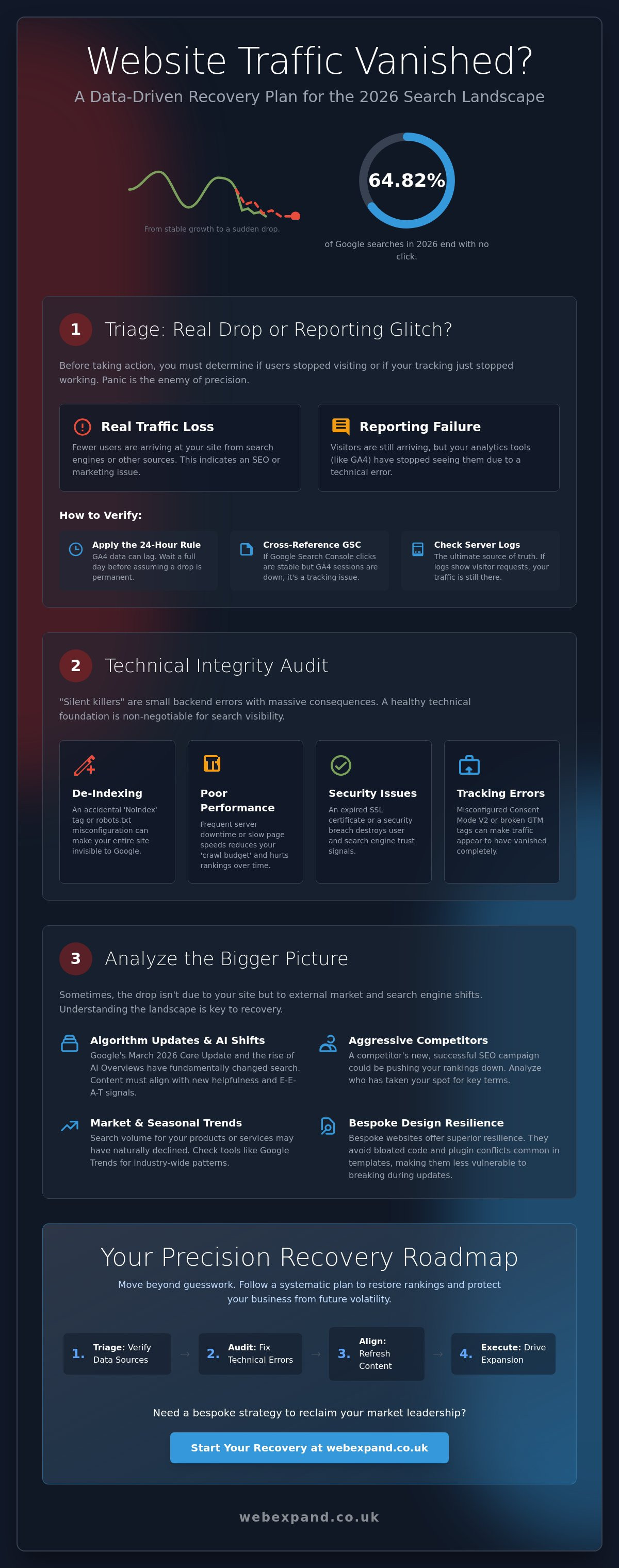
Did you know that 64.82% of all Google searches in 2026 now end without a single click to a website? If your website traffic dropped suddenly what to do is likely the only question on your mind as you watch your lead volume stall and sales figures dip. It’s a gut-wrenching moment to see years of SEO progress vanish from your GA4 dashboard overnight, especially when the cause feels hidden behind complex algorithm shifts or the rise of AI Overviews.
We know how unsettling it is to feel like the rules of search changed while you weren’t looking. You need a bespoke strategy that moves beyond guesswork and focuses on measurable ROI. This guide delivers a systematic, data-driven diagnostic checklist to identify exactly why your visibility vanished. We’ll provide a step-by-step recovery plan to restore your rankings, protect your business from future volatility, and ensure your brand begins its transformative journey back toward market leadership.
Key Takeaways
- Distinguish between genuine traffic loss and GA4 reporting errors caused by broken tags or consent mode misconfigurations.
- Understand why bespoke website design provides superior technical resilience against “silent killers” like accidental de-indexing and robots.txt errors.
- Discover exactly if your website traffic dropped suddenly what to do by aligning your data with the latest 2026 Google Core Updates and AI search shifts.
- Identify external threats, from aggressive competitor SEO campaigns to seasonal search volume fluctuations impacting the UK market.
- Execute a precision recovery roadmap that prioritizes technical fixes and content refreshes to drive long-term visibility and expansion.
Step 1: The Triage Phase — Is Your Traffic Drop Real or a Tracking Error?
Panic is the enemy of precision. When you see a sharp decline in your analytics dashboard, your first instinct is likely to ask website traffic dropped suddenly what to do while considering a total site overhaul. Before you touch a single line of code, you must determine if the loss is real or simply a reporting failure. A real drop indicates that users have stopped arriving at your site. A reporting drop means your tracking tools have stopped seeing them.
We often see businesses overreact to a single day of poor data. We advocate for the 24-hour rule. Data processing in GA4 can lag, and a sudden dip might be nothing more than a delay in Google’s servers. You should also distinguish between a site-wide collapse and a decline on a single, high-traffic page. If only one page has vanished, the issue is likely specific to that URL rather than a global algorithm penalty. This distinction is vital for protecting your ROI and focusing your recovery efforts where they matter most.
Verifying Your Data Sources
To find the truth, you need to cross-reference multiple platforms. Google Search Console (GSC) is your best friend here. While GA4 measures what happens on your site, GSC measures what happens on the search result page. If your GSC clicks remain steady but your GA4 sessions have plummeted, your Search engine optimization (SEO) efforts are likely still working; your tracking is simply broken. Check your server logs to see if actual visitor requests are hitting your hosting. If the logs show activity but the dashboard is empty, you have a measurement failure rather than a visibility crisis.
Identifying Measurement Failures
In 2026, tracking is more fragile than ever. The GA4 update in April 2026 made Consent Mode V2 a strict requirement for businesses. If your cookie consent banner isn’t configured correctly, it might be blocking tracking scripts for every visitor, making it look like your traffic has vanished. Recent CMS updates or changes to your Google Tag Manager (GTM) container can also cause scripts to stop firing unexpectedly. Use Google Tag Assistant to debug your tags in real-time. It’s a quick way to see if your tracking code is actually active. We find that businesses using bespoke website design often have fewer issues here than those relying on generic templates with bloated plugin conflicts. To see how custom development can enhance your site’s stability, you can learn more about Elves Lab Pte Ltd. Our goal is to ensure your data foundation is solid so your brand can continue its journey toward market expansion.
The Technical Integrity Audit: Checking Your Website’s Foundation
Once you verify that your data is accurate, you must look under the hood. Technical SEO isn’t just a checklist; it’s the structural integrity that allows your business to scale and dominate its niche. If your website traffic dropped suddenly what to do is often a matter of identifying a single point of failure in your site architecture. Unlike generic templates that often suffer from bloated code and plugin conflicts, bespoke web design ensures your foundation is lean, fast, and built for maximum search engine visibility.
We often find “silent killers” lurking in the backend of sites that have experienced a collapse. These are small errors with massive consequences. A developer might accidentally leave a “NoIndex” tag on a live site after a staging update, or a misconfigured robots.txt file could block Googlebot from crawling your most profitable pages. If your server experiences frequent downtime or poor performance, Google will eventually reduce your “crawl budget,” leading to a certain decline in rankings. Security is equally critical. An expired SSL certificate or a security breach doesn’t just trigger browser warnings; it destroys the trust signals Google requires to maintain your position. Reviewing the history of Google’s algorithm updates, including the March 2026 Core Update that concluded on April 8, shows that technical health remains a non-negotiable pillar of search success.
Crawlability and Indexing Red Flags
Start your investigation in Google Search Console. Navigate to the Indexing reports and look for sudden spikes in “Excluded” pages. This is the fastest way to spot if a large chunk of your site has been de-indexed. Look for redirect loops, which often occur during site migrations or URL structure changes. If a crawler gets stuck in a loop, it will abandon the session, and your page will eventually drop from the results. If you are struggling to pinpoint the leak, our team can provide a bespoke technical audit to secure your visibility and stop the bleed.
Site Speed and Core Web Vitals
Google’s March 2026 Core Update placed a renewed emphasis on a holistic view of Core Web Vitals. A sudden drop in page speed, perhaps due to a new heavy script or unoptimized images, can trigger an immediate algorithmic demotion. Google prioritizes user experience, and a sluggish site is a liability to your ROI. You must test your site against 2026 performance standards on both mobile and desktop. Remember, mobile zero-click rates hit 77.2% in early 2026. Your mobile technical performance must be flawless to capture the limited volume of users who still choose to click through to a website.
Navigating the 2026 Search Landscape: Algorithm Updates and AI Shifts
The search landscape of 2026 is a different beast than it was just twelve months ago. If your website traffic dropped suddenly what to do depends largely on whether you’ve been caught in an algorithmic net or displaced by a new search interface. The March 2026 Core Update, which ran from March 27 to April 8, signaled a ruthless re-evaluation of content quality. Google now prioritizes original, authoritative, and in-depth material over the generic, AI-generated filler that saturated the web in 2025. If your rankings fell during this window, it’s likely that your content failed the latest E-E-A-T (Experience, Expertise, Authoritativeness, and Trust) stress test.
Thin content is more vulnerable than ever. The March 2026 Spam Update, completed in just 24 hours between March 24 and 25, specifically targeted auto-generated pages and keyword stuffing. If your strategy relied on high-volume, low-value content, your visibility didn’t just dip; it was likely dismantled. Success in this environment isn’t about gaming the system. It’s about demonstrating genuine expertise that AI cannot replicate. We believe in building content that serves as a transformative journey for the user, positioning your brand as the definitive expert in your niche.
Analysing Algorithm Volatility
Identifying a core update hit requires precision. Use tools like Semrush Sensor or MozCast to check for global SERP turbulence during your period of decline. If the volatility score was high when your traffic fell, you’re likely dealing with an algorithmic shift rather than a technical error. We find that businesses relying on strategic SEO services weather these storms better because they focus on long-term authority rather than short-lived hacks. Correlate your Google Search Console data with these known update windows to confirm the root cause.
The AI Search Impact
You might still rank in the top positions but see significantly fewer clicks. This is the “Zero-Click” reality of 2026. Currently, 64.82% of Google searches end without a click to a website. This shift is largely driven by AI Overviews. When an AI Overview is present, organic click-through rates can drop by an average of 18% and as much as 61%. In fact, searches triggering an AI Overview have a zero-click rate of up to 83%. You aren’t just competing with other sites anymore; you’re competing with Google’s own answers. To recover, you must adapt your content to become the cited source within these AI summaries, ensuring your brand remains the authority even when the click stays on the search page.
External Threats and Competitive Shifts: Who Moved Your Cheese?
Sometimes your visibility vanishes not because of your own mistakes, but because the world around you changed. If you find your website traffic dropped suddenly what to do involves looking beyond your own dashboard and examining the broader market. Search is a zero-sum game; if your traffic is down, someone else is likely winning those clicks. Identifying whether a new market entrant has launched an aggressive campaign or an established rival has revamped their digital marketing strategy is vital for your recovery.
External factors aren’t always human competitors. Seasonal trends and UK-wide market shifts can cause dramatic fluctuations in search volume. For instance, a retail site might see a sharp decline in January following the holiday rush, which is a reflection of user demand rather than a ranking failure. However, more sinister threats like “Negative SEO” attacks can also be at play. These involve malicious actors injecting toxic backlinks into your profile to trigger a manual penalty. Similarly, losing a high-value backlink from a major referring site that has gone dark can strip away your authority overnight. Precision in your diagnostic process is the only way to separate temporary market noise from targeted external threats.
Competitor Benchmarking
Success requires knowing exactly who is taking your space. Use the “Compare” feature in Google Search Console to map your current performance against the previous period. Identify specific keywords where you have lost position and examine who has replaced you. Look for new SERP features such as expanded Local Map Packs or aggressive Google Ads placements that might be pushing your organic results further down the page. If a competitor has leapfrogged your position with superior content, it’s time to refine your approach. You can request a competitive gap analysis to see exactly where your rivals are outperforming you and how to reclaim your market share.
Backlink Profile Health
Your backlink profile is the backbone of your site’s authority. A sudden loss of “Trust Flow” or “Domain Authority” often points to a link-related issue. Audit your profile for a sudden influx of low-quality, spammy links that look like a coordinated attack. If you find harmful injections, you must use the disavow tool carefully to signal to Google that you don’t endorse those connections. Conversely, if you’ve lost legitimate links from authoritative sources, you need a strategy to replace that lost equity. A diverse and naturally growing link ecosystem is your best defense against both algorithm shifts and malicious external activity. We focus on building bespoke link profiles that drive long-term expansion and protect your ROI from sudden volatility.
The Recovery Action Plan: Restoring Visibility and Driving Expansion
You have completed the diagnostic phase. Now, it’s time to execute. Knowing your website traffic dropped suddenly what to do is only half the battle; the other half is the speed and precision of your response. Recovery is not a single event but a series of calculated moves designed to regain Google’s trust and reclaim your market share. We focus on a high-energy approach that prioritizes high-ROI actions to deliver rapid results without sacrificing quality.
- Step 1: Fix technical blockers immediately. Resolve any “silent killers” identified in your audit, such as robots.txt blocks or accidental noindex tags. Restoring crawlability is the absolute prerequisite for any ranking recovery.
- Step 2: Refresh and expand at-risk content. With AI Overviews causing organic CTR to drop by an average of 18% to 61%, your content must meet 2026 quality standards. Update your high-value pages with fresh data, expert insights, and structured data to ensure you remain the cited source in AI-driven results.
- Step 3: Re-submit your sitemap. Once fixes are live, use Google Search Console to re-submit your sitemap and request priority re-indexing. This signals to Google that your site has undergone significant improvements.
- Step 4: Launch a targeted PR campaign. Signal your authority to search engines by earning high-quality backlinks from reputable industry sources. This counters any loss of authority from external shifts or competitive moves.
Investing in professional web design serves as the ultimate insurance against future traffic volatility. A bespoke architecture eliminates the technical decay often found in generic templates, providing the resilience needed to survive aggressive algorithm updates like the March 2026 Core Update.
Short-Term Fixes vs. Long-Term Strategy
Focus your initial efforts on pages that drive actual business conversions rather than chasing vanity metrics. It’s vital to avoid “over-optimisation” during this phase; making too many aggressive changes at once can lead to further algorithmic penalties. Set realistic timelines for your recovery. While technical fixes can show results in weeks, regaining authority lost during a major core update often takes months of consistent, high-quality output.
Future-Proofing Your Digital Presence
Success in the 2026 search era requires moving from a maintenance mindset to a market leadership mindset. You must stay ahead of search engine trends to protect your interests and ensure your brand continues its journey toward market dominance. A bespoke, high-performance site architecture is no longer a luxury; it’s a strategic requirement for business expansion. Contact Webexpand for a bespoke SEO audit and recovery strategy. We are ready to help you scale and dominate your niche through data-backed solutions.
Reclaiming Your Market Leadership in the AI Era
Navigating the search landscape of 2026 requires more than just maintenance; it demands a strategic evolution. We’ve identified that separating a true traffic loss from a GA4 reporting error is your first priority. From there, your journey back to visibility relies on a flawless technical foundation and content that passes the rigorous 2026 E-E-A-T standards. If your website traffic dropped suddenly what to do is now clear. You must triage the data, audit your technical integrity, and adapt to the rise of AI Overviews.
At Webexpand, we’ve been refining our expertise since 2004. We provide jargon-free, data-backed strategic advice that focuses on your ROI rather than vanity metrics. Our bespoke solutions are specifically tailored to drive UK business growth and ensure your brand dominates its niche despite global search volatility. Don’t let a temporary dip define your future. Secure your digital growth with a Bespoke SEO Recovery Plan today. You have the tools to recover, and we’re ready to be your strategic partner in this transformative journey toward market leadership.
Frequently Asked Questions
How long does it take to recover website traffic after a drop?
Recovery timelines vary based on the root cause. Technical errors like broken tracking or robots.txt blocks can often be resolved within 48 to 72 hours once the fix is indexed. However, recovering from a core algorithm update typically takes three to six months of consistent quality improvements. You must demonstrate to Google that your site now meets the latest standards before your visibility fully returns.
Can a sudden drop in traffic be a sign of a Google penalty?
A sharp decline can indicate a penalty, though algorithmic shifts are more frequent in 2026. You should immediately check the Manual Actions report in Google Search Console. If you find a notification there, a human reviewer has flagged your site for a specific violation. If the report is clear, your visibility loss is likely due to a broad algorithm update or a technical failure.
What is the difference between an algorithm update and a manual action?
Algorithm updates are automated changes to how Google ranks all websites, such as the March 2026 Core Update. These happen without direct human intervention. A manual action is a specific penalty issued by a Google employee because your site violates webmaster guidelines. While algorithm hits require broad strategy shifts, manual actions require you to fix a specific issue and submit a reconsideration request.
Does changing my website design cause traffic to drop suddenly?
Is it possible for traffic to drop if I haven’t made any changes to my site?
Yes, because the digital landscape is never static. Your competitors might have launched aggressive new strategies, or Google may have updated how it displays results for your key terms. External factors like seasonal shifts in the UK market can also reduce search volume. Staying stagnant while the market evolves is a common reason businesses lose their competitive edge and see a decline in ROI.
How can I tell if an AI search update is responsible for my traffic loss?
Examine the search results for your high-volume keywords to see if an AI Overview is now present. If your rankings remain high but your click-through rate has plummeted, AI is likely answering the user’s query directly on the page. This shift requires a change in strategy where you optimize to become the cited source within those AI answers to maintain your brand’s authority.
Should I delete ‘thin’ content to recover my rankings?
Deleting content should be your last resort. It is far more effective to merge thin pages into comprehensive, authoritative guides or to refresh them with expert insights that meet 2026 E-E-A-T standards. Google rewards depth and original value. Removing content can accidentally strip away long-tail keyword rankings, so we recommend a precision audit before you begin pruning your site’s architecture.
What should I do if my traffic dropped but my rankings stayed the same?
This scenario points to a click-through rate crisis. If your position is stable but visitors aren’t clicking, check for new SERP features like AI Overviews, expanded local packs, or more aggressive competitor ads. You may need to optimize your meta titles and structured data to make your listing more compelling. We focus on maximizing visibility and conversion even when the search layout becomes more crowded.