

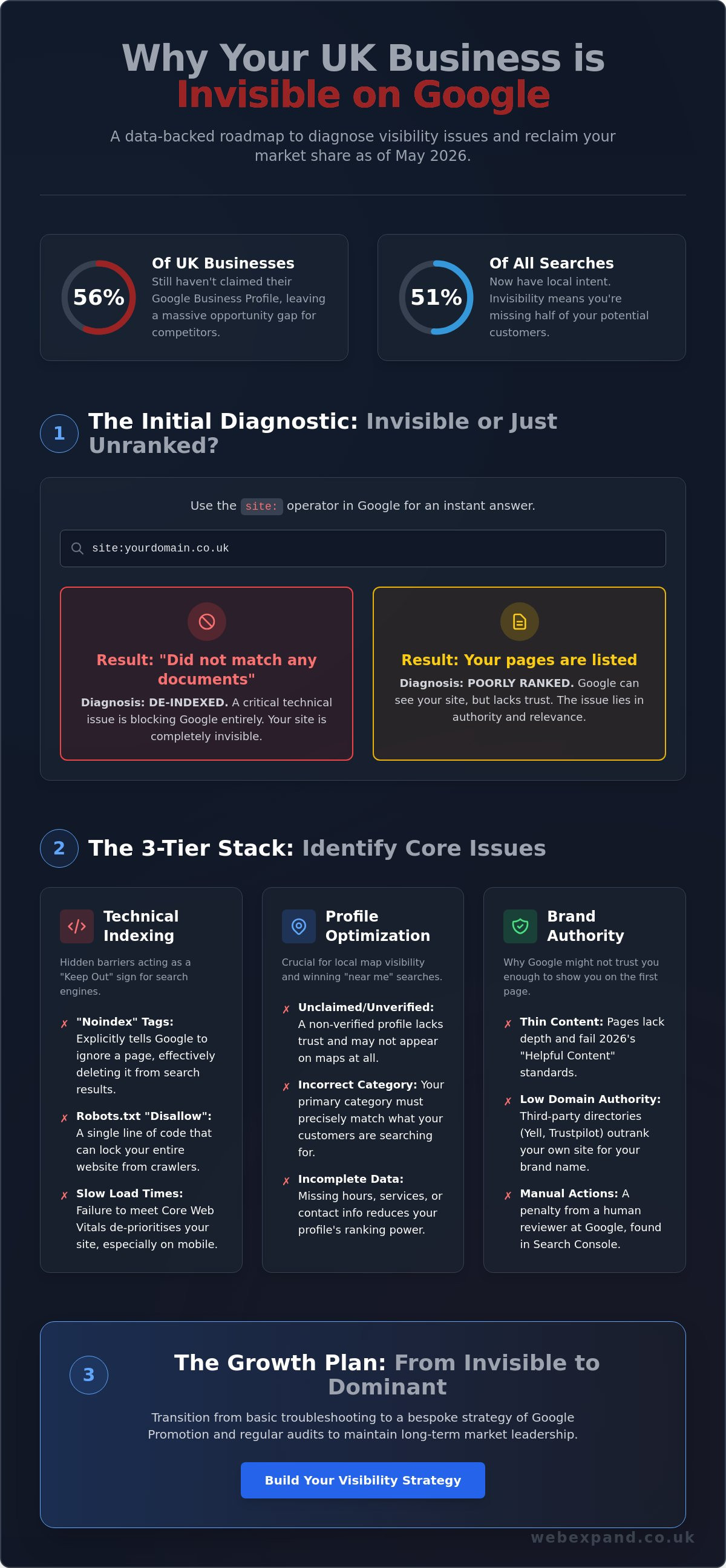
56% of UK businesses still haven’t claimed their Google Business Profile as of May 2026, leaving a massive gap for competitors to seize your market share. It’s incredibly frustrating when you’ve invested in a bespoke website only to find that searching for your exact brand name yields nothing but competitor ads or irrelevant results. If you are struggling because my business doesn’t show up on google uk, you are likely losing out on the 51% of all searches that now have local intent. Visibility isn’t a matter of luck; it’s a three-tier stack of technical indexing, profile optimization, and brand authority.
We understand that you want to scale and dominate your niche, not get lost in technical jargon about the March 2026 Core Algorithm Update or the April 2026 ICO cookie guidance. This systematic checklist identifies exactly where your strategy is broken. You’ll discover the precise steps to restore your brand visibility, fix technical errors that prevent indexing, and align your profile with the latest 2026 identity policies. We’ll provide the data-backed roadmap you need to move from invisible to market leader, ensuring your digital presence is a true engine for expansion.
Key Takeaways
- Distinguish between being de-indexed and poorly ranked by using the “site:” search operator to audit exactly what Google sees.
- Identify hidden technical barriers like “Noindex” tags or Robots.txt “Disallow” commands that prevent search engine crawlers from accessing your site.
- Ensure your Google Business Profile is fully verified and your primary category is optimized to fix invisibility on local maps.
- Discover why my business doesn’t show up on google uk by auditing for thin content and aligning your pages with 2026 “Helpful Content” standards.
- Transition from basic troubleshooting to a bespoke strategy of Google Promotion and regular audits to maintain long-term market leadership.
The Initial Diagnostic: Is Your Business Invisible or Just Unranked?
Before we can implement a growth strategy, we must define the exact nature of your invisibility. When you find that my business doesn’t show up on google uk, you are likely facing one of two distinct problems: you are either de-indexed or poorly ranked. De-indexing is a technical crisis where Google has completely removed your website from its database. Poor ranking means Google knows you exist but doesn’t trust your site enough to place it on the first page. With 51% of all searches now carrying local intent according to Visionary Marketing data from May 2026, staying invisible is not an option for businesses ready to scale.
The fastest way to diagnose this is by performing a “site:yourdomain.co.uk” search. Type this directly into the Google search bar to see every page Google currently has in its library. If the result returns “did not match any documents,” your site is de-indexed. If your pages appear here but don’t show up in standard searches, your issue is authority and relevance rather than a total technical block. Understanding the fundamentals of local search engine optimization is vital during this phase, as it helps you distinguish between these two states.
You must also check for “Manual Actions” within Google Search Console. This is the only definitive way to know if Google has penalized your site. Following the March 27, 2026 Core Algorithm Update, Google increased its scrutiny of content quality. If a human reviewer has flagged your site for violating webmaster guidelines, you’ll find a notification in the “Security & Manual Actions” tab. Without clearing these penalties, no amount of SEO will restore your visibility. Finally, verify if your brand name is unique. If your business name is too generic, Google may struggle to trigger a Knowledge Panel, even if your technical setup is perfect.
The ‘Brand Name’ Search Test
Search for your exact business name without adding your city or service. If your website doesn’t appear at the top, check if competitors are bidding on your brand via PPC ads. They might be siphoning your traffic before users even see your organic listing. This is why established names like Jagelo Haulage prioritise brand search visibility to ensure clients find their official transport services immediately. You should also look for third-party directories like Yell or Trustpilot. If these platforms outrank your own website for your brand name, it indicates a lack of domain authority that requires a bespoke content strategy to fix.
Using Google Search Console for Instant Clarity
Open your “Indexing” report to find “Excluded” pages. Google often finds pages but decides not to index them if they’re considered thin or duplicate. Check for “Crawl errors” that might be stopping Google’s bot from reading your code. It’s also essential to verify your primary domain settings. If your site is accessible via both “www” and “non-www” versions without a proper redirect, Google may see this as duplicate content, which splits your ranking power and contributes to why my business doesn’t show up on google uk.
Technical Checklist: Why Your Website Might Be Hidden
While a Google Business Profile is essential for local visibility, your website remains the foundation of your digital authority. If your site is technically inaccessible, Google’s crawlers will simply move on to a competitor. This is a primary reason why my business doesn’t show up on google uk, even after you’ve spent weeks on content. Technical barriers often act as a “keep out” sign for search engines, and identifying these errors is the first step toward reclaiming your market position.
Performance benchmarks are no longer optional. Since 89.7% of “near me” searches in 2026 occur on mobile devices, Google’s mobile-first indexing is more aggressive than ever. Sites that fail Core Web Vitals or exhibit slow load times are frequently de-prioritised in favour of faster, more responsive competitors. We often find that businesses struggling with visibility are actually suffering from poor server response times or unoptimised code that prevents their bespoke website from scaling as intended.
The Robots.txt and Metadata Audit
You can find your robots.txt file by navigating to yourdomain.co.uk/robots.txt. This simple text file tells search engines which parts of your site they are allowed to visit. A common developer mistake involves moving a site from a staging environment to a live server without removing the “Disallow: /” command. This single line of code effectively locks your entire site away from the public. Similarly, a “noindex” tag is a piece of metadata that explicitly instructs search engines to ignore a page, effectively deleting it from search results even if the rest of your SEO strategy is perfect.
Sitemaps and URL Structure
A clean URL structure helps Google understand your business hierarchy and the relationship between your services. In 2026, your XML sitemap serves as a direct roadmap for Google’s bot, ensuring that every core service page is discovered and crawled efficiently. Without a submitted sitemap in Google Search Console, you are essentially asking Google to guess where your most important content lives. For a deeper look at how to align your technical setup with modern standards, you can review our guide on What Makes a Good Business Website? to ensure your foundation is built for growth. If you are unsure if your current setup is holding you back, a professional technical audit is often the catalyst for rapid ROI.
Google Business Profile Checklist: Fixing Map Invisibility
A technically sound website is only half the battle. If your digital foundation is solid but my business doesn’t show up on google uk when customers search locally, your Google Business Profile (GBP) is likely the culprit. Data from March 2026 shows that 44% of local search clicks go directly to the Local Pack. If you aren’t appearing in those top three map results, you’re missing out on the 78% of mobile searches that result in an offline visit within 24 hours. Visibility here isn’t just about presence; it’s about precision and trust.
- Verification Status: Unverified profiles are invisible. Google now utilizes more stringent video verification methods to combat the 56% of businesses that still haven’t claimed their profiles.
- Primary Category: Your category must align perfectly with user intent. Selecting a generic category instead of a bespoke service match can lead to immediate disqualification from relevant searches.
- Identity Integrity: Following the April 2026 Identity Change Policy update, Google is rejecting edits that significantly alter a business’s nature. Attempting to “pivot” an old profile to a new industry will often trigger an immediate suspension.
- Duplicate Suppression: Having multiple listings for one location dilutes your authority. Google’s algorithm prioritizes single, authoritative sources of truth over fragmented data.
Optimising for the 2026 Map Pack
Relevance in the current landscape is driven by “freshness” and activity. Profiles that go more than 30 days without new geo-tagged imagery or updates often see a significant drop in visibility. While Google discontinued the Q&A feature in late 2025, you must now use the “Updates” section to signal your expertise. If you operate as a service-area business, it’s vital to define your boundaries correctly in the dashboard. For instance, a provider of mobile automotive care like Elite Mobile Services must ensure their service area is correctly mapped to reach clients throughout the Midlands without triggering verification issues. Failing to clear a residential address while claiming to be a storefront is a leading cause of profile shadow-banning in 2026.
NAP Consistency and Citations
Your Name, Address, and Phone number (NAP) must be identical across every digital touchpoint. Inconsistent data erodes the trust Google has in your business, which is a major reason why my business doesn’t show up on google uk for brand searches. Even a small discrepancy in a postcode or phone format can stall your growth. We help businesses navigate these complexities through our SEO Services Kent, ensuring your citations reinforce your authority. High-trust profiles receive 4.4 times more clicks than those with inconsistent data, making precision a non-negotiable part of your expansion strategy.
Content and Authority Checklist: Why You Aren’t Ranking
Google’s March 27, 2026, Core Algorithm Update solidified the shift toward “people-first” content. If your pages provide generic information or fail to answer a user’s query more effectively than your competitors, your rankings will suffer. This is often the primary reason why my business doesn’t show up on google uk even when technical boxes are ticked. We find that pages with thin content, typically containing fewer than 300 words, struggle to gain traction because they lack the depth required to satisfy modern search intent. High-quality content must be the engine of your expansion strategy.
Authority is built through your backlink profile and internal structure. A lack of UK-based referring domains tells Google that your business doesn’t have local relevance, which is critical for ranking in British search results. Additionally, keyword cannibalization occurs when multiple pages on your site target the same term. This confuses Google’s algorithm, leading to a situation where neither page ranks well. You must ensure each page has a unique, bespoke purpose within your overall strategy to avoid competing against yourself. Precision in your content hierarchy is the only way to dominate your niche.
Meeting E-E-A-T Standards in 2026
E-E-A-T standards (Experience, Expertise, Authoritativeness, and Trustworthiness) are the cornerstone of search trust in 2026. Your content must be backed by clear professional credentials and author bios that prove you are a legitimate authority in your field. Google systematically ignores websites that fail to provide clear UK contact signals like a physical address and local phone number. Without these markers of trust, your site will remain invisible to the customers who are ready to convert.
Strategic Keyword Alignment
Stop chasing “vanity keywords” that drive traffic without conversions. Focus on intent-based keywords that align with the specific problems your customers face. While AI tools can generate text, they often produce low-value fluff that Google’s March 24, 2026, spam update was designed to catch. High-energy growth requires a commitment to original, data-backed insights. For a deeper dive into how to build a high-conversion presence, see our guide on Digital Marketing in Kent. If you’re ready to fix these content gaps and scale your visibility, our bespoke SEO strategies are designed to drive measurable ROI and long-term market leadership.
From Invisible to Dominant: Your Growth Plan
Moving from a state where my business doesn’t show up on google uk to a position of market leadership requires a fundamental shift in mindset. Troubleshooting technical errors and fixing profile suspensions is merely the starting line. To truly scale and dominate your niche, you must transition into proactive Google Promotion. This involves a strategic blend of high-authority link building and precision-targeted content that compels Google to recognize your brand as the definitive choice. With 51% of all searches now carrying local intent as of May 2026, the cost of remaining reactive is simply too high for ambitious enterprises.
Regular technical audits are the only way to safeguard your visibility against the continuous evolution of search. Google’s March 2026 Core Algorithm Update demonstrated that ranking is never permanent; it’s a dynamic competition. By maintaining a rigorous audit schedule, we identify potential invisibility triggers like broken redirects or crawl errors before they impact your bottom line. This proactive approach ensures that your digital presence remains an asset rather than a liability, protecting your investment from the sudden fluctuations that often catch unmanaged sites off guard.
Setting realistic expectations for ROI is vital for long-term success in the UK market. While some technical fixes can yield immediate visibility for brand searches, ranking for competitive service terms typically takes between three to six months of consistent optimization. This timeline reflects the period Google needs to verify your authority and trust signals following the April 2026 Identity Change Policy updates. We focus on delivering sustainable growth that compounds over time, ensuring your journey toward market leadership is grounded in transparent data and measurable returns.
The Value of Bespoke Development
Generic website templates often come with excessive code bloat that slows down your site and complicates the indexing process. When we provide bespoke website design, we are delivering an SEO-first architecture built specifically for your business goals. These custom-coded sites rank faster because they offer the precision and speed that Google’s 2026 mobile-first crawlers demand. We offer fixed-price design and development solutions that eliminate technical debt and provide a clean foundation for your future expansion.
Ongoing SEO Management
SEO is a recurring monthly commitment rather than a one-time project. The digital landscape moves too quickly for a “set and forget” strategy. Professional monitoring allows us to track your performance against the 89.7% of mobile “near me” searches that dominate the current market. This level of oversight ensures that if a new competitor emerges or a policy update occurs, your rankings don’t suffer. If you’re ready to stop wondering why my business doesn’t show up on google uk and start dominating your local search results, contact Webexpand for an SEO audit today. We’ll provide the data-backed roadmap you need to turn your website into a high-conversion engine for growth.
Take Control of Your Digital Expansion
Invisibility on search results is a solvable technical challenge, not a permanent state. You now have the tools to move beyond the initial diagnostic phase and address the technical, profile, and content barriers we’ve discussed. By aligning your technical foundation with your Google Business Profile authority, you can finally resolve the frustration felt when my business doesn’t show up on google uk. A commitment to E-E-A-T and a clean, bespoke site architecture are the only ways to ensure your brand remains a fixture in the UK digital market.
Webexpand has been navigating these digital shifts since 2004. With over 20 years of UK SEO experience, we provide the bespoke, jargon-free advice you need to scale and dominate your niche. Our fixed-price web design includes integrated SEO architecture to prevent the technical bloat that hinders ranking. We don’t just fix errors; we build engines for growth. Stop being invisible, expand your reach with Webexpand’s SEO expertise.
Your journey toward dominating the UK search landscape starts with a single, data-backed step. We are ready to help you lead your market and protect your digital interests.
Frequently Asked Questions
How long does it take for a new UK business to show up on Google?
New UK businesses typically see their pages indexed within 4 to 28 days after submission through Google Search Console. However, appearing in the results is only the first step. Achieving a prominent position for competitive service terms usually requires a strategic period of 3 to 6 months to build the necessary authority and trust signals. We focus on accelerating this growth through bespoke technical setups that ensure your site is crawl-ready from the moment it launches.
Why did my business suddenly disappear from Google search results?
Sudden disappearance is often triggered by the March 27, 2026 Core Algorithm Update or a critical technical error like an accidental “noindex” tag. If you find that my business doesn’t show up on google uk overnight, your first step should be checking the manual actions report in Search Console. Ranking drops are frequently linked to technical changes made during site updates that inadvertently block search engine crawlers from accessing your content.
Can I pay Google to show my business at the top of the results?
You can achieve immediate visibility at the top of the page by using Google Ads, which places your business in the sponsored sections. While you cannot pay to influence organic rankings directly, a professional Google Promotion strategy ensures your brand dominates the non-paid spots. Combining these approaches is an effective way to capture the 156% growth in “near me” mobile searches recorded over the last two years.
Does my business address affect my national search visibility in the UK?
Your physical address is a primary ranking factor for the Local Pack, but it has less impact on national organic search results. Following the April 2026 identity updates, Google prioritizes verified UK locations for regional queries to ensure user trust. If you serve the entire country, we use service-area settings and bespoke landing pages to ensure your visibility extends far beyond your registered office’s postcode.
What is the difference between Google Search and Google Maps visibility?
Google Search visibility refers to your website’s ability to rank for specific informational or service queries, while Google Maps visibility is driven entirely by your Google Business Profile. Since 88% of consumers trust online reviews as much as personal recommendations according to 2026 BrightLocal data, your Maps presence is vital for conversion. We synchronize both platforms to ensure your brand is visible whether a user is looking for a deep-dive resource or a local service provider.
Why is my competitor showing up for my business name?
Competitors often bid on your brand terms using PPC ads to capture high-intent traffic before users reach your organic listing. If a competitor’s website outranks yours for your own name, it suggests your domain lacks the authority signals required by the March 2026 updates. This is a common reason why my business doesn’t show up on google uk correctly, and it requires a robust brand-protection strategy to reclaim your market share.
How do I know if my website has been penalised by Google?
The only definitive way to confirm a penalty is by reviewing the “Security & Manual Actions” section in Google Search Console. If your site was affected by the March 24, 2026 Spam Update, you will find a notification detailing the specific violation and the steps required for reconsideration. Most visibility issues are algorithmic rather than manual, meaning your site simply needs to be optimized to meet current quality benchmarks.
Is a Google Business Profile necessary if I only sell online across the UK?
Online-only e-commerce businesses are not eligible for a traditional Google Business Profile and should instead focus on securing a “brand panel” in search results. Google’s 2026 guidelines state that profiles without a physical storefront or face-to-face service area risk immediate suspension. We help e-commerce brands build national authority through bespoke SEO and hosting solutions that target buyers across the UK without relying on map-based listings.