

61% of small businesses spent under $10,000 on their most recent website project, yet a significant portion of these owners still feel they’ve been misled by technical jargon and hidden “scope creep.” You’ve likely felt that same hesitation when reviewing a quote that seems more focused on an agency’s overhead than your business’s growth. It’s a common frustration in the UK market where price transparency remains elusive. This guide will show you exactly how to avoid being overcharged for a website by identifying the red flags that lead to unexpected bills.
We’ll help you dismantle complex agency terminology and understand why AI-assisted development, which has reduced median build times by up to 34% since last year, should be reflected in your project’s efficiency. You’ll discover how to secure a bespoke website design and high-performance e-commerce solutions at a fair, fixed price. We are going to break down the total cost of ownership and provide a clear roadmap for finding a strategic partner who prioritizes your financial performance as you broaden your horizons and dominate your sector.
Key Takeaways
- Distinguish between upfront price and the total cost of ownership to ensure your digital presence serves as a high-performance growth asset.
- Identify the specific “agency taxes” and proprietary lock-ins that inflate budgets without adding technical value to your bespoke website design.
- Discover how to avoid being overcharged for a website by choosing fixed-price billing models that incentivise efficiency and provide total cost certainty.
- Utilise a professional vetting checklist to secure full ownership of your domain and website hosting before committing to a project.
- Learn why moving toward a strategic partnership focused on ROI is the most effective way to scale your business and dominate your sector.
Understanding the Black Box of Web Design Pricing in 2026
Pricing in the digital space often feels like a guessing game. You receive three quotes for the same project, and the difference between them could fund a small fleet of vehicles. This variance usually stems from information asymmetry. Agencies know the technical requirements, but you might not. In 2026, the value of a website has shifted from simply having a digital presence to driving measurable revenue. If an agency can’t explain why their price is higher through data-backed ROI, you’re likely paying for their overhead rather than your own growth.
We distinguish between price, which is the check you write today, and cost, which is the total investment over three years. Industry data suggests the total cost of ownership for a website over a three-year period is often double the initial build cost. Knowing how to avoid being overcharged for a website starts with looking past the initial number and scrutinizing the long-term value. Transparency is your best defense against inflated invoices that don’t translate into performance.
The Definition of a Fair Quote
A fair quote isn’t necessarily the lowest one. It’s a transparent breakdown of design, technical coding, and initial SEO. When an agency explains their Web design process without hiding behind complex terminology, it’s a sign of a healthy, collaborative partnership. You must define your specific business goals before requesting a price. Whether you need e-commerce solutions or lead generation, clarity prevents agencies from padding quotes with unnecessary features. High-energy agencies move quickly from identifying your challenge to presenting a data-backed solution that fits your budget.
Bespoke vs. Template: The Hidden Financial Trap
Many businesses fall into the trap of choosing a cheap template to save money. This often leads to technical debt. A poorly coded, template-based site requires more maintenance and security patches over time. A bespoke website design ensures you only pay for the features your business actually needs to scale. It’s about precision. While AI coding assistants have shortened development timelines by up to 34% year over year, the best agencies reinvest that time into performance and analytics. This is how to avoid being overcharged for a website; you pay for technical performance that drives growth, not for an agency’s fancy office or sales team.
5 Common Ways Agencies Inflate Website Costs
Many business owners don’t realize they’re paying for an agency’s lifestyle rather than their own digital growth. High-end quotes often include an “Account Manager Tax,” where you fund the salary of a middle-man who never touches your site. Spotting this bloat is an essential step in learning how to avoid being overcharged for a website. When you pay for layers of management, your budget is diverted away from technical precision and SEO performance. Direct communication with the experts who actually build your platform is always more efficient and cost-effective.
Another common inflation tactic is the proprietary CMS lock-in. Some agencies build on their own closed systems, effectively charging “ransom” fees if you ever want to move your site. This is often paired with hosting markups that exceed 500% of the actual market rate. While premium cloud hosting typically costs between $150 and $300 per year, some agencies charge that monthly. Consulting a reputable website cost guide reveals that these recurring costs should be transparent, not a hidden profit center for the vendor. Understanding these tactics is how to avoid being overcharged for a website while securing a high-performance asset.
The “Boutique” premium is equally draining. You aren’t just paying for expertise; you’re paying for an agency’s expensive city-centre office and the sales commissions of the person you met at the initial pitch. Add hidden plugin subscriptions to the mix, and your “fixed” price suddenly becomes a monthly drain. These tools should be built into your initial build, not rented back to you at a markup. A strategic partner will integrate these costs into a clear, bespoke solution from day one.
Identifying Agency Bloat
Direct access to the developer is the hallmark of an efficient partnership. If you can’t speak to the person building your site, you’re paying for a middle-man’s time. This lack of transparency leads to sales commissions being baked into your quote. A strategic partner focuses on your ROI, ensuring every pound spent contributes to your digital presence and financial performance. We believe in lean, expert teams that prioritize your growth over corporate hierarchy.
The Trap of Recurring Maintenance Fees
Maintenance shouldn’t be a black hole for your capital. Standard hosting fees should cover server space and security, not vague support charges for low-traffic sites. Understanding what makes a good business website helps you identify which features require active management and which should be self-sustaining. If you’re looking for a transparent path to growth, choosing bespoke website design ensures your investment stays focused on measurable outcomes and long-term industry leadership.
Fixed-Price vs. Variable Billing: Which Model Protects Your ROI?
Variable billing is often the primary reason businesses struggle with how to avoid being overcharged for a website. In the UK and EU, senior development rates currently range from $95 to $225 per hour. When an agency bills by the hour, their financial incentive is tied to the time spent rather than the results achieved. This model inherently rewards inefficiency; the longer a task takes, the more the agency earns. For a business ready to scale, this creates a conflict of interest that can stall momentum and drain capital.
Most “estimated” quotes are built on this variable foundation. Data indicates that these estimates frequently lead to price hikes of 20% to 30% by the time the project is signed off. This isn’t always a result of added features. Often, it’s simply the cost of the agency’s learning curve or internal delays being passed on to you. To protect your investment, you should look for a partner who offers cost certainty through a fixed-price model. This ensures that the price you agree on at the start is the price you pay at the finish.
Accountability is best maintained by linking payments to specific project milestones. Instead of paying for hours logged, you pay for progress verified. This structure guarantees that the agency remains focused on performance delivery. It transforms the relationship from a vendor-client transaction into a strategic partnership where both parties are invested in a rapid, high-quality launch. When milestones are clearly defined, the path to broadening your digital horizons becomes transparent and predictable.
Why We Advocate for Fixed-Price Fees
Fixed-price fees force an agency to be precise during the initial discovery phase. We have to understand your technical requirements and business goals perfectly before we start. This eliminates the “surprise invoice” that often appears at the end of the development phase in hourly models. It provides the budget certainty you need to plan your broader Search Engine Optimisation and Google Promotion strategies without worrying about a shrinking development fund. Efficiency becomes our priority, not just yours.
The False Economy of the Low-Ball Quote
A quote that undercuts the market significantly is often a trap. These “low-ball” offers typically use a basic template and exclude essential components like mobile responsiveness or initial content integration. You might save money on the initial fee, but you’ll pay more in the long run through variable “add-on” charges. Learning how to avoid being overcharged for a website means recognizing that a bespoke build with a fixed price offers better protection for your ROI than a cheap, variable-rate template that requires constant, paid adjustments.
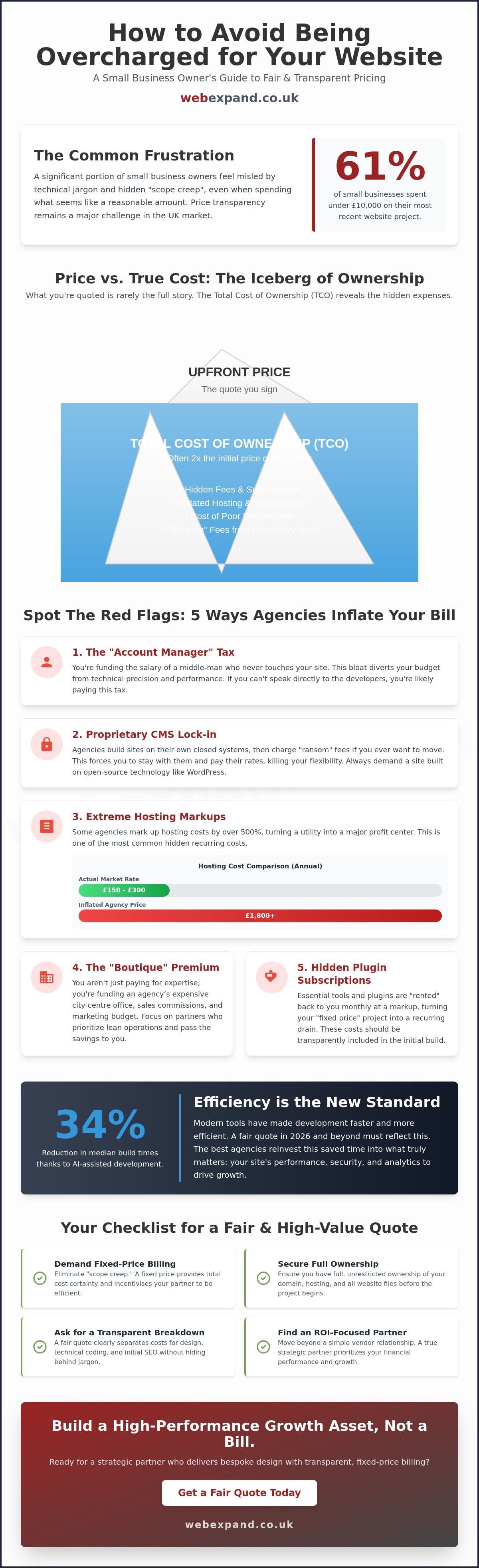
The Business Owner’s Checklist: How to Vet a Quote Before Signing
Vetting a quote is where you turn suspicion into certainty. It’s the final hurdle in understanding how to avoid being overcharged for a website. Many agencies rely on vague line items to hide project bloat, assuming you won’t dig into the technical specifics. To protect your capital, you must verify that your investment secures a high-performance growth engine rather than a restricted digital brochure. A quote shouldn’t just be a price; it should be a transparent contract of ownership and accountability.
Before you sign, ensure the proposal answers these five critical questions:
- Ownership: Do you have full legal ownership of the domain and website hosting accounts?
- Content: Is the initial content integration included, or are you paying for a “DIY” builder where you do the heavy lifting?
- SEO: Are specific SEO services, such as schema markup and meta optimization, baked into the technical build?
- Autonomy: Is the platform easy for your team to manage without paying the agency for every minor text change?
- Certainty: Does the agency offer a clear, one-time project fee for the entire build phase?
Questions to Reveal Hidden Overcharges
Transparency starts with the people behind the screen. Ask the agency exactly who will be working on your site and if you can speak with them directly. This helps you identify if you’re paying for a middle-man or a true technical partner. You should also demand a list of every recurring cost you’ll face after the site goes live. Finally, ask about the exit strategy. If you decide to move your site to a different host later, there should be zero “release fees” or technical barriers. If an agency hesitates to answer these, they’re likely hiding a “ransom” model.
Reviewing the Technical Scope
You need to verify that bespoke web design isn’t just a marketing term for a “customised” template. A true bespoke build is engineered for your specific conversion goals and includes Google Promotion as a core requirement. Your contract must explicitly mention mobile responsiveness and optimization for Core Web Vitals. These aren’t “add-ons”; they’re the standard for any site intended to dominate its sector in 2026. If these technical benchmarks are missing, you’re being set up for future “performance upgrade” bills. This is how to avoid being overcharged for a website while ensuring your digital presence is ready to scale. If you want a quote that prioritizes your ROI without the hidden fees, request a transparent project breakdown today.
Strategic Partnership: Why Transparent, Bespoke Design Wins
Choosing a web developer shouldn’t feel like hiring a temporary vendor; it’s about selecting a strategic growth partner who understands your bottom line. When you move beyond the transaction and into a collaborative relationship, the focus shifts from “what does this cost” to “what does this earn.” This mindset shift is the most effective way to understand how to avoid being overcharged for a website. A high-performance site is an investment that pays for itself through increased conversions and measurable digital growth. We prioritize jargon-free advice because you can’t make informed financial decisions if you’re buried in technical noise.
Our approach centers on fixed-price fees because they align our goals with yours. While other agencies might profit from delays and inefficiency, we prioritize precision and speed. This model ensures that your capital is used to build a robust digital presence rather than funding an agency’s administrative bloat. By focusing on measurable outcomes, we transform your website from a static expense into a transformative journey toward industry leadership. Your progress is the ultimate measure of our own performance.
The ROI of Bespoke Development
Bespoke development offers a level of precision that off-the-shelf templates simply cannot match. Custom code allows for a leaner, faster site that directly improves your digital marketing performance. Because the foundation is scalable from day one, you reduce long-term costs by avoiding the “rip and replace” cycle common with cheaper builders. Industry leaders invest in bespoke solutions because they need tools that adapt to their specific workflows and customer journeys. This technical edge ensures you aren’t paying for features you don’t need, which is exactly how to avoid being overcharged for a website in the long run.
Securing Your Digital Future
Transitioning from an overpriced agency to a transparent partner starts with a thorough audit of your current costs. Look at your hosting, maintenance, and support bills to identify where markups are being applied without adding value. If you feel trapped by proprietary systems or hidden fees, it’s time to reclaim your digital autonomy. The first step toward broadening your horizons is gaining total cost certainty. We are ready to help you dismantle the complexity and focus on results. Ready for an honest assessment? Contact us for a fixed-price bespoke quote and let’s start building your high-performance growth engine today.
Secure Your Digital Growth with Total Cost Certainty
Your digital presence should be a catalyst for expansion, not a drain on your resources. By prioritizing fixed-price billing and auditing the technical scope of every proposal, you’ve learned exactly how to avoid being overcharged for a website. It’s about shifting from a traditional vendor relationship to a strategic partnership where transparency is the foundation. You now have the checklist to spot agency bloat and ensure your investment goes directly into high-performance bespoke design that drives measurable growth.
Since 2004, we’ve built a reputation for jargon-free advice that helps businesses dominate their sectors. We eliminate the “surprise invoice” culture by offering fixed-price development fees with no hidden fees or recurring “ransom” charges. Our team is dedicated to building scalable growth engines that align with your long-term financial goals. It’s time to demand more from your digital partner.
Ready to broaden your horizons and secure your digital future? Get a Transparent, Fixed-Price Quote for Your Bespoke Website and take the first step toward industry leadership today. We’re here to help you scale with precision and confidence.
Frequently Asked Questions
How much should a professional business website cost in 2026?
A professional 5 to 10 page business website typically ranges between $3,000 and $15,000 depending on whether you hire a freelancer or a boutique agency. For complex custom eCommerce solutions, budgets often start at $20,000 and can exceed $75,000 for full custom builds. These figures reflect the 2026 market where AI assisted development has stabilized costs despite increasing demands for bespoke features and performance.
What are the most common hidden costs in web design contracts?
The most frequent hidden costs include proprietary CMS licensing fees, inflated hosting markups, and ransom exit fees for moving your site. You might also encounter unexpected bills for SSL certificates, premium plugin renewals, or payment processing fees that weren’t clearly disclosed. Knowing how to avoid being overcharged for a website requires scrutinizing the contract for these recurring annual costs which can often double the initial build price over three years.
Is it cheaper to use a website builder or hire an agency?
Using a DIY website builder is cheaper in terms of initial capital, but hiring an agency is often more cost effective for long term growth. While a builder might cost $100 to $500 per year, the time investment and lack of custom SEO or performance optimization can limit your ROI. Agencies provide a full team to ensure your site is a high performance asset rather than just a digital brochure, making the higher upfront investment more profitable.
Why do some agencies charge a monthly fee for “maintenance”?
Monthly maintenance fees are usually charged to cover security updates, plugin compatibility checks, and cloud hosting management. However, some agencies use these fees as a hidden profit center by overcharging for basic server space. A transparent partner will clearly define what is included in these charges, such as Search Engine Optimisation monitoring or security patches, ensuring you only pay for services that maintain your site’s peak performance and security.
How can I tell if an agency is using a template instead of bespoke design?
You can identify a template by checking the site’s source code for common theme names or by using tools that detect pre built frameworks. If the agency cannot provide a unique design file or if the site looks remarkably similar to others in their portfolio, it’s likely a template. Bespoke website design is built from the ground up to meet your specific conversion goals, offering a level of precision and speed that templates cannot match.
What should be included in a standard web design quote?
A standard, transparent quote must include a full breakdown of design, technical coding, and initial content integration. It should also explicitly state that you have full ownership of the domain and hosting, along with a fixed price fee for the entire project. Essential elements like mobile responsiveness, Google Promotion setup, and Core Web Vitals optimization should be listed as standard features rather than expensive add ons discovered mid project.
Can I move my website to a different agency if I am unhappy?
You can move your website easily if it is built on an open source platform and you have full ownership of the hosting and domain. However, if an agency uses a proprietary CMS, you may find yourself locked into their ecosystem with no way to export your data without significant costs. This is a critical factor in how to avoid being overcharged for a website; always ensure your contract guarantees full portability and zero exit fees.
How does bespoke design impact my SEO and Google rankings?
Bespoke design significantly boosts your Google rankings by allowing for cleaner code, faster load times, and better mobile optimization. Unlike templates, which are often bloated with unnecessary scripts, custom builds prioritize Core Web Vitals and technical SEO from day one. This precision ensures that your site is fully optimized for Google Promotion, helping you scale your digital presence and dominate your sector more efficiently than competitors using off the shelf solutions.