

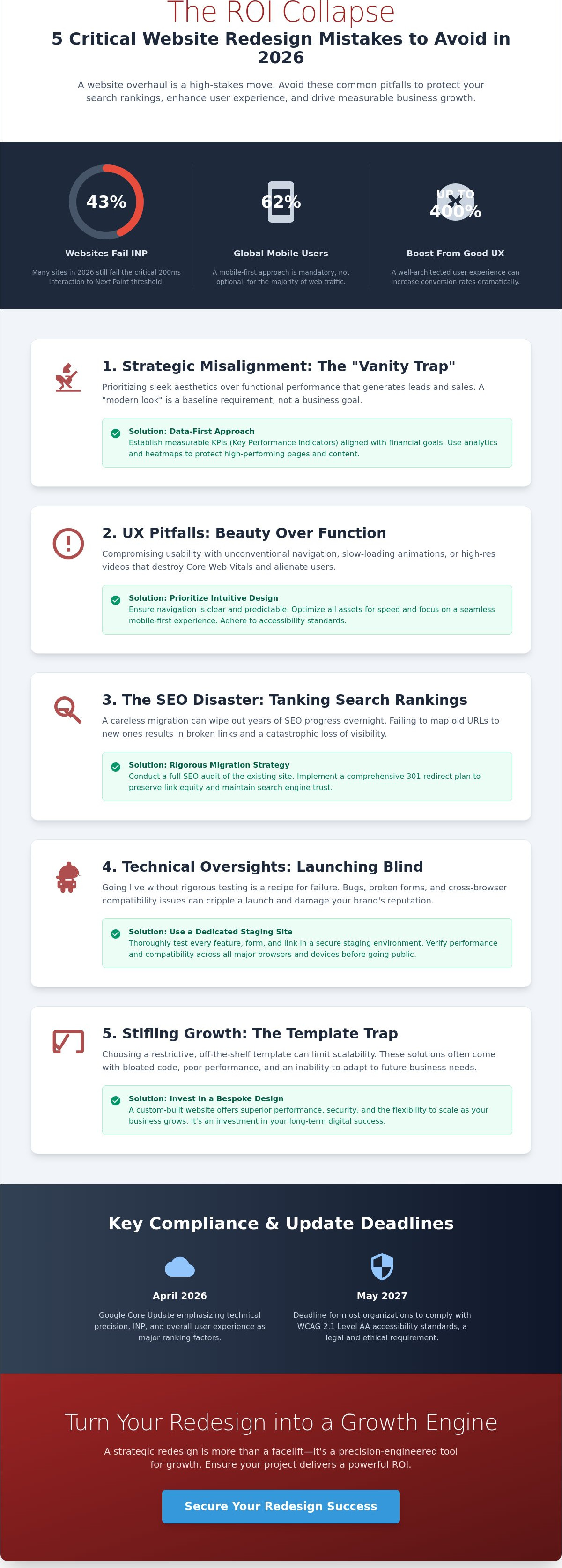
Did you know that 43% of websites in 2026 still fail the critical Interaction to Next Paint (INP) threshold of 200 milliseconds? This technical oversight is one of the most common website redesign mistakes to avoid if you want to scale your business and dominate your sector. You’ve likely invested significant resources into your digital presence, so the fear of losing your current Google rankings during a transition is entirely justified. It’s a high-stakes move where a single misstep in your site architecture can lead to a total ROI collapse.
In 2026, “looking modern” is a baseline requirement, not a valid business goal. Your design must map the user journey to specific conversion points that drive revenue. Whether you are selling bespoke website design or e-commerce solutions, every visual element must support the primary service. A common website redesign mistake to avoid is creating a beautiful site that confuses the visitor. If the path to purchase isn’t clear, your bounce rate will climb regardless of how “clean” the layout looks. This is where the strategic conversion analysis offered by Create2Convert becomes essential for aligning design with financial performance. We help you align your ambitious growth targets with a site structure that guides users toward measurable outcomes.
We’re here to ensure your overhaul is a strategic success rather than a technical failure. By following this guide, you’ll learn how to navigate the pitfalls of a website overhaul to protect your search rankings and drive measurable business growth. We’re committed to helping you achieve a seamless transition that prioritizes both user experience and technical precision.
We will break down the essential requirements of the April 2026 Google Core Update and the upcoming WCAG 2.1 Level AA accessibility deadlines. You’ll also discover why a mobile-first approach is mandatory for the 62% of global users now browsing on mobile devices. Let’s move beyond basic aesthetics and build a bespoke digital presence that delivers the financial performance your organization deserves.
Key Takeaways
- Shift your perspective from a cosmetic facelift to a strategic digital evolution that prioritizes lead generation over simple aesthetics.
- Prevent conversion loss by ensuring your navigation remains intuitive and that design choices never compromise site speed or visitor usability.
- Secure your search visibility by implementing a rigorous migration strategy and identifying technical website redesign mistakes to avoid before you launch.
- Protect your live environment by utilizing a dedicated staging site to verify cross-browser compatibility and eliminate technical bugs before going public.
- Maximize your long-term growth by choosing bespoke website design that offers superior scalability and performance compared to restrictive off-the-shelf templates.
Why Most Website Redesigns Fail to Deliver ROI
A website redesign represents a strategic evolution of your digital assets, not a simple cosmetic facelift. Too many organizations fall into the “Vanity Trap,” where they prioritize aesthetics over functional performance. While a sleek interface looks impressive, it fails if it doesn’t generate leads or sales. This is one of the most expensive website redesign mistakes to avoid because the cost of failure includes lost search rankings, broken sales funnels, and long-term brand damage. Before the first wireframe is even drawn, you must establish measurable KPIs that align with your financial goals. We view a redesign as a precision-engineered tool for growth, not just a portfolio piece.
Understanding the design process requires a balanced focus on both interface design and back-end efficiency. If your new site doesn’t outperform the old one in speed, conversion rates, and search visibility, the project is a liability. We advocate for a data-first approach that treats your website as a living component of your business development strategy. By identifying potential friction points early, you protect your investment and ensure your new digital presence is ready to dominate your sector.
Misaligning Design with Business Objectives
In 2026, “looking modern” is a baseline requirement, not a valid business goal. Your design must map the user journey to specific conversion points that drive revenue. Whether you are selling bespoke website design or e-commerce solutions, every visual element must support the primary service. A common website redesign mistake to avoid is creating a beautiful site that confuses the visitor. If the path to purchase isn’t clear, your bounce rate will climb regardless of how “clean” the layout looks. We help you align your ambitious growth targets with a site structure that guides users toward measurable outcomes.
Ignoring Current Performance Data
Don’t guess what your users want when the data is already available. Use heatmaps and Google Analytics to identify exactly what’s working on your current site. High-traffic pages are your most valuable assets; they must be protected at all costs during a migration. You’ve worked hard for your search rankings, and a careless redesign can wipe out years of SEO progress in a single afternoon. Audit your current site to find technical debt before migrating it. This prevents old errors from haunting your new environment and ensures a clean slate for your Google promotion efforts. We prioritize the human element of data to turn existing traffic into a loyal customer base.
User Experience (UX) Pitfalls: When Aesthetics Compromise Performance
A striking visual identity might capture attention, but it’s the user experience that captures the sale. One of the most common website redesign mistakes to avoid is prioritizing “clever” design over intuitive functionality. When you hide your primary navigation behind unconventional icons or use obscure terminology for menu items, you create friction. This friction directly translates to lost revenue. Research highlights the massive impact of UX on conversion rates, suggesting that a well-architected interface can boost performance by up to 400%. You need a clear content hierarchy where users can scan and find information in seconds. If your visitors have to think about how to use your site, they’ve already started looking for your competitor.
Accessibility is no longer a “nice to have” feature. In 2026, it’s a legal and ethical requirement. Most organizations must comply with WCAG 2.1 Level AA standards by May 2027. If your redesign ignores these protocols, you’re not just alienating a significant portion of your audience; you’re creating a massive legal liability. From color contrast to screen reader compatibility, every element must be inclusive. We believe that accessibility and high performance go hand in hand, creating a digital presence that serves every stakeholder with precision.
The “Beauty Over Function” Trap
High-resolution videos and complex JavaScript animations can look spectacular on a high-end desktop. However, these elements often destroy your Core Web Vitals. Google’s thresholds are strict: Largest Contentful Paint (LCP) must stay under 2.5 seconds. If your heavy graphics cause a delay, 53% of your mobile visitors will abandon the site before it even loads. We balance your brand’s ambitious visual identity with lightning-fast performance to ensure your CTA is always the star of the show. By identifying these website redesign mistakes to avoid early, you protect your conversion funnel from technical bloat.
Neglecting Mobile-First Architecture
With mobile devices accounting for 62-64% of global web traffic, designing for desktop first is a relic of the past. A truly mobile-optimized experience goes beyond simple responsive scaling. It involves testing for “fat-finger” errors on buttons and ensuring navigation is effortless on a small screen. A one-second delay in mobile load times can decrease conversion rates by 20%. Our approach to bespoke website design ensures that your site feels native to every device, protecting your search visibility and enhancing user trust. We build for the palm of the hand, ensuring your growth is never limited by hardware.
The SEO Disaster: How Redesigns Tank Search Rankings
A website redesign is a technical migration of your brand’s most valuable digital equity. Treating search visibility as a post-launch checklist is one of the most catastrophic website redesign mistakes to avoid. When you change your site structure, you aren’t just moving buttons; you’re rerouting the map Google uses to understand your authority. Without a rigorous migration strategy, years of Search Engine Optimisation (SEO) progress can evaporate in a single afternoon. We see it often: a beautiful new site launches, and organic traffic immediately plummets because the “invisible” foundations were ignored.
The risk isn’t just about broken links. It’s about the loss of backlink equity. High-authority domains that link to your site point to specific URLs. If those pages disappear or return 404 errors, that link juice is gone. Google’s April 2026 Core Update places a higher premium on helpful, people-first content. If you thin out your content during a redesign to achieve a minimalist look, you signal a loss of authority to the algorithm. SEO must be baked into your site architecture from the very first wireframe to protect your Google promotion efforts.
You must treat your content as a strategic asset. If you remove pages that currently drive traffic, you’re effectively cutting off your own lead supply. We advocate for a data-driven audit that identifies your “hero” pages. These pages require the most protection during a transition. Every structural change should be evaluated for its impact on crawlability and indexation. This proactive approach ensures your new site isn’t just a visual upgrade, but a high-performance engine ready to dominate your sector.
Forgetting the 301 Redirect Map
A 301 redirect map is your most critical document during a transition. You must create a comprehensive mapping file that matches every old URL to its logical new home. Failing to do this causes a 404 spike that tells Google your site is no longer reliable. We ensure that every high-authority page is accounted for, preserving the flow of traffic and ranking power. This level of precision is essential for maintaining the momentum of your digital presence and ensuring a seamless transition for both users and search bots.
Content and Metadata Erasure
Never start from scratch with your best-performing copy. While you might want a fresh voice, you must preserve the title tags and meta descriptions that already earn clicks. A common website redesign mistake to avoid is deleting the metadata that tells search engines what your pages are about. We also audit your internal link structures to maintain the flow of page authority. Whether you are launching e-commerce solutions or a corporate site, your technical foundations must remain intact to support your long-term growth ambitions.
Technical and Testing Oversights Before Going Live
Launching a site without rigorous testing is like opening a retail store while the painters are still on ladders. You must use a staging environment to isolate development from your live traffic. Editing a live site is one of the most reckless website redesign mistakes to avoid. It invites downtime and creates a fragmented experience that erodes user trust. We ensure that every element, from navigation menus to footer links, is verified across multiple browsers and devices. A consistent experience for all users isn’t just a goal; it’s a requirement for brand authority.
In 2026, speed is a confirmed ranking factor that directly impacts your bottom line. Data shows that 53% of mobile site visitors will leave a page if it takes longer than three seconds to load. Even a one-second delay can decrease conversion rates by 20%. We don’t just aim for “fast enough”; we target the “Green Zone” in Google’s PageSpeed Insights. This includes meeting the strict Interaction to Next Paint (INP) threshold of 200 milliseconds, a metric that 43% of websites still fail to hit as of early 2026.
Inadequate Speed and Performance Testing
Optimizing images and scripts for the modern mobile web is essential. Large, unoptimized files are conversion killers. We also emphasize the role of secure, high-performance website hosting. A cheap server can negate even the most advanced code optimizations. If you want to protect your investment, partner with experts who prioritize technical precision to ensure your site remains fast, stable, and ready to scale.
Breaking the Conversion Path
Every form and button must be a friction-free gateway to growth. We test lead generation forms on diverse devices to prevent user frustration and “fat-finger” errors. For businesses utilizing e-commerce solutions, verifying that payment gateways are secure and functional is non-negotiable. A two-second delay in load times can increase the shopping cart abandonment rate to 87%. Finally, ensure your Google Promotion tracking is correctly installed. If you can’t measure your success, you can’t optimize for it. Our approach ensures that your technical foundations support your ambitious financial targets from day one.
Strategic Execution: Turning a Redesign into a Growth Engine
A successful relaunch is just the beginning of your journey toward industry leadership. One of the final website redesign mistakes to avoid is treating the project as a one-and-done transaction. High-growth organizations understand that their digital presence requires continuous evolution based on real-time performance data. We position ourselves as your strategic partner, moving beyond the limited scope of a freelancer to provide a roadmap for long-term dominance. By broadening your horizons, you turn a technical update into a transformative growth engine that scales alongside your ambitions.
A freelancer might deliver a site that looks good on launch day, but a strategic partner ensures that site performs for years. We focus on the human element of business development, ensuring your team can manage content easily while we handle the technical complexities of website hosting and maintenance. This collaborative rhythm allows your business to move quickly from identifying market challenges to deploying data-backed solutions. Your progress is our ultimate measure of performance, and we stay ahead of technological shifts to protect your interests.
Post-launch, the focus shifts to refinement. We use the data gathered from your new environment to optimize conversion paths and enhance Google Promotion efficiency. This iterative process prevents your site from becoming stagnant, ensuring it remains a high-energy asset. By avoiding the common website redesign mistakes to avoid that plague static projects, you ensure your digital presence is always working to broaden your market reach.
Integrating SEO from Day One
Integrating search strategy from the earliest conceptual stages ensures your new architecture is built for visibility. Our SEO services Kent specialists work to align your site structure with high-intent keywords and future content expansion. This proactive planning is the foundation of digital marketing success in 2026. We don’t just build pages; we engineer pathways for your target audience to discover your brand and convert into loyal stakeholders.
Bespoke vs. Template: Choosing the Right Foundation
Choosing between a template and a custom build is a choice between limitation and liberation. Off-the-shelf themes often come with excessive technical bloat that slows down your site and restricts your ability to scale. In contrast, bespoke web design allows for a precision-engineered foundation that eliminates unnecessary code. This custom approach signals your status as an industry leader, providing a unique user experience that templates simply cannot replicate. It’s a commitment to precision that pays dividends through improved conversion rates and long-term reliability.
Secure Your Digital Future with Strategic Precision
Your digital presence is a high-performance asset that requires precision engineering to deliver lasting results. By identifying the critical website redesign mistakes to avoid, you’ve already taken the first step toward protecting your search visibility and conversion potential. We’ve explored why a rigorous migration strategy is essential and how bespoke architecture eliminates the technical bloat that often hinders off-the-shelf templates. Success in 2026 demands a site that isn’t just visually impressive but technically flawless and aligned with your organizational goals.
Realizing your ambitious growth targets requires more than just a new look; it demands a data-backed foundation. With over 20 years of technical expertise, we specialize in delivering results-driven strategic partnerships that prioritize your long-term ROI. We focus on the human element of business development while ensuring your site remains a high-energy engine for growth. It’s time to broaden your horizons and dominate your sector with a site built for the future.
Partner with Webexpand for a strategic, high-performance website redesign and turn your digital vision into a measurable financial success. Your journey toward industry leadership starts with a single, well-executed move. We’re ready to help you scale.
Frequently Asked Questions
How long does a professional website redesign typically take?
A professional redesign typically spans between 8 and 16 weeks. This timeline accounts for strategic discovery, bespoke website design, and rigorous technical testing. Complex e-commerce solutions or large-scale migrations may extend this period. We prioritize a thorough process to ensure your launch is flawless and meets your specific growth targets.
Will my search engine rankings drop after a redesign?
Your rankings shouldn’t drop if you execute a precise technical migration strategy. One of the primary website redesign mistakes to avoid is launching without a comprehensive 301 redirect map. When handled correctly, a redesign often leads to improved search visibility by fixing technical debt and enhancing the overall user experience.
How do I know if my website actually needs a redesign?
Look for indicators like high bounce rates, declining conversion numbers, or failure to pass Google’s 2026 Core Web Vitals. If your site takes longer than 2.5 seconds for Largest Contentful Paint (LCP), it’s time for an update. A redesign is necessary when your current platform restricts your ability to scale or fails to meet modern accessibility standards.
What is a 301 redirect and why is it critical for my new site?
A 301 redirect is a permanent instruction that tells search engines a page has moved to a new URL. It’s critical because it passes the ranking power and traffic from your old site to the new one. Without these, you’ll face a surge in 404 errors, which can severely damage your SEO standing and frustrate your visitors.
Should I change my website hosting during a redesign?
You should evaluate your hosting if your current provider causes slow load times or security vulnerabilities. High-performance website hosting is essential for meeting the 2026 Interaction to Next Paint (INP) threshold of 200 milliseconds. If your redesign includes complex e-commerce solutions, you need a robust environment capable of handling increased data processing without lag.
How much should a bespoke website redesign cost in 2026?
The investment for a bespoke redesign depends entirely on the technical scope and the specific goals of your organization. Tailored solutions are priced based on the complexity of the architecture and the level of customization required. We suggest focusing on the projected ROI and long-term business growth rather than seeking the lowest initial price point.
How do I maintain my Google Promotion results during a site change?
Maintain your Google Promotion results by verifying that all tracking pixels and conversion tags are correctly migrated to the new environment. Ensure your landing pages maintain their relevance to your active ad groups. A seamless transition prevents a drop in Quality Score and ensures your marketing budget continues to deliver measurable performance throughout the launch phase.
What are the most common UX mistakes to avoid in a redesign?
Common errors include hidden navigation menus, poor color contrast, and a lack of mobile optimization. Failing to account for fat-finger errors on mobile devices can alienate 62% of your global traffic. Prioritizing aesthetics over functionality is among the most frequent website redesign mistakes to avoid. We ensure your interface is intuitive, accessible, and designed to convert.