

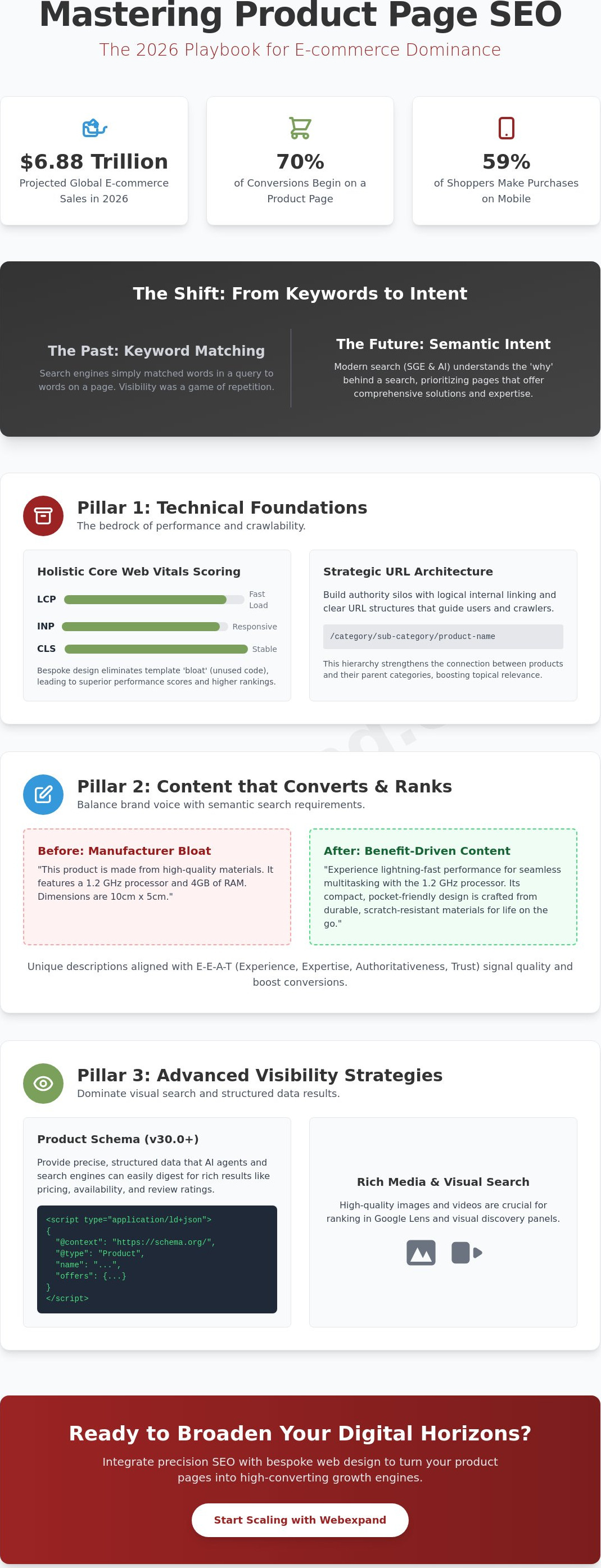
With global retail e-commerce sales projected to hit $6.88 trillion in 2026, the battle for digital shelf space has reached a fever pitch. You’ve likely felt the sting of healthy traffic that refuses to convert; or perhaps your product pages remain buried in search results despite your best efforts. It’s a common roadblock for ambitious brands ready to scale. You understand that basic tactics fail when Google’s May 2026 Core Update has already redefined technical authority. Mastering product page seo best practices is no longer a luxury; it’s the baseline for any business that intends to dominate its sector.
We’re here to turn your product detail pages into high-ranking, high-converting growth engines. This guide delivers a clear, data-backed roadmap to master the technical and creative strategies required for modern e-commerce success. We’ll break down the complexities of Schema.org version 30.0 and the latest composite Core Web Vitals scoring into actionable steps. You’ll learn how to align with E-E-A-T principles and optimize for the 59% of shoppers buying on mobile. By implementing these tailored solutions, we’ll broaden your digital horizons and ensure your audience’s progress becomes the ultimate measure of your brand’s performance.
Key Takeaways
- Understand the shift from keyword matching to semantic intent to capture high-intent shoppers in the 2026 search landscape.
- Learn how bespoke website design serves as a technical catalyst for meeting the latest, more stringent Core Web Vitals standards.
- Implement product page seo best practices to craft unique, benefit-driven descriptions that eliminate ‘manufacturer bloat’ and boost conversion.
- Explore advanced Product Schema and rich media tactics to dominate visual search results and Google Lens discovery.
- Discover how to build strategic authority silos through internal linking to strengthen the connection between your products and categories.
The Strategic Importance of Product Page SEO in 2026
In 2026, the product detail page (PDP) is the true frontline of your digital presence. With global retail e-commerce sales reaching $6.88 trillion this year, the competition for visibility has shifted from the homepage to the individual SKU level. You can’t rely on a broad brand presence to drive revenue anymore. Instead, your growth depends on how effectively each product page functions as a standalone entry point for high-intent shoppers. This is where search engine optimization (SEO) becomes a precision tool for organizational growth.
Google’s May 2026 Core Update signaled a definitive end to simple keyword matching. Modern search algorithms now prioritize semantic intent; they understand the “why” behind a query just as well as the “what.” When you implement product page seo best practices, you aren’t just ticking boxes for a crawler. You’re building topical authority that signals to both AI agents and human users that your brand is the definitive expert in your niche. High-ranking PDPs fuel your site’s overall health, creating a halo effect that boosts your entire catalog’s performance.
Moving Beyond the Homepage-Centric Mindset
Industry data suggests that approximately 70% of e-commerce conversions now begin on a deep-linked product page rather than your homepage. Shoppers are bypassing the “front door” and landing exactly where their needs meet your solutions. By capturing “ready-to-buy” traffic through long-tail keyword precision, you reduce the friction between discovery and checkout. These pages are often the first impression a customer has of your expertise. If the technical execution or content is lacking, you don’t just lose a sale; you lose the opportunity to broaden your brand’s horizons with a new advocate.
The 2026 Search Landscape: AI and SGE
The rise of Search Generative Experience (SGE) has fundamentally changed how products appear in results. Search engines now “understand” complex product attributes, like material durability or specific compatibility, without needing a direct keyword match. If your technical clarity is weak, your products won’t appear in AI-generated shopping comparisons or zero-click discovery panels. We see technical accuracy as the new prerequisite for visibility. To dominate, you must provide structured, precise data that AI agents can digest and recommend. It’s a shift from passive listing to active, data-driven positioning that protects your stakeholders’ interests in an increasingly automated market.
Technical Foundations: Architecture and Performance Best Practices
Strong search performance starts with the code. Many e-commerce platforms rely on off-the-shelf templates that carry excessive “bloat,” such as unused CSS and JavaScript that throttle your site’s potential. Bespoke website design eliminates this weight, ensuring every line of code serves a specific purpose for your business. This precision is vital for implementing product page seo best practices effectively, as search engines now penalize technical inefficiency more harshly than ever before.
The March 2026 Google Core Update introduced holistic Core Web Vitals scoring, meaning your product pages are now judged on a composite performance score. You can’t afford to ignore the technical health of your product detail pages (PDPs) if you intend to scale. We focus on building architectures that prioritize both crawlability and the human experience, ensuring your digital presence remains robust under the scrutiny of modern algorithms.
Core Web Vitals and the Speed-to-Conversion Link
Largest Contentful Paint (LCP) remains a make-or-break metric for PDPs. If your primary product image or hero section takes too long to render, your bounce rate will climb and your rankings will suffer. We eliminate Cumulative Layout Shift (CLS) by reserving specific dimensions for high-resolution imagery and dynamic elements like “Buy Now” buttons. Custom-built architectures significantly reduce latency, allowing your site to achieve superior Interaction to Next Paint (INP) scores by ensuring the browser main thread remains unencumbered by third-party script interference.
Scalable URL Structures and Breadcrumbs
Your URL structure should signal hierarchy and relevance instantly to both users and crawlers. While flat structures are popular, a logical hierarchy often wins for e-commerce by grouping products under clear, descriptive categories. For in-depth product page optimization, you must also implement logical breadcrumb navigation. Breadcrumbs improve the user journey and distribute internal link equity back to your high-level category pages. Always use canonical tags on variant pages to prevent duplicate content issues when a single product is available in multiple colors or sizes.
Mobile commerce now accounts for 59% of all online retail sales in 2026. This means your PDPs must be “thumb-friendly,” with critical navigation and call-to-action buttons placed within easy reach. To ensure search engines can see this content, we recommend Server-Side Rendering (SSR). SSR makes your product data immediately available to crawlers, avoiding the indexing delays often associated with client-side JavaScript execution. When a product goes out of stock, don’t delete the page and lose your SEO equity. Instead, keep the page live, suggest relevant alternatives, and use “out of stock” schema to maintain data accuracy for AI search agents.
If you’re struggling with slow load times or technical errors, our bespoke website design solutions are engineered to maximize your technical performance and search visibility.
Content Optimisation: Balancing Brand Voice with Semantic Search
While technical foundations provide the engine, your content is the fuel that drives both rankings and conversions. In the 2026 search environment, generic descriptions are a liability. Google’s March 2026 Spam Update specifically targeted low-quality, scaled content, making unique editorial oversight a non-negotiable requirement. To excel, you must blend product page seo best practices with a narrative that resonates with your specific audience while providing the semantic signals AI search engines crave. For a brand like Sarum Rocks, this means weaving the story of handcrafted, ocean-inspired jewellery into every description to build emotional connection alongside SEO authority. We see this as a transformative journey from simply listing items to establishing industry leadership.
Mastering the Product Naming Convention
Precision in your H1 and title tags is the first step toward organizational growth. We recommend a standardized formula: [Brand] + [Gender/Category] + [Key Attribute] + [Product Type]. For example, “Aura Women’s Sustainable Organic Cotton Jumper” provides immediate clarity. Moving high-value attributes to the start of the H1 improves click-through rates by matching the user’s primary intent instantly. For UK-based businesses, it’s vital to align your naming with national search patterns. Ensure you’re using “trainers” instead of “sneakers” or “trousers” instead of “pants” to capture local high-intent traffic accurately. These small adjustments represent the precision we bring to every tailored solution.
Structuring Product Attributes for AI Discovery
Search engines now act as sophisticated comparison engines. They need to extract data quickly to populate AI-generated shopping panels. Adhering to product page seo best practices ensures that your technical specs are easy to digest. You can facilitate this by using clear, concise bullet points for technical specifications. This structure allows AI to “understand” your product’s unique selling points without wading through paragraphs of fluff. We also suggest a dedicated ‘Value Proposition’ section. This should directly answer the searcher’s primary objection, such as durability or compatibility, in a way that feels like a natural conversation rather than a sales pitch.
User-generated content (UGC), such as customer reviews and Q&A sections, remains a powerful ranking factor. These provide a steady stream of fresh, keyword-rich content that search engines crawl regularly. With an estimated 2.77 billion online shoppers worldwide as of March 2026, trust is your most valuable currency. By showcasing real experiences, you demonstrate the E-E-A-T (Experience, Expertise, Authoritativeness, Trustworthiness) that Google’s algorithm prioritizes. We don’t just aim for traffic; we focus on the human element of business development to deliver rapid, measurable results.
Advanced Structured Data and Rich Media Strategy
Precision data is the language of the modern web. While your content speaks to the shopper, your structured data speaks to the AI agents that now curate search results. Following product page seo best practices in 2026 requires a move beyond basic price and availability tags. With the release of Schema.org version 30.0 on March 19, 2026, the standard for rich snippets has evolved to include much deeper product context. We help you leverage these technical layers to ensure your products aren’t just listed, but prominently featured in AI-driven comparison carousels.
Synchronizing your site with Google Merchant Center feeds is no longer optional for organic success. This real-time link ensures your organic listings reflect current stock levels and promotional pricing instantly. It bridges the gap between your backend inventory and the SERP, protecting your stakeholders’ interests by preventing clicks on out-of-stock items. This level of precision demonstrates a commitment to transparency that search engines reward with higher visibility.
The Essential Schema Checklist for 2026
To dominate the search results, you must implement properties like ‘AggregateRating’, ‘Brand’, and ‘Material’ within your JSON-LD. These tags provide the granular detail that fuels rich snippets and helps search engines categorize your offerings with precision. In 2026, ‘shippingDetails’ and ‘hasMerchantReturnPolicy’ schema are now mandatory for ranking because they provide the transparency search engines require to trust your commerce data. Always validate your structured data using the latest inspection tools to avoid ‘Unparsable’ errors that could hide your products from the Agentic Web. If you need a partner to handle these complexities, our bespoke website design services integrate these technical requirements from day one.
Visual Search Optimisation and Rich Media
Visual search has become a dominant force, with Google Lens discovery driving significant high-intent traffic. Your alt-text shouldn’t just label the object; it needs to describe the ‘why’ behind the product’s design to feed visual search algorithms. Instead of “blue jumper,” use “women’s navy blue sustainable wool jumper for winter layering.” This helps AI understand the context and intent of your imagery. For high-performance stores, WebP and AVIF formats are the 2026 standard. These formats deliver the high-resolution detail shoppers expect without the layout shifts (CLS) that damage your Core Web Vitals scores.
The Webexpand Approach: Integrating SEO with Bespoke Design
We view bespoke website design as the non-negotiable foundation for industry leadership. Standard templates often trap businesses in a cycle of slow load times and technical debt that limits their digital presence. By engineering your site from the ground up, we ensure that every product page adheres to product page seo best practices without the interference of unnecessary code. This clean architecture allows search engines to crawl your catalog with maximum efficiency, translating technical precision into measurable financial performance.
Strategic internal linking is where we help you build true topical authority. Most competitors stop at basic “related products” lists, but we focus on creating sophisticated authority silos. By linking specific products back to high-level categories and complementary items, you distribute link equity across your entire store. This architecture signals to search engines that your brand possesses deep expertise in its niche. It’s about more than just navigation; it’s about guiding both users and AI agents through a logical journey that reinforces your market position and drives sales.
Building for Conversion and Scale
Conversion Rate Optimisation (CRO) has become a primary ranking signal in 2026. Search engines monitor how users interact with your “Add to Basket” journey to determine page quality. Our custom e-commerce solutions eliminate the friction often caused by third-party plugins that slow down the checkout process. We use “Customers Also Bought” sections not just for sales, but as a technical tool to pass authority between your most valuable assets. This creates a sense of momentum that search engines recognize as a marker of a high-quality user experience.
Your Roadmap to E-commerce Growth
We recommend the Pareto Approach to scale your presence quickly. Focus your initial efforts on the top 20% of your products that drive the majority of your revenue. Auditing these high-performance PDPs for quick-win optimisations, such as updated Schema or enhanced alt-text, delivers the fastest ROI. Your business website must remain a dynamic growth engine to stay ahead of the quarterly Google Core Updates. Through ongoing SEO management, we protect your interests and ensure your digital presence continues to broaden your commercial horizons.
Securing Your Market Position in the 2026 E-commerce Landscape
Dominating the digital shelf requires a synthesis of technical precision and creative authority. By implementing product page seo best practices, you transition from a participant to a leader in your sector. We’ve explored how bespoke architecture eliminates technical debt, while advanced Schema version 30.0 ensures your products remain discoverable by AI agents. These aren’t just minor adjustments; they’re the fundamental building blocks of a high-performance growth engine.
Since 2004, we’ve provided over 20 years of technical expertise to businesses ready to broaden their horizons. We specialize in custom e-commerce solutions that consistently outperform standard templates through measurable, results-driven strategies. Our team provides bespoke, jargon-free advice focused entirely on your organizational growth. Ready to scale your e-commerce growth? Contact Webexpand for a tailored SEO strategy today.
Your journey toward industry leadership starts with a single optimized page. We’re ready to help you dominate your sector and achieve the rapid results your business deserves. Let’s start building your future today.
Frequently Asked Questions
What is the most important SEO factor for a product page in 2026?
Semantic intent and technical precision are the most critical factors for visibility. Search engines now prioritize pages that demonstrate deep product knowledge and meet the composite Core Web Vitals scoring introduced in the March 2026 update. You must ensure your technical architecture is flawless while providing content that answers the shopper’s specific needs better than your competitors. This approach secures your position as a strategic leader in your niche.
How long should a product description be for SEO purposes?
Your product descriptions should be as long as necessary to fully inform the shopper and provide search engines with enough context. While there isn’t a fixed word count, aim for 300 to 500 words of unique, high-quality text. This allows you to integrate product page seo best practices by covering technical specifications, use cases, and benefit-led narratives that differentiate your brand from generic manufacturer listings.
Does user-generated content like reviews really help my rankings?
Customer reviews and ratings significantly boost your rankings by providing a steady stream of fresh, keyword-rich content. Search engines regularly crawl this user-generated data to assess your trustworthiness and authority. Because reviews often contain natural language and long-tail keywords used by real shoppers, they help your pages appear in more relevant search results while simultaneously improving your conversion rates and building mutual success.
How do I handle SEO for products that are out of stock?
You should keep the product page live rather than deleting it or using a 404 error. Deleting pages destroys your hard-earned SEO equity and creates a poor user experience. Instead, update your structured data to “out of stock,” display a clear message to the visitor, and suggest relevant alternative products. This strategy maintains your rankings and keeps potential customers within your digital ecosystem while they wait for restocks.
Should I use the same product description provided by the manufacturer?
No, using manufacturer descriptions is a critical mistake that leads to duplicate content penalties. When multiple retailers use the same text, search engines struggle to decide which page to rank, often burying identical listings. By writing unique, expert descriptions, you demonstrate the Experience and Expertise components of Google’s E-E-A-T framework, which is essential for standing out and protecting your stakeholders’ interests in a crowded market.
How can I make my product images show up in Google Image search?
Optimizing images requires a combination of descriptive filenames, accurate alt-text, and high-performance file formats. Ensure your images use WebP or AVIF formats to maintain high resolution without slowing down your site. Your alt-text should describe the “why” of the product, helping visual search algorithms understand its context. This is a vital component of product page seo best practices for capturing high-intent traffic via Google Lens discovery.
What is the difference between a category page and a product page for SEO?
Category pages target broad, informational queries, while product pages target high-intent, SKU-specific searches. A category page helps users explore a range of solutions, acting as an authority hub for your brand. In contrast, the product page is where the final conversion happens. Both are essential for your digital presence, but they require different internal linking strategies to build the authority silos necessary for sector dominance.
Is it better to have a custom-built product page or use a template?
Custom-built pages are superior because they eliminate the technical bloat and rigid constraints of standard templates. A bespoke approach allows for precision control over Core Web Vitals and ensures your site is engineered for rapid growth. By removing unnecessary third-party scripts, you achieve better performance scores and create a more professional, tailored experience that standard e-commerce platforms simply cannot match in the 2026 landscape.