
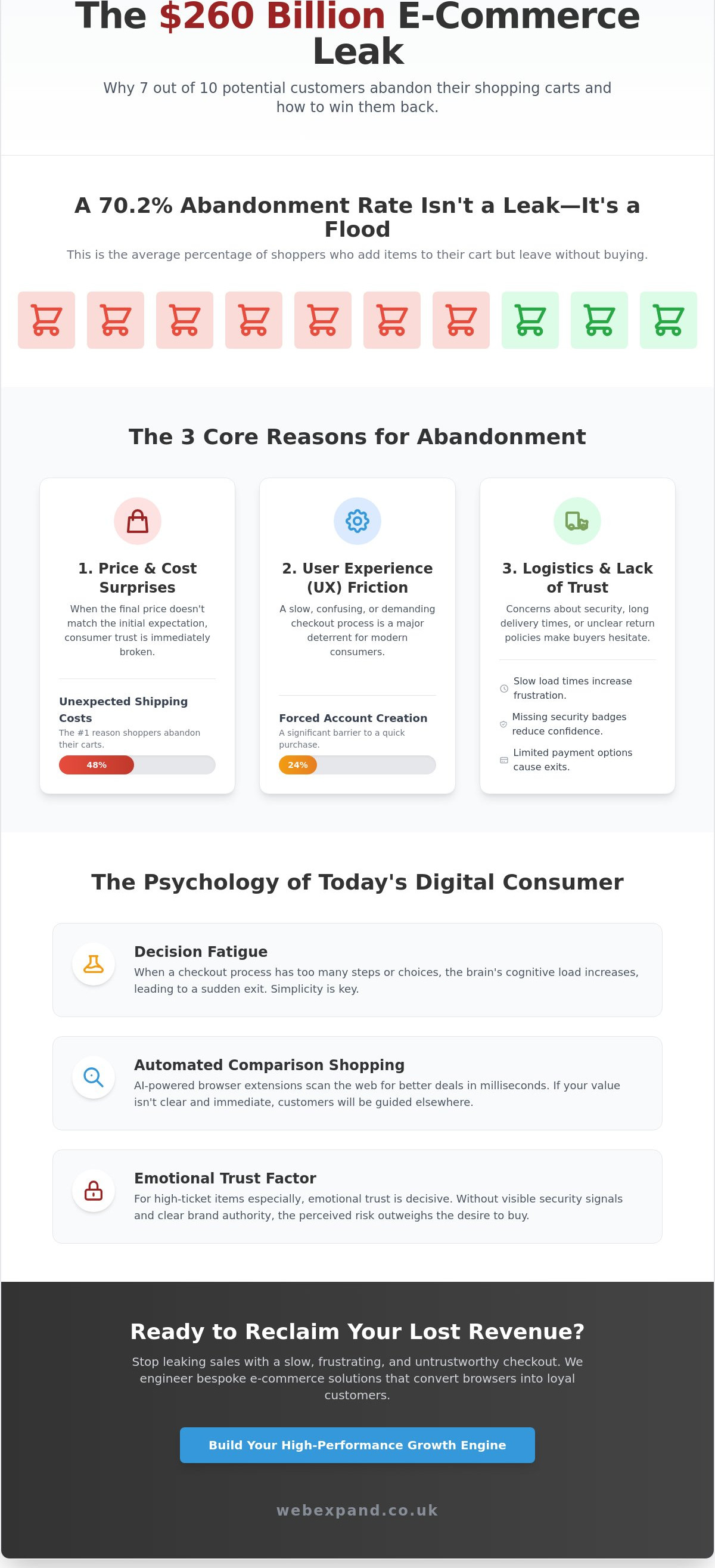
With the average shopping cart abandonment rate sitting at 70.2% in 2026, your e-commerce store is likely losing seven out of every ten potential sales at the final click. This isn’t just a minor leak; it’s a structural failure that leaves an estimated $260 billion in recoverable revenue on the table. We understand how frustrating it is to see customer acquisition costs rise while revenue slips away because of technical friction or hidden costs. Implementing effective strategies to reduce shopping cart abandonment is no longer about minor tweaks. It’s about building a high-performance growth engine that prioritizes user trust and technical precision.
You’ve probably realized that today’s shoppers demand radical transparency and a frictionless experience. We agree that your checkout should be a bridge to industry leadership, not a barrier for your customers. This guide will help you master the technical and psychological tactics required to recover lost revenue and turn hesitant browsers into loyal customers. We’ll explore ten proven solutions, from AI-powered recovery sequences to one-page checkouts, providing a clear roadmap to scale your conversions and dominate your sector.
Key Takeaways
- Identify the primary drivers behind the 70% abandonment rate and uncover the hidden financial impact on your bottom line.
- Implement high-performance strategies to reduce shopping cart abandonment by prioritizing Core Web Vitals and lean, bespoke coding over bulky templates.
- Build immediate consumer trust through radical price transparency and the strategic placement of security certifications to eliminate checkout friction.
- Leverage advanced AI tools to create personalized recovery sequences that turn exit-intent behaviors into successful transactions.
- Understand how a bespoke e-commerce growth engine provides the technical foundation needed to scale and dominate your specific sector.
Understanding the Impact: Why 70% of Shoppers Abandon Their Baskets
In the modern UK e-commerce landscape, cart abandonment is the silent killer of organizational growth. It occurs when a user adds items to their digital basket but exits the site before finalizing the purchase. While some browsers are simply “window shopping” or using the basket as a wishlist, a significant portion of these departures stems from fixable friction. Data shows that approximately 70% of shoppers abandon their baskets, representing a massive gap between consumer intent and successful conversion. For businesses ready to scale and dominate their sector, identifying specific strategies to reduce shopping cart abandonment is the first step toward reclaiming this lost revenue.
The financial reality is sobering. Research indicates that an estimated $260 billion in lost orders are recoverable in the US and EU through better checkout design alone. When you factor in high customer acquisition costs (CAC), every abandoned cart represents a wasted marketing investment and a lower ROI. We view these lost conversions not just as missed sales, but as a leak in your growth engine that needs a precise, data-driven solution. Shoppers in 2026 have zero patience for ambiguity. They expect lightning-fast load times and total price transparency from the first click. If your site feels sluggish or hides costs until the final stage, they’ll simply move to a competitor who offers a more seamless experience.
Distinguishing between “window shopping” and “friction-based abandonment” is vital for your strategy. Window shoppers might never have intended to buy, but friction-based abandoners are customers you’ve already convinced, only to lose them at the finish line. This is where your technical performance and user experience (UX) must be flawless to ensure the journey from browser to buyer is uninterrupted.
The Psychology of the Modern Digital Consumer
Decision fatigue is a real threat to your conversion rates. When a checkout process requires too many steps or presents too many choices, the brain’s cognitive load increases, leading to a sudden exit. This is compounded by the rise of AI-powered browser extensions that have transformed comparison shopping into an automated process. These tools scan the web for better deals in milliseconds, making it easier than ever for customers to leave if they don’t feel they’re getting the best value. For high-ticket e-commerce transactions, emotional trust is the deciding factor. Without visible security signals and clear brand authority, the perceived risk often outweighs the desire to buy, causing the user to hesitate at the final click.
The Three Pillars of Abandonment: Logistics, Price, and UX
Most abandonment issues fall into three distinct categories: logistics, price, or UX design. Identifying which pillar is failing your specific business model is essential for precision targeting. Unexpected shipping costs remain the primary reason for a lost sale, cited by 48% of shoppers. If the final price doesn’t match the initial expectation, the consumer feels misled and loses trust in the brand. UX friction is equally damaging. Forcing users to create an account is a major deterrent, with roughly 24% of shoppers abandoning their carts because of this requirement. By isolating these pain points, you can implement targeted strategies to reduce shopping cart abandonment and streamline the path to purchase, turning hesitant browsers into loyal, long-term customers.
Optimising Technical Performance to Eradicate Checkout Friction
Technical performance is the bedrock of any successful e-commerce growth strategy. If your site stutters at the final hurdle, your revenue stalls. We’ve seen that technical friction is often the silent catalyst behind high bounce rates, making the implementation of precise strategies to reduce shopping cart abandonment a technical necessity rather than a design choice. In 2026, the correlation between Core Web Vitals and checkout success is absolute. Google’s performance metrics, particularly Largest Contentful Paint (LCP) and Interaction to Next Paint (INP), directly mirror the user’s frustration levels. A delay of just one second can lead to a sharp drop in conversions, as the “Buy Now” impulse is incredibly fragile.
To maintain peak performance, bespoke coding consistently outperforms heavy, plugin-laden templates. While off-the-shelf solutions offer convenience, they often introduce unnecessary script bloat that slows down the path to purchase. We advocate for lean, customized architectures that prioritize speed and stability. This technical precision allows you to implement the “Three-Click” rule: a user should never be more than three clicks away from completing their purchase once they’ve reached their basket. Eliminating forced account creation is another critical move. Since 24% of shoppers will abandon their cart if they’re required to register, providing a seamless guest checkout is a standard requirement for industry leaders. While these technical foundations are vital, integrating Advanced Recovery Tactics ensures you have a safety net for when external factors interfere with a transaction.
Mobile-First Design as a Growth Strategy
The mobile abandonment gap is a significant challenge, with mobile abandonment rates reaching 76.98% compared to 64.78% on desktop. Closing this 12.2 percentage point gap requires a dedicated mobile-first approach. We design for “thumb-friendly” navigation, ensuring that large action buttons are placed within easy reach. Form fields must be optimized for mobile keyboards and auto-fill functionality to minimize typing effort. By reducing page weight and optimizing image delivery, we ensure your checkout loads instantly even on standard 4G or 5G networks, protecting your ROI across all devices.
Technical SEO and Site Stability
Site stability is paramount during peak traffic periods. A single script error or a 404 during a high-stakes promotion can devastate your brand authority. We focus on ensuring your checkout remains crawlable and error-free, utilizing server-side optimizations to maintain speed under pressure. This proactive approach to stability ensures that your growth engine never falters. If you’re ready to move beyond generic templates, our team can help you build bespoke website design solutions that are engineered for high-performance conversions and long-term scalability.
Building Radical Transparency and Trust through Design
Transparency isn’t just a moral choice in 2026; it’s a financial imperative for any scaling business. We’ve seen that “sticker shock” remains the primary catalyst for mid-checkout exits, with 48% of shoppers citing unexpected extra costs as their reason for leaving. When you’re developing strategies to reduce shopping cart abandonment, your first priority must be the total elimination of hidden fees. By displaying shipping costs, taxes, and any surcharges on the product page or the initial basket view, you remove the psychological barrier of betrayal that occurs when prices jump at the final payment step.
Trust is built through a combination of technical verification and visual authority. A bespoke website design does more than just look good; it subconsciously validates your brand’s legitimacy. While off-the-shelf templates can feel generic or untrustworthy, a tailored interface signals a commitment to quality and professional standards. For niche services like custom photobook printing, this visual consistency is vital. Integrating social proof directly into the checkout flow is another high-impact tactic. Shoppers who interact with user-generated content, such as authentic reviews or photos, convert at a 161% higher rate than those who don’t. This layer of peer validation acts as a powerful offset to the inherent risk of digital transactions.
Advanced research into predictive analytics for cart abandonment suggests that trust is often lost during the transition from the cart to the payment gateway. To mitigate this, ensure your trust signals are prominent and consistent throughout the entire journey. We recommend placing security seals and payment icons in the footer and directly next to the “Complete Purchase” button to provide constant reassurance.
Visual Trust Signals and Security
Choosing the right security seals is vital for influencing UK buyers. Recognized badges like SSL certifications and industry-specific endorsements provide the technical reassurance hesitant customers need. We also recommend maintaining a professional “About Us” and “Contact” presence that’s easily accessible from the footer. Using clean, jargon-free microcopy guides users through the process without creating confusion or anxiety. This clarity ensures your value proposition remains the focus, rather than the mechanics of the transaction.
Clear Policies as a Conversion Tool
Reframing your returns policy as a “Satisfaction Guarantee” shifts the narrative from a potential problem to a promise of quality. Since 18% of abandonments are caused by unsatisfactory return policies, making these terms explicit before the user enters the funnel is essential. We find that explicit shipping timelines and “No-Hassle” cancellation language significantly reduce pre-purchase anxiety. By positioning your brand as a transparent partner, you build the authority required to turn browsers into loyal advocates and drive long-term organizational growth.
Advanced Recovery Tactics: Beyond the Initial Abandonment
Recovery in 2026 has shifted from reactive follow-ups to proactive, real-time interventions. While previous sections focused on preventing the exit, advanced strategies to reduce shopping cart abandonment involve building a safety net that captures revenue the moment a user wavers. We’ve seen that AI-driven recovery tools now achieve an 8.17% conversion rate, which is double the performance of traditional, template-based systems. By deploying persistent carts, you ensure that a user who begins their journey on a mobile device during a commute can seamlessly complete it on their desktop later. This cross-device continuity is essential for protecting your ROI and maintaining a high-performance growth engine.
Modern recovery isn’t just about sending an email. It’s about using data to understand why the user hesitated. AI-optimized three-email sequences can now recover between 15% and 30% of abandoned carts, a massive leap from the 5% seen with basic programs. These sequences use dynamic send times and personalized product recommendations to re-engage the shopper when they’re most likely to convert. If you’re ready to implement these high-level tactics, our E-commerce Solutions integrate these automated systems directly into your bespoke site architecture.
Personalised Remarketing Strategies
Success in remarketing depends on precision and timing. We recommend segmenting your recovery efforts based on cart value to ensure your margins remain protected. High-value carts might trigger a personalized discount via SMS or a push notification, while lower-value baskets receive a helpful reminder of the items left behind. Crafting subject lines that address the specific pain points of the 2026 consumer, such as highlighting your “No-Hassle” return policy or offering a limited-time free shipping window, can significantly boost open rates and drive immediate action.
The Role of Payment Flexibility
Payment diversity is a powerful conversion lever that many businesses overlook. Providing a variety of digital wallets, such as Apple Pay and Google Pay, can increase your conversion rates by 12% to 15%. In the UK, the “Buy Now, Pay Later” (BNPL) trend has become a standard expectation for larger purchases. Offering BNPL options at checkout reduces abandonment by an average of 20% for orders over £100. By reducing the immediate financial friction and supporting multi-currency transactions, you broaden your horizons and position your brand as a flexible, customer-centric leader in your sector.
Engineering a Bespoke E-commerce Growth Engine with Webexpand
Relying on off-the-shelf templates often places an invisible ceiling on your conversion potential. While generic themes are accessible, they’re built to serve everyone and, consequently, optimize for no one. We believe that true industry leadership requires a platform tailored to your specific operational needs and customer behaviors. Implementing high-level strategies to reduce shopping cart abandonment is significantly more effective when the underlying code is lean, fast, and purpose-built. By moving away from bloated plugins and rigid structures, you gain the agility needed to respond to market shifts and technical trends in real time.
Our approach transforms your digital presence from a simple “website” into a strategic growth engine. A custom-built e-commerce solution doesn’t just look better; it performs better. We ensure that every element, from the navigation structure to the checkout flow, is engineered to minimize friction and maximize trust. This level of precision is what allows businesses to scale without the technical debt that often plagues template-based stores. As your business grows, your platform should evolve with you, supporting increased traffic and complex recovery tactics without sacrificing stability.
Tailored Solutions for UK Businesses
We specialize in providing UK firms with the technical expertise required to dominate their sectors. Our fixed-price development model is designed to ensure you see a measurable ROI from day one, providing clarity and confidence in your investment. We’ve seen how targeted, bespoke changes to a checkout process can lead to double-digit growth in conversion rates for our partners. By offering jargon-free, expert advice, we act as a strategic partner rather than just a service provider, ensuring your progress is the ultimate measure of our performance.
Integrating SEO and Digital Marketing
A high-performance storefront is only effective if it’s visible to your target audience. This is why we ensure your build is intrinsically linked to a strategic digital marketing Kent plan. Visibility and conversion are two sides of the same coin. Your ecommerce website developers London must understand SEO at a fundamental level to ensure that technical performance supports your ranking goals. We recommend requesting a bespoke audit to identify your specific friction points and unlock your store’s full potential. Together, we can build a digital presence that broadens your horizons and secures your place as an industry leader.
Transforming Your Checkout into a High-Performance Growth Engine
Recovering 70% of lost shoppers isn’t just about technical fixes; it’s about a fundamental shift toward transparency and trust. You’ve seen how AI-driven recovery and mobile-first design can bridge the gap between intent and conversion. Implementing these strategies to reduce shopping cart abandonment is the definitive path to reclaiming lost revenue and securing your brand’s authority. By prioritizing the human element alongside technical precision, you transform a hesitant browser into a lifelong customer.
At Webexpand, we’ve been helping UK businesses scale and dominate their sectors since 2004. Our UK-based professional team specializes in fixed-price bespoke development and expert SEO integration, ensuring your platform is a strategic growth engine rather than a technical liability. We’re ready to help you move beyond generic templates and build a tailored solution that truly reflects your ambition. Broaden your horizons and scale your e-commerce store with Webexpand. Your journey toward industry leadership starts with a single, optimized click. We’re excited to partner with you on this transformative journey.
Frequently Asked Questions
What is a good shopping cart abandonment rate for UK e-commerce?
The average shopping cart abandonment rate across all industries currently sits at 70.2%. High-performing stores aim to keep this figure below 65% on desktop and 70% on mobile. Achieving these targets requires a combination of technical precision and radical price transparency. By benchmarking your performance against these 2026 industry standards, you can identify if your current checkout process is a bridge or a barrier to your organizational growth.
How do I calculate my store’s cart abandonment rate accurately?
You calculate your cart abandonment rate by dividing the number of completed transactions by the total number of initiated carts, subtracting that result from one, and multiplying by 100. For instance, if 1,000 users add items to their basket but only 300 complete the purchase, your rate is 70%. We recommend monitoring this metric weekly to identify sudden friction points caused by technical updates or seasonal shifts in consumer behaviour.
Does website speed really affect how many people finish their purchase?
Website speed is a critical driver of checkout success. Even a one-second delay in page load times can lead to a sharp drop in conversion rates because the “Buy Now” impulse is incredibly fragile. In 2026, shoppers expect instantaneous transitions between the basket and the payment gateway. Prioritising Core Web Vitals is one of the most effective technical strategies to reduce shopping cart abandonment and protect your marketing ROI.
Is it better to offer a discount or free shipping to recover a cart?
Free shipping is generally more effective than a percentage-based discount. Since unexpected shipping costs cause 48% of abandonments, eliminating this specific pain point directly addresses the primary reason shoppers leave. For high-value orders, a time-sensitive discount can act as a powerful emotional trigger. We suggest using AI-driven segmentation to offer the most relevant incentive based on the specific contents and value of the abandoned basket.
Can SEO help reduce cart abandonment?
SEO reduces abandonment by ensuring you attract high-intent traffic rather than casual browsers. When your organic strategy targets specific, bottom-of-funnel queries, the users arriving at your site are already prepared to buy. Additionally, technical SEO improvements like faster load times and mobile optimisation directly improve the final checkout experience. Implementing holistic strategies to reduce shopping cart abandonment ensures that the promise made in search results is fulfilled by a seamless purchase journey.
Why should I choose bespoke web design over a template like Shopify?
Bespoke web design eliminates the technical bloat and rigid structures that often limit conversion potential in off-the-shelf templates. Custom-coded solutions allow for precise optimisation of the checkout flow, ensuring every pixel supports your specific business model. While templates offer a quick start, they often require heavy plugins that slow down performance. A tailored platform scales with your ambition, providing the stability and speed required to dominate your sector long-term.
What are the most trusted payment gateways for UK customers in 2026?
UK customers place the highest trust in digital wallets like Apple Pay and Google Pay, alongside established processors like Stripe. Providing these options can increase your conversion rate by up to 15%. Additionally, “Buy Now, Pay Later” (BNPL) services have become a standard expectation for orders over £100. Offering a diverse range of payment methods reduces financial friction and signals that your brand is modern, reliable, and customer-centric.
How many emails should be in an abandoned cart recovery sequence?
An AI-optimised three-email sequence is the gold standard for recovery in 2026. Send the first reminder within an hour of abandonment to capture immediate intent. The second should follow within 24 hours, highlighting social proof or FAQs. The final email, sent at the 48-hour mark, can include a time-sensitive incentive. This structured approach can recover up to 30% of abandoned carts, significantly outperforming basic, single-email recovery attempts.