

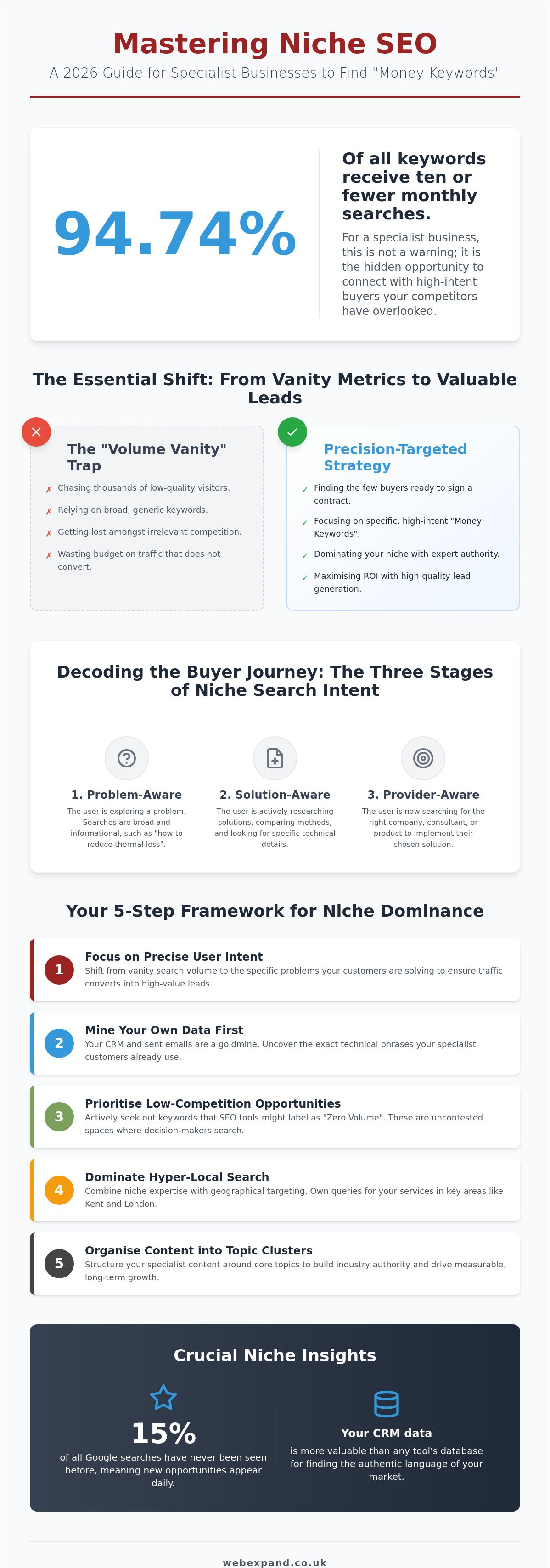
Did you know that 94.74% of all keywords tracked by Ahrefs in 2026 receive ten or fewer monthly searches? For a specialist business, this statistic isn’t a warning; it’s a hidden opportunity. If you’ve struggled with keyword research for my business niche only to find that generic tools return “no data” for your industry, you aren’t alone. You’ve likely felt the frustration of watching your budget disappear into broad search terms that attract curious browsers rather than committed buyers.
We understand that in a specialist market, search volume is often a vanity metric that masks the true value of high-intent leads. This guide will help you move beyond surface-level data to identify the “money keywords” your competitors have overlooked. You’ll learn how to align your digital presence with actual customer behaviour, ensuring your 2026 growth plan is built on precision rather than guesswork. We’ll explore how to navigate AI Overviews, master intent-first research, and transform your SEO strategy into a primary driver of measurable financial performance.
Key Takeaways
- Shift your focus from vanity search volume to precise user intent to ensure your digital traffic actually converts into high-value leads.
- Discover how to mine your own CRM and sent emails to uncover the exact technical phrases your specialist customers are already using.
- Master a structured framework for keyword research for my business niche that prioritises low-competition opportunities over saturated, broad terms.
- Learn how to dominate hyper-local search queries in Kent and London by combining niche expertise with specific geographical targeting.
- Understand how to organise your specialist content into topic clusters to build industry authority and drive measurable growth throughout 2026.
Why Generic Keyword Research Fails Specialist Business Niches
Many business owners fall into the “Volume Vanity” trap. They see a keyword with 10,000 monthly searches and assume it’s the holy grail of digital growth. However, if you run a specialist engineering firm or a boutique consultancy, 10,000 students looking for a basic definition won’t pay your bills. Huge traffic numbers are useless if none of those visitors are actually in your niche. Precision-targeted niche SEO is about finding the five people who are ready to sign a contract today, rather than the five thousand who are just browsing.
Traditional Keyword research often prioritises these broad-market terms because they look impressive on a monthly report. For specialist sectors, this approach is fundamentally flawed. It creates a massive blind spot that hides high-value opportunities. When you conduct keyword research for my business niche, you must look past the aggregate data and focus on the technical nuances of your specific industry. We believe that search volume is a vanity metric; search intent is the only metric that drives a genuine return on investment.
The Problem with Big Data SEO Tools
Mainstream SEO tools aggregate massive amounts of data, but they often fail to capture low-frequency specialist queries. If a term is searched only a few times a month, a tool might report “Zero Volume”. This is where many businesses stop. They see a zero and move on, yet in a niche business, those few searches could represent several multi-million-pound contracts. According to Google data from 2026, 15% of all searches have never been seen before. This means that waiting for a tool to verify a keyword is a losing strategy. You must be the one defining the space. Relying solely on “difficulty” scores in a vacuum is equally dangerous. A “hard” keyword might just be crowded with irrelevant blog posts, whilst an “easy” one could be the exact phrase a high-level decision-maker uses when they’re ready to buy. Your own customer conversations and CRM data are far more valuable than any tool’s database because they reveal the authentic language of your market.
Shifting Your Focus from Traffic to Lead Quality
We define “Money Keywords” as terms that signal a high degree of buyer maturity. When a user searches for a broad term, they’re usually just exploring a problem. When they use specific, technical terminology, they’ve moved from being problem-aware to being provider-aware. This is where the real revenue lives. It requires a shift in mindset to ignore the allure of high traffic in favour of precise, high-intent leads.
At Webexpand, we prioritise Google promotion strategies that target these specific queries. We don’t just want to increase your traffic; we want to broaden your horizons by connecting you with leads that actually convert into long-term partners. A precision-targeted approach ensures that every click has the potential to become a client. By ignoring the vanity metrics and focusing on lead quality, you protect your marketing budget and ensure your digital growth is both sustainable and measurable.
Decoding Searcher Intent in Specialist Sectors
Niche Search Intent is the specific problem a user is trying to solve within a technical or specialist field. Understanding this nuance is the core of effective keyword research for my business niche. In specialist sectors, the buyer journey is rarely a straight line; it’s a layered process of education and validation. We categorise this intent into three distinct stages of awareness: problem-aware, solution-aware, and provider-aware. Each stage requires a different vocabulary to capture the searcher’s attention effectively.
A significant challenge in niche SEO is the “Terminology Gap”. This occurs when there is a disconnect between how your internal experts talk and how your potential clients search. Your lead engineers might use highly technical jargon, whilst a procurement officer or business owner searches for the broader benefit or the specific problem they need to fix. Bridging this gap requires a focus on long-tail keywords. These longer, more specific phrases are the lifeblood of niche business success because they reflect a searcher who is further along the decision-making path and closer to a transaction.
Informational vs. Commercial Intent in Niche Markets
In a specialist B2B environment, an informational “how-to” search can be just as valuable as a commercial one. When a prospect searches for a technical solution to a complex problem, they’re often a high-value lead in the research phase. For example, a query about “reducing thermal loss in industrial kilns” signals a specific pain point that a bespoke engineering firm can solve. By creating content that bridges the gap between a technical problem and your solution, you establish authority early. Following a practical guide to niche keyword research allows you to identify these comparison-based queries where prospects are weighing up technical specifications before reaching out to a provider.
The Role of Semantic Search and LSI Keywords
Google’s 2026 search environment prioritises semantic understanding over simple keyword matching. This means the search engine looks for related entities and industry-adjacent terms to determine if your website is a true authority in your field. To dominate your sector, you must build topical authority by including terms that your customers expect to see. If you provide specialist architectural services, your content should naturally mention planning permissions, sustainable materials, and building regulations. Leveraging tools like Google’s “People Also Ask” feature provides a direct window into the granular questions your audience is asking. If you want to ensure your strategy is aligned with these modern search behaviours, you can speak with our strategic team to map out your intent-based plan.
A Practical 5-Step Framework for Your Business Niche
Generic tools often fail to capture the nuance of specialist markets. To build a strategy that actually converts, you need a process that prioritises precision over broad estimates. This framework moves beyond basic data entry to help you master keyword research for my business niche by looking where your competitors aren’t.
Step 1: Mine your internal data. Start by looking through your “Sent” folder and CRM. The exact phrases your customers use to describe their problems are your most valuable keywords. Step 2: Expand with seed keywords. Use these customer phrases to find niche-adjacent topics. If you sell specialist laboratory equipment, don’t just target the product name; target the regulatory standards or calibration issues your customers face. For a practical example of this approach, you can check out MarGav Solar to see how a renewable energy specialist prioritises technical consultancy needs. Step 3: Map the buyer journey. You must distinguish between technical jargon used by engineers and the benefit-driven language used by procurement officers. This “Technical vs. Layman” mapping ensures you capture both the specialist and the decision-maker.
Step 4: Analyse the SERP for content gaps. Look at the current search results for your technical terms. If the top results are generic or lack depth, you’ve found a gap. Specialist audiences crave detail that generic sites can’t provide. Step 5: Prioritise business value. Forget search volume. If a term is searched twice a month but those searchers are looking for a high-value contract, that keyword is a priority. We focus on identifying these high-stakes opportunities to ensure your digital growth is tied directly to your bottom line.
Qualitative Research: Listening to Your Customers
Your best keyword researchers are your front-line staff. They hear the sales objections and the frequently asked questions that never appear in a global database. Turning a common sales objection into a detailed technical guide is a powerful way to capture high-intent traffic. When you address the specific hurdles that prevent a sale, you aren’t just attracting visitors; you’re pre-qualifying leads. This qualitative approach ensures your keyword list is grounded in the reality of your market behaviour rather than abstract statistics.
Competitor Intelligence for Niche Markets
In specialist sectors, your real competitors aren’t always other businesses. You often face “Ghost Competitors”, such as industry publications or information-only sites that rank for your target terms. By analysing their content, you can see exactly what your target audience is reading. Use tools to examine the backlink profiles of these niche leaders. This often reveals untapped keywords and industry-specific forums where your audience is active. Identifying what your competitors don’t want to talk about, such as specific technical limitations or pricing structures, allows you to position your brand as the transparent authority in the field. This level of insight is essential for those ready to scale and dominate their sector through bespoke digital strategies.
Localising Niche Research for Kent and London Businesses
For businesses operating in specialist sectors, geography is often the final piece of the puzzle. Whilst your expertise might be national, your most profitable leads often come from your own doorstep. The combination of “Service + Location” remains the most potent formula when conducting keyword research for my business niche. It bypasses the noise of global competition and places your brand directly in front of prospects who value proximity and local accountability. By narrowing your focus, you don’t just gain visibility; you gain the right kind of visibility.
To dominate SEO in Maidstone or other commercial hubs, you must target hyper-local niche queries. This isn’t just about adding a town name to a service page. It involves understanding how local search intent differs from national interest. A prospect in Kent looking for “specialist industrial cooling systems” has different logistical concerns than someone searching for the same thing in the north of England. Addressing these local nuances through your Google Business Profile and location-specific content builds a layer of trust that national giants struggle to replicate. You’re no longer just a service provider; you’re a local expert with national-level authority.
For a real-world example of how a specialist trade business maintains this local authority while showcasing technical expertise, you can check out Jelvis to see their approach to domestic and commercial electrical services in the South East.
Targeting the Kent and London Corridor
Many firms operate from Kent whilst serving the lucrative London market. This requires a dual-layered keyword strategy that bridges the gap between Kent-based operations and London-based clients. You can use “Kent” and “Maidstone” modifiers as your base, but avoid sounding repetitive by focusing on the benefits of your location. For example, a specialist firm in Sevenoaks can outrank national giants by highlighting their rapid response times to London sites or their deep understanding of South East planning regulations. This approach allows you to capture high-value queries without getting lost in the saturated London search results. It’s about being the big fish in a precisely defined pond.
Local Search Intent vs. National Authority
Deciding when to use a local landing page versus a national blog post is a critical part of your strategy. If a keyword has clear local intent, such as “bespoke engineering Kent”, it deserves a dedicated landing page that speaks directly to that audience. Conversely, a technical blog post on industry trends builds your national authority. Local citations and consistent NAP (Name, Address, Phone number) data play a huge role in niche keyword rankings, signaling to Google that you’re a legitimate entity within your region. Integrating these elements with Bespoke Web Design in Kent ensures that your site isn’t just a brochure, but a high-performance growth engine designed to capture conversion-ready traffic.
If you’re ready to align your local presence with your niche expertise to drive genuine growth, contact our team today to discuss a tailored search strategy.
Executing Your Niche Strategy: From Research to Revenue
Identifying the right terms is only the first step. To transform keyword research for my business niche into measurable revenue, you must organise your findings into a logical structure known as topic clusters. This involves creating a comprehensive pillar page for your core service and surrounding it with granular, technical articles that answer specific customer questions. This approach doesn’t just help search engines understand your site; it guides your prospects through a structured journey from problem awareness to provider selection.
A template-based site often fails to support the complex information architecture required for specialist sectors. This is why Bespoke Website Design is essential. You need a platform that can house technical diagrams, case studies, and regulatory information whilst maintaining a seamless user experience. In the 2026 search landscape, where AI Overviews appear in 25% to 47% of tracked queries, your site must provide clear, structured data that AI can easily interpret and credit. Success is no longer about raw traffic. We focus on tracking qualified leads, ensuring that every visitor has the potential to contribute to your organisational growth.
Building Topical Authority
Topical authority is built through the strategic interlinking of your content. By linking supporting articles back to your main pillar page, you distribute “ranking power” across your entire site. This signals to Google that you meet the high standards of E-E-A-T (Experience, Expertise, Authoritativeness, and Trust) required in specialist fields. In an era where 68% of searches often end without a click, your content must be so authoritative that users feel compelled to click through to your site for the full technical solution rather than relying on a brief AI summary.
Partnering with a Strategic SEO Agency
Niche businesses rarely benefit from standardised marketing packages. You need a strategic partner who understands the human element of business development as well as the data. We pride ourselves on delivering jargon-free, data-backed growth that respects the technical complexity of your industry. Our goal is to broaden your horizons and help you dominate your sector through a customised approach. If you’re ready to turn your specialist knowledge into a primary driver of financial performance, contact us for a tailored SEO audit and let’s begin your transformative journey toward industry leadership.
Secure Your Sector Dominance in 2026
The shift toward intent-first search behaviour in 2026 demands a more sophisticated approach than generic tools provide. By focusing on the technical language of your specific market and bridging the gap between national authority and local visibility, you position your business to capture high-value leads that competitors often miss. Effective keyword research for my business niche is no longer about chasing raw traffic; it’s about building a digital presence that reflects your deep industry expertise and drives measurable financial performance.
Since our establishment in 2004, we’ve spent over 20 years refining our technical expertise to help local Kent trades and national firms scale their digital presence. We deliver a jargon-free, results-driven approach that prioritises your organisational growth over vanity metrics. If you’re ready to move beyond standardised packages and embrace a transformative journey toward industry leadership, our team is here to act as your strategic partner. We possess the data and the human insight required to turn technical searches into genuine revenue streams.
Book your bespoke SEO strategy session with Webexpand today and let’s broaden your horizons together. Your journey toward market leadership starts with a single, data-backed step.
Frequently Asked Questions
How do I find keywords if my niche has very low search volume?
You should mine your own customer communications, internal CRM data, and specialist industry forums rather than relying solely on global databases. These sources reveal the authentic language your clients use when they’re ready to buy, even if mainstream tools show “zero volume”. Qualitative research often uncovers high-value phrases that generic software misses because the terms are too specific or technical for aggregate data sets to capture accurately.
Is it worth targeting keywords with only 10 to 20 searches a month?
Yes, targeting low-volume keywords is often the most profitable strategy for a specialist business. A search query with only 10 monthly hits usually signals a highly specific need from a prospect who is deep within the buyer journey. These individuals aren’t just browsing; they’re looking for a precise solution, making them far more likely to convert into a high-value lead than someone using a broad, high-volume term.
How long does it take to rank for niche keywords in Kent?
You can typically see measurable results for local niche keywords within three to six months, depending on your domain’s current authority. Whilst national terms can take longer to move, targeting specific geographic areas like Maidstone or Sevenoaks allows you to gain traction much faster. Consistent publishing of high-quality, technical content combined with local citations will accelerate this process and help you outrank national competitors who lack local relevance.
Should I use technical jargon or simple language in my niche keywords?
You must use a strategic combination of both to capture different decision-makers within your target organisations. Engineers and specialists often search using technical jargon, whilst procurement officers or directors might use simpler, benefit-oriented language. Mapping your keyword research for my business niche to both audiences ensures you capture the initial technical researcher and the final budget holder, covering the entire specialist sales cycle effectively.
What are the best free tools for niche keyword research in 2026?
Google Search Console and the “People Also Ask” feature remain the most effective free resources for uncovering niche insights. These tools provide direct data on how users are currently finding your site and the specific questions they’re asking. Additionally, niche-specific forums and communities offer a window into the real-world problems your audience is trying to solve, providing raw data that paid platforms often filter out or overlook.
How do I know if a niche keyword is too competitive for my small business?
You can gauge competition by analysing the search engine results page to see if the top results are dominated by massive industry publications or generic directories. If the results lack technical depth or don’t directly address the specific query, there’s a clear opening for your expert content. Small businesses can dominate these spaces by providing the detailed, authoritative information that larger, more general sites simply cannot match.
Can I use the same keywords for SEO and Google Ads in a niche market?
You can use the same keywords, but your strategy for each should differ based on the searcher’s immediate intent. Paid ads are highly effective for capturing “provider-aware” prospects who need to buy immediately, protecting your brand from competitors. SEO is better suited for building long-term topical authority across the entire journey. Combining both allows you to dominate the search results for your most valuable niche terms whilst building organic momentum.
How often should I update my niche keyword research?
You should review your keyword research for my business niche at least every six months to stay ahead of shifting industry trends and technological changes. In fast-moving sectors, new technical standards or regulatory updates can create entirely new search behaviours overnight. Regular audits ensure your content remains relevant and continues to address the evolving pain points of your specialist audience as we move through 2026 and beyond.