

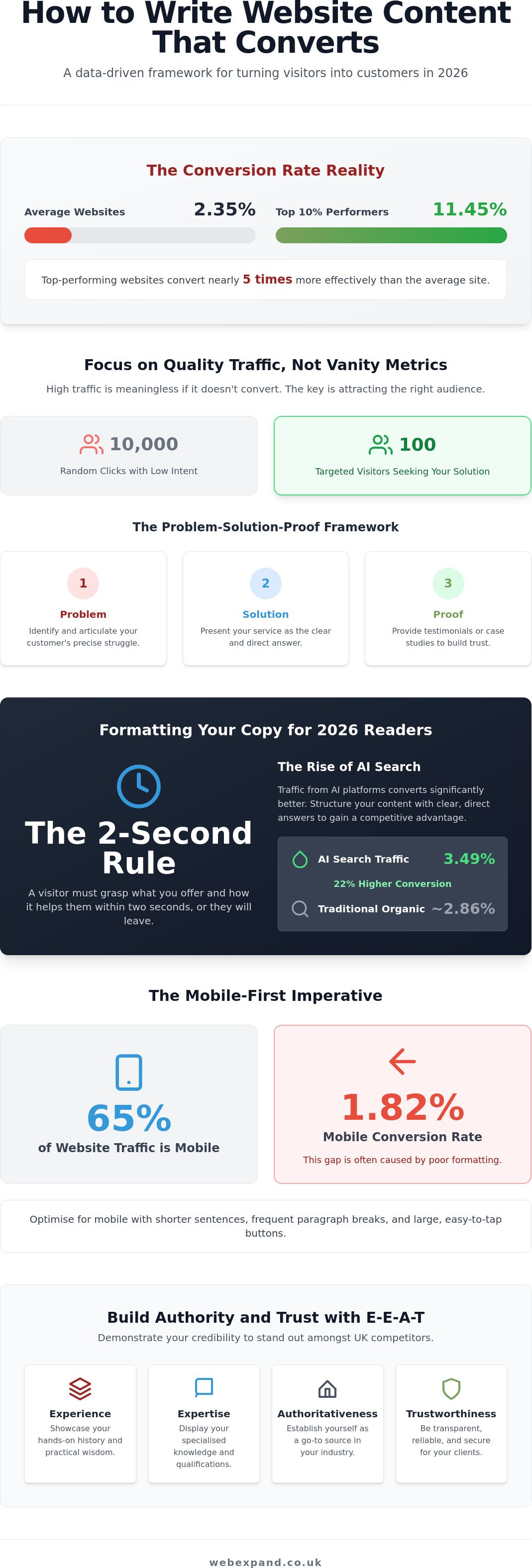
Did you know that while the average website only converts at 2.35%, the top 10% of performers are reaching rates of 11.45% or higher? If you’re currently watching your bounce rates climb whilst your enquiry volume stays flat, you aren’t alone. Many UK business owners feel the sting of spending a marketing budget on ads that don’t deliver a return. The disconnect often lies in a misunderstanding of how to write website content that converts in a market that demands more than just keywords.
We understand that balancing technical SEO with persuasive copywriting feels like a constant battle. You want to rank, but you also need to build trust. This strategic guide provides the exact framework you need to turn casual visitors into loyal customers. We’ll show you how to fix your copy using 2026 data, including why AI search traffic is now converting 22% better than traditional organic search according to Digital Applied. By the end of this article, you’ll have a clear plan to dominate your sector and secure better quality leads from Maidstone and beyond.
Key Takeaways
- Understand why prioritising targeted traffic over vanity metrics is essential for increasing your conversion rates.
- Learn how to structure your copy to pass the “2-second rule” and prevent potential leads from bouncing.
- Discover how to leverage local E-E-A-T to build authority and trust amongst your UK competitors.
- Master the framework of how to write website content that converts by balancing technical SEO with strategic, user-focused copy.
- Explore how bespoke design and high-quality copywriting work together to drive measurable growth for your business.
Why Traffic is a Vanity Metric: The Psychology of Conversion
Many businesses find themselves trapped in the “traffic trap”. They celebrate rising visitor numbers in their analytics whilst their bank balance remains static. High traffic is a vanity metric if it doesn’t lead to measurable outcomes. Understanding how to write website content that converts starts with a psychological shift: moving your focus from attracting eyes to inspiring action.
For a local firm, 100 targeted visitors are far superior to 10,000 random clicks. If you operate in Kent, you don’t need global reach; you need local relevance. Those 100 people are looking for a specific solution to a specific problem. If your copy fails to address their needs immediately, they will bounce. We use the “Problem-Solution-Proof” framework to guide users through this journey. First, identify their struggle. Second, present your service as the answer. Third, provide the proof through case studies or testimonials to remove the risk of enquiry.
Conversion-led content is the bridge between curiosity and commitment. It identifies “friction points”, such as vague calls to action or confusing service descriptions, and replaces them with clarity and momentum.
Identifying Your Ideal Customer’s Pain Points
Stop writing about what you do and start writing about what you solve. Your customers don’t care about your internal processes; they care about their own results. Use common enquiries and feedback to fuel your content strategy. If clients always ask about lead quality, make that a focal point of your copy. Distinguish between features and benefits clearly to help users see the value in your offering:
- Feature: We offer bespoke web design in Kent.
- Benefit: You get a high-performing digital platform that generates consistent enquiries.
The Shift from Persuasion to Problem Solving
The traditional “hard sell” often fails for professional services in the UK. Modern buyers are savvy and research-heavy. They don’t want to be persuaded; they want to be helped. By positioning your business as an expert guide rather than a pushy salesperson, you build the trust necessary for a long-term partnership. When you master how to write website content that converts, you aren’t just selling a service; you’re offering a transformative journey toward industry leadership. This approach ensures your digital presence acts as a silent partner in your business growth.
Mastering the Structure: Formatting Your Copy for 2026 Readers
Mastering how to write website content that converts begins with understanding that your layout is just as important as your language. The 2-second rule is the ultimate test for your digital presence. If a visitor cannot grasp exactly what you offer and how it helps them within two seconds of landing, you’ve likely lost them. Modern readers don’t digest every word; they scan for relevance. This is why “walls of text” are the fastest way to kill your conversion rate. To combat this, we use “bucket brigades”—short, punchy phrases like “Here’s the kicker” or “But that’s not all”—to maintain reading momentum and pull the user down the page.
In 2026, structuring your content isn’t just for humans; it’s for Answer Engine Optimisation (AEO). With traffic from AI platforms like ChatGPT and Perplexity converting at 3.49%—which is 22% higher than traditional organic search—your copy must be structured for AI-driven discovery. This involves providing clear, direct answers to specific questions within your text. When you understand how to write website content that converts for both humans and AI assistants, you gain a significant competitive advantage over businesses stuck in the past.
The Hierarchy of High-Converting Pages
Your H1 header must promise a result. Instead of “Accountancy Services”, try “Reduce Your Tax Burden with Expert Accountancy”. Your H2s and H3s should then act as a roadmap, answering the reader’s internal “Yeah, but…” questions. Bold text and bullet points aren’t just decorative; they’re visual cues that guide the eye to the most important data. If you’re struggling to structure your message effectively, our team can help you refine your digital strategy.
Writing for Mobile-First Users in Kent
Mobile devices account for 65% of website traffic, yet they convert at only 1.82%. This gap is usually due to poor formatting. For Kent businesses, mobile-first design is non-negotiable. Screen size dictates shorter sentences and frequent paragraph breaks. Ensure your primary value proposition and call-to-action are “above the fold”. Buttons must be large enough to tap whilst on the move, ensuring a seamless experience for a customer in Maidstone or London.
The E-E-A-T Factor: Building Local Authority Amongst UK Competitors
In 2026, Google’s emphasis on E-E-A-T (Experience, Expertise, Authoritativeness, and Trustworthiness) has shifted from a suggestion to a survival requirement. Following the March 2026 core update, the “Experience” component has become a primary ranking differentiator. For a UK business, this framework is the backbone of how to write website content that converts. It’s no longer enough to claim you’re the best; you must provide evidence that both search engines and local customers can verify. Trust is the currency of the digital economy, and E-E-A-T is how you earn it.
If you’re a tradesman in Maidstone or a consultant in Sevenoaks, your copy should reflect your physical presence. Mentioning local landmarks or specific Kent-based case studies grounds your business in reality. This isn’t just for SEO. It tells a potential lead that you understand the local market and are physically accessible. Whilst technical expertise is essential, using overly complex jargon can actually damage trust. Clear, jargon-free advice shows you value the customer’s understanding, positioning you as a helpful expert rather than a distant corporation.
Integrating social proof is equally vital. The Digital Markets, Competition and Consumers Act 2024 (DMCCA) now mandates strict transparency regarding online reviews, with the CMA actively enforcing rules against misleading endorsements. Ensure your testimonials are genuine and placed strategically near your service descriptions. This provides “social proof” at the exact moment a user is considering an enquiry, reducing the perceived risk of reaching out.
Demonstrating Real-World Experience
Building Trust Through Transparency
Transparency is a powerful conversion tool. Be honest about who your service is not for; this filters out poor-quality leads and increases the confidence of your ideal customers. Avoid “over-optimised” keywords that make your copy sound like it was written by a robot. Instead, focus on natural language and ensure your contact page is always just one click away. This accessibility proves you’re a real organisation ready to support your clients’ growth. When you master how to write website content that converts, you create a narrative of reliability that competitors simply cannot match.
Strategic CTAs: Guiding Visitors from Interest to Enquiry
If your website content is the engine, your call-to-action (CTA) is the steering wheel. Without it, your visitors are simply idling. Every single page on your site must have a primary objective and a clear next step. When learning how to write website content that converts, you must distinguish between ‘Hard’ CTAs and ‘Soft’ CTAs. A hard CTA, such as ‘Enquire Now’ or specialised AI booking for hunting guides, is designed for users at the decision stage of their journey. Conversely, a soft CTA like ‘Download our Guide’ caters to those still in the awareness or consideration phase. Matching your request to the user’s current mindset is the difference between a conversion and a bounce.
Reducing the fear of the unknown is a critical part of this process. We recommend the ‘What Happens Next’ technique. By briefly explaining what occurs after they click; for instance, ‘We’ll call you within 24 hours to discuss your goals’, you remove the friction caused by uncertainty. This transparency builds the trust we discussed previously when exploring E-E-A-T. It ensures the user feels in control of the interaction from the very first click.
How to Write Compelling Button Text
Move beyond generic commands like ‘Submit’ or ‘Click Here’. These words describe an action, not a benefit. Instead, use language that promises a result. ‘Get My Free Audit’ or ‘Start My Kent Growth Journey’ are far more enticing because they focus on what the user gains. Whilst urgency and scarcity are powerful tools, use them with precision. Avoid the high-pressure tactics of a ‘solar cowboy’ and instead focus on genuine time-sensitive opportunities or limited availability for bespoke consultations.
Placement and Frequency of CTAs
User behaviour studies consistently highlight the ‘Z-Pattern’ and ‘F-Pattern’ of reading. Use these insights to place your links where eyes naturally land. Don’t wait until the very bottom of a long article to ask for an enquiry. Mid-article CTAs capture readers whilst their interest is at its peak. Understanding how to write website content that converts requires a data-backed approach to user journey mapping. Strategic internal linking to our SEO services Kent helps deepen engagement by showing the breadth of our expertise. If you’re ready to transform your digital presence into a lead-generating machine, contact our experts today to begin your journey.
The Webexpand Approach: Tailoring Content for Kent Growth
At Webexpand, we view digital growth as a holistic journey where every element of your site must work in harmony. Learning how to write website content that converts is a vital skill, but that copy needs a high-performance framework to truly excel. We don’t just deliver text; we build the technical and visual structures that allow your message to resonate with your target audience. Our approach is built on the belief that your progress is the ultimate measure of our own performance, positioning us as a strategic partner in your business development.
We act as an ambitious guide for businesses ready to scale and dominate their sector. By staying ahead of technological shifts like Answer Engine Optimisation and Google’s evolving E-E-A-T standards, we protect our stakeholders’ interests. This forward-thinking strategy ensures your digital presence remains a powerful asset long after the initial launch. We combine technical precision with a clear focus on measurable outcomes, moving your business toward industry leadership through a data-backed 2026 digital strategy.
Why Design and Content Must Be Organised Together
Template-driven sites often force your message into rigid, pre-defined boxes. This restricts your ability to communicate your unique value proposition. In contrast, bespoke web design amplifies your voice by building the interface around your specific narrative. We organise every element to lead the user naturally toward an enquiry, ensuring the visual hierarchy matches the psychological journey we’ve mapped out. Technical performance is equally critical. A site that loads slowly will lose a reader’s attention before they’ve even processed your first headline. By prioritising speed and mobile responsiveness, we ensure your high-quality copy has the stage it deserves to perform.
Ready to Broaden Your Online Horizons?
Our commitment to jargon-free advice ensures that firms in Maidstone and London receive clear, actionable strategies without the confusion of corporate fluff. We believe the synergy between SEO services Kent and expert copywriting is what separates market followers from sector leaders. We help you identify and dominate your local market by combining sophisticated search strategies with the human-centric principles of how to write website content that converts.
Transparency is at the heart of our professional values, which is why we offer fixed-price clarity for your digital investment. This transformative journey is about more than just maintenance; it’s about broadening your horizons and securing a competitive edge. Contact Webexpand today for a results-driven content strategy that turns your website into your most effective lead-generation tool.
Dominate Your Sector with Conversion-Led Copy
Refining your digital presence is no longer just about visibility; it’s about establishing authority. We’ve explored how prioritising the user journey and mastering the E-E-A-T framework can transform your engagement levels. By moving beyond vanity metrics and aligning your structure with 2026 search behaviours, you position your brand for sustainable growth.
Understanding how to write website content that converts requires a blend of psychological insight and technical precision. Since 2004, Webexpand has built a reputation for delivering jargon-free advice that helps businesses broaden their horizons. As specialists in bespoke web design for Kent and London firms, we’ve refined our expertise in local SEO and Google promotion since 2008 to ensure our partners stay ahead of industry shifts.
Your journey toward industry leadership starts with a single strategic step. Book your free digital strategy consultation with Webexpand to see how we can turn your visitors into loyal customers. Let’s work together to build a digital platform that truly reflects your ambition and drives measurable results.
Frequently Asked Questions
How long should a blog post be to convert readers?
Quality always outweighs quantity when considering how to write website content that converts. Whilst long-form articles of 1,500 to 2,500 words often dominate search rankings, a concise post of 500 to 800 words can be more effective for driving immediate action on a specific service. Focus on providing a complete solution to the reader’s problem rather than hitting an arbitrary word count that might dilute your message or increase your bounce rate.
Do I need to be an expert writer to create good website content?
You don’t need to be a professional novelist to produce high-performing copy; you simply need to be an expert in your field. Authenticity and first-hand experience are the primary drivers of trust in 2026. If you can clearly explain how you solve a customer’s problem and provide evidence of your success, you’re already ahead of most competitors. Clarity and transparency will always outperform complex, over-engineered prose that feels cold or corporate.
How often should I update my website content for SEO?
Reviewing and updating your core service pages at least once every quarter ensures your information remains accurate and relevant. Search engines reward “content freshness”, particularly when you add new case studies or update statistics to reflect current market conditions. Regular audits allow you to identify underperforming sections and refine your approach based on real user behaviour data, keeping your digital presence ahead of the competition and ensuring your links remain active.
What is the most important part of a high-converting landing page?
Your primary value proposition is the most critical element of any landing page. This headline must immediately communicate the specific benefit your customer will receive and why they should choose you over a competitor. If your headline fails to grab attention within the first two seconds, the rest of your copy won’t even be read. Ensure this message is supported by a clear, benefit-driven call to action that reduces the user’s perceived risk.
Should I use AI to write my website content in 2026?
AI should be used as a collaborative tool for structuring and brainstorming rather than a total replacement for human expertise. Following the 2026 Google updates, “Experience” is a vital ranking factor that AI simply cannot replicate. To ensure you know how to write website content that converts, you must infuse your copy with real-world examples, local Kent knowledge, and the unique personality that defines your brand’s commitment to its clients.
How do I measure if my content is actually converting?
Tracking your conversion rate and total enquiry volume is the only way to measure true success. Whilst metrics like bounce rate and time on page provide helpful context, they are secondary to the number of visitors who actually complete your desired action. Use tools like Google Analytics 4 to set up specific conversion goals, allowing you to see exactly which pages are driving growth and which require further optimisation to improve your ROI.
Is local SEO different from regular SEO when writing copy?
Local SEO requires a specific focus on geographic relevance and community trust signals that national campaigns often overlook. When writing for a Kent or London audience, you must incorporate local landmarks, regional case studies, and specific local pain points. This grounded approach builds immediate rapport with your neighbours, proving that you aren’t just a faceless entity but a dedicated local partner invested in the region’s success and professional development.