

If 94% of first impressions are tied to design, why do so many UK businesses treat their project requirements like a last-minute shopping list? You’ve likely felt the frustration of an agency not getting your brand or feared the scope creep that turns a modest budget into a financial drain. Translating ambitious business goals into technical specs shouldn’t feel like learning a second language. Learning how to write a web design brief is the single most effective way to protect your investment and scale your digital presence.
We agree that the fear of overpaying for unnecessary features is a valid concern in a competitive market. This guide promises to show you how to craft a professional brief that eliminates jargon, secures fixed-price quotes, and ensures your new website drives measurable growth. We’ll preview the essential 2026 strategy, from navigating the Data (Use and Access) Act 2025 to meeting WCAG 2.2 standards. You’ll discover how to align your commercial objectives with a site that ranks on Google and converts visitors into loyal clients. It’s time to stop settling for standard packages and start building a bespoke solution that reflects your professional behaviour and broadens your horizons.
Key Takeaways
- Define your project’s “single source of truth” to ensure your commercial goals and technical requirements remain perfectly aligned throughout the development process.
- Discover how to write a web design brief that effectively eliminates technical jargon and allows you to secure accurate, fixed-price quotes from potential agencies.
- Master the art of integrating SEO objectives and mobile-first design requirements from day one to guarantee your site ranks well and performs for UK users.
- Learn a structured step-by-step process for organising brand assets and sitemaps that turn your unique selling points into a high-converting digital presence.
- Identify the key traits of a strategic partner who can translate your vision into a bespoke website that drives measurable growth and broadens your business horizons.
What is a Web Design Brief and Why Does Your Business Need One?
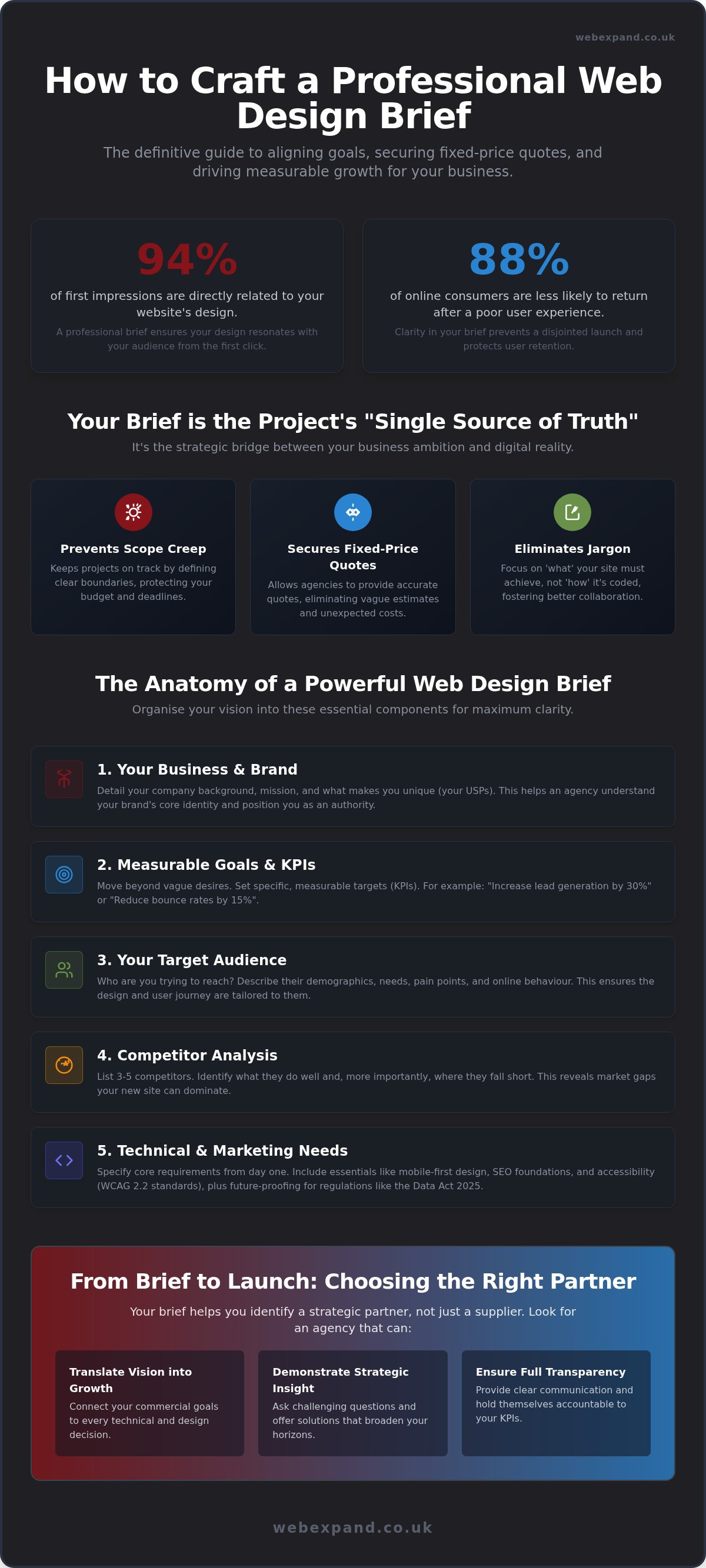
A web design brief is far more than a simple to-do list. It is the foundational document that outlines your project goals, target audience, and technical requirements. Think of it as the “single source of truth” that guides both you and your agency through every stage of development. Essentially, the brief acts as a strategic bridge between your business ambition and digital reality. Mastering how to write a web design brief ensures that your vision isn’t lost in translation as the project moves from concept to code.
Skipping this step is a recipe for disaster. Without a clear outline, projects often succumb to “scope creep,” where features are added haphazardly, leading to missed deadlines and unexpected costs. In a market where 88% of online consumers are less likely to return to a site after a bad experience, you can’t afford a disjointed launch. A robust brief keeps the project on track and protects your budget from the start. It’s the difference between a project that wanders and one that delivers a high-energy return on investment whilst broadening your commercial horizons.
The Benefits of a Precise Project Outline
Precision pays dividends. Knowing how to write a web design brief allows you to set clear benchmarks, ensuring all stakeholders are aligned on the desired outcomes before a single line of code is written. This clarity allows agencies to provide accurate, fixed-price quotes rather than vague estimates that fluctuate later. By documenting your expectations early, you significantly reduce the need for costly revisions during the development phase. This approach transforms the process from a guessing game into a controlled, measurable journey toward industry leadership. It empowers you to hold your digital partner accountable for specific, data-backed results.
Preventing the Jargon Trap
You don’t need to be a developer to lead a successful project. A well-crafted brief allows you to communicate in plain English whilst remaining technically specific. Your focus should stay on “what” the site must achieve for your business, such as increasing lead generation or streamlining e-commerce, rather than the minutiae of “how” it should be coded. This clarity fosters a collaborative emotional style between you and your web design kent partner. By removing the barrier of technical jargon, you position yourself as a strategic partner in the development process. It ensures the final product reflects your brand’s unique identity and professional behaviour, allowing you to dominate your sector without getting lost in procedural complexity.
Core Components: Defining Your Business and Objectives
Every successful digital transformation begins with a clear sense of purpose. When you’re determining how to write a web design brief, you must start with your “Why”. Is the primary goal to generate high-quality leads, sell products directly, or provide a secure portal for existing clients? Clearly defining your company background and unique selling points (USPs) allows an agency to build a site that truly represents your brand’s authority. This section isn’t just about history; it’s about positioning your business as the dominant force in your sector.
Analysing the competition amongst local firms in Kent or London is equally vital. Don’t just look at what they do; look for what they’re missing. If competitors in the Maidstone area ignore mobile performance or use confusing navigation, that’s your gap to dominate. Identifying these market weaknesses allows you to position your business as the superior choice from the moment a visitor lands on your page. Understanding how to write a web design brief that addresses these local competitive nuances ensures your site doesn’t just exist but actively competes.
Setting Measurable Goals and KPIs
Ambition requires a roadmap. You must move beyond vague desires for a “pretty site” and focus on tangible outcomes. Aim for specific targets, such as increasing lead generation by 30% or reducing bounce rates by 15%. These success metrics provide a clear benchmark for your digital partner. When objectives are this precise, it’s much easier for an agency to organise the site structure for maximum conversions. Every button, page, and image should serve a specific purpose in achieving these KPIs, ensuring your digital presence is a high-performance growth engine.
Understanding Your Audience Persona
Your website isn’t for you; it’s for your customers. Creating specific personas helps you understand their pain points and how your business provides the solution. Map the user journey from that first Google search click to the final contact form submission. Understanding their behaviour is key to success. For example, whilst your favourite colour might be a bold red, data might suggest that your target audience responds better to a professional, muted palette. Aligning the design with customer expectations ensures a seamless experience that builds trust and encourages repeat visits. If you’re ready to translate these goals into a professional roadmap, you can discuss your project goals with us to get started.
Technical Scope and Digital Marketing Requirements
Technical requirements shouldn’t be a source of anxiety. When you’re determining how to write a web design brief, your focus must remain on the functionality that supports your growth. Whether you need complex e-commerce solutions, integrated booking systems, or secure client portals, these features must be defined early to secure a fixed-price quote. With over 60% of UK web traffic now coming from mobile devices, a mobile-first, responsive design approach is no longer a luxury. It’s a fundamental requirement for any business looking to dominate their sector in 2026. Defining these technical pillars early ensures your digital presence is built on a stable, scalable foundation.
Content management is another critical factor to address. You need to decide how much control you want over your site’s daily updates. Do you have an in-house team to manage blog posts and product listings, or do you require a fully managed service? Specifying these requirements now prevents future operational bottlenecks. Additionally, your brief must address accessibility. Adhering to WCAG 2.2 standards is essential for reaching all potential customers and ensuring your business remains compliant with modern digital expectations. This proactive approach protects your brand’s reputation whilst ensuring your digital presence is inclusive and effective for every visitor.
The SEO-First Briefing Strategy
Integrating SEO services kent from the beginning is the only way to ensure your investment pays off. Most businesses make the mistake of treating search visibility as an afterthought. However, ranking on Google depends heavily on site architecture and performance. Your brief should specify requirements for near-instantaneous loading speeds, as even a one-second delay can reduce conversions by 7%. High-performance website hosting and clean code are the invisible engines of your digital presence. A strategic brief includes a clear plan for Google Promotion and local search visibility from day one, ensuring you don’t just launch a site, but a lead-generating asset.
Functional Deliverables and E-commerce
Functional deliverables must be precise to avoid the jargon trap. If you’re building an online store, define your payment gateways, shipping rules, and product management workflows in plain English. You should also consider how the site will interact with your existing tools, such as CRMs, social media feeds, or email marketing platforms. Decide whether you require a completely bespoke design or if a tailored, high-quality solution meets your needs. This level of detail in your brief ensures that your chosen partner understands the full scope of your ambition. It prevents the technical “black box” and keeps the conversation focused on measurable outcomes rather than procedural complexity, allowing you to scale with confidence.
How to Write Your Brief: A Step-by-Step Process
Transitioning from strategic vision to a tangible document requires a structured approach. When you sit down to determine how to write a web design brief, begin by gathering your existing brand assets. This includes high-resolution logos, current website performance data, and established brand guidelines. Having these ready prevents delays and ensures your new digital presence remains consistent with your professional identity. You should also conduct a thorough content audit. Identify which existing pages still serve your commercial goals and which require a complete overhaul. This clarity helps your agency understand the true scale of the work required.
Next, draft a preliminary content outline and sitemap. You don’t need to be a designer to visualise the site’s hierarchy. Simply mapping out the primary navigation and how pages connect helps you identify potential user journey bottlenecks early. Once you’ve established this structure, review the document to ensure it is concise and authoritative. A brief that is too long risks burying your core objectives, whilst one that is too short lacks the detail needed for a fixed-price quote. Your goal is a precise roadmap that leaves no room for ambiguity.
Gathering Assets and Inspiration
Inspiration shouldn’t be about copying competitors; it’s about identifying what works for your audience. Create a list of websites you admire, but be specific about why. Is it the intuitive navigation, the use of colour, or the speed of the checkout process? This context is invaluable for your design team. Alongside this, organise your brand guidelines to ensure your unique selling points are front and centre. If you’re planning to scale, identify which new content needs writing from scratch. High-quality imagery and clear brand values are the building blocks of a site that broadens your horizons and dominates your sector.
Budget, Timelines, and Selection Criteria
Transparency regarding your budget is essential for securing a viable solution. By being open about your financial range, you allow agencies to propose the most effective features within your means. Set realistic milestones for feedback, user testing, and your final “go-live” date. This structured timeline creates a sense of momentum and accountability. When evaluating potential partners, look beyond the surface. Review their portfolio to see how they’ve handled similar challenges for other UK firms. A strategic partner should offer more than just a service; they should provide a data-backed roadmap for your success. If you’re ready to start this journey, get in touch with us today to discuss your brief.
From Brief to Launch: Choosing the Right Strategic Partner
Securing a professional document is only half the battle; the real transformation begins when you align with a partner who understands your regional market. For businesses in Kent and Maidstone, local expertise is a significant advantage. A partner with deep roots in the area understands the local competitive landscape and consumer behaviour, ensuring your digital presence resonates with your target audience. When you’ve learned how to write a web design brief effectively, you provide the clarity needed for Webexpand to offer our signature fixed-price certainty. This model eliminates the fear of hidden costs and scope creep, providing you with a transparent financial roadmap from the outset.
Your website is a living asset that requires continuous attention to remain a high-performance growth engine. Beyond the initial build, you must plan for long-term Search Engine Optimisation and consistent site maintenance. A static site quickly loses its edge in a fast-paced market. By integrating these ongoing needs into your initial strategy, you protect your stakeholders’ interests and ensure your site continues to rank on Google and convert visitors. This proactive mindset is what separates industry leaders from those who simply exist online. It’s about moving beyond the build to ensure your investment continues to broaden your horizons for years to come.
The Value of Jargon-Free Expertise
Next Steps: Getting Your Bespoke Quote
The transition from a written document to a bespoke digital solution is an exciting journey toward industry leadership. If you’ve followed our guide on how to write a web design brief, you’re already ahead of the competition. Now, it’s time to turn that vision into a reality. Submit your brief for a comprehensive review, and let’s discuss how we can deliver the results your ambition deserves. We move quickly from identifying your market challenges to presenting data-backed solutions that mirror the fast-paced nature of the professional landscape you inhabit.
Ready to scale? Send us your brief or contact our Maidstone team today to secure your bespoke quote and start your journey toward digital dominance.
Secure Your Digital Future Today
Your digital presence is the engine of your business growth, not just a static brochure. By mastering how to write a web design brief, you’ve taken the first step toward transforming your commercial vision into a high-performance reality. You now understand that a successful project requires clear objectives, a mobile-first technical scope, and a partner who values transparency over technical jargon.
At Webexpand, we’ve spent over 20 years serving businesses across Kent and London with bespoke solutions that prioritise measurable outcomes. We specialise in Google Promotion and SEO-led design, ensuring your site doesn’t just look professional but actively attracts your target audience. Our jargon-free, fixed-price development model provides the financial certainty you need to scale with confidence and dominate your sector.
Don’t let your project stall at the planning stage. It’s time to broaden your horizons and secure a website that works as hard as you do. Get a fixed-price quote for your bespoke web design project and let’s build something exceptional together. Your journey toward industry leadership starts with a single, well-crafted document.
Frequently Asked Questions
How long should a web design brief be?
Aim for a document between three and five pages of concise, high-impact information. It needs enough detail to secure a fixed-price quote but shouldn’t bury your commercial goals in unnecessary fluff. Focus on clarity over volume. A well-structured document ensures your agency understands your unique selling points and professional behaviour without getting lost in procedural complexity or technical jargon.
Do I need to include a budget in my website brief?
Yes, providing a realistic budget range is essential for receiving viable proposals. It allows an agency to recommend the most effective features and bespoke solutions within your financial parameters. Transparency regarding investment prevents wasted time and ensures the proposed strategy aligns with your business’s ability to scale. Without this, you risk receiving quotes that don’t reflect your actual commercial requirements.
What is the most important part of a design brief?
Your primary business objectives and the “Why” behind the project are the most critical elements. Knowing how to write a web design brief that leads with measurable goals ensures every design choice serves a specific purpose. Whether you want to increase leads or streamline e-commerce, these targets act as the benchmark for the entire project’s success and long-term growth.
Can an agency help me write my brief?
A strategic partner should always collaborate with you to refine your requirements. Whilst you provide the business context and USPs, an expert guide can translate those ambitions into technical specifications. This collaborative approach ensures your brief is technically sound and aligned with modern industry trends, such as the Data (Use and Access) Act 2025, whilst protecting your interests from the start.
Should I include a sitemap in the initial brief?
A preliminary sitemap is highly beneficial for visualising the site’s hierarchy and user journey. It doesn’t need to be final, but it helps the agency understand the scale of the content and navigation requirements. Mapping out these pages early reduces the risk of scope creep and helps ensure the site structure is organised for maximum conversions and a seamless user experience.
How do I define my target audience in the brief?
Move beyond broad demographics and create specific user personas that reflect your ideal customers. Identify their specific pain points, professional behaviour, and what motivates them to choose your services over local competitors. Understanding the human element behind the data allows your designer to craft an experience that builds trust and encourages repeat visits from your most valuable audience segments.
What technical requirements must be included for SEO?
You must specify requirements for near-instantaneous loading speeds, mobile-first responsiveness, and clean site architecture. Learning how to write a web design brief that prioritises Search Engine Optimisation from day one is vital for long-term visibility. Include needs for high-performance website hosting and a clear plan for Google Promotion to ensure your site is a high-energy growth engine from launch.
Is a brief necessary for a small business website?
A brief is vital regardless of your business size or project scale. It protects your investment by ensuring you don’t overpay for features you don’t actually need. Even for a simple “brochure” site, a clear outline provides a roadmap for the project and ensures the final product accurately reflects your brand identity whilst broadening your commercial horizons in a competitive market.