

What if your next digital upgrade actually cost you half your organic traffic overnight? For many UK firms, the prospect of planning a website content migration feels less like an opportunity and more like a high-stakes gamble with their hard-earned search rankings. It’s a valid concern, especially when Google holds over 91% of the UK search market and every technical misstep can trigger a visible dip in your bottom line.
You’ve worked tirelessly to establish your digital presence; you shouldn’t have to sacrifice that authority to modernise your platform. We’re here to ensure your transition to a bespoke CMS or a newer version like WordPress 7.1 is a strategic leap forward rather than a recovery mission. This article provides a precision-engineered roadmap to master 301 redirects, content pruning, and technical SEO preservation. You’ll learn how to safeguard your visibility in Maidstone and beyond whilst transforming your site into a high-performance asset ready to dominate the 2026 market.
Key Takeaways
- Identify why pruning your existing assets during a comprehensive audit is the most effective way to improve site speed and user engagement.
- Secure your organic search authority by following a precise technical roadmap for planning a website content migration without losing ranking momentum.
- Shift from restrictive legacy platforms to high-performance bespoke website design to better align your digital presence with evolving UK market trends.
- Minimise operational risk by implementing a rigorous staging and testing workflow that guarantees a seamless transition for your customers and stakeholders.
- Leverage post-launch optimisation strategies, including proactive sitemap management, to ensure your new site scales rapidly and dominates search results.
What is Website Content Migration and Why Does It Matter for Your Growth?
At its core, Content migration is the tactical process of transferring digital assets, such as text, images, and databases, from one system to another. For ambitious UK organisations, it’s far more than a technical housekeeping task. It’s a strategic pivot point where your digital presence evolves from a static brochure into a high-performance engine for growth. We view this as a transformative journey toward industry leadership rather than a mere server move.
In 2026, the landscape has shifted significantly. With Drupal 10 reaching its end-of-life in December and the implementation of the Data (Use and Access) Act 2025, many firms are realising that legacy page builders no longer suffice. Planning a website content migration is now a prerequisite for any business looking to scale within the UK’s £120 billion e-commerce market. It’s the difference between a simple copy-paste job and a strategic technical overhaul that protects your search authority whilst broadening your business horizons.
Identifying the Signs You Have Outgrown Your Current CMS
If your marketing team spends more time fighting the back-end than crafting campaigns, you’ve hit a publishing bottleneck. Outdated platforms often lead to sluggish loading speeds, which directly impacts your mobile user experience in Kent. When you can’t integrate modern SEO tools or complex e-commerce solutions without the system crashing, your platform is officially a liability. Moving toward bespoke website design allows you to strip away the “bloat” of generic templates and build a foundation tailored to your specific commercial goals.
The Business Risks of a Poorly Executed Migration
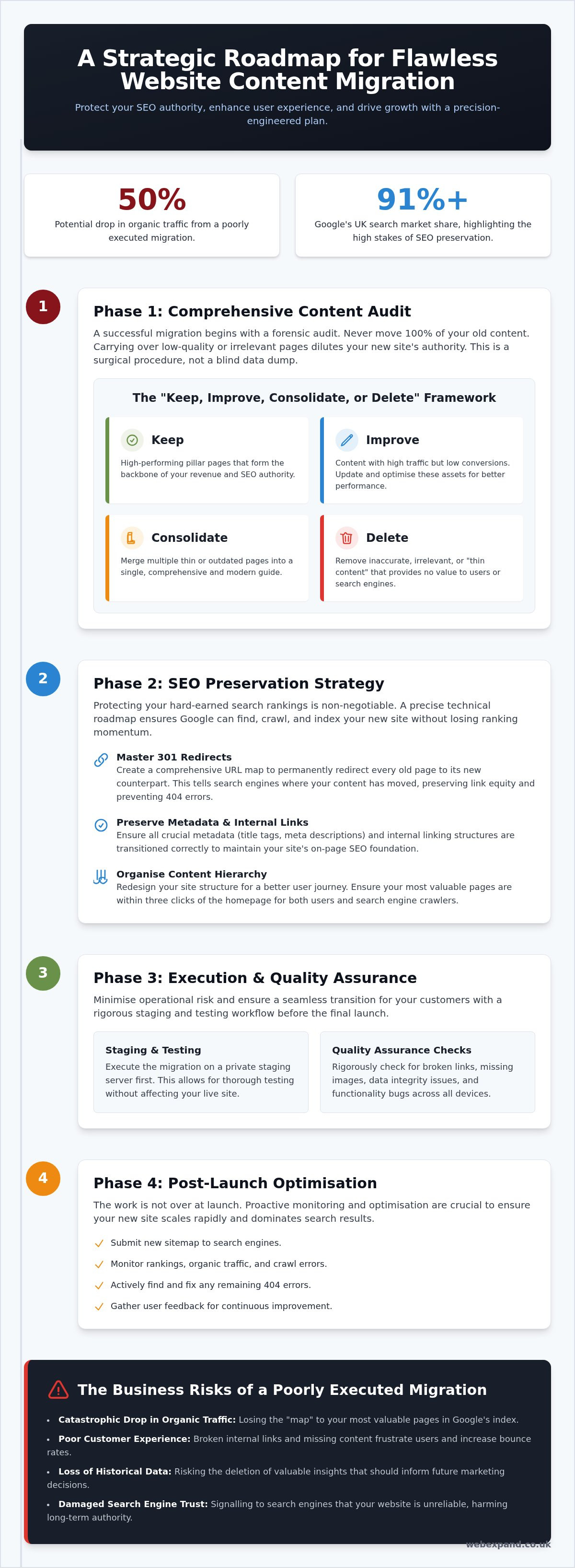
The stakes are incredibly high during this transition. A botched move can result in a catastrophic drop in organic traffic, often because Google loses the “map” to your most valuable pages. Broken internal links frustrate your customers and signal to search engines that your site is unreliable. Perhaps most damaging is the loss of historical data. Without a precise strategy for planning a website content migration, you risk deleting the very insights that should inform your future marketing decisions. We’re here to ensure your move is seamless, protecting every ounce of your hard-earned digital authority.
Conducting a Comprehensive Content Audit: The First Step to Success
Moving to a new platform is the ultimate opportunity to prune for profit. You should never migrate 100% of your old content. Carrying over low-quality or irrelevant pages only dilutes your site authority and slows down your new, high-performance system. A successful project starts with a forensic audit. We use advanced crawling tools to identify every URL, image, and PDF on your current server. This data-driven inventory ensures that planning a website content migration becomes a precise surgical procedure rather than a blind data dump.
We implement a “Keep, Improve, Consolidate, or Delete” framework. Every asset must justify its place on the new site. We evaluate content by cross-referencing search performance with conversion rates. A page might have high traffic but zero leads; this is a candidate for “Improve” or “Consolidate”. Conversely, a high-converting page with low traffic is a “pillar” that needs better visibility in your new architecture. This phase identifies exactly what fuels your revenue and what is merely taking up digital space.
Inventory and Pruning: Deciding What Stays and What Goes
Thin content is a silent killer of SEO. These are pages with little value that distract search engines from your core expertise. During your audit, look for outdated blog posts that no longer reflect your Maidstone brand’s current standards. If a post from 2018 is no longer accurate, delete it or merge it into a modern, comprehensive guide. Protecting your high-performing pillars is non-negotiable. These pages are the backbone of your revenue and must be transitioned with their metadata and internal linking structures intact.
Organising Your Content Hierarchy for Better User Experience
A migration isn’t just a move; it’s a redesign of your customer journey. We map your audited pages to a new, intuitive structure that prioritises ease of use. Your most vital services should always be within three clicks of the homepage. This hierarchy ensures that both users and Google’s crawlers can find your value quickly. If you’re unsure how to categorise your existing assets to maximise growth, we can help you refine your digital strategy. This audit often reveals content gaps where new, bespoke pages are needed to capture emerging market trends. Effective planning a website content migration means building a site that is logically organised for the 2026 search landscape.
SEO Preservation Strategy: Protecting Your Rankings During the Move
SEO is the most fragile component when you are planning a website content migration. Google interprets major site changes as a signal of instability unless you provide a clear, logical path for its crawlers. With 62% of UK searches now triggering AI overviews as of August 2026, maintaining your structured data and E-E-A-T signals is vital. If you lose your technical foundation, you risk disappearing from AI-generated summaries entirely. We ensure your metadata, alt tags, and header tags remain consistent to signal to Google that your authority hasn’t changed, just your digital infrastructure.
Your local SEO signals must remain a priority throughout this transition. If you’ve spent years building authority in the Kent market, your new site must carry over those geo-specific markers. This includes consistent NAP (Name, Address, Phone number) data and local schema markup that tells search engines you’re still the primary choice for Maidstone and London businesses. A successful migration doesn’t just move your content; it preserves your reputation within your specific service areas.
Creating a Robust 301 Redirect Map
A 301 redirect is a permanent instruction to search engines that a page has moved to a new location. These are technically necessary for preserving link equity, which is the SEO value passed from external sites to yours. We create forensic redirect maps that link every old URL to its most relevant new equivalent. This prevents 404 errors and ensures you don’t trap crawlers in infinite redirect loops. Such loops confuse search engines and can lead to your pages being de-indexed, stalling your growth at a critical moment.
Maintaining Metadata Integrity and Internal Linking
Your title tags and meta descriptions act as your digital shop window. Migrating these exactly as they are ensures your click-through rate (CTR) remains stable during the transition. Once your content is moved, we update every internal link to point to the new URL structure immediately. This prevents a chain of redirects that can slow down your site speed and frustrate users. Leveraging SEO services Kent allows you to audit your post-migration link health with precision, catching broken paths before they impact your revenue. Precision in these technical details is what separates a successful move from a costly digital setback.
Executing the Migration: Technical Workflows and Quality Assurance
Execution is the moment where months of planning a website content migration face the reality of technical implementation. You must establish a timeline that avoids disruption to your daily operations. We suggest scheduling the final switch-over during low-traffic periods to minimise risk. Central to this process is the use of a staging environment. This is a secure, non-indexed version of your site where every new feature is stress-tested. It allows us to verify CMS compatibility and performance before your customers ever interact with the new interface.
Effective communication is just as important as technical precision. Your stakeholders and customers should be aware of the transition. Frame the move as a commitment to their user experience, highlighting benefits like faster load times or improved mobile navigation. Whilst automated tools can handle the heavy lifting of data transfer, they lack the eye for detail that a strategic partner provides. Manual oversight ensures that your brand voice and visual standards aren’t lost in the code during the move.
Manual vs. Automated Migration: Which is Right for You?
Automated scripts are efficient for bulk data, such as migrating five years of news archives or massive e-commerce inventories. However, scripts often struggle with complex layouts or custom styling. For your most important service pages, a hand-crafted approach is superior. This level of detail is a hallmark of bespoke web design Kent. Manual migration allows us to ensure that formatting, high-resolution images, and data tables remain consistent and professional across systems. It’s about protecting the human element of your digital presence whilst leveraging technology for scale.
Pre-Launch Testing and Post-Migration Validation
Testing represents your final safeguard against operational failure. We conduct an exhaustive sweep of the staging site to identify 404 errors, missing assets, or broken images. Every functional element must be validated. We test contact forms, search bars, and e-commerce checkout flows multiple times to ensure your revenue streams remain robust. Verification of tracking codes, specifically Google Analytics 4, is non-negotiable. Without correct data collection from day one, you cannot measure the ROI of your move or identify areas for further optimisation. If you’re ready to ensure your technical execution is flawless, book a consultation with our experts to begin your journey.
Beyond the Launch: Optimising Your New Site for Long-Term Performance
The moment your new platform goes live isn’t the final whistle. It’s the beginning of a critical stabilisation period where your digital assets are re-evaluated by search engines. Successfully planning a website content migration requires a post-launch strategy that focuses on rapid indexing and performance validation. You must submit your new XML sitemap to Google Search Console immediately. This action signals to crawlers that your new structure is ready for inspection, accelerating the transition of your rankings from the old URLs to the new ones.
Loading speed is a primary driver of commercial success in 2026. With the UK e-commerce market reaching a valuation of £120 billion this year, every millisecond of latency can impact your bottom line. We use this post-launch window to review site speed and Core Web Vitals on the new platform. A migration provides a rare clean slate; it’s the perfect time to implement more aggressive growth strategies, such as advanced schema markup or enhanced data collection, which may have been impossible on your previous legacy system.
Monitoring Search Rankings and User Behaviour
Vigilance is required during the first month of your new site’s life. We recommend tracking your primary keyword positions in Maidstone and London for at least 30 days post-launch to identify any unexpected fluctuations. Heatmaps are invaluable here. They allow you to see exactly how users interact with your new site architecture, confirming whether your planning a website content migration has actually improved the customer journey. You should also check for “crawl errors” daily in the first week. Catching a rogue 404 error early prevents it from damaging your hard-earned search authority.
How Webexpand Supports Strategic Content Migrations
We’ve been guiding UK businesses through complex technical transitions since 2004. Our approach focuses on removing the stress of migration by providing jargon-free advice that prioritises your organisational growth. We don’t just move your data; we ensure your new site functions as a high-performance growth engine capable of dominating the 2026 market. We act as your strategic partner, protecting your historical SEO value whilst broadening your digital horizons. If you’re ready to move toward a more scalable future, contact our Kent web design team today for expert guidance.
Secure Your Digital Future for 2026 and Beyond
Mastering a seamless transition requires more than just moving data; it demands a strategic overhaul of your digital assets. By prioritising a forensic content audit and implementing a precise 301 redirect map, you protect the search authority you’ve built over years. We’ve seen how planning a website content migration with technical precision turns a potential risk into a transformative catalyst for business scalability. Don’t let technical confusion or fear of ranking loss hold your organisation back from the high-performance platform it deserves.
Since 2004, Webexpand has provided jargon-free, expert advice to Maidstone and London firms ready to scale. We act as your strategic partners in SEO and bespoke web design, ensuring your move is efficient and results-driven. Whether you’re escaping a legacy CMS or upgrading to a modern e-commerce solution, our proven track record guarantees your visibility remains intact whilst your business horizons broaden. Ready to take the next step? Book a consultation with our Kent migration experts to ensure your transition is a resounding success. Your journey toward industry leadership starts with a single, well-planned move.
Frequently Asked Questions
How long does a typical website content migration take for a UK business?
A standard migration usually takes between four and twelve weeks depending on the volume of your digital assets. Smaller professional sites may conclude the process faster, whilst complex e-commerce platforms require more extensive testing. This timeline accounts for the initial audit, the technical transfer, and the vital post-launch validation period required to ensure your business operations remain uninterrupted throughout the transition.
Will my website go offline during the content migration process?
Your current website should remain fully operational throughout the entire process. We build and test your new platform in a secure staging environment that’s hidden from the public and search engines. The final switch happens via a DNS update, which typically results in zero downtime for your users. This approach ensures your customers in Maidstone and London can continue to browse and buy whilst we finalise the move.
Is it possible to migrate content from WordPress to a bespoke CMS?
Yes, transitioning from WordPress to a bespoke solution is a common path for firms that have outgrown template-based limitations. The process involves exporting your database and mapping the information to a more efficient, custom-built architecture. This shift often results in significantly faster loading speeds and better security, providing a more robust foundation for your 2026 growth strategy than standard plugins can offer.
Do I need to change my hosting provider when I migrate my content?
You aren’t strictly required to change providers, but a migration is the perfect time to evaluate your current hosting performance. Bespoke designs often require specific server configurations to deliver the best possible speed and security. If your current host doesn’t meet the technical standards of your new platform, moving to a specialist provider can improve your site’s reliability and user experience immediately after the launch.
How can I ensure my images and videos are migrated without losing quality?
We preserve media quality by using direct file transfers rather than automated scraping tools that can compress or corrupt your files. When planning a website content migration, we verify that your new system handles high-resolution assets correctly. This ensures your visual brand remains sharp and professional. We also take this opportunity to optimise file names and alt tags, which helps maintain your visibility in Google’s image search results.
What happens to my Google rankings immediately after a migration?
It’s normal to see minor, temporary fluctuations in your keyword positions for a few weeks as Google crawls your new structure. However, if your 301 redirects and metadata are handled correctly, your rankings should stabilise or even improve. Planning a website content migration with a focus on technical SEO prevents the catastrophic traffic drops that occur when migrations are rushed or poorly mapped.
Can I change my domain name at the same time as migrating my content?
You can change your domain name simultaneously, but it increases the technical complexity of the move. Changing both your content structure and your URL at once makes it harder to troubleshoot if search rankings fluctuate. If your brand requires a new domain, we recommend a phased approach or an extremely rigorous redirect map to ensure Google understands that your established authority is moving to the new address.
Should I redesign my website at the same time as migrating the content?
Combining a redesign with a migration is often the most cost-effective strategy for UK firms. It allows you to build a site hierarchy that’s perfectly aligned with your current business goals rather than trying to fit old content into a new look later. This ensures your bespoke web design is fully optimised for conversions and user engagement from the very first day your new platform goes live.