

In 2026, the cheapest website you can buy is often the most expensive mistake your business will ever make. While a DIY builder might only cost you £9 per month, a site that fails to rank or convert leads ends up costing you thousands in lost opportunities. Understanding the average cost of a business website 2026 requires looking past the surface to see the precise investment needed for a high-performance growth engine. Whether you’re budgeting £3,000 for a professional brochure site or £75,000 for a mid-market B2B platform, the focus must remain on bespoke architecture that secures your market leadership.
You’ve likely felt the frustration of confusing, jargon-filled quotes or the fear of hidden fees that emerge long after the build is finished. We agree that transparency is vital when you’re ready to dominate your niche. This guide provides a clear budget roadmap for the current UK landscape, covering everything from initial development to strategic expansion costs. You’ll learn the difference between a simple digital placeholder and a strategic asset, including how SEO-led design and headless architecture are redefining ROI this year. We’re here to give you the confidence to choose a partner who treats your growth as the ultimate measure of success.
Key Takeaways
- Shift your strategy from a static digital brochure to a high-performance growth engine that meets 2026 search engine performance standards.
- Understand the average cost of a business website 2026 by comparing investment tiers, from entry-level DIY builders to professional bespoke agency solutions.
- Identify the essential “hidden” drivers of pricing, including baked-in technical SEO architecture and AI automation tools that protect your long-term visibility.
- Apply a data-driven ROI framework to calculate how superior conversion rates on custom sites outweigh the false economy of cheap templates.
- Gain complete budget certainty by moving away from unpredictable hourly billing toward a fixed-price model that focuses on expansion and results.
The 2026 Digital Landscape: Why Website Costs Are Shifting
The average cost of a business website 2026 reflects a fundamental shift in how successful companies view their digital presence. You can no longer afford to treat your website as a “digital brochure,” which is a static page that merely exists to provide contact details. In today’s competitive market, your website must function as a high-performance growth engine. This means moving away from a passive web presence and toward active market expansion. If you focus solely on the initial price tag without defining what the site should achieve, you’re likely to invest in a platform that fails to deliver a measurable return.
The Death of the Template Website
Off-the-shelf templates and themes are increasingly becoming a liability. These pre-built solutions often fail modern Core Web Vitals tests because they’re weighed down by redundant code and rigid structures. When you try to “fix” a cheap template to meet strict SEO requirements, the hidden costs quickly spiral. Following contemporary Web design principles requires a level of flexibility that templates simply can’t provide. Bespoke design is now a prerequisite for high-tier Google rankings, as it allows for the precise optimization of page speed, mobile responsiveness, and technical architecture from the ground up.
Websites as Strategic Assets
Think of your website as a 24/7 salesperson who never sleeps. It’s often the first point of contact for a potential client, making it a critical tool for establishing brand authority. Utilizing bespoke website design ensures that every element of the user experience is tailored to drive action. In 2026, consumer behavior is defined by a demand for speed and precision. Users expect to find exactly what they need in seconds. If your site doesn’t provide a seamless, intuitive journey, they’ll move to a competitor who does. We focus on building assets that don’t just look good but work hard to scale your business and protect your interests in a fast-paced digital landscape.
Decoding the 2026 Price Tiers: From DIY to Bespoke Agencies
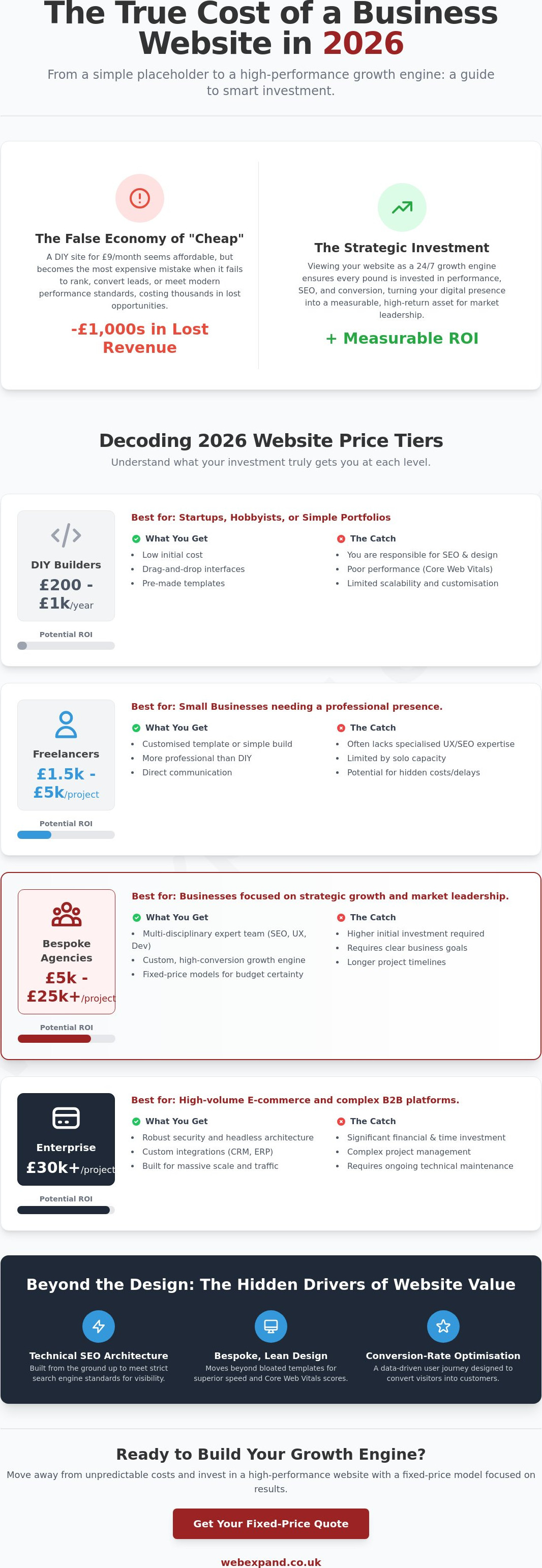
Choosing the right investment level depends entirely on your growth targets and the complexity of your market. The average cost of a business website 2026 spans a wide spectrum, ranging from a few hundred pounds for basic tools to six-figure sums for enterprise platforms. To make an informed decision, you must understand what each tier delivers in terms of performance, scalability, and long-term ROI. Industry data on Website development costs shows that while entry points are accessible, the price of high-performance architecture is driven by the need for technical precision.
- Tier 1: DIY Website Builders (£200 – £1,000/year): These platforms are suitable for startups or hobbyists. This cost includes subscriptions, premium apps, and plugins. While affordable, you’re responsible for the design, SEO, and content.
- Tier 2: Freelance Developers (£1,500 – £5,000 per project): A step up for small businesses. You typically get a customized template or a simple custom build. However, freelancers often work solo, meaning you may lack specialized expertise in UX or advanced SEO.
- Tier 3: Bespoke Digital Agencies (£5,000 – £25,000+ per project): This is where strategic growth begins. You aren’t just buying a site; you’re hiring a multi-disciplinary team of designers, developers, and SEO experts to build a high-conversion engine.
- Tier 4: Enterprise-Level E-commerce (£30,000+): For businesses with complex product catalogues, custom integrations, and high traffic volumes. These sites require robust security and advanced headless architecture.
What You Truly Get at Each Price Point
The fundamental difference between these tiers is the shift from “making it look nice” to “making it convert.” A freelancer might deliver a visually appealing site, but they often lack the data-driven insights required for strategic business expansion. When you partner with an agency, the investment covers deep market research, technical SEO “baked into” the code, and a user experience designed to lead visitors toward a specific action. If you’re unsure which tier aligns with your ROI goals, speaking with a growth-focused partner can clarify your roadmap.
The Risk of the “Middle Ground” Trap
Many businesses fall into the “middle ground” trap, spending £2,000 to £3,000 on what is essentially a premium template with a few logo changes. This often results in the worst ROI because you pay professional prices for a site that still suffers from bloated code and slow load speeds. You can spot these agencies by their inability to explain the technical “why” behind their design choices. In 2026, owning your code and data is vital. Avoid “locked-in” proprietary systems that prevent you from migrating your site or scaling your features as your business expands.
Beyond the Design: The Hidden Drivers of Website Pricing
Most business owners focus on the visual layout, but the technical drivers beneath the surface determine your ultimate market visibility. We view technical precision as a non-negotiable foundation rather than an optional add-on. The average cost of a business website 2026 is increasingly influenced by these invisible layers. Modern sites must be AI-ready and fully compliant with the latest UK accessibility standards. If you don’t bake these requirements into the initial build, you’ll face expensive retrofitting costs that can exceed the original project fee by 40% or more.
AI and automation integrations have moved from novelty to necessity. Whether you’re implementing intelligent chatbots, dynamic pricing engines, or automated lead-qualification workflows, these features require custom development. Advanced security is another critical driver. In a high-threat digital environment, protecting user data requires robust encryption and proactive monitoring. When you calculate your startup costs, you must factor in these mandatory compliance and safety layers. Ignoring them doesn’t just risk your budget; it risks your brand’s reputation and legal standing in the UK market.
SEO: The Engine Under the Bonnet
Visibility isn’t something you can sprinkle on a site after it’s launched. It has to be built into the wireframes. Investing in high-performance SEO ensures your site structure aligns with search engine logic from day one. There’s a massive gulf between a site that is merely “SEO-friendly” and one that is “SEO-dominant.” Dominant architecture focuses on clean code and extreme site speed. This directly impacts your long-term Google promotion efficiency. A site built with headless architecture, which can increase upfront costs by 20% to 30%, will consistently outperform bloated templates by delivering superior Core Web Vitals scores.
Hosting and Maintenance in 2026
Your choice of hosting is the difference between a reliable storefront and a broken link. While standard hosting might cost between £60 and £600 per year, it often lacks the resources for a business ready to scale. Managed High-Performance Cloud hosting, which typically ranges from £150 to £350 per month plus VAT for WordPress sites, provides the security and speed needed for market leadership. Cheap hosting is the primary cause of lost conversions. If your server fails during a traffic spike, the “savings” you made on a budget plan vanish instantly. Regular security patches and CMS updates are essential to protect your investment and ensure your growth engine remains operational 24/7.
The ROI Framework: Calculating the Real Value of Your Investment
Stop viewing your website as a line item on a balance sheet. To understand the average cost of a business website 2026, you must pivot toward a results-driven ROI framework. A site that costs £5,000 but generates zero leads is infinitely more expensive than a £20,000 investment that doubles your revenue. We use a precise four-step calculation to determine the real value of your digital asset and ensure your capital is working as hard as possible.
- Step 1: Estimate the value of a single lead or sale. If your average customer lifetime value is £2,000, your website’s performance becomes a simple math problem rather than a guessing game.
- Step 2: Compare conversion rates. A generic template often converts at a mere 0.5% because it lacks tailored user journeys. In contrast, a bespoke site built for your specific audience can achieve 3% or higher, effectively sextupling your results from the same traffic.
- Step 3: Factor in the “Cost of Inaction.” Every day your site lags behind faster, more intuitive competitors, you lose market share. If 40% of users bounce due to poor technical performance, that’s 40% of your marketing budget wasted before a single word is read.
- Step 4: Calculate the 3-year Total Cost of Ownership (TCO). By looking at the average cost of a business website 2026 through the lens of TCO, you see that the initial price is only a fraction of the story. This calculation must include the build, high-performance hosting, and proactive maintenance.
Conversion Rate Optimisation (CRO) as a Cost Saver
Efficiency is the ultimate budget protector. A £10,000 site that converts at 4% is significantly cheaper than a £2,000 site that converts at 1% because the cost per acquisition drops dramatically. Understanding what makes a good business website is essential here. It’s about precision UX and data-backed design that reduces your customer acquisition cost (CAC). When your site works harder, your Google promotion budget goes further, allowing you to dominate your niche with lower overall spending.
Future-Proofing Your Budget
Scalability is where bespoke architecture pays for itself. Template sites often hit a functional ceiling within 18 months, forcing a full rebuild that doubles your long-term costs. Bespoke code is clean and modular; it allows you to expand features without starting from scratch. You avoid the cycle of re-paying for the same foundation every two years. We build platforms designed for longevity, ensuring your technical debt remains low while your visibility grows. If you’re ready to stop wasting money on sites that don’t scale, book a strategy call with our expansion experts today.
Navigating Fixed-Price vs. Variable Website Costs
Budgeting for your digital future requires a choice between two primary pricing models: hourly billing or fixed-price project fees. Hourly rates for UK agencies in 2026 range from £60 to £200, but this variable structure often leads to scope creep and unexpected invoices. When you’re calculating the average cost of a business website 2026, uncertainty is your biggest enemy. We believe that creative development should never be a gamble. Hourly billing can inadvertently punish efficiency, whereas a fixed-price model ensures that both the agency and the client are focused on the final delivery rather than the clock.
Defining “bespoke” is critical to understanding what you’re actually paying for. In a world full of digital jargon, many providers claim to offer custom solutions while merely tweaking a pre-made theme. A truly bespoke build involves writing unique code that serves your specific business logic and performance requirements. This precision eliminates the bloat that slows down generic sites. To get an accurate quote, your brief must move beyond “I need a website” to “I need a platform that handles specific traffic volumes and converts a set percentage of visitors.” This clarity allows for a precise investment roadmap that avoids the pitfalls of variable costs.
The Webexpand Approach to Bespoke Design
We strip away the technical noise to provide jargon-free, strategic advice that focuses on your bottom line. Every project we undertake is built with expansion in mind. This is why we integrate Google promotion into the very foundation of our builds. You shouldn’t have to hire a second agency to fix a site that was never designed to rank. Our personalized service ensures that your digital asset reflects your unique brand authority while meeting the rigorous technical demands of the 2026 search landscape. We act as your strategic partner, not just a service provider.
Securing Your 2026 Growth
Transitioning from a budget-first to a results-first mindset is the final step in your digital transformation. A high-performance website is not a cost to be minimized but a tool to be optimized. By preparing your business for this shift, you position yourself to dominate your niche and scale rapidly. The average cost of a business website 2026 is an investment in your market leadership, and choosing the right partner is the most critical variable in that equation. If you’re ready to move past confusing quotes and hidden fees, it’s time to choose a roadmap built on transparency and precision. Ready to expand? Get a bespoke, fixed-price quote from Webexpand and start your journey toward market dominance today.
Secure Your Digital Leadership in 2026
Navigating the digital landscape requires more than just a budget; it requires a strategy for expansion. We’ve explored how the average cost of a business website 2026 is defined by technical precision and ROI potential rather than just aesthetics. By shifting from a brochure mindset to a growth engine approach, you ensure your capital builds a long-term asset. You now understand that technical SEO and security are the mandatory foundations of visibility in a competitive market.
At Webexpand, we’ve spent 22 years since our founding in 2004 refining this process for our partners. We provide jargon-free strategic advice that turns technical complexity into market dominance. Our team specializes in ROI-driven bespoke design and SEO, ensuring your site doesn’t just look professional but actively captures market share. We focus on your growth as the ultimate measure of our performance.
Ready to stop guessing and start growing? Request a Fixed-Price Bespoke Website Quote to lock in your roadmap for success. Your transformation into a market leader starts with a single, strategic decision. We’re ready to help you dominate your niche.
Frequently Asked Questions
How much does a basic small business website cost in the UK for 2026?
Why are bespoke websites so much more expensive than WordPress templates?
Bespoke websites involve writing custom code tailored to your specific business logic, whereas templates rely on bloated, pre-made themes. You’re paying for superior site speed, better security, and a user experience designed to convert. Templates often fail 2026 Core Web Vitals tests; this leads to higher long-term costs in lost visibility and technical fixes.
Do I have to pay for my website all at once or are there monthly options?
Most professional agencies offer structured payment plans, typically requiring a 50% deposit with the remainder split across project milestones. While some providers offer “website as a service” monthly models, these often result in you not owning your code. We prioritize transparency and budget certainty through fixed-price agreements that align with your business expansion goals.
What are the typical ongoing monthly costs for a business website?
You should budget between £150 and £350 per month for high-performance managed hosting and proactive maintenance. This investment covers security patches, CMS updates, and backups that keep your growth engine operational. Annual domain renewals add another £10 to £50. Choosing cheap hosting is a common mistake that leads to slow load times and abandoned carts.
Will a more expensive website automatically rank higher on Google?
A higher price tag doesn’t automatically guarantee page-one rankings, but an SEO-led build provides the technical foundation required to compete. Success in 2026 depends on integrating technical SEO architecture from day one. Investing in a bespoke build ensures your site is optimized for search engine visibility, making your ongoing Google promotion far more effective.
How long does it take to build a bespoke business website in 2026?
A professional agency build typically takes between 8 and 16 weeks to complete. This timeline allows for deep market research, bespoke design, and rigorous technical testing before launch. Rushing the process often results in technical debt and a platform that fails to scale. We focus on delivering a high-quality asset that supports your long-term market leadership.
What is the average cost of an e-commerce website with 100+ products?
For a growing UK business with 100 or more products, a realistic budget for a professional e-commerce build is between £8,000 and £20,000. This includes advanced inventory management and secure payment integrations. The average cost of a business website 2026 in the retail sector reflects the necessity of headless architecture for faster mobile shopping experiences.
Can I update a bespoke website myself or do I need to pay the agency?
Yes, every bespoke site we build includes a user-friendly Content Management System that allows you to update text and images effortlessly. You don’t need to pay an agency for simple content changes or blog posts. While we handle the complex technical maintenance and security updates, you maintain full control over your day-to-day messaging and brand expansion.