
Did you know that a single second of lag on your site could be stripping 7% from your conversion rate? You’ve likely felt the frustration of watching high bounce rates climb whilst competitors with snappier sites secure the leads that should be yours. It’s exhausting to battle technical jargon like LCP and CLS when you’re simply trying to scale your organisation. We’re here to show you how improving website speed for better ranking isn’t just a technical chore; it’s a strategic move to dominate your sector in 2026.
We understand that your digital presence is the engine of your growth. In a landscape where Google’s March 2026 core update has tightened Largest Contentful Paint thresholds to just 2.0 seconds, staying ahead requires precision. This guide provides a clear roadmap to transform your website’s performance into a competitive advantage. You’ll gain a thorough understanding of speed’s impact on SEO, a prioritised list of technical fixes, and a strategy to boost conversion rates through a seamless user experience that keeps your visitors engaged.
Key Takeaways
- Understand why Google’s 2026 algorithm prioritises Page Experience and how speed acts as a decisive tie-breaker in competitive sectors.
- Master the latest performance metrics, such as Interaction to Next Paint (INP), to ensure your strategy for improving website speed for better ranking is data-driven.
- Identify the common technical drains, from bloated plugins to sub-optimal hosting, that frequently hinder the growth of UK-based businesses.
- Learn how to implement a structured roadmap for speed optimisation, beginning with professional audits to secure immediate and measurable performance gains.
- Discover how integrating technical expertise with bespoke website design creates a high-performance digital presence ready to dominate your market.
Beyond the Stopwatch: Why Speed is a Critical Ranking Factor in 2026
Speed in 2026 is far more than a technical metric; it’s a fundamental ranking signal. Google defines this signal by how efficiently your site satisfies a user’s intent. If a visitor clicks your link and faces a blank screen, you’ve failed the first test of relevance. Understanding web performance fundamentals is now essential for any business leader looking to scale their digital presence. Whilst deep, high-quality content remains vital, Google’s current algorithm prioritises ‘Page Experience’ over raw content depth during the crawling process. If your site doesn’t load instantly, search engines may not even bother indexing your deeper pages.
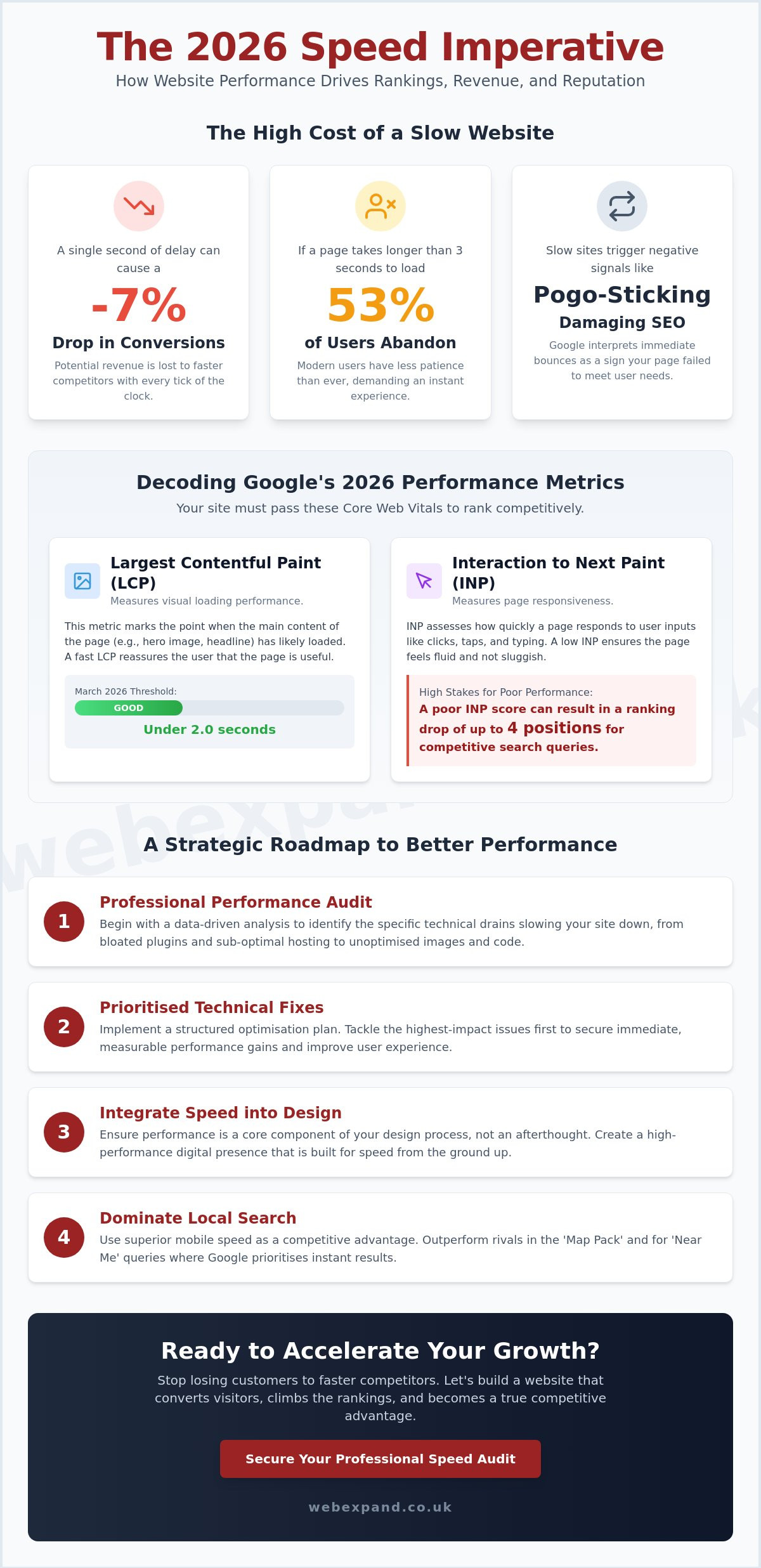
Slow sites trigger a damaging phenomenon known as ‘pogo-sticking’. This occurs when a user clicks your result, finds the loading time unacceptable, and immediately hits the back button to find a faster competitor. Google’s systems interpret this behaviour as a clear sign that your page didn’t meet the user’s needs. Consequently, improving website speed for better ranking becomes a defensive necessity to protect your visibility. For UK SMEs, the financial stakes are high. Research from 2026 shows that a one-second delay can slash conversions by 7%, turning potential revenue into a missed opportunity for your rivals to seize.
The Psychology of a Fast Website
Sub-second loading times do more than satisfy algorithms; they build immediate brand authority. When a page snaps into view, it projects a sense of precision and reliability. In 2026, the ‘3-second rule’ has evolved into a strict threshold. Users across London and the South East have less patience than ever, with 53% abandoning a page if it takes longer than three seconds to load. A fast site feels secure and professional. It tells your audience that you value their time, which is the quickest way to earn their trust before they’ve even read your first headline.
Speed as a Competitive Advantage in Local Search
In competitive local markets like Maidstone, Sevenoaks, and West Malling, performance is often the deciding factor in the ‘Map Pack’. Google prioritises mobile speed for ‘Near Me’ queries because users on the move require instant answers. If you’re outperforming your local rivals on speed, you’re likely to leapfrog them in search results. Investing in high-performance web design in Kent ensures your site isn’t just a digital brochure, but a high-speed growth engine. Regularly improving website speed for better ranking allows you to dominate these crowded local spaces by providing the friction-less experience that modern consumers demand.
Decoding the 2026 Performance Metrics: Core Web Vitals and Beyond
Google no longer relies on a single “load time” to judge your website. Instead, the algorithm uses a sophisticated suite of modern performance metrics known as Core Web Vitals to evaluate user experience. These metrics are binary; your site either passes or fails. In the competitive landscape of 2026, failing even one of these three pillars can drag down your total SEO score, regardless of how strong your content is. Understanding these technical benchmarks is the first step toward improving website speed for better ranking and securing a dominant digital presence.
The March 2026 core update introduced stricter requirements that every business leader must recognise. Largest Contentful Paint (LCP) now requires your main content to load in under 2.0 seconds to be considered “Good”. Simultaneously, Interaction to Next Paint (INP) has become the primary signal for responsiveness, measuring the delay of every click and scroll. If your site feels sluggish, Google’s field data will reflect this, often resulting in a ranking drop of up to 4 positions for highly competitive queries. These aren’t just technical hurdles; they are direct reflections of your brand’s reliability in the eyes of your customers.
LCP and the First Impression
Your Largest Contentful Paint is typically the hero image or the main headline that appears at the top of your page. Many Kent business sites fail this metric because they use unoptimised, high-resolution local photography that hasn’t been properly compressed for the web. When a visitor from Maidstone or Sevenoaks lands on your page, they expect to see value immediately. If that hero image takes longer than two seconds to appear, the psychological bond of trust is broken, and the user is likely to bounce back to the search results. Precision in media delivery is no longer optional for growth-focused organisations.
Visual Stability and CLS
Cumulative Layout Shift (CLS) measures how much your content “jumps” as the page loads. We’ve all experienced the frustration of trying to click a link, only for the page to shift, causing an accidental click on an advert or a different button. For e-commerce solutions in London and Kent, high CLS scores are a major cause of abandoned carts and user irritation. Ensuring your images and ad units have defined dimensions prevents these shifts, satisfying Google’s 2026 algorithm and keeping your mobile users engaged. If you are unsure where your site currently stands, you can request a performance audit to identify these hidden friction points.
Interaction to Next Paint (INP) is perhaps the most challenging metric to master in 2026. It measures the time it takes for a page to respond to a user’s interaction, with a “Good” threshold of under 200 milliseconds. Approximately 43% of sites currently fail this threshold because of bloated JavaScript and complex background tasks. By improving website speed for better ranking through cleaner code and reduced third-party scripts, you ensure that your site feels snappy and responsive, directly translating to higher engagement and better conversion rates.
Common Performance Bottlenecks for Business Websites in Kent
Identifying the friction points that stall your growth is the first step in improving website speed for better ranking. Many organisations in Kent unknowingly sabotage their digital presence by prioritising aesthetics over infrastructure. For instance, trade businesses in Maidstone often showcase their craftsmanship through stunning, high-resolution project photos. Whilst visually impressive, these unoptimised files are often the primary cause of sluggish performance, forcing mobile users to wait whilst megabytes of data download. Precision in image management is essential to ensure your work is seen without driving potential leads away.
Beyond images, third-party scripts present a significant hurdle. Every chatbot, tracking pixel, and social media feed you embed sends an external request that pauses your site’s rendering. Whilst these tools offer functionality, they often come at a cost to your Core Web Vitals. Analysis using Google’s PageSpeed Insights frequently reveals that these scripts are the hidden culprits behind failing responsiveness scores. You must audit these tools regularly to ensure their business value outweighs the performance penalty they impose on your SEO.
Hosting and Server Location
Location matters more than many realise. If your business is based in the South East, using cheap, international hosting creates unnecessary latency. Data must travel across oceans before it reaches your local audience, adding precious milliseconds to every interaction. We recommend prioritising UK-based servers to ensure the shortest possible path between your content and your customers. Transitioning to professional website hosting in Kent provides a stable, high-performance foundation that shared, budget providers simply cannot match. It’s a fundamental shift from merely being online to being fast enough to dominate your local search results.
Code Bloat and Plugin Overload
A Strategic Roadmap for Improving Website Speed and SEO
Successful growth is never accidental; it requires a disciplined strategy that moves beyond simple fixes. Improving website speed for better ranking starts with a structured roadmap designed to eliminate technical friction whilst enhancing user experience. We recommend a five-step approach to transform your digital presence into a high-performance asset. This journey begins with a professional performance audit using PageSpeed Insights and Search Console to identify exactly where your site is losing momentum. Once you’ve identified the leaks, you can prioritise ‘Quick Wins’ like image compression and browser caching to see immediate gains.
The next phase involves technical refinement. You must optimise your ‘Critical Rendering Path’ to ensure the most important content appears first, followed by implementing a Content Delivery Network (CDN) to serve assets efficiently across the UK. Finally, you need a system for regular monitoring. Performance drift is common as you add new blog posts or products, so consistent checks are vital to protect your hard-won search positions. If you’re ready to secure your market position, contact our technical SEO team for a bespoke performance roadmap.
Auditing Your Current Performance
You don’t need a computer science degree to understand your site’s health, but you do need to know which data matters. Google distinguishes between ‘Lab Data’, which is a simulated test, and ‘Field Data’, which reflects real user experiences from the Chrome User Experience Report. Whilst Lab Data is useful for debugging, Google prioritises Field Data for rankings. We suggest setting benchmarks against your top three local competitors in Maidstone or Sevenoaks. If their sites load faster, they have a psychological and algorithmic head start that you must overcome through precise optimisation.
Practical Image and Asset Optimisation
Improving website speed for better ranking often comes down to how you handle your visual assets. Switch all business photography to next-gen formats like WebP, which offers superior compression without sacrificing quality. We also recommend ‘Lazy Loading’, a technique where images only download as the user scrolls towards them. This significantly reduces the initial load weight. Combined with minifying your CSS and JavaScript code to strip away unnecessary characters, these steps streamline what the browser has to download, ensuring your site feels snappy and professional from the very first click.
Accelerating Your Growth: Professional Speed Optimisation with Webexpand
Technical excellence is the bedrock of any successful digital strategy. At Webexpand, we don’t view performance as an afterthought or a final coat of polish. We integrate high-velocity performance into the very foundation of every bespoke web design in Kent that we deliver. Our philosophy is simple: a beautiful website is only effective if your customers actually see it. By improving website speed for better ranking from the initial wireframe to the final launch, we ensure your organisation possesses a high-performance engine capable of outrunning the competition.
We pride ourselves on a jargon-free, results-driven approach. Whilst the underlying technology of Core Web Vitals is complex, our communication is always clear and focused on your business growth. Our SEO services in Kent move beyond basic keyword targeting to address the technical precision Google demands in 2026. As a Maidstone-based agency, we have a deep understanding of the UK market dynamics and the specific expectations of local consumers. We know that for a business in the South East, every millisecond of latency is a barrier between you and a new lead.
Our Tailored Approach to Performance
We don’t believe in standardised packages because your business goals are unique. We don’t just ‘fix speed’; we optimise your entire digital presence for conversion and search dominance. Our team has helped numerous Kent firms reclaim their positions on page 1 by resolving the deep-seated technical issues that templates often hide. A fast, secure, and professionally managed website is a long-term asset that pays dividends through lower acquisition costs and higher customer retention. We partner with you to ensure your digital infrastructure reflects the quality and ambition of your brand.
Ready to Broaden Your Horizons?
The digital landscape moves quickly, and waiting to address performance issues is a choice that costs you leads every single day. If your site is amongst the 43% failing the 200ms INP threshold, you’re effectively handing market share to your faster rivals. It’s time to take control of your digital trajectory. We invite you to secure a professional audit of your current performance to see exactly where you can gain a competitive edge. Contact Webexpand today to start your journey toward industry leadership and transform your website into your most powerful growth tool.
Secure Your Competitive Edge in 2026
The digital landscape of 2026 leaves no room for technical hesitation. By now, you understand how critical metrics like Interaction to Next Paint (INP) are to your organic visibility. Improving website speed for better ranking isn’t just about shaving off milliseconds; it’s about delivering a superior user experience that converts traffic into loyal customers. Every technical refinement, from streamlining code to prioritising local hosting, strengthens your brand’s authority and protects your market share.
Since 2004, Webexpand has provided jargon-free expert advice to businesses ready to dominate their sectors. We specialise in bespoke, high-performance web design for Kent organisations, with a proven track record of moving our clients to Page 1 of Google. Your growth depends on a partner that values precision and measurable outcomes as much as you do. Don’t let technical friction hold your business back from broadening its horizons.
Book your free performance and SEO audit with Webexpand today to start your transformation. We’re ready to help you turn your website into a high-speed engine for measurable success and industry leadership.
Frequently Asked Questions
How fast does my website actually need to be for Google to rank it higher?
Your site should aim for a Largest Contentful Paint (LCP) of 2.0 seconds or less to satisfy the March 2026 core update. Google also requires an Interaction to Next Paint (INP) score of under 200 milliseconds to consider your site responsive. Meeting these specific benchmarks is essential for improving website speed for better ranking in competitive sectors. If you fall outside these thresholds, your visibility will likely suffer against faster local rivals.
Can I improve my website speed without redesigning the whole site?
You can achieve significant performance gains without a complete overhaul of your visual design. Many speed issues stem from back-end infrastructure, such as sub-optimal hosting, uncompressed media, and bloated database tables. By focusing on technical optimisations like minifying code and implementing advanced caching, you can streamline your existing site. This allows you to protect your current brand identity whilst securing the technical benefits of a faster digital presence.
Does website speed affect my Google Ads (PPC) performance as well as SEO?
Speed is a critical factor for your Google Ads performance because it directly influences your Landing Page Experience score. A slow-loading page increases your bounce rate and lowers your Quality Score, which ultimately forces you to pay more for every click. By improving website speed for better ranking on the organic side, you simultaneously lower your PPC costs. This dual benefit ensures your marketing budget works harder across all digital channels.
Why does my website feel fast to me but Google says it is slow?
Your browser often stores a local version of your site, making it appear instant to you whilst remaining slow for new visitors. Google bases its evaluation on real-world Field Data from the Chrome User Experience Report, which captures the actual load times of users across various devices and network speeds. If your server response time is high or your mobile assets are heavy, new leads will experience the lag that your cached browser hides.
What is the most common thing that slows down UK business websites?
Unoptimised imagery and excessive third-party scripts are the most frequent culprits for sluggish performance in the UK. Many organisations use high-resolution photography that hasn’t been converted to next-gen formats like WebP, alongside numerous tracking pixels and chat widgets. These elements create a heavy page weight that stalls the browser. Addressing these specific bottlenecks is often the quickest way to see a measurable boost in your Core Web Vitals.
How often should I check my website speed for SEO purposes?
We recommend conducting a thorough performance check at least once a month or immediately following any significant site update. Performance drift occurs naturally as you add new blog posts, products, or marketing scripts, which can gradually erode your SEO gains. Regular monitoring ensures that you maintain your competitive advantage. It allows you to catch and fix minor issues before they impact your search engine positions or user conversion rates.
Is mobile speed more important than desktop speed for ranking in 2026?
Mobile speed is the primary benchmark for ranking in 2026 because Google exclusively uses mobile-first indexing. With over 64% of global traffic now originating from mobile devices, a site that performs well on desktop but lags on a smartphone is considered a failure. Your mobile Core Web Vitals carry the most weight in determining your overall search authority. Precision in mobile delivery is the first step toward dominating your sector.
Will adding more plugins to my WordPress site always make it slower?
Almost every plugin you add to a WordPress site increases the Plugin Tax by adding more CSS and JavaScript files for the browser to process. Whilst some tools are well-coded, most contribute to code bloat and increased server requests. We advise keeping your plugin list lean and only using tools that provide clear business value. Choosing bespoke solutions over generic plugins is a far more effective strategy for maintaining high-speed performance.