
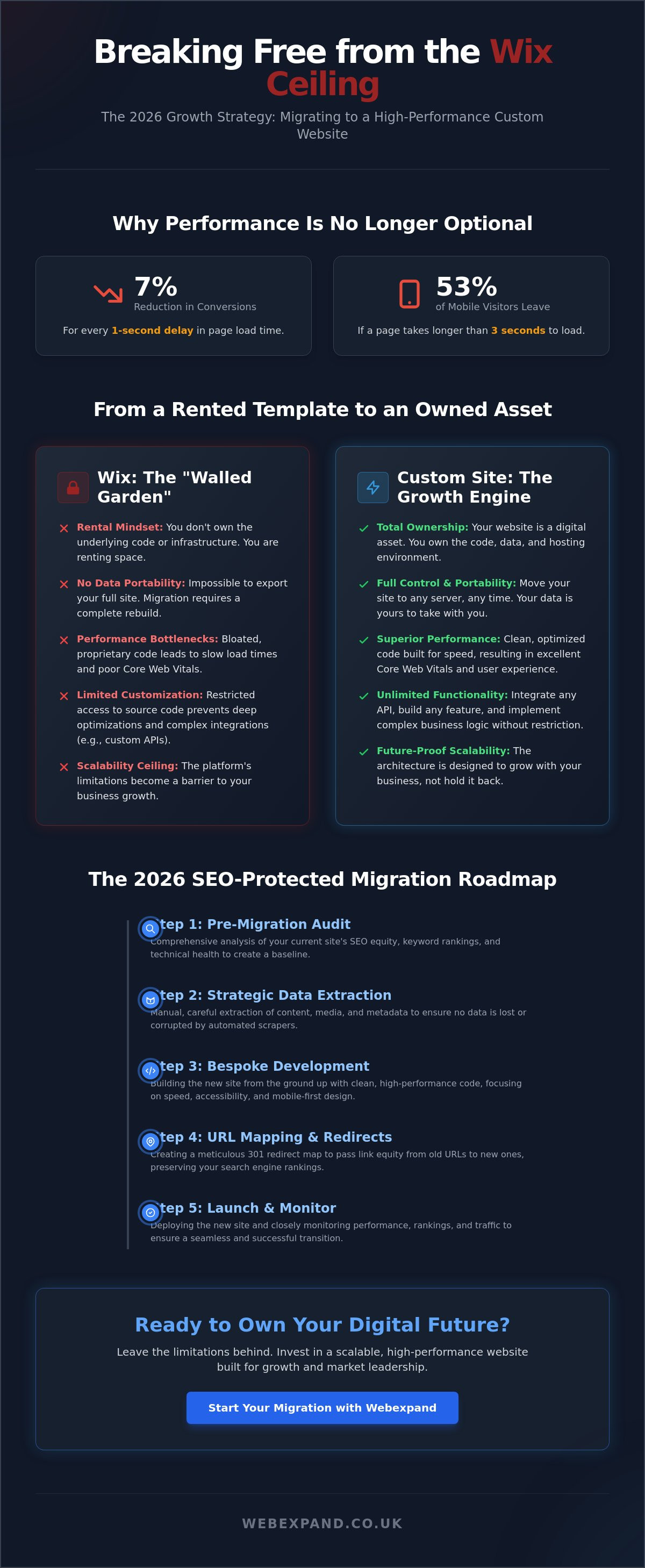
What if the platform you built your business on is actually the ceiling holding it back? You likely chose Wix for its accessibility, but you’ve now hit the “walled garden” where data export is restricted and mobile performance often fails to meet modern standards. It’s a common frustration for growing brands to realize that a one-second delay in page load time can lead to a 7% reduction in conversions. When your business outgrows a template, migrating from wix to a custom website becomes the necessary evolution from renting a space to owning a bespoke growth engine.
We understand the anxiety of potentially losing your search rankings during a transition. You’ve worked hard for your visibility, and you shouldn’t have to start from scratch just to gain the functionality you need. This strategic guide details how to transition to a high-performance site while protecting your SEO and scaling your operations. We will preview the roadmap for securing full ownership of your digital assets, achieving superior site speed, and implementing the complex custom features that drive market leadership in 2026.
Key Takeaways
- Learn why migrating from wix to a custom website is the definitive move for brands ready to transition from a starter presence to industry leadership.
- Uncover the technical constraints of the Wix “walled garden” and the precise steps needed to recreate your site with clean, high-performance code.
- Evaluate the direct impact of bespoke development on Core Web Vitals and discover why custom sites consistently outperform templates for competitive keywords.
- Master the 2026 SEO protection strategy, including pre-migration audits and URL mapping, to ensure your search rankings remain intact during the transition.
- Identify how transitioning to a tailored digital asset provides the full ownership and scalability required to future-proof your organizational growth.
Beyond the Template: Why Businesses are Migrating from Wix to Custom Websites
Your business has evolved. You likely started with Wix because it was fast, accessible, and served as a perfect “starter” home for your brand. However, as you scale toward industry leadership, you eventually hit the “Wix Ceiling.” This is the specific point where your growth goals outpace the capabilities of a drag-and-drop builder. In 2026, standing out requires a digital presence that isn’t just functional but is technically superior to every competitor in your sector.
Moving away from a template means shifting from a rental mindset to one of total ownership. When you use a builder, you’re essentially renting space on their proprietary servers. You don’t own the underlying code; you can’t take the full site with you if you decide to leave. Migrating from wix to a custom website allows you to claim your digital asset as your own property. This ownership is vital for businesses that want to dominate their market and ensure their platform grows alongside their ambitions without artificial restrictions.
The Limitations of Proprietary Builders
Proprietary builders operate within a “walled garden” that prioritizes ease of use over performance. This structure restricts your access to the source code, making deep server-side optimizations impossible. You’re often left with bloated code that slows down your site. This directly impacts your mobile responsiveness and user experience. In a market where 53% of mobile visitors abandon a page that takes longer than three seconds to load, these technical bottlenecks become significant financial liabilities. Beyond these code issues, these platforms often struggle with complex business logic. If you need to integrate unique APIs or develop custom functionality, you’ll find yourself hitting a wall. Understanding the technical realities of content migration is the first step in breaking free from these constraints and building a foundation that supports your specific operational needs.
The Shift to High-Performance Bespoke Design
Bespoke website design isn’t just about aesthetics; it’s about precision engineering. A custom-built site is a tailored solution designed to convert your specific audience. By eliminating the generic scripts found in templates, we can achieve the lightning-fast speeds that search engines demand. This gives you a massive competitive edge in saturated markets where every millisecond of performance counts toward your ranking. While the upfront investment in a custom site is higher, the long-term financial benefits are clear. You’re no longer tied to recurring builder fees that offer diminishing returns. Instead, you invest in a scalable platform that increases in value as your business expands. Migrating from wix to a custom website is an investment in your brand’s future, ensuring you have the infrastructure to support high-traffic e-commerce solutions and advanced Google promotion strategies.
The Wix “Walled Garden”: Understanding the Technical Realities
The term “walled garden” isn’t just a metaphor; it’s a technical reality for every Wix user. If you’ve ever looked for a “Download My Website” button, you already know it doesn’t exist. Wix sites are built on proprietary infrastructure that requires the site to remain on Wix’s servers to function. This means that migrating from wix to a custom website isn’t a simple file transfer. It’s a strategic extraction and reconstruction process. You aren’t just moving files; you’re liberating your brand’s data from a closed ecosystem.
Automated scraping tools often promise a quick fix, but they rarely deliver a clean result. These tools frequently miss metadata, break internal linking structures, or fail to capture high-resolution media correctly. A professional rebuild is the only way to ensure your new site is free from the technical debt of the past. By starting with a clean slate, you can implement web accessibility standards from the ground up, ensuring your new digital asset is inclusive and compliant with current regulations.
Why Wix Code Cannot Be “Transferred”
Wix uses a specific combination of JSON and JavaScript to render your site’s design on the fly. This code is fundamentally different from the standard HTML5 and CSS3 used in bespoke development. If you try to “lift and shift” design elements by copy-pasting, you’ll end up with a fragmented, slow-loading mess. Custom development allows us to write every line of code with a specific purpose. This leads to a leaner, faster codebase that improves your Core Web Vitals and provides a superior foundation for bespoke website design.
Protecting Your Content and Data
Before you flip the switch, you need a bulletproof inventory of your current assets. While Wix allows you to export blog posts via an RSS feed, most other pages and media must be manually managed. We recommend creating a detailed spreadsheet that maps every URL, image, and customer database entry. This ensures nothing is left behind in the “walled garden.” Managing your domain transfer is equally critical. You must coordinate the transition of your DNS settings carefully to avoid service interruptions or the loss of professional email accounts. A precise, data-backed roadmap ensures that your transition is seamless and your brand’s digital presence remains uninterrupted throughout the entire process.
Custom Development vs. Wix: Performance, SEO, and ROI
Performance isn’t just a technical metric; it’s a financial lever. While Wix might suffice for a local presence, ambitious brands aiming for national dominance eventually encounter significant platform limitations that hinder growth. In a digital landscape where a one-second delay in page load time can lead to a 7% reduction in conversions, every millisecond of “code bloat” matters. When you are migrating from wix to a custom website, you are essentially removing the technical governor from your digital engine. Bespoke sites consistently outperform templates in Core Web Vitals because they lack the heavy, unused scripts that builders require to maintain their drag-and-drop flexibility.
The “SEO Ceiling” is a documented challenge for businesses in competitive sectors. While Wix provides basic on-page tools, it lacks the granular control required for aggressive search strategies. Custom sites allow for superior server-side rendering and precise crawl budget management. From a financial perspective, you must evaluate the Total Cost of Ownership (TCO) over a five-year period. While Wix has a lower entry cost, the cumulative expense of subscription fees, third-party app costs, and lost revenue from lower conversion rates often exceeds the investment in a high-performance bespoke asset. Scalability is the ultimate differentiator. A custom site handles traffic spikes and complex user journeys with a level of stability that template-based platforms simply cannot match.
SEO and Strategic Search Ranking
Success in 2026 requires more than just keywords; it requires technical precision. Our approach to bespoke website design allows for the implementation of granular schema markup that builders often truncate. By integrating professional SEO services directly into the site architecture, we ensure that search engines can index your content with maximum efficiency. This structural advantage is why custom sites often outrank builders for highly competitive, high-intent national keywords.
Conversion Rate Optimisation (CRO)
Templates are designed for the masses, not your specific customer. A good business website focuses on removing friction from the user journey. Custom development allows us to build personalised checkout flows and lead forms that align perfectly with user intent. By eliminating the generic constraints of a builder, we create unique user experiences that drive higher engagement and measurable financial outcomes. Migrating from wix to a custom website allows you to build a platform that adapts to your customers, rather than forcing your customers to adapt to a template.
The 2026 Migration Roadmap: Protecting Your SEO Equity
Your search engine visibility is a hard-won asset. You shouldn’t risk it for a platform upgrade. When migrating from wix to a custom website, the primary goal is a “zero-loss” transition. This begins with a rigorous pre-migration audit. We benchmark your current rankings, organic traffic levels, and top-performing pages to create a data-backed baseline for success. Without this initial data, you’re flying blind during the most critical phase of your brand’s digital evolution.
The most common failure point in any migration is a neglected URL structure. Wix often generates messy or proprietary URL strings that don’t always align with clean, bespoke hierarchies. You must map every single legacy URL to its new counterpart using permanent 301 redirects. This tells Google precisely where your content has moved, preventing the 404 errors that destroy user trust and search rankings. We synchronize your metadata and content to ensure consistency, keeping your established authority intact as you move to a faster, more capable environment.
Step-by-Step SEO Preservation
Mapping is just the beginning. You need to preserve the internal linking structures that distribute page authority across your site. If your old blog posts linked to specific service pages, those links must be updated to point to the new, high-performance versions. Once the new site is live, we immediately update your XML sitemap and robots.txt. This signals to search engines that your new architecture is ready for a fresh crawl. Post-launch, we use Search Console to monitor the transition in real-time, identifying and fixing any indexing issues before they impact your bottom line.
Testing and Quality Assurance
A high-performance site is only effective if it works for every user. 2026 business standards demand flawless performance across all browsers and devices. We conduct extensive cross-browser testing to ensure your bespoke design remains consistent, whether viewed on a flagship smartphone or a legacy desktop. We verify every form and third-party integration to ensure your lead generation remains uninterrupted. Finally, we confirm that your tracking codes, such as GA4 and GTM, are correctly implemented. This ensures your data remains accurate as you begin your new chapter.
Ready to secure your search rankings while upgrading your infrastructure? Let our team handle the technical heavy lifting by partnering with us for your strategic migration.
Transitioning to a Bespoke Future with Webexpand
Choosing to leave a restrictive builder is a declaration of ambition. You’ve recognized that your brand requires a foundation capable of supporting national industry leadership. When you’re migrating from wix to a custom website with us, you aren’t just changing your hosting provider; you’re fundamentally upgrading your business’s capacity to convert and scale. We don’t believe in “lift and shift” methods that carry over old technical debt. Instead, we transform your existing presence into a high-performance bespoke asset designed specifically for the 2026 market.
Our collaboration is built on transparency and measurable outcomes. We avoid the coldness of corporate jargon, opting for a jargon-free approach that keeps you in control of the technical transition. By utilizing a fixed-price web design model, we remove the uncertainty often associated with custom development. You receive a precise roadmap and a clear investment structure, allowing you to focus on your organizational growth while we handle the technical precision of the build.
Our Bespoke Migration Process
Every successful transition begins with a discovery phase where we align your new site with your specific 2026 business goals. We don’t just build pages; we engineer growth engines. Our technical execution focuses on clean coding, completely removing the proprietary bloat that previously hindered your mobile performance. The process concludes with a seamless launch. We manage the entire domain and hosting transition, ensuring your professional emails and site stability remain uninterrupted as you move to your new, high-performance environment.
Ready to Scale Beyond the Builder?
The move to a custom platform is your first step toward dominating your sector. Migrating from wix to a custom website is the definitive move for businesses that need the infrastructure for advanced Google promotion and specialized e-commerce solutions that templates simply cannot sustain. Beyond the launch, we offer ongoing support and secure website hosting to give you total peace of mind. Your digital presence should be your most powerful employee, working 24/7 to secure your market position. It’s time to stop renting your brand’s future and start owning your digital assets. Contact Webexpand today for a strategic migration consultation and let’s begin your journey toward industry leadership.
Take Command of Your Brand’s Digital Future
Your website shouldn’t be a limitation; it should be a high-performance engine for growth. Transitioning from a restrictive builder to a bespoke platform allows you to reclaim total ownership of your code and secure the technical metrics that drive 2026 search rankings. By following a strategic roadmap, you can protect your hard-earned visibility while eliminating the code bloat of a generic template. This move ensures your infrastructure is as ambitious as your business goals.
Migrating from wix to a custom website is the definitive step toward industry leadership. At Webexpand, we bring over 20 years of bespoke web development expertise to every project, ensuring a transition that’s both seamless and secure. We provide fixed-price project fees with no hidden costs and maintain a proven track record of SEO-safe migrations. We’re ready to help you broaden your horizons and dominate your sector with a precision-engineered digital asset.
Upgrade your digital presence with a bespoke website migration from Webexpand. Your business is ready to scale; let’s build the platform that takes you there.
Frequently Asked Questions
Can I automatically export my Wix website to another platform?
No, you cannot automatically export a full Wix site because the platform uses proprietary code that only functions on its own servers. While you can export certain data like blog posts via RSS feeds or store products via CSV files, your actual pages and design elements must be manually reconstructed. This technical reality is why we focus on a precision rebuild rather than a simple file transfer to ensure your new site is clean and fast.
Will I lose my Google rankings if I move away from Wix?
You won’t lose your rankings if you follow a rigorous SEO preservation strategy during the transition. By mapping every old URL to a new bespoke counterpart using permanent 301 redirects, you signal to Google exactly where your authority has moved. Our meticulous approach ensures that your hard-earned visibility remains intact throughout the entire process of migrating from wix to a custom website.
How long does it typically take to migrate from Wix to a custom website?
The timeline depends on the complexity of your site and the volume of content requiring extraction. A standard business site usually takes between four to eight weeks, while complex e-commerce solutions with large databases may require twelve weeks or more. We prioritize a thorough discovery phase to ensure your launch date is realistic and your new platform is fully optimized for performance from day one.
Do I need to buy a new domain name when I migrate?
You don’t need a new domain name; you can simply point your existing domain to your new hosting provider. We manage the DNS transition to ensure there is no downtime for your site or professional email accounts. Keeping your current domain is essential for maintaining brand consistency and preserving the SEO equity you’ve built over years of operation.
What happens to my Wix blog posts during a migration?
Your blog posts can be migrated by using an RSS feed to export the text and images, though some manual formatting is required to match your new bespoke design. We ensure that every post is correctly redirected to prevent broken links. This preserves your internal linking structure and keeps your content accessible to both your audience and search engine crawlers during the move.
Is a bespoke website more expensive to maintain than Wix?
While the initial investment is higher, a bespoke site is often more cost-effective in the long term. You eliminate recurring builder fees and expensive third-party app subscriptions that often provide diminishing returns. Because custom sites provide superior speed and conversion rates, the return on investment typically far outweighs the ongoing costs of a template-based platform.
Can I keep my current design when moving to a custom site?
Yes, you can keep your current aesthetic, but migrating from wix to a custom website is the perfect time to refine your user experience. We can recreate your visual identity while stripping away the underlying code bloat that slows down Wix templates. This results in a site that looks familiar to your customers but performs with the precision of a modern, bespoke growth engine.
How do I manage my emails during the website migration process?
Managing your emails requires careful coordination of your DNS records during the domain transfer. If you use a service like Google Workspace, your email hosting is separate from your website hosting. We ensure these records remain untouched or are updated correctly so you don’t experience any interruption in communication with your clients during the transition to your new platform.