

That bargain-bin website template you’re considering isn’t a cost-saving measure; it’s a high-interest loan against your company’s future scalability. In 2026, the hidden costs of cheap websites manifest quickly through poor performance and security vulnerabilities that can cripple your reputation. We know it’s tempting to opt for the lowest price point when you’re overwhelmed by technical jargon or past negative experiences with agencies. You need a digital presence that generates leads, not one that requires a total rebuild in twelve months.
This article uncovers the technical, financial, and strategic risks of budget web design so you can make an informed decision for your brand. We’ll explore how modern requirements like WordPress 7.0 and Google’s Core Web Vitals make professional execution a necessity rather than a luxury. You’ll learn how to shift from a maintenance mindset to a transformative journey toward industry leadership. You’ll understand how to secure a site that offers a clear ROI on your digital spend and positions you to dominate your sector.
Key Takeaways
- Move beyond the sticker price to calculate the true impact of technical repairs and lost time on your bottom line.
- Uncover the hidden costs of cheap websites and how bloated foundations can quietly erode your search engine visibility and load speeds.
- Recognize the visual and functional barriers that cause generic templates to drive away potential customers and damage your professional credibility.
- Protect your digital assets by understanding the risks of “rented” platforms and the critical importance of scalability for future growth.
- Transition to a strategic investment mindset where your website functions as a tireless salesperson delivering measurable financial performance.
Beyond the Invoice: Identifying the Real Cost of Budget Web Design
Selecting the lowest quote for your digital presence feels like a win for the balance sheet, but the initial invoice is a deceptive metric. A site that costs a few hundred pounds today often accumulates thousands in technical repairs and lost revenue by next year. This is the bargain paradox. Professional developers frequently see businesses forced into a total rebuild because their initial budget solution couldn’t scale or handle basic security updates. You aren’t just buying a layout; you’re entering into a long-term relationship with your technology. The hidden costs of cheap websites usually surface when you realize your affordable foundation is actually a liability that prevents you from reaching your full potential.
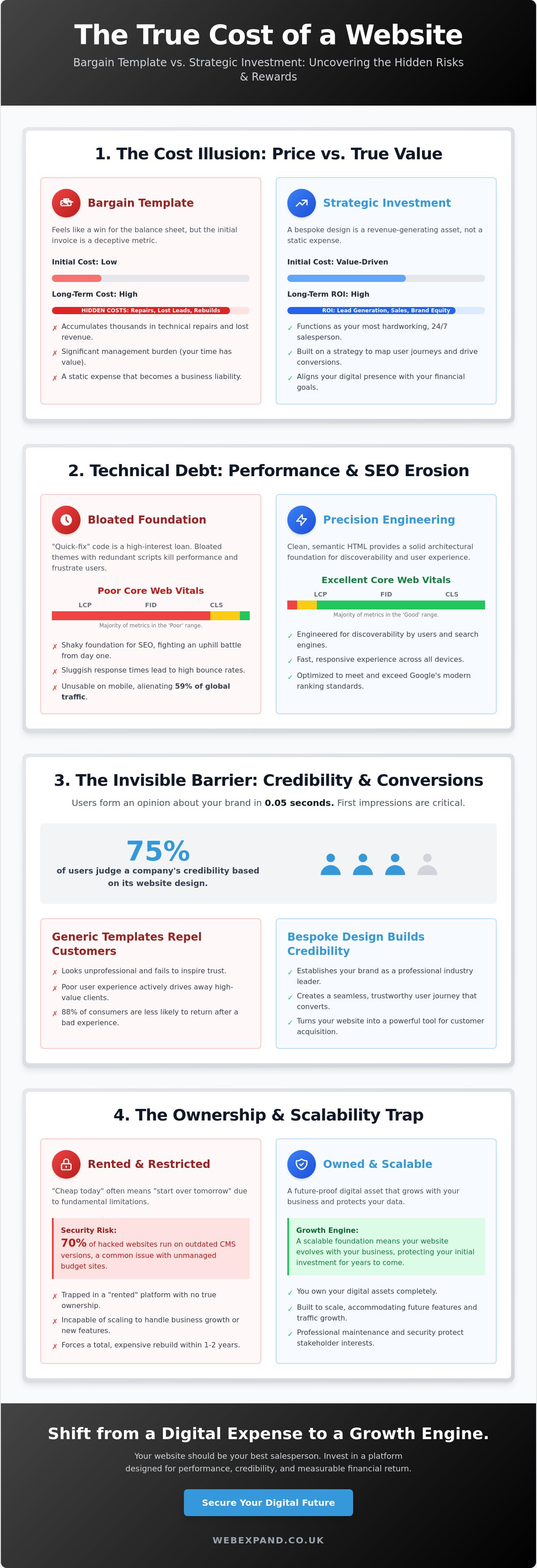
Consider the opportunity cost of an underperforming site. Research shows users form an opinion about your brand in just 0.05 seconds. If your site looks generic or functions poorly, you’ve lost that lead before they even read your headline. Since 75% of users judge a company’s credibility based on its website design, a cheap template can actively repel high-value clients. You won’t see these lost leads on your bank statement, but they represent a massive drain on your growth. Uncovering the hidden costs of cheap websites involves looking at the business you didn’t get because your digital storefront failed to inspire trust.
The Distinction Between Price and Value
A bespoke website design is a revenue-generating asset, not a static expense. Cheap options almost always skip the critical strategy phase where we map out your user journey and conversion architecture. Without this blueprint, your site is just a digital brochure that nobody visits. We focus on building a platform that functions as your most hardworking salesperson. Investing in precision from the start ensures your digital presence aligns with your financial goals. It’s the difference between a standardized package and a tailored solution designed to dominate your sector.
The Management Burden of DIY Solutions
DIY builders and “easy” editors often promise simplicity but deliver a significant management burden. You’ll likely find yourself troubleshooting plugin conflicts or fixing broken layouts instead of running your business. Your time has a specific financial value, and spending it on technical maintenance is rarely the best use of your expertise. Security is another major concern; 70% of hacked websites are running on outdated CMS versions. When you manage your own updates on a budget platform, you’re often one missed patch away from a disaster. Professional hosting and maintenance allow you to focus on your core operations while experts protect your stakeholders’ interests.
Technical Debt: How Cheap Foundations Erode SEO and Performance
One of the most persistent hidden costs of cheap websites is the accumulation of technical debt. When you choose low-quality, “quick-fix” code, you aren’t saving money; you’re taking out a high-interest loan. Most budget templates are bloated “all-in-one” themes designed to be everything to everyone. They ship with thousands of lines of redundant code and unnecessary scripts that your server must process for every single visitor. This digital clutter kills your response times and creates a sluggish experience that frustrates users and search engines alike.
Your online visibility depends on a solid architectural foundation. If your Search Engine Optimisation (SEO) is built on a shaky, automated template, you’re fighting an uphill battle from day one. Google’s crawlers prioritize clean, semantic HTML that clearly defines your content’s hierarchy. Fixing structural flaws in a cheap site is often more expensive than building a high-performance platform from scratch. We focus on precision engineering to ensure your brand is discoverable by both human users and the sophisticated AI agents that drive modern search.
Mobile performance is no longer a luxury. With 59% of global traffic originating from mobile devices, a “responsive” site that breaks on real-world smartphones is a liability. Cheap templates often look acceptable on a desktop but become unusable on smaller screens due to unoptimized assets. This friction drives away 88% of consumers who are less likely to return after a bad experience. To avoid these pitfalls, you can broaden your digital horizons by investing in a foundation built for speed and stability.
Core Web Vitals and Ranking Suppression
Google’s 2026 ranking standards are unforgiving. To secure a spot on Page 1, your site must meet “Good” thresholds for Core Web Vitals. This includes a Largest Contentful Paint (LCP) of 2.5 seconds or less and an Interaction to Next Paint (INP) under 200 milliseconds. Budget sites rarely hit these targets because they rely on unoptimized code and low-tier shared hosting. Another of the hidden costs of cheap websites is ranking suppression; if your site is slow, Google will simply promote a faster competitor who provides a better user experience.
The Security Vulnerability Gap
Security should never be an afterthought. Cheap sites are the primary targets for automated bot attacks because they often lack robust defensive architecture. Since 70% of hacked websites run on outdated CMS versions, cutting corners on professional maintenance is a significant risk. A data breach destroys the trust you’ve worked hard to build and carries heavy legal implications under GDPR. By choosing bespoke website design, you build security into the site’s DNA, protecting your stakeholders and your reputation simultaneously.
The Invisible Barrier: Why Budget Templates Kill Conversions and Credibility
Your website is often the primary touchpoint between your brand and a high-value lead. If that touchpoint is a generic, off-the-shelf template, you’re immediately signaling that your business is average. This “template look” is one of the most damaging hidden costs of cheap websites because it makes your brand invisible in a crowded market. When every competitor in your sector uses the same layout and stock imagery, you lose the ability to differentiate your value proposition. You aren’t just buying a site; you’re building a barrier between your services and your audience.
Cognitive friction is the silent killer of digital growth. Budget designs often prioritize aesthetics over functionality, leading to a user interface (UI) that confuses potential leads. If a visitor has to work to find your contact details or understand your offerings, they’ll simply leave. Statistics show that 88% of online consumers are less likely to return to a site after a bad experience. A cheap site suggests that your service quality might be equally low, eroding your brand equity before you’ve even had a chance to speak with the customer.
Trust Signals and Professional Authority
In 2026, professional design is the primary driver of perceived value. 94% of first impressions are design-related, and users form an opinion about your credibility in just 0.05 seconds. To command premium prices, you must project professional authority. Understanding what makes a good business website is critical; it requires a blend of precision, transparency, and strategic layout. Cookie-cutter designs fail because they don’t account for the unique psychological triggers of your specific audience, leading to high bounce rates and stagnant growth.
Bespoke vs. Template: A Performance Comparison
The gap between a budget template and a high-performance site is measurable in both speed and revenue. While templates offer a rigid structure, bespoke solutions allow for surgical marketing adjustments that align with your specific sales funnels. This is especially vital for E-commerce solutions, where every millisecond of delay and every point of friction directly reduces your total transaction value.
| Performance Metric | Budget Template | Bespoke Website Design |
|---|---|---|
| User Experience (UX) | Generic, high friction | Tailored, up to 400% higher conversion |
| Load Speed (LCP) | Often > 3 seconds | Optimized, ≤ 2.5 seconds |
| SEO Flexibility | Restricted by theme code | Full semantic control |
| Mobile Responsiveness | Standardized/Rigid | Fluid and precision-tested |
Investing in a custom build isn’t just about looking better; it’s about removing the invisible barriers that prevent your business from scaling. We view every project as a transformative journey toward industry leadership, ensuring your digital presence is a precise reflection of your professional standards.
The Ownership and Scalability Trap: Why Cheap Today Means Starting Over Tomorrow
Building your business on a proprietary website builder is like constructing a house on rented land. You might pay a small monthly fee for the convenience, but you never truly own the foundation. This proprietary lock-in is one of the most significant hidden costs of cheap websites. If you decide to move to a more professional setup later, you’ll find that you can’t simply “export” a Wix or Squarespace site to a new host. You’re forced to start from zero; recreating every page, redirecting every link, and manually migrating every piece of content. It’s a technical nightmare that costs far more in labor than you originally saved on the design.
This lack of portability creates a functional ceiling that eventually halts your progress. As your organization scales, you’ll need deep integrations with professional CRMs, custom API connections, or bespoke automation tools. Cheap builders often lack the open architecture required for these sophisticated connections. You’ll hit a wall where your software can’t support your growth. This leads to a costly and disruptive total rebuild that could’ve been avoided with a scalable foundation. We see businesses outgrow these platforms every 18 months, proving that budget solutions are often just a temporary fix for an ambitious brand.
Data Portability and Legal Ownership
Understanding the difference between a license and ownership is vital for your long-term security. With many budget platforms, you’re only paying for a license to use their tools; you don’t own the underlying code. This leaves you vulnerable to sudden platform price hikes or changes in service terms. You’re effectively held hostage by subscription fees. In contrast, a bespoke site provides total freedom. You own the code, the data, and the digital assets. This allows you to move, modify, or expand your presence whenever you choose, ensuring your progress is never dictated by a third-party provider.
Future-Proofing Your Digital Presence
A modular design approach ensures your site grows alongside your revenue. Instead of “bolting on” features to a rigid template that wasn’t designed for them, a custom build allows for organic expansion. This scalability is essential for long-term Google promotion. High-performance campaigns require landing pages and tracking systems that budget builders often struggle to implement correctly. By investing in a flexible platform now, you protect your stakeholders’ interests and ensure your site remains a high-energy growth engine for years to come.
If you’re ready to secure your digital future with a high-performance platform you actually own, let’s build your custom growth engine today.
Strategic Investment: Shifting from a Digital Expense to a Growth Engine
Stop viewing your website as a static line item on a balance sheet. To dominate your sector in 2026, you must adopt an ROI mindset that treats your digital presence as your most hardworking salesperson. A high-performance site doesn’t take holidays or require a pension; it simply delivers leads around the clock. The hidden costs of cheap websites often stem from a lack of upfront strategy, which forces you to pay for expensive corrections later. By investing in a precise foundation from the start, you eliminate the risk of budget creep and ensure every pound spent contributes to your organizational growth.
Transparency is the hallmark of a professional partnership. We believe in providing jargon-free advice that connects technical execution to your specific financial goals. Quality web design isn’t about chasing the latest visual fad; it’s about building a reliable, scalable engine that protects your stakeholders’ interests. Choosing fixed-price development allows you to plan your digital spend with confidence, removing the uncertainty that often accompanies budget-tier projects. We align our technical expertise with your vision to create a transformative journey toward industry leadership.
How to Evaluate a Web Design Partner
Selecting the right team is critical for avoiding the hidden costs of cheap websites. You should look for a kent web design agency that prioritizes your business outcomes over simple layouts. A quality partner will ask about your lead generation targets and customer pain points before they even mention aesthetics. Always check portfolios for measurable performance metrics, such as load speeds and conversion rates, rather than just visual appeal. Ongoing support and robust website hosting are also non-negotiable; your site needs a secure, high-speed environment to maintain its competitive edge.
Your 2026 Digital Roadmap
Success begins with a comprehensive strategy. The first 20% of your project defines 80% of the eventual results, so don’t rush the planning phase. Your roadmap should include a clear plan for continuous SEO and Google promotion to ensure your brand remains visible as search algorithms evolve. Staying ahead of technological shifts requires a proactive approach to marketing management rather than a “set and forget” mentality. You can take the first step toward a more profitable digital future by requesting a professional audit of your current footprint. Let’s identify the friction points in your existing site and build a roadmap that broadens your horizons and secures your market position.
Securing Your Competitive Edge in 2026
A high-performance digital presence is no longer a luxury; it’s a fundamental requirement for market dominance. Throughout this guide, we’ve explored how technical debt, conversion barriers, and proprietary lock-in create significant financial liabilities for your organization. Understanding the hidden costs of cheap websites is the first step toward building a sustainable digital future that prioritizes precision and measurable outcomes. By shifting your focus from initial expense to long-term ROI, you ensure your site functions as a tireless growth engine rather than a recurring repair bill.
Since 2004, our team has helped businesses navigate technological shifts with jargon-free advice and transparent, fixed-price development fees. As specialists in bespoke website design and strategic SEO, we’re committed to delivering tailored solutions that protect your stakeholders and broaden your horizons. Your website should be your most valuable asset. Don’t let a budget foundation hold your brand back from its true potential. Broaden your horizons with a bespoke growth engine, contact Webexpand today. We’re ready to help you scale and dominate your sector with confidence.
Frequently Asked Questions
Why is a cheap website bad for my business SEO?
Cheap websites typically rely on bloated code and unoptimized templates that significantly slow down your load speeds. Search engines prioritize clean, semantic HTML and fast performance metrics like Core Web Vitals to rank content. Budget sites often fail these technical benchmarks, leading to suppressed visibility. This is one of the primary hidden costs of cheap websites because you’ll spend more on Google Promotion just to compensate for a weak foundation.
Can I upgrade a cheap template website later?
Upgrading a budget template is often technically impossible or prohibitively expensive because these sites are built on rigid frameworks. You’ll likely hit a functional ceiling where the software can’t support custom feature additions or deep structural changes. Instead of a simple update, most businesses face a total rebuild to integrate professional CRM tools or bespoke functionality. Building a scalable foundation from the start prevents this costly and disruptive cycle.
Do I actually own my website if I use a budget builder?
You typically don’t own the underlying code when you use proprietary budget builders. You’re essentially paying for a license to use their platform on “rented land.” If you try to move your site to a new hosting provider, you’ll find your data and design aren’t portable. This lack of ownership leaves you vulnerable to sudden subscription price hikes and platform restrictions that can stifle your long-term business development.
What is the average lifespan of a cheap website vs. a bespoke one?
A cheap website usually lasts 12 to 18 months before technical debt or an outdated design forces a replacement. In contrast, a bespoke website design is built for longevity and scalability, often serving as a high-performance asset for three to five years. Investing in precision from the beginning prevents the “pay twice” phenomenon where you’re forced to reinvest in a new platform far sooner than your business plan intended.
How do hidden costs in web design manifest after launch?
These costs appear as high maintenance fees, lost leads due to slow load times, and expensive emergency repairs for security vulnerabilities. You might also find that basic SEO improvements require hours of developer time because the site’s code isn’t accessible or clean. The hidden costs of cheap websites often outweigh the initial savings within the first year, draining resources that should have been spent on active lead generation.
Is it better to have no website at all than a cheap one?
A poorly designed site can damage your brand’s credibility more than having no digital presence at all. Since 75% of users judge a company’s credibility based on its web design, an unattractive or broken site signals low service quality. If your digital storefront repels high-value leads or fails to secure their data, it becomes a liability. Professionalism is a non-negotiable requirement for businesses that are ready to dominate their sector.
What should I look for in a web design quote to avoid hidden fees?
Look for a transparent, fixed-price quote that clearly defines the scope of work, including SEO foundations and robust website hosting. Avoid vague estimates that don’t mention data ownership, mobile optimization, or security protocols. A quality partner will provide a detailed breakdown of the strategy phase and conversion architecture. Ensure the quote covers long-term support so you aren’t hit with unexpected charges for basic updates or bug fixes later.
How much should a professional business website really cost in 2026?
Professional web design costs vary based on the complexity of your business goals and the specific functionality your audience requires. You should evaluate quotes based on the projected ROI and the depth of the strategy involved rather than the lowest sticker price. While costs depend on your unique roadmap, we focus on delivering bespoke solutions that eliminate technical debt and provide a clear, measurable path to industry leadership.