

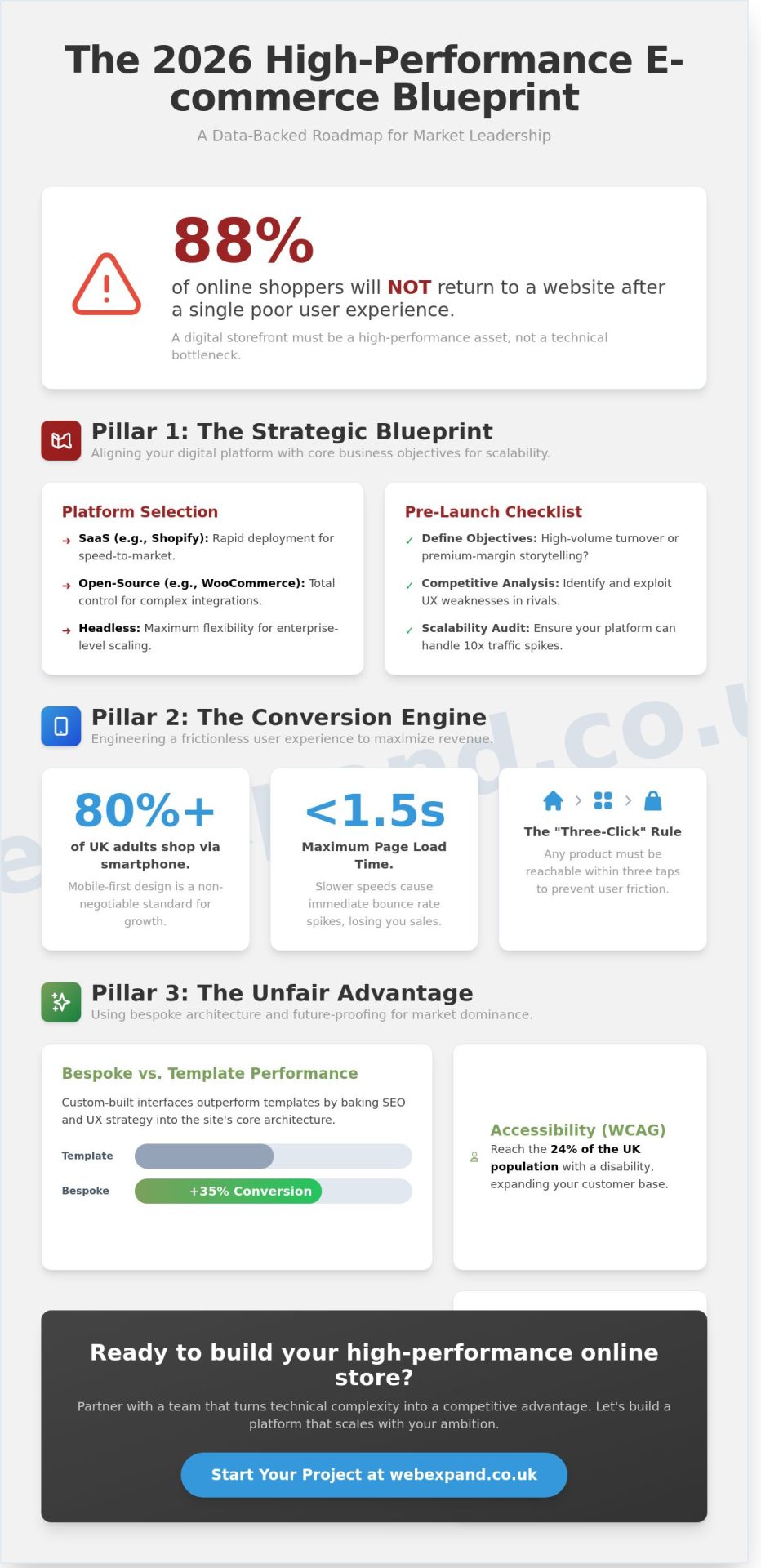
A staggering 88% of online shoppers will not return to a website after a single poor user experience. You likely agree that a digital storefront should be an asset, not a technical bottleneck that prevents you from scaling. Roughly 74% of growing businesses fear launching a site that fails to rank or struggles with complex stock integrations, which is why the benchmark for ecommerce web design has shifted. It’s no longer about simple templates; it demands a bespoke, high-performance engine that prioritises visibility and precision.
We’ve developed this 2026 checklist to provide a clear, data-backed roadmap for project success and market leadership. You’ll learn exactly how to build a scalable platform that handles technical complexity while you focus on your core business expansion. This guide previews the 12 critical pillars of high-performance design, including seamless payment integration, advanced SEO architecture, and the conversion strategies required to outperform your competition within the competitive digital market.
Key Takeaways
- Align your digital blueprint with core business objectives to identify market gaps and accelerate brand expansion.
- Master the “three-click” rule and mobile-first engineering to eliminate user friction and maximise conversion potential.
- Discover how bespoke ecommerce web design london integrates advanced ERP and CRM systems for seamless, real-time business management.
- Future-proof your brand visibility by optimising for Generative Engine Optimisation (GEO) and AI-driven search results.
- Execute a rigorous launch and post-live strategy to ensure technical stability and sustained ROI as you scale.
Strategic Planning: The Ecommerce Web Design London Blueprint
Launching a digital storefront in the UK capital requires more than a functional website; it demands a tactical roadmap focused on aggressive scalability. Your success hinges on a deep understanding of ecommerce fundamentals before the first line of code is written. We start by defining your primary objective. High-volume models prioritise rapid stock turnover, while margin-focused brands invest in premium storytelling to justify higher price points. In a city where 2023 retail data showed digital sales holding over 26% of the total market, identifying your niche gap is vital. We analyse your London-based competitors to find where their user experience fails. Then, we map a journey that transforms first-time visitors into long-term brand advocates through precision-engineered touchpoints.
Choosing the Right Platform for National Growth
Selecting your technology stack is a critical financial decision that dictates your future agility. SaaS platforms like Shopify offer speed to market, while WooCommerce provides open-source control for complex integrations. For enterprise-level scaling, headless solutions decouple the front-end from the back-end to provide maximum design flexibility. You must ensure your choice supports a 10x traffic surge without performance degradation. Consider the total cost of ownership beyond the initial build. Hosting, domain management, and essential app integrations often range from £50 to over £500 per month depending on your transaction volume. High-performance ecommerce web design london ensures these technical foundations align with your long-term expansion goals.
Defining Your Bespoke Value Proposition
Generic templates dilute your brand authority and often include bloated code that slows down your mobile load speeds. A bespoke approach allows us to bake your SEO strategy directly into the site architecture from the start. This precision drives visibility for your “hero” products, which are the high-margin items that anchor your initial Google promotion. Recent industry audits suggest that custom-built interfaces can outperform standard templates in conversion rates by up to 35%. We focus on building a site structure that doesn’t just look professional but functions as a high-velocity sales tool. This strategic alignment ensures your ecommerce web design london project delivers a measurable return on investment by speaking directly to the needs of the sophisticated UK consumer.
- Define Objectives: Establish if you’re chasing market share or premium positioning.
- Competitive Analysis: Identify specific UX weaknesses in your top three rivals.
- Scalability Audit: Verify that your chosen platform can handle peak season traffic spikes.
- Journey Mapping: Outline every step from the first Google click to the final delivery confirmation.
The Conversion Checklist: Engineering Frictionless UX
Success in the competitive London market hinges on technical precision. You don’t just need a website; you need a high-performance sales engine. By 2026, mobile-first responsiveness is the non-negotiable standard for any brand serious about growth. With over 80% of UK adults now shopping via smartphones, your site must feel native to mobile devices. We build with a focus on frictionless UX to ensure your customers never encounter a digital dead end.
Efficiency drives revenue. We apply a strict “three-click” rule to every project: any product must be reachable within three taps. If a user gets lost in your menu, you’ve lost the sale. Speed is equally critical. Page load times exceeding 1.5 seconds trigger immediate bounce rate spikes. We optimise every asset to ensure your store remains lightning-fast, even during high-traffic periods like Black Friday. To solidify trust, we integrate SSL certificates and verified customer reviews directly into the user journey. The final hurdle is the checkout. Streamline this by offering guest checkout and one-click payment options like Apple Pay or Google Pay to prevent cart abandonment at the last second.
Visual Hierarchy and Brand Expansion
Bespoke imagery and video assets are essential to reduce reliance on generic stock photos that dilute your brand’s authority. We focus on creating a consistent brand voice that stays uniform across all digital touchpoints. This level of detail helps you stand out in the crowded ecommerce web design london scene. Accessibility is another core pillar. Designing for WCAG 2.2 standards ensures your store is accessible to the 24% of the UK population with a disability, significantly expanding your potential customer base and protecting your brand’s reputation.
Product Page Optimisation
High-quality product descriptions are the foundation of CRO because they replace the physical experience of handling a product with persuasive, data-driven storytelling. Every page should feature dynamic pricing and real-time stock indicators to drive immediate action. We also implement “similar items” logic to increase your average order value through relevant recommendations. Social proof, such as user-generated photos or star ratings, should feel like a natural part of the layout. If you’re ready to scale your operations and capture more market share, our bespoke ecommerce strategies can transform your digital presence into a market leader.
Technical Infrastructure & Advanced Integrations
Your store’s backend is the engine room of your digital expansion. To dominate the UK market, you must move beyond basic templates and invest in a stack that handles high-volume traffic without a stutter. We focus on ecommerce web design london that prioritises seamless connectivity. This starts by linking your storefront to your ERP or CRM systems. Whether you use Microsoft Dynamics, Sage, or Salesforce, real-time inventory synchronisation is vital. It eliminates the risk of overselling and ensures your stock levels are 100% accurate across every channel. For companies looking to learn more about coordinating operations across several digital or physical sites, strategic management is the key to sustainable growth.
Conversion happens at the checkout. You need to offer the UK’s preferred payment methods, including Stripe, PayPal, and Apple Pay, to reduce basket abandonment. Security is equally critical. You must implement robust data protection protocols that align with UK GDPR and ICO standards. Adhering to established usability guidelines for e-commerce ensures your technical infrastructure supports a frictionless buyer journey. We also recommend automating your invoicing and customer notification workflows. This reduces manual admin by up to 40% and keeps your buyers informed from the moment they click “pay” until the parcel arrives at their door.
The Power of Headless and API-First Commerce
Headless commerce decouples your front-end presentation layer from your back-end logic. This architecture offers superior loading speeds, often outperforming traditional monolithic platforms by 25% or more. It future-proofs your brand for the next wave of retail, including voice search through Alexa and IoT device purchases. By using an API-first approach, you can manage multiple storefronts or international sub-domains from a single back-end database. This creates a bespoke experience for different regions while maintaining total control over your global inventory and pricing strategy. For businesses operating across the South East, working with a specialist Shopify developer Kent can unlock the same level of custom API integration and bespoke liquid code development to eliminate platform limitations at scale.
Security and Performance Monitoring
A slow site is a dead site. We host our clients on secure, UK-based servers to maintain 99.9% uptime and lightning-fast response times for local shoppers. Your strategy must include regular security audits and automated malware scanning to protect both your data and your reputation. Precision is everything in modern ecommerce web design london, so we implement GA4 and server-side tracking. Unlike standard client-side cookies, server-side tracking provides a cleaner data set for accurate ROI reporting. This allows you to see exactly which marketing pounds are driving sales and which ones are being wasted, ensuring your growth remains profitable and predictable.
Visibility Checklist: From SEO to Generative Engine Optimisation (GEO)
Traditional search is undergoing a seismic shift. Ranking as a “blue link” is no longer enough to dominate the London market. You now need to ensure your store is the definitive answer provided by AI agents. This evolution requires a technical foundation in ecommerce web design london that prioritises machine readability alongside user experience. If an AI can’t parse your product data, you don’t exist in the next generation of search.
The Shift to AI-Powered Search
Generative Engine Optimisation (GEO) focuses on how platforms like Perplexity and Gemini synthesise information. These engines prioritise content that demonstrates high E-E-A-T (Experience, Expertise, Authoritativeness, and Trustworthiness). To win here, you must move beyond simple keyword density. Modern search algorithms favour topic clusters; groups of interlinked content that prove you’re an authority on a subject. A 2024 study by SparkToro revealed that zero-click searches have risen to 58.5%, meaning your content must be concise enough for AI to summarise while still driving the user to click for deeper value.
- Schema Markup: Implement advanced Schema.org structured data for every product. This tells Google exactly what your price, stock levels, and delivery times are in real-time.
- Conversational Content: Format your FAQ sections to answer the “why” behind a purchase. AI agents look for natural language patterns that solve specific user problems.
- Citation Building: Focus on being mentioned in “Best of” lists and comparison articles. AI models rely on these citations to recommend your brand as a trusted option.
Local Signals for National Brands
Even if you’re shipping products across the UK, your London roots are a powerful trust signal. Google’s 2024 “Hidden Gems” update rewards businesses that show authentic local connections. You should optimise your Google Business Profile even if you don’t have a physical storefront; it anchors your brand to a specific geographic authority. This local relevance often acts as the gateway to national visibility.
Use location-based landing pages to capture high-intent queries. For instance, a London-based luxury watch retailer should still target regional search intent to capture buyers outside the capital. For a deeper look at how regional targeting drives growth, read our related guide on SEO services Kent. This strategic approach ensures your ecommerce web design london project isn’t just a digital brochure, but a precision-engineered sales tool.
Backlink strategy remains vital, but the focus has shifted to quality over volume. Aim for placements in high-authority UK publications like The Guardian or industry-specific trade journals. A single link from a .co.uk domain with a Domain Authority (DA) over 60 is worth more than hundreds of low-quality international links. We focus on building these high-authority bridges to protect your site from future algorithm volatility.
Ready to outpace the competition with a future-proof visibility strategy? Let’s build your bespoke digital growth engine today.
Launch and Beyond: Scaling Your Digital Presence
Your store’s launch isn’t a finish line. It’s the start of a journey toward market dominance. Before the site goes live, we execute rigorous cross-browser and cross-device testing. Industry data indicates that 88% of online consumers are less likely to return to a site after a single bad experience. We ensure your platform performs flawlessly on everything from an iPhone 15 to a high-resolution desktop. This level of technical precision is what separates standard sites from elite ecommerce web design london projects.
Post-launch momentum depends on a data-driven digital marketing strategy. We don’t guess what works; we follow the numbers. High-performance ecommerce web design london requires constant refinement to stay ahead of the competition. We monitor conversion rates in real-time and use A/B testing to eliminate friction in the user experience. By partnering with a strategic agency for monthly SEO and performance management, you protect your investment and ensure your visibility continues to climb in search results.
Post-Launch Maintenance and Growth
Many businesses mistakenly view web design as a one-off cost. In reality, fixed-price design projects require ongoing hosting and domain management to stay online and accessible. Security is a non-negotiable priority. We implement regular software and plugin updates to shield your store from evolving cyber threats. As your data accumulates, we help you scale your ad spend. By focusing on real-time conversion data, we ensure your marketing budget targets the highest-performing segments, maximizing your ROI and driving sustainable expansion. To ensure your internal operations keep pace with this growth, you can discover Altum HR for expert guidance on outsourced HR and employment law compliance.
Executing Your Expansion Strategy
Growth means looking beyond your initial borders. We help you identify opportunities for internationalisation, integrating multi-currency support so customers can shop in £, €, or $. To drive repeat business, we leverage sophisticated email and SMS marketing sequences that increase customer lifetime value. This proactive approach transforms a simple shop into a global brand. Partner with ecommerce website developers London to lead your market and engineer a growth engine that lasts well into 2026 and beyond.
Future-Proof Your Brand for the 2026 Shift
Winning the digital race in 2026 demands more than a standard storefront. It requires a high-performance engine built on frictionless UX and advanced Generative Engine Optimisation. As search behaviours shift toward AI-driven answers, your brand’s visibility depends on technical precision and strategic depth. Since 2004, Webexpand has helped ambitious UK businesses transform their digital presence into high-yield assets. By prioritising ROI-driven bespoke design and robust infrastructure, you ensure your platform doesn’t just launch; it scales effectively across the global market. Navigating the complexities of ecommerce web design london doesn’t have to be overwhelming when you have a partner focused on measurable growth. You deserve jargon-free expert advice that translates complex data into clear, actionable steps for your team. The transition from a local player to a market leader starts with a roadmap tailored to your specific expansion targets. We’re ready to turn these technical checklists into a sustainable competitive advantage that protects your interests for years to come.
Ready to expand your market reach? Book a bespoke strategy session with Webexpand today.
Frequently Asked Questions
How much does bespoke ecommerce web design in London typically cost?
Bespoke ecommerce web design in London typically starts at £5,000 for small businesses, while enterprise-level solutions often exceed £50,000. These costs reflect the precision required for custom integrations, unique user journeys, and conversion-optimised architecture. You’re investing in a scalable asset designed to outperform generic templates. Every pound spent focuses on driving measurable ROI through superior site speed and brand-specific functionality.
How long does it take to build a custom ecommerce website?
A custom ecommerce website usually takes between 8 and 16 weeks to launch. This timeline covers the full strategic lifecycle from initial wireframing to final quality assurance testing. We prioritise a structured workflow to ensure your store goes live with zero technical debt. Rapid deployment is possible for simpler builds, but high-performance expansion requires this window for rigorous data migration and SEO configuration.
Which is better for a new online store: Shopify or WooCommerce?
Shopify is generally better for businesses seeking a managed, high-security environment, while WooCommerce offers total control over every technical detail. Shopify powers roughly 20% of the UK ecommerce market due to its reliability and ease of use. WooCommerce remains the preferred choice for brands that require deep customisation within the WordPress ecosystem. We help you select the platform that aligns with your 3-year growth strategy and technical capabilities. Brands based outside the capital may also benefit from engaging a dedicated Shopify developer Kent to engineer a bespoke store that moves beyond off-the-shelf template constraints.
Can I migrate my existing products and customers to a new website?
You can migrate 100% of your existing product data, customer records, and order history to a new platform without losing information. Our team uses automated scripts and manual verification to ensure data integrity during the transition. Protecting your SEO equity is the priority, so we implement 301 redirects for every legacy URL. This process prevents traffic loss and ensures your loyal customers enjoy a seamless transition to your upgraded store.
What is Generative Engine Optimisation (GEO) and why does it matter for ecommerce?
Generative Engine Optimisation (GEO) is the process of tailoring your content to appear in AI-driven search results like Google Search Generative Experience or Perplexity. This matters for ecommerce web design london because 40% of younger consumers now use AI or social platforms for product discovery. We focus on structured data and authoritative citations to ensure your brand becomes the preferred recommendation for these intelligent systems.
Do I need a separate mobile app for my ecommerce store?
Most London retailers don’t need a native mobile app if their website uses a high-performance responsive design. Mobile commerce accounts for over 70% of UK online sales, so we prioritise mobile-first architecture in every ecommerce web design london project. A Progressive Web App (PWA) often provides a better ROI than a native app. It offers app-like speed and offline functionality without the high development costs of the Apple or Google stores.
What kind of ongoing support do I need after the site goes live?
You need proactive support that includes monthly security patches, server monitoring, and conversion rate optimisation (CRO) audits. Digital landscapes shift quickly, so standing still means falling behind your competitors. Our support packages focus on maintaining 99.9% uptime and identifying new opportunities for market expansion. Regular performance reviews ensure your technology stack remains lean, fast, and ready to handle peak shopping periods.