

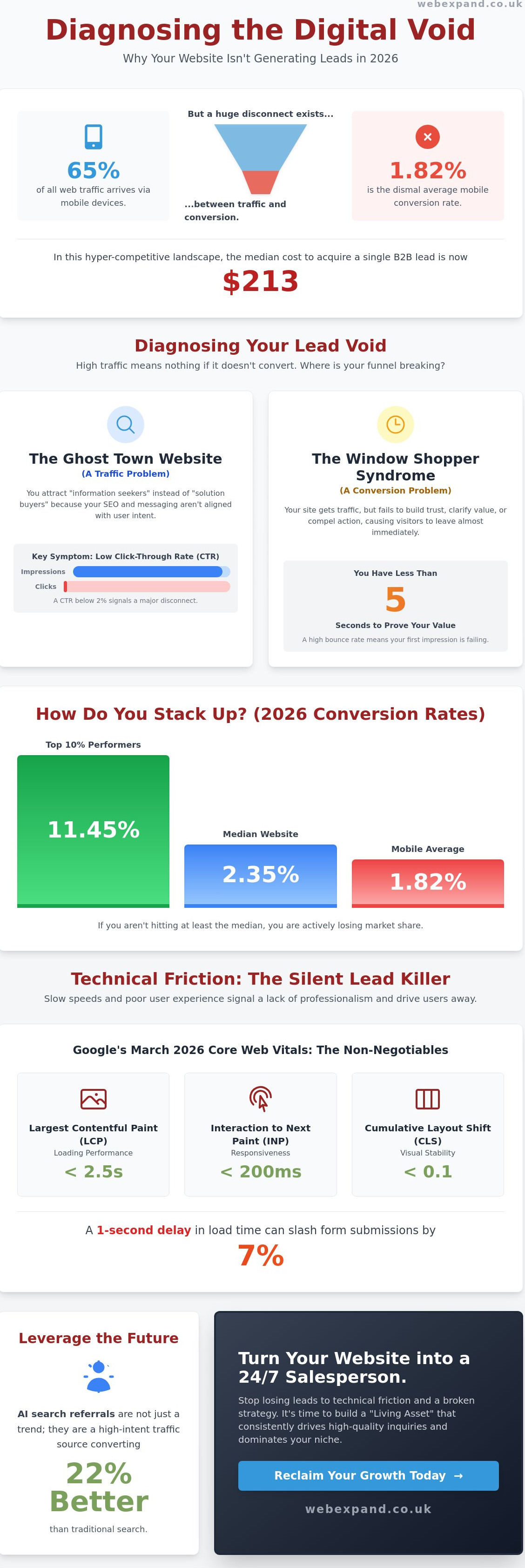
If 65% of your traffic arrives via mobile but converts at a dismal 1.82%, you aren’t just losing visitors; you’re handing market share to your competitors on a silver platter. It’s an exhausting cycle to invest heavily in digital growth only to find yourself asking, “why is my website not getting any leads?” while your marketing budget evaporates. You know your offering is superior, yet the data shows that 61% of marketers still struggle to generate high-quality leads in this hyper-competitive 2026 landscape where the median B2B lead costs $213.
We understand that a stagnant website is a liability rather than the growth engine you deserve. This article promises to reveal the precise technical, psychological, and strategic friction points that are currently killing your conversion rates. You’ll gain a clear diagnostic checklist to reclaim your visibility and dominate your niche. We’ll explore how to navigate the March 2026 Google Core Update and leverage AI search referrals, which convert 22% better than traditional search, to ensure your website finally acts as your most ambitious, 24/7 salesperson.
Key Takeaways
- Learn to diagnose the “Lead Void” by analyzing your traffic-to-conversion ratio to pinpoint whether your challenge is visibility or site performance.
- Discover why meeting the latest Core Web Vitals benchmarks is non-negotiable for retaining impatient prospects in a high-speed digital market.
- Understand how bespoke design bridges the trust deficit, ensuring your brand projects the authority needed to convert skeptical 2026 consumers.
- Identify the specific reasons why is my website not getting any leads by auditing your value proposition and the effectiveness of your transitional calls to action.
- Explore how integrating strategic SEO with a “Living Asset” mindset transforms your website into a high-performance, 24/7 salesperson for your business.
Diagnosing the Lead Void: Is It a Traffic Problem or a Conversion Problem?
Many business owners stare at their analytics dashboards with a sense of growing frustration. They see the numbers ticking upward, yet the phone remains silent. They find themselves asking, “why is my website not getting any leads?” while competitors seem to scale effortlessly. The reality is that lead generation is governed by a precise mathematical formula: Traffic x Conversion Rate = Leads. If your traffic is high but your conversion rate is low, or vice versa, your growth will stall.
The “Lead Void” is the strategic gap between your brand’s digital visibility and the actual engagement that drives revenue. To bridge this gap, you must first understand what a “good” result looks like in 2026. The median website conversion rate currently sits at 2.35%. However, the top 10% of high-performing websites are achieving rates as high as 11.45%. If you aren’t hitting at least the median, you’re leaving money on the table. Having 1,000 visitors arrive at your site means nothing if they aren’t the right 1,000 people with the specific intent to buy.
The Ghost Town Website: When You Have a Traffic Problem
A traffic problem is often invisible until you dig into the data. Open your Google Search Console and compare your total impressions to your actual clicks. If your impressions are high but your click-through rate is below 2%, your messaging isn’t resonating or you’re targeting the wrong keywords. Poor keyword targeting attracts “information seekers” rather than “solution buyers.” Ranking on Page 1 for a generic term might feel like a win, but if that term doesn’t align with your service, it’s a wasted investment that won’t result in a single inquiry.
The Window Shopper Syndrome: When You Have a Conversion Problem
If your traffic is healthy but your bounce rate is climbing, you’re suffering from Window Shopper Syndrome. This happens when your site fails to stop the scroll and force action. In 2026, user intent is the primary driver of success. Visitors today have zero patience for generic templates or confusing navigation. If a user can’t tell exactly what you do and how you solve their problem within 5 seconds, they’ll leave. A high bounce rate usually signals that your website doesn’t match the user’s psychological state. They came looking for an expert, but they found a digital brochure that feels outdated and untrustworthy.
The Technical Friction: How UX and Speed Silently Repel Your Prospects
If your site takes longer than three seconds to load, you’ve already lost the lead. In 2026, user patience has hit an all-time low, and technical lag is the primary reason you’re asking why is my website not getting any leads. Technical friction acts as an immediate psychological barrier that signals a lack of professionalism before a single word of your copy is read. Google reinforced this with the March 2026 Core Algorithm Update, which now aggregates performance into a holistic score. Your Largest Contentful Paint (LCP) must be 2.5 seconds or less, and your Interaction to Next Paint (INP) must stay under 200 milliseconds to avoid being penalized. Additionally, your Cumulative Layout Shift (CLS) should be 0.1 or less to ensure visual stability as the page loads.
Your choice of website hosting often serves as the silent lead-killer. Cheap, shared hosting environments can’t handle the multi-modal interfaces and AI-driven personalization that modern users expect. High-quality hosting ensures that your site stays responsive even during traffic spikes. Investing in Conversion Rate Optimization starts with a high-performance foundation. Without it, even the most persuasive copy won’t save a site that stutters or breaks during the user journey. We focus on precision because every millisecond of delay represents a measurable drop in your ROI.
Mobile-First is Now Mobile-Only
Mobile devices account for 65% of all web traffic in 2026, yet many businesses still design for the desktop first. This mismatch is why mobile conversion rates lag at a disappointing 1.82% compared to 3.14% on desktop. You must test your site on actual handsets to identify the ‘Fat Finger’ problem. If your contact buttons or form fields are too small to tap easily, users will abandon the process. Mobile speed directly correlates to lead volume; a one-second delay can slash your form submissions by 7%. Our approach to SEO services integrates technical excellence with user experience to ensure your site isn’t just visible, but functional.
Navigation Nightmares: Why Users Give Up
Complexity is the enemy of conversion. We advocate for the ‘3-Click Rule’ which states that a prospect should find your contact page or primary service in under five seconds. Bespoke website design eliminates the cluttered, bloated feel of standard templates that confuse visitors. By simplifying your menu and creating clear, logical paths, you guide the user toward the lead goal rather than letting them wander into a dead end. A streamlined interface reduces user anxiety and builds the momentum needed to turn a visitor into a client.
The Trust Deficit: Why Your Website Fails to Build Authority
In an era of AI-generated content and mass-produced digital noise, the “Stranger Danger” effect is at an all-time high. Consumers in 2026 are inherently skeptical. If your site looks like a carbon copy of every other business in your sector, you’ll inevitably wonder reasons your website isn’t driving leads as visitors bounce within seconds. Bespoke Authority is the visual proof of your business’s precision. When you rely on cheap, generic templates, you’re signaling to your prospects that your services might be equally unoriginal. This “cheap” aesthetic ends up being the most expensive mistake you can make in terms of lost ROI.
Trust is no longer a “nice to have” feature; it’s the primary currency of the digital economy. While 90% of B2B buyers now use digital channels to find new vendors, they’re looking for reasons to disqualify you. Static, unverified testimonials are a relic of the past. Social Proof 2.0 requires verified data, live reviews, and deep transparency. If you’re still asking why is my website not getting any leads, consider that your lack of authoritative visual cues is likely creating a massive trust deficit. No amount of traffic can overcome a site that feels “off” to a sophisticated modern buyer who values reliability above all else.
The Psychology of Professionalism
High-quality, original imagery and custom layouts do more than just look good. They signal reliability and attention to detail. Many businesses fall into the “About Us” trap by presenting a faceless corporate wall. In 2026, people still buy from people. A professional Bespoke Website Design is a prerequisite for attracting high-ticket leads who value expertise over the lowest price. It transforms your presence from a digital brochure into a strategic growth engine that justifies your pricing from the first click.
Modern Trust Signals for 2026
Basic requirements like SSL certificates and strict privacy compliance are now baseline expectations. To truly stand out, you must integrate video case studies that prove real-world results. These multi-modal experiences reduce user anxiety and build confidence. Our approach to Google Promotion works best when it’s backed by a site that looks the part. Without these modern signals, your marketing spend is simply subsidizing your competitor’s growth. You need a site that acts as a 24/7 salesperson, not a 24/7 liability that scares away your most valuable prospects.
The Conversion Framework: Mastering CTAs and Value Propositions
If you’ve optimized your site speed and established authority but still find yourself asking why is my website not getting any leads, the failure likely lies in your conversion framework. Your website has approximately five seconds to capture a visitor’s attention before they bounce. During this window, your Value Proposition must communicate exactly what you do and why it matters to the user. A Value Proposition is the bridge between a user’s pain and your solution. If that bridge is shaky or confusing, your traffic will simply flow back to the search results.
Most businesses make the mistake of only offering “Hard CTAs,” such as “Buy Now” or “Contact Us.” However, data from early 2026 suggests that up to 97% of your visitors aren’t ready to make a high-intent purchase on their first visit. To capture these prospects, you must implement “Transitional CTAs.” These are low-friction offers like downloadable guides or free audits that provide value in exchange for an email address. By nurturing the 97%, you build a pipeline of future customers rather than fighting for the small fraction ready to buy today. The anatomy of your buttons also matters. Use high-contrast colors and action-oriented copy like “Get My Free Strategy” instead of passive words like “Submit” or “Send.”
Crafting a Value Proposition That Resonates
Effective headlines focus on benefits rather than features. Instead of listing your technical specifications, tell the user how their life or business improves by using your service. Use the “So What?” Test: read your homepage copy aloud and ask “so what?” from the perspective of a cynical prospect. If your copy doesn’t provide a compelling answer, it needs a rewrite. Bespoke content that speaks directly to your target audience’s specific challenges is a non-negotiable pillar of What Makes a Good Business Website in a competitive market.
Optimising the Lead Capture Process
Friction is the ultimate lead killer. Every additional field you add to a contact form can lower your conversion rate by as much as 10%. Only ask for the absolute essentials; you can gather more data once the relationship is established. Don’t ignore your “Thank You” page either. This is the most underutilised real estate on your site and serves as the perfect place to offer a secondary resource or a link to a high-performing case study. We use targeted Google Promotion strategies to drive traffic to specific, high-intent landing pages that are built specifically to convert, ensuring your marketing spend results in measurable growth. If your current site is failing to convert, it’s time to refine your conversion strategy and turn visitors into loyal clients.
Strategic Expansion: Turning Your Website into a 24/7 Lead Engine
A website is never truly finished. It’s a living asset that requires constant refinement to remain effective in a landscape where 90.7% of marketers rely on their digital presence for growth. If you’ve been asking why is my website not getting any leads, the answer often lies in the lack of a post-launch strategy. High-performing sites aren’t built on “set and forget” principles; they thrive through the synergy between expert SEO Services and a seamless user experience. We treat your website as a dynamic growth engine that evolves alongside your business and the shifting expectations of your audience.
Continuous monitoring is the only way to protect your ROI. By analyzing exactly where prospects drop off, we can implement precise fixes that improve conversion rates over time. The WebExpand philosophy centers on providing jargon-free, data-backed advice. We don’t just look at traffic; we look at the human element of business expansion. In early 2026, with the median B2B cost-per-lead reaching $213, every friction point on your site is a direct hit to your bottom line. Precision isn’t optional. It’s the foundation of your market leadership.
The Role of Ongoing SEO and Marketing
Effective Google Promotion isn’t a one-time event. It requires a monthly management strategy to navigate the continuous algorithm updates that Google now rolls out every three months. The March 2026 Core Update changed how site reputation and technical performance are scored, punishing those who fail to maintain their digital standards. Strategic Digital Marketing expands your reach by identifying new search trends and AI-driven referral opportunities before your competitors do. This proactive approach ensures your lead flow remains stable even when the digital landscape shifts.
Taking the Next Step Toward Expansion
Transitioning from a passive brochure site to a high-performance lead generation engine starts with a professional audit. This process identifies the “silent killers” like broken mobile pathways or misaligned value propositions that repel qualified prospects. While off-the-shelf templates offer a quick fix, bespoke solutions are built for long-term scalability. They provide the technical flexibility needed to integrate conversational AI and personalized interfaces, which 62% of B2B sites are expected to use by Q2 2027. We’re here to guide you through this transformative journey, ensuring your website becomes your most reliable partner in expansion.
Reclaim Your Competitive Edge in 2026
Your digital presence should be your most powerful asset, not a source of frustration. You’ve identified the technical, psychological, and strategic reasons why is my website not getting any leads, and now it’s time to implement the fixes that drive expansion. By optimizing for the March 2026 Core Algorithm Update and refining your value proposition, you move closer to joining the top 10% of performers who enjoy conversion rates as high as 11.45%. Success in this landscape requires a shift from a static brochure mindset to a dynamic, ROI-driven strategy.
WebExpand has been a strategic partner for businesses since 2004, providing expert, jargon-free advice that turns technical complexity into measurable growth. We specialize in proven, ROI-focused bespoke designs that build immediate authority and capture the 97% of visitors who aren’t yet ready to buy. Don’t let your marketing budget continue to leak through a site that repels your ideal prospects. Book Your Bespoke Website Audit with Webexpand Today to identify the silent killers on your site. You have the potential to dominate your niche, and we have the precision to help you get there.
Frequently Asked Questions
How many leads should a small business website realistically generate?
A realistic lead volume depends on your traffic and the industry median conversion rate of 2.35%. If you attract 1,000 targeted visitors, you should expect approximately 23 leads under standard conditions. Top-tier websites in the top 10% achieve rates of 11.45%, which would result in 114 leads from the same traffic. We focus on moving your site toward that higher bracket through precision and strategic design.
Is it better to have a complex form or a simple one for lead generation?
Simple forms always outperform complex ones because they remove friction from the user journey. Data shows that every additional field you include can lower your conversion rate by 10%. Only ask for the absolute essentials like an email address or phone number. You can qualify the lead further once the initial connection is established and trust is built.
Why is my website traffic high but my lead count zero?
High traffic with zero leads usually signals a mismatch between user intent and your content. You might be ranking for informational keywords rather than transactional ones. This is a common reason why is my website not getting any leads even with thousands of monthly visitors. If your site doesn’t stop the scroll within five seconds, users will bounce back to the search results.
Does the design of my website really affect how many leads I get?
Design is the primary driver of digital trust and directly impacts your lead volume. Research indicates that 94% of a user’s first impression is related to your site’s visual appeal. A bespoke design signals authority and professionalism, whereas cheap templates often create a trust deficit. High-ticket leads specifically look for bespoke indicators before they’re willing to share their contact information.
While bespoke design is ideal for high-ticket authority, small businesses can still achieve a professional standard through structured solutions like those from Good Budget Website, which focus on essential trust signals to ensure the site functions as a lead-generation tool rather than just a digital brochure.
Can SEO help me get more leads, or just more traffic?
SEO is designed to drive high-quality leads by targeting users with specific purchase intent. In 2026, traffic from AI search platforms like ChatGPT converts at 3.49%, which is 22% higher than traditional organic search at 2.86%. By optimizing for these high-intent queries, we ensure you aren’t just getting more traffic. You’re getting more prospects who are actually ready to hire you.
How often should I update my website content to keep leads coming in?
You should update your content continuously to stay aligned with Google’s core algorithm updates, which now occur approximately every three months. The March 2026 update specifically penalized sites with stale or low-quality content. Regular updates ensure your site remains relevant to both search engines and users. A living asset approach protects your lead flow from sudden drops in visibility.
What is a ‘Transitional CTA’ and do I need one?
A Transitional CTA is a low-friction offer, like a free guide or audit, designed for the 97% of visitors who aren’t ready to buy immediately. You absolutely need one to build a long-term pipeline. Most people leave a site without purchasing on their first visit. Capturing their email through a transitional offer allows you to nurture the relationship until they are ready to convert.
How much does it cost to fix a website that isn’t converting?
The cost of fixing a non-converting site is an investment in reducing your long-term acquisition costs. With the median B2B cost-per-lead currently at $213, a site that fails to convert is a massive financial drain. While we don’t provide flat rates without a bespoke audit, the ROI of a strategic fix is measured by how quickly it pays for itself through increased lead volume.