

Your DIY website was built to help you start, but it was never designed to help you win. While drag-and-drop platforms offer a low-cost entry point, they eventually become a glass ceiling that stifles your brand’s authority and search engine visibility. You’re likely researching the average cost of a bespoke website uk because your current site can’t handle the custom features or the lightning-fast speeds your customers now demand. It’s a common frustration for ambitious businesses ready to move beyond basic templates and dominate their sector.
We understand that choosing to reinvest in your digital infrastructure is a significant strategic move. You’ve worked hard to validate your business model, and now you need a platform that reflects your professional expertise. This guide identifies the critical inflection points where your current site starts costing you more in lost leads than it saves in monthly fees. We’ll show you how to transition to a high-performance bespoke solution that secures superior Google rankings and scales alongside your ambitions, turning your website into a transformative engine for growth.
Key Takeaways
- Identify the specific performance bottlenecks, such as plateaued search rankings and slow mobile loading, that signal your business has outgrown its current template.
- Understand how clean, hand-coded architecture provides a superior foundation for advanced SEO services compared to the cluttered code found in standard drag-and-drop builders.
- Evaluate your investment by comparing the average cost of a bespoke website uk against the long-term ROI of a platform built for national reach and high-value client acquisition.
- Learn the strategic steps for a successful migration, starting with a comprehensive data audit to ensure your existing search visibility remains protected during the transition.
- Discover how transitioning to a tailored digital presence transforms your website from a simple brochure into a high-performance engine capable of dominating your sector.
The DIY Ceiling: Why Successful Businesses Outgrow Website Builders
Every successful business reaches a point where its tools start working against its ambitions. Many UK entrepreneurs start their digital journey by asking What is a DIY Website Builder? and finding that these platforms are perfect for launching a concept with minimal risk. However, as you scale, you will eventually hit the “DIY Ceiling.” This is the invisible barrier where the very templates that enabled your start begin to obstruct your expansion. By 2026, consumer expectations have shifted towards high-speed, high-authority experiences. Users no longer tolerate generic layouts that feel like a carbon copy of a hundred other businesses.
A DIY site often functions as a digital brochure; it tells people you exist, but it rarely drives significant growth. In contrast, a high-performance growth engine actively converts visitors into high-value clients through precision engineering. Staying on a template-based platform for too long creates technical debt. This is the accumulation of messy, bloated code and rigid structures that make future updates difficult and slow down your site’s performance. You are effectively building on rented land with limited control over your foundation, which can be a dangerous position for an ambitious brand.
Validation vs Dominance: The Two Phases of Digital Presence
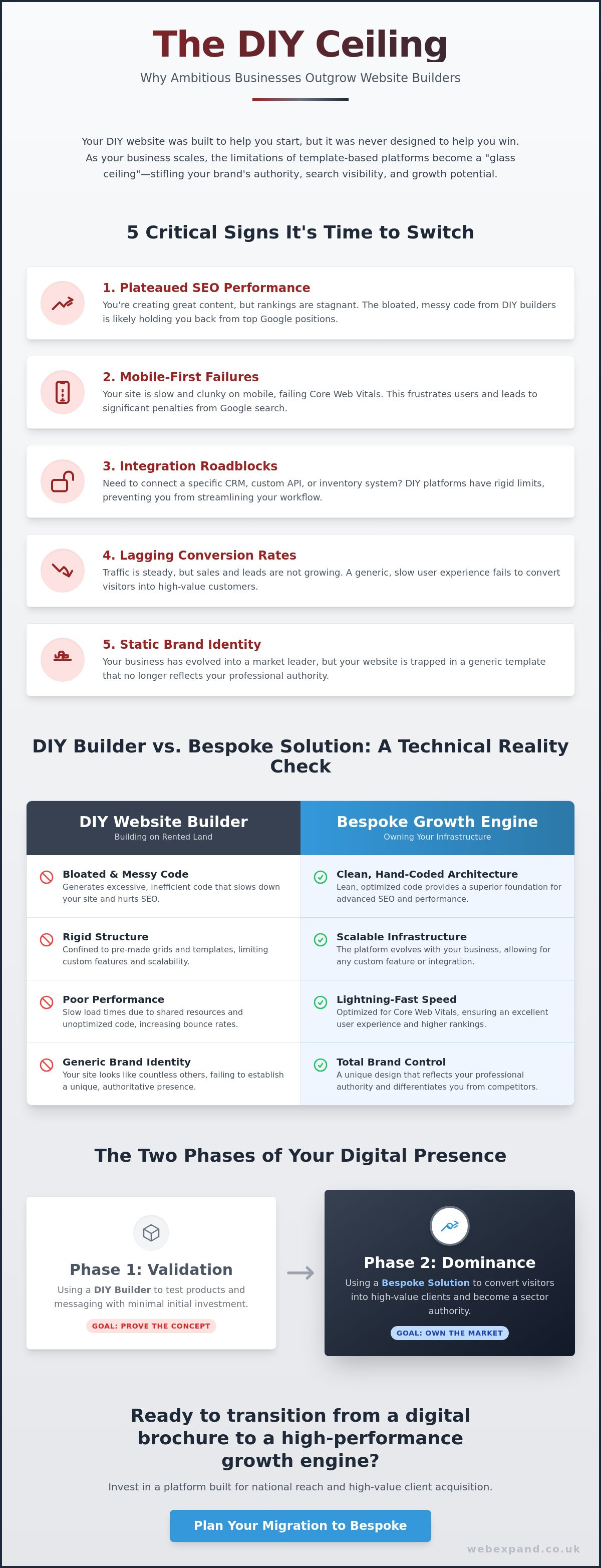
DIY platforms are excellent for the validation phase of a business. They allow you to test products and messaging without a heavy initial investment. But as you transition into the dominance phase, you need a brand identity that isn’t trapped by a pre-made grid. Market leaders don’t just use tools; they own their infrastructure. Transitioning to a bespoke solution offers several strategic advantages:
- Total control over brand aesthetics to reflect professional authority.
- Clean, hand-coded architecture that supports advanced SEO.
- Scalable infrastructure that evolves alongside your business goals.
When you start researching the average cost of a bespoke website uk, it’s a clear sign you’re ready to stop being a service-user and start being a sector authority. This shift in mindset is what separates businesses that plateau from those that broaden their horizons.
Identifying the Point of Diminishing Returns
You can measure the cost of staying on a DIY platform in more than just monthly subscriptions. Calculate the hours your team spends fighting a rigid builder to add a simple custom feature. Consider the financial impact of high bounce rates caused by slow loading times on mobile devices. Often, that “cheap” monthly subscription becomes your most expensive overhead because it’s throttling your lead generation. While the average cost of a bespoke website uk requires a higher upfront commitment, it removes the friction that prevents your business from reaching its full potential. A site that doesn’t scale with you is a liability that costs you more in lost opportunities than a professional build ever will.
5 Critical Signs It is Time to Switch from a DIY Website Builder
Recognising growth friction before it stalls your revenue is a hallmark of a successful leader. It’s easy to overlook minor technical hurdles when you’re focused on daily operations, but these small issues often mask deeper structural failures. You might be researching the average cost of a bespoke website uk because you’ve noticed that your digital presence no longer matches your business’s real-world authority. When your platform starts dictating what you can’t do, it has ceased to be a tool and has become a liability.
- Plateaued SEO performance: You’re publishing high-quality content, but your rankings remain stagnant because your template’s code bloat is holding you back.
- Mobile-first failures: Your site fails Core Web Vitals, resulting in a clunky experience for the 2026 mobile user and a penalty from Google.
- Integration roadblocks: You’re unable to connect the specific CRM, inventory management, or custom APIs required to streamline your workflow.
- Conversion lag: Your traffic is steady, yet your conversion rates are falling behind industry benchmarks for tailored, high-performance sites.
- Static brand identity: Your business has evolved into a market leader, but your website still looks like a generic, off-the-shelf template.
When these signs appear, the “cheap” monthly subscription of a DIY builder becomes your most expensive overhead. It’s costing you high-value leads and search engine visibility that your competitors are likely claiming. Investing in bespoke web design isn’t just about aesthetics; it’s about removing the technical barriers to your next stage of growth.
Performance Bottlenecks and Mobile-First Failures
In 2026, Google’s algorithms are more sensitive than ever to technical efficiency. DIY builders often rely on “div-soup”-layers of unnecessary code used to make drag-and-drop interfaces work. This bloat slows down your site, particularly on mobile devices where processing power is limited. Furthermore, forced platform updates can break your custom workarounds, leaving you with a broken site and no control over the fix. Professional design provides the technical precision needed to pass every performance audit with ease.
The Invisibility of Poor User Experience (UX)
Template fatigue is a real phenomenon among UK consumers. When a potential client visits your site and sees the same layout used by a hundred other small businesses, trust diminishes instantly. Rigid navigation structures in DIY builders often force users into awkward journeys that don’t align with their needs. A bespoke platform allows us to map out intuitive user paths that guide visitors toward conversion, turning your digital presence into a persuasive and authoritative sales tool.
Bespoke vs DIY: The 2026 Technical Reality Check
While visual builders offer a convenient interface for beginners, they hide a messy technical reality that often throttles business growth. Drag-and-drop platforms rely on what developers call “div-soup,” which is an excessive layering of redundant code required to make a generic editor function. This bloat isn’t just a background issue; it directly impacts your site’s ability to pass modern performance audits. In contrast, a bespoke build uses hand-coded precision where every line of code serves a specific purpose. This lean architecture ensures your platform remains incredibly fast and responsive, which is why the average cost of a bespoke website uk is often viewed as a premium investment in long-term technical stability.
Ownership and security also separate these two models. DIY ecosystems operate as “walled gardens” where you rent your digital presence rather than owning it. If you rely on third-party plugins for core functionality, you’re creating multiple points of failure and potential security vulnerabilities. A bespoke solution offers total portability and asset ownership. You own the code, the database, and the intellectual property. Integrating advanced SEO services into a bespoke environment allows for deeper technical optimisations that generic builders simply cannot support due to their rigid server-side restrictions.
SEO Architecture: Beyond the Metadata
True search engine dominance in 2026 requires more than just filling in basic metadata fields. It demands complete control over the server environment, custom schema markup, and advanced technical optimisations that DIY platforms often block. For businesses with complex ecommerce requirements, this level of control is non-negotiable. A bespoke site allows for server-side customisations that ensure your product data is indexed with absolute precision, giving you a significant advantage over competitors trapped in restrictive templates. Real SEO dominance requires a foundation built on technical excellence rather than just surface-level checklists.
Scalability and Future-Proofing Your Investment
A custom build provides a modular foundation that allows your digital presence to evolve without requiring a total rebuild every two years. You can integrate proprietary software, custom APIs, or advanced inventory management tools directly into a bespoke environment with ease. This flexibility ensures your infrastructure is ready for the shifts we expect in 2027 and beyond. Understanding the average cost of a bespoke website uk helps you frame this transition as a strategic move toward building a permanent, scalable asset that you actually own. You’re not just buying a website; you’re securing a future-proof platform that broadens your horizons and protects your long-term interests.
Planning the Migration: A Strategic Roadmap to Bespoke
Transitioning from a template to a custom build is a strategic overhaul, not a simple copy-paste exercise. While you’re likely evaluating the average cost of a bespoke website uk, the success of your investment depends entirely on how you manage the migration. Moving to a high-performance platform allows you to shed the technical debt we discussed earlier and replace it with a foundation built for scale. A poorly executed move can damage your existing search visibility, so you must treat this process as a precision operation rather than a quick fix.
Your roadmap begins with a clear definition of the custom functionalities your DIY builder currently lacks. Whether it’s a sophisticated booking system, complex e-commerce integrations, or bespoke client portals, these requirements should drive the development process. Mapping out your content migration is equally critical. You need to preserve your hard-earned link equity through a rigorous redirect strategy, ensuring that your existing Google rankings don’t vanish when your new site goes live.
Auditing Your Digital Assets
Before writing a single line of code, we must identify which parts of your current site are driving value and which are dead weight. A comprehensive audit involves analysing heatmaps and user recordings to see where visitors are dropping off due to template limitations. This data informs the new bespoke design, allowing us to fix UX friction points from the start. We recommend setting clear, measurable KPIs for the new site, such as a 20% increase in lead generation or a significant reduction in mobile bounce rates. This ensures your transition has a quantifiable impact on your bottom line.
Choosing the Right Strategic Partner
Building a market-leading digital presence requires more than just a coder; it requires a strategic partner who understands your business goals. When you consult a professional web design agency, you should look for a team that offers jargon-free communication and focuses on measurable outcomes. Evaluate portfolios based on performance results and conversion improvements rather than just aesthetics. A true partner will challenge your assumptions and suggest solutions that broaden your horizons and protect your long-term interests.
Ready to move beyond the limitations of your current platform? To ensure your transition is handled with technical precision, consult with our strategic design team to begin your migration planning today.
Broadening Your Horizons: The ROI of Bespoke Web Design
Investing in a custom digital platform is the definitive step toward professionalising your brand. While the average cost of a bespoke website uk reflects a significant initial commitment, it transforms your online presence from a local brochure into a national asset. By 2026, the market has become too competitive for businesses to rely on restrictive templates that fail to project authority. A bespoke build allows you to serve a national audience with technical precision, ensuring that your brand message resonates with high-value clients who expect a seamless, professional experience.
Professional bespoke web design also delivers substantial long-term savings by reducing your reliance on expensive paid advertising. When your site is engineered with clean code and a logical architecture, your organic reach improves naturally. This superior search engine visibility means you spend less on constant Google Promotion to maintain your position. You aren’t just buying a new look; you’re building a scalable growth engine that lowers your overall marketing costs while increasing the quality of your incoming leads.
Turning Your Website into a 24/7 Sales Force
Your website should do more than just sit there. It needs to work as an active participant in your sales process. Custom-built funnels allow us to map out specific user journeys that shorten the sales cycle and address customer pain points before they even speak to your team. Industry observations indicate that businesses making the switch from DIY builders to tailored platforms often experience a sharper increase in conversion rates. This happens because the site is no longer a passive presence but a high-performance tool designed for one specific goal: driving your organisational growth.
Next Steps: Your Journey Toward Industry Leadership
2026 is the year to stop settling for “good enough” templates that hold your business back. The transition to a custom platform is a collaborative journey that requires a partner invested in your data and your long-term success. We move beyond simple maintenance to create a transformative digital identity that positions you as a leader in your sector. This process ensures your infrastructure is ready for 2027 and beyond, protecting your interests in an ever-shifting technological landscape.
Don’t let a generic template be the glass ceiling for your ambitions. Partner with Webexpand for a bespoke digital transformation and start building a platform that truly reflects your professional authority.
Secure Your Digital Future with a High-Performance Foundation
Transitioning from a DIY builder to a custom platform is a definitive statement of intent for your business. You’ve identified the technical bottlenecks and SEO plateaus that signal the “DIY Ceiling” has been reached. Now, understanding the average cost of a bespoke website uk allows you to view this shift as a strategic investment in your brand’s authority. By shedding code bloat and taking total ownership of your digital assets, you position your business to lead your sector rather than just participate in it.
We’ve been guiding ambitious organisations through this transformative journey since 2004. Our team specialises in jargon-free, strategic growth and brings over two decades of technical expertise to every project. We have a proven track record in national SEO and bespoke development, ensuring your new site becomes a powerful engine for expansion. Ready to outgrow your template? Consult with our bespoke design experts today. Your journey toward industry leadership starts with a platform that finally scales with your vision.
Frequently Asked Questions
Is it difficult to move my content from a DIY builder to a bespoke site?
Moving content requires a systematic migration process rather than a simple export. We perform a full data audit to identify your most valuable assets and map them to a new, high-performance architecture. This ensures your brand story remains consistent while your technical foundation moves from a restrictive template to a scalable, custom environment.
Will I lose my Google rankings if I switch to a new bespoke website?
You won’t lose your search visibility if the transition is managed with technical precision. We use 301 redirects and careful URL mapping to protect your existing search equity and link power. Many businesses find that after investing in the average cost of a bespoke website uk, their rankings actually improve because clean, hand-coded architecture is much easier for Google to crawl and index.
How long does the transition from a DIY platform to a custom build take?
A professional agency build typically takes between 8 and 16 weeks depending on the complexity of your requirements. This timeframe allows for the strategic planning, tailored design, and rigorous testing needed to ensure your platform is a true growth engine. It’s a thorough process designed to deliver a high-quality asset that serves your business for years to come.
Can I still manage my own content on a bespoke business website?
Yes, you retain full control over your content through a custom-configured CMS. Unlike restrictive DIY builders, a bespoke system is built specifically around your unique workflow. This allows you to update text, images, and blog posts easily without the risk of breaking the site’s core design or slowing down its performance.
What is the real cost difference between a DIY builder and bespoke design over three years?
DIY builders have low monthly fees but often result in high opportunity costs through lost leads and poor search visibility. A bespoke site requires a higher initial investment but provides a scalable platform that reduces long-term marketing spend and improves conversion rates. You should view the average cost of a bespoke website uk as a strategic asset that pays for itself through superior business performance.
Do I need a bespoke website if I only have a small business?
You need a bespoke site if your ambition is to dominate your sector and outpace larger competitors. While a simple template might suffice for a basic digital brochure, a custom build is essential for any small business looking to scale nationally. It provides the professional authority and technical efficiency required to win high-value clients who expect a premium experience.
What technical features can a bespoke site offer that DIY builders cannot?
Bespoke sites offer total server-side control and clean, hand-coded architecture that eliminates the code bloat typical of drag-and-drop builders. This allows for deep API integrations with your internal CRM, inventory systems, or proprietary software. You get a platform tailored to your exact operational requirements rather than trying to force your business processes into a platform’s rigid limitations.
This level of customization is crucial for businesses that need to sync their website with complex industrial hardware, such as the bagging systems manufactured by Choice Bagging Equipment, ensuring that every part of the operation is digitally integrated.
How do I know if my current DIY site is actually hurting my brand reputation?
High bounce rates and poor mobile performance scores are clear indicators that your site is frustrating potential clients. If your digital presence looks identical to hundreds of other businesses, you’re likely suffering from template fatigue. A generic website often suggests a generic service, which can drive your most valuable leads straight into the arms of your competitors.