

What if hiring a single SEO manager in 2026 costs your business up to $215,000 in total compensation, yet still leaves you trailing behind rapid AI-driven search shifts? It’s a frustrating reality for ambitious leaders who feel caught between the massive overhead of internal recruitment and the fear of becoming just another account at a firm. When weighing in-house seo vs agency pros and cons, the decision isn’t just about desk space; it’s about whether you’re securing a single set of hands or a diverse ecosystem of specialized talent.
You already know that organic search drives 53% of all website traffic, so getting this right is essential for your bottom line. This article provides a strategic framework to help you decide whether to build an internal team or partner with experts to dominate search results. We’ll explore how to achieve 3x higher ROI through specialized execution and access elite-level strategy, ensuring your brand leads the market throughout 2026 and beyond.
Key Takeaways
- Understand the fundamental shift from traditional keyword targeting to complex AI-driven search ecosystems to future-proof your digital presence.
- Evaluate in-house seo vs agency pros and cons through a strategic lens that weighs deep brand integration against rapid, specialist-led scalability.
- Use our growth-focused decision matrix to determine whether an internal hire or a strategic partner aligns with your current technical maturity and revenue goals.
- Discover why the Total Cost of Employment (TCE) for internal teams often makes a bespoke agency model the more efficient path to sector dominance.
- Learn how a personalized partnership offers a middle ground, providing the agility of an internal team with the elite tools of a high-performance agency.
The SEO Landscape in 2026: Why the Management Model Matters
The search environment has shifted fundamentally. In 2026, Search Engine Optimization (SEO) is no longer a peripheral marketing task; it’s a core operational function. Choosing between an internal hire and an external partner requires a deep understanding of the in-house seo vs agency pros and cons. An in-house model involves a dedicated employee focused entirely on your brand, while an agency provides a scalable ecosystem of experts. Both have merits, but the decision impacts your ability to pivot as search technology evolves.
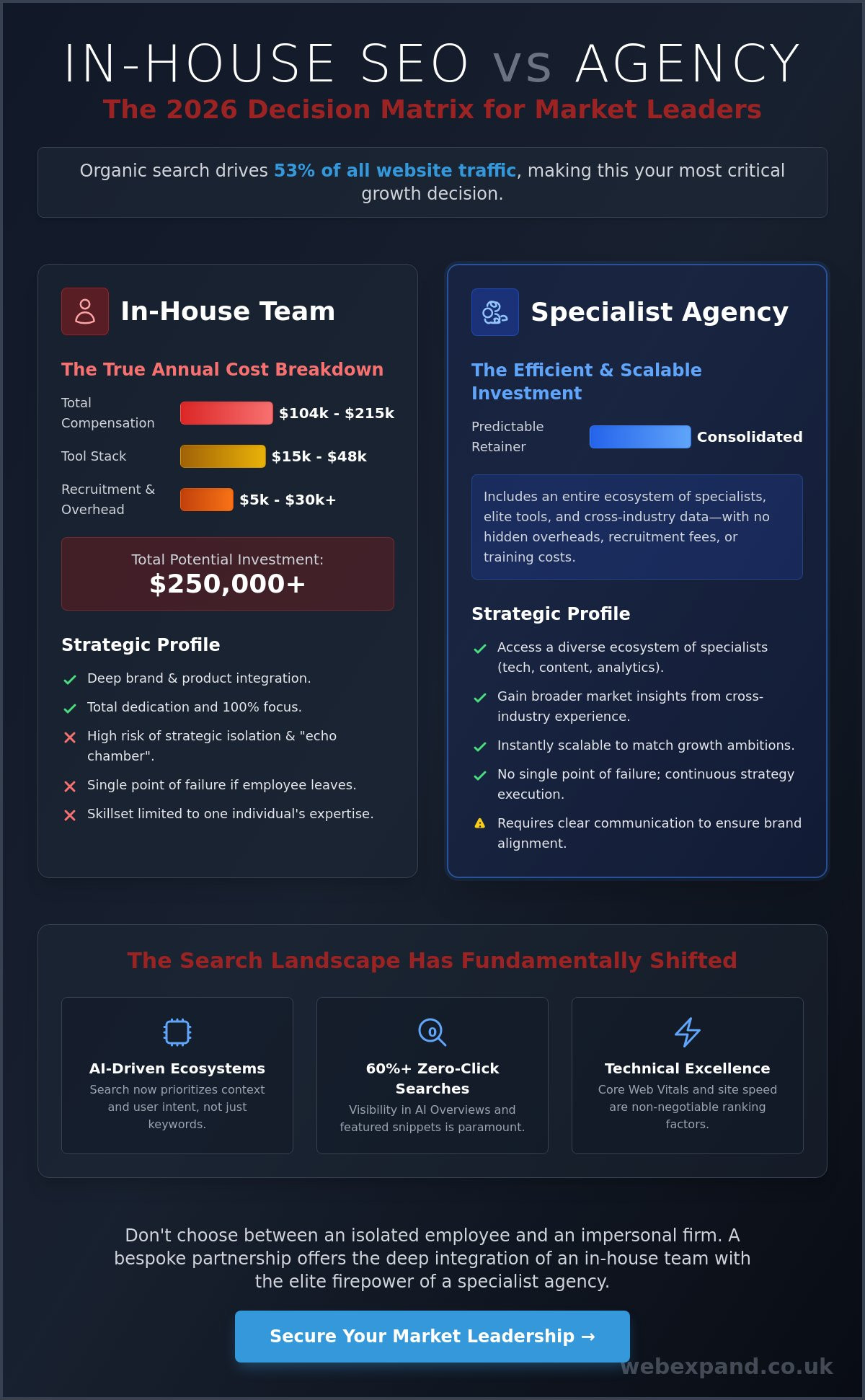
We’ve moved past simple keyword matching. Today, AI-driven search ecosystems prioritize context, user intent, and technical precision. For UK businesses, a “set and forget” strategy is a recipe for invisibility. With zero-click searches accounting for over 60% of all queries according to growth-onomics data, your digital presence must be dynamic. Search engines now demand high performance across Core Web Vitals, making technical health a non-negotiable ranking factor. Analyzing the in-house seo vs agency pros and cons helps you identify which model supports these rigorous technical needs.
The Rise of Technical Complexity
Modern search visibility requires a multi-disciplinary approach. You need a mix of roles that rarely exist in one person. To dominate your sector, your team must include:
- Technical developers to optimize for Core Web Vitals and site speed.
- Content strategists to craft messaging that satisfies AI Overviews.
- Analysts to monitor Generative Engine Optimization (GEO) and structured data.
Expecting a single in-house hire to master every discipline is unrealistic. This complexity turns your digital presence into a transformative journey. It’s no longer about maintenance; it’s about industry leadership through technical excellence and precision.
Defining Your Search Ambitions
Your management model must match your growth trajectory. If you aim for aggressive market domination, you need a structure that can scale instantly without recruitment lags. Your choice reflects your commitment to organizational growth. If you treat search as a secondary concern, your results will follow that same path. High-growth businesses understand that search isn’t just about traffic; it’s about protecting their financial performance in an increasingly automated marketplace.
In 2026, the strategic management of search is the decisive factor that determines whether a brand remains a participant or becomes the definitive authority in its sector.
In-House SEO Pros and Cons: The Value of Deep Focus
Hiring internally offers a level of ownership that’s difficult to replicate through external partnerships. You gain a team member who breathes your brand identity every hour of the workday. When you analyze the in-house seo vs agency pros and cons, this total dedication stands out as the primary driver for many UK firms. An internal specialist can walk over to the product team or join a development sprint meeting on a whim, ensuring that search considerations are baked into every organizational decision from the start.
This proximity allows for instant collaboration across departments. Your SEO lead can work directly with sales to understand shifting customer pain points or coordinate with PR for immediate link-building opportunities. However, this deep integration often creates a strategic echo chamber. Without exposure to other industries, internal teams frequently miss broader shifts in search behavior. Many leaders find that evaluating the pros and cons of in-house vs. agency SEO requires looking beyond the immediate convenience of a desk-side chat to see the risks of isolation.
The True Cost of an Internal Hire
The financial commitment of an internal hire extends far beyond a monthly paycheck. Based on April 2026 data, an SEO manager’s base salary typically reaches up to $143,000. Once you factor in benefits, taxes, and overhead, the fully loaded cost lands between $104,000 and $215,000 annually. You must also account for a professional tool stack, which costs between $15,000 and $48,000 per year. Recruitment itself is a hurdle; average costs sit at $4,700 per hire, with recruiter fees often hitting 20% of the first-year salary. If your lead SEO leaves, your entire strategy faces a single point of failure, leaving your search presence vulnerable while you restart the expensive hiring process.
Brand Intimacy vs. Strategic Blindness
Deep product knowledge is a double-edged sword. While an in-house expert knows your technical specifications perfectly, they may struggle to maintain an objective perspective. They often fall into the trap of using internal jargon that customers don’t actually search for. This strategic blindness can limit your creative reach. Internal models also struggle to scale during rapid growth phases because one person only has so many hours in a day. If you want to expand your reach without the friction of traditional hiring, bespoke search engine optimisation provides a more agile path to industry leadership.
In 2026, the challenge for internal teams is staying current. The skills required to manage AI-driven search experiences change weekly. This necessitates a massive, ongoing investment in training to prevent your internal talent from becoming obsolete in a fast-moving market.
Agency SEO Pros and Cons: Accessing the Specialist Ecosystem
The financial logic of the agency model is compelling. Building a functional 4-person in-house team costs between $400,000 and $620,000 annually once you factor in benefits and recruitment. In contrast, an agency provides instant scalability. You gain immediate access to a dedicated strategist, a technical lead, and content specialists without the $4,700 average recruitment cost per hire. Agencies also absorb the high cost of enterprise-level toolsets, which typically range from $15,000 to $48,000 per year, providing your business with elite data without the direct overhead.
Accountability remains a primary driver for the agency model. Outsourced campaigns generate a 3x higher ROI on average compared to in-house efforts, according to 2026 data from growth-onomics. Agency contracts naturally focus on measurable financial performance, as their continued partnership depends on delivering clear value. This results-driven pressure ensures that your digital presence remains a priority rather than a task that gets buried under internal administrative burdens.
The Power of Collective Intelligence
Success in modern search requires more than a generalist. Agencies provide a collective intelligence that a single hire simply cannot replicate. Because they manage multiple accounts, they see how search engine algorithm updates affect different site architectures in real-time. This bird’s-eye view allows them to implement proven strategies while others are still guessing. For businesses ready to dominate their sector, this depth of expertise is the difference between maintaining visibility and achieving industry leadership.
Navigating the Common Agency Pitfalls
Many businesses fear being treated as just another account or getting lost in a sea of technical jargon. Transparency is a non-negotiable value in a successful partnership. You need a partner that acts as a strategic extension of your team, providing clarity instead of complexity. Our SEO services Kent model prioritizes this jargon-free approach, ensuring you understand exactly how your investment translates into growth. By choosing a partner focused on bespoke solutions rather than standardized packages, you protect your interests while scaling your reach.
The Decision Matrix: Choosing the Model for Your Growth
Deciding your path forward requires a cold assessment of your current digital maturity and future revenue drivers. For businesses with annual revenues under $5 million, outsourcing search efforts is almost always the more cost-effective option. The in-house seo vs agency pros and cons become most visible when you calculate the Total Cost of Employment (TCE). While a single manager might seem affordable, their fully loaded cost in 2026 sits between $104,000 and $215,000. When you add a professional tool stack costing up to $48,000 annually, the financial burden of an internal team often outweighs the agility of an agency partnership.
Speed to market is another decisive factor. An agency arrives with established processes and a team of specialists ready to execute on day one. If you need to see results on page 1 of Google to hit quarterly growth targets, the recruitment lag of an internal hire represents a significant opportunity cost. Flexibility also favors the agency model. You can pivot your strategy or scale your investment without the administrative friction of restructuring your payroll or managing redundancies.
When to Hire In-House
Internal hires are most effective for businesses with extremely niche, high-frequency content needs that require constant, minute-by-minute updates. In these cases, deep brand intimacy outweighs the need for a broad specialist ecosystem. Large enterprises often adopt a hybrid model, employing an internal “SEO Champion” to act as a strategic bridge. This individual ensures brand alignment while managing an agency partner that handles the heavy lifting of technical execution and data analysis.
When an Agency is the Superior Choice
Ambitious firms prioritize strategic business expansion over mere maintenance. An agency provides a “Gap Analysis” framework, identifying exactly where your internal resources lack the technical or analytical skills required to dominate search results. The pivot point occurs when the cost of maintaining a multi-disciplinary internal team exceeds the investment required for an agency’s 3x higher average ROI. Secure your position as an industry leader by choosing a partner that delivers bespoke search engine optimisation tailored to your specific financial goals.
By shifting the focus from “headcount” to “outcome,” you ensure your search strategy remains a driver of organizational growth rather than a drain on your resources. In the fast-paced landscape of 2026, access to elite talent will always beat the limitations of a single, isolated hire.
The Bespoke Partnership: A Modern Alternative to the Binary Choice
The choice between a single internal hire and a traditional agency doesn’t have to be binary. In 2026, many leaders find that a bespoke partnership offers the strategic middle ground they need to dominate their sector without the friction of a growing payroll. By prioritizing fixed-price, jargon-free solutions, you avoid the hidden costs of recruitment while maintaining the deep brand alignment usually reserved for internal teams. This model directly addresses the in-house seo vs agency pros and cons by combining the agility of a specialist ecosystem with the personal attention of a dedicated partner.
Personalized service beats standardized packages every time. While off-the-shelf SEO bundles often fail to account for your unique market position, a bespoke approach focuses on your specific revenue drivers. We believe in turning search rankings into measurable financial outcomes. You’ve already seen that outsourced campaigns generate a 3x higher ROI on average; a bespoke partnership ensures that this return is tailored to your organizational growth. It’s about broadening horizons and moving beyond the limitations of a single set of hands to access a team that is deeply invested in your success.
The Webexpand Approach to SEO Management
We bridge the gap between internal focus and external expertise by acting as a strategic extension of your business. Our bespoke website design and search strategies work in tandem to create high-performance growth engines. We understand what makes a good business website in 2026; it’s not just about aesthetics, but about technical precision and clear communication. Transparency and reliability are the foundation of our work, ensuring you always know how your digital presence is performing without getting lost in procedural complexity.
Next Steps for Your 2026 Strategy
Before making a structural change, it’s essential to audit your current performance. Identify the key performance indicators that actually drive your growth rather than focusing on vanity metrics. Are your search rankings converting into e-commerce sales or high-quality leads? Once you have a clear baseline, you can decide which model supports your transformative journey toward industry leadership. Your progress is the ultimate measure of our performance, and we’re ready to help you scale with precision and confidence.
Ready to scale? Contact Webexpand for a jargon-free SEO strategy and discover how a customized approach can protect your interests and broaden your market reach.
Secure Your Dominance in the 2026 Search Landscape
Success in 2026 requires more than just visibility; it demands a strategic choice between deep internal focus and the scalable expertise of a specialist partner. Evaluating the in-house seo vs agency pros and cons reveals that while internal hires offer brand intimacy, the technical complexity of modern search often makes a collaborative model more efficient. You’ve seen how agencies provide a 3x higher ROI and absorb the massive costs of enterprise toolsets, allowing your team to focus on core operations while experts handle the technical heavy lifting.
We invite you to Scale your business with expert, jargon-free SEO management from Webexpand. Established in 2004, we bring over 20 years of expertise to every partnership. Our fixed-price management fees ensure predictable budgeting, while our bespoke strategies are specifically tailored to drive national UK growth. Whether you need precise Google Promotion or a complete digital overhaul, we provide the authoritative guidance your brand needs to lead its sector.
The journey toward industry leadership starts with a single, data-backed decision. Take the next step with confidence and let’s broaden your horizons together.
Frequently Asked Questions
Is it cheaper to hire an SEO agency or an in-house specialist?
Generally, an agency is more cost-effective for small to mid-sized businesses. An in-house specialist’s fully loaded cost in 2026 ranges from $104,000 to $215,000. When comparing in-house seo vs agency pros and cons, agencies offer access to a full team and enterprise tools for a monthly retainer that typically sits far below the total cost of employment for a high-level internal manager.
Can a single in-house SEO handle technical, content, and link-building tasks?
It’s increasingly difficult for one person to master every discipline in 2026. While a generalist can perform basic tasks, the technical complexity of Core Web Vitals and AI-driven search usually requires specialized skills. Most single hires eventually face burnout or strategic gaps because they lack the time to execute technical audits, high-authority link building, and Generative Engine Optimization simultaneously. A team-based approach is essential.
How long does it typically take to see results from an SEO agency?
Most businesses observe initial movement within three to six months. Achieving sector dominance through organic search is a long-term journey. Agencies often deliver faster wins because they bring established processes and instant scalability. Sustainable rankings and a 3x higher ROI typically materialize as the partnership matures and data-backed optimizations accumulate over the first year. This approach ensures your growth remains steady and predictable.
What are the main risks of outsourcing SEO to an agency?
The primary risks include a lack of transparency and the fear of becoming a “number” in a large portfolio. When weighing the in-house seo vs agency pros and cons, choosing a partner that uses standardized packages can lead to misaligned goals. You can mitigate these risks by selecting an agency that prioritizes jargon-free reporting and acts as a strategic extension of your internal team.
What is a hybrid SEO model, and is it right for my business?
A hybrid model combines an internal strategist with an external agency for execution. This is often the superior choice for large enterprises that need deep brand intimacy alongside specialist technical support. It allows your internal lead to manage brand alignment while leveraging an agency’s collective intelligence and advanced toolsets. This balance ensures you execute complex technical and content strategies at scale without sacrificing brand voice.
How do I measure the performance of an SEO agency effectively?
Focus on financial performance and conversion metrics rather than just keyword rankings. Effective measurement involves tracking organic traffic growth, lead quality, and e-commerce revenue tied to search. A results-driven agency will provide transparent dashboards that connect technical activities to your organizational growth. This ensures that your search presence acts as a predictable driver of business expansion rather than just a maintenance cost.
Should I hire a freelancer instead of an agency or an employee?
Freelancers are a viable option for small projects, but they often lack the breadth of a full ecosystem. The average monthly retainer for a freelancer in 2026 is $1,348, which is lower than agency fees but carries higher risk. Unlike an agency, a freelancer represents a single point of failure and rarely possesses the diverse toolstack or cross-industry insights required for true industry leadership.
What specialized tools do SEO agencies provide that I would otherwise have to buy?
Agencies provide access to enterprise-level software for technical crawling, link analysis, and AI-driven content optimization. Buying these tools internally costs between $15,000 and $48,000 per year. By partnering with an agency, you benefit from these elite platforms without the direct overhead. This ensures your strategy is powered by the same high-level data used by the world’s most successful brands to protect their market share.