

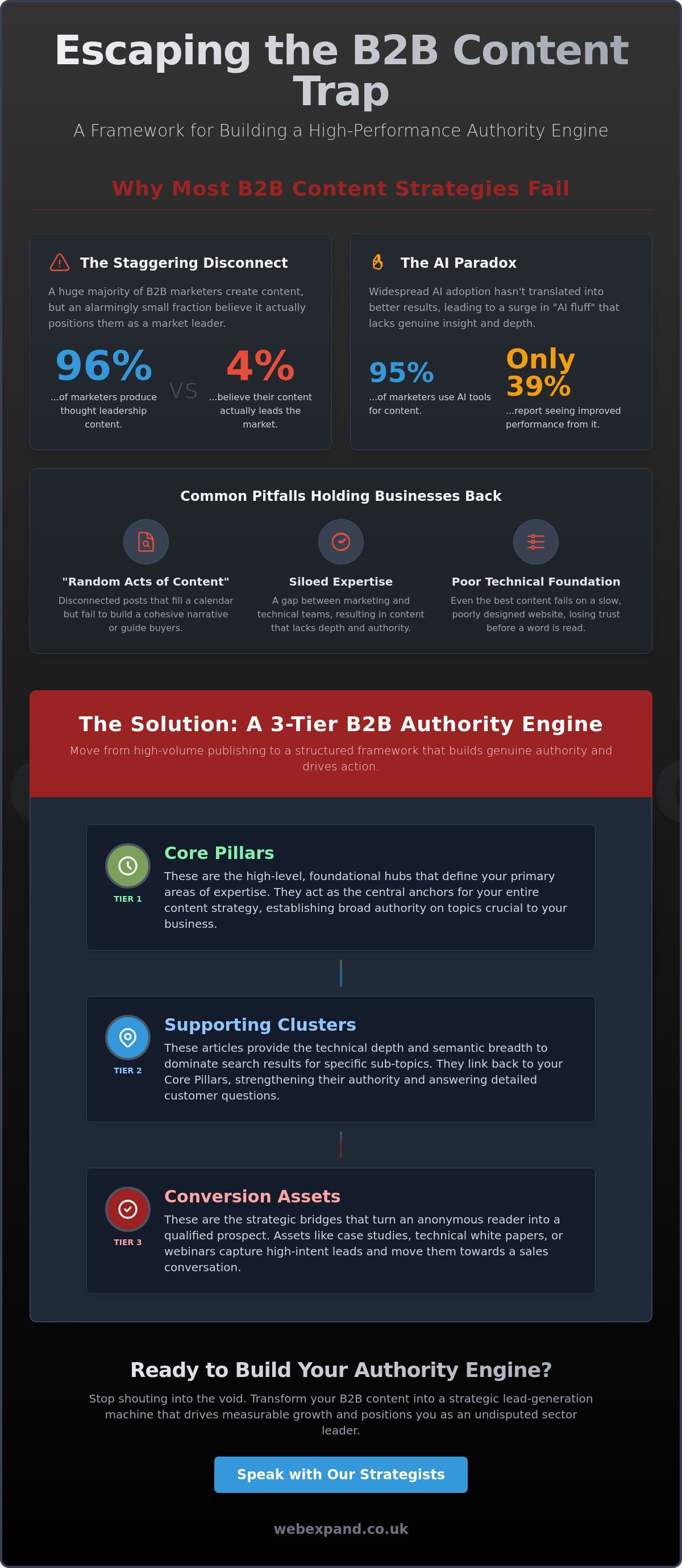
Did you know that whilst 96% of B2B marketers produce thought leadership content, only a mere 4% believe their programmes actually lead the market? It’s a staggering gap that proves most businesses are shouting into a void of indistinguishable, “safe” articles that fail to move the needle. If your current content strategy for b2b companies feels like a series of random acts of publishing, you aren’t alone. You’re likely struggling to differentiate your brand whilst facing the uphill battle of proving real ROI to your stakeholders.
We recognise the frustration of maintaining a consistent publishing schedule amidst the chaos of daily operations, only to see stagnant search rankings and low-quality leads. It’s time to stop treating content as a checkbox exercise and start viewing it as a high-performance authority engine. Our goal is to help you transform your output into a strategic lead-generation machine that drives measurable growth and positions you as an undisputed sector leader.
In this article, we’ll provide a repeatable framework for content creation that targets high-intent B2B keywords and builds genuine trust. You’ll learn how to align your technical expertise with a precise editorial strategy to ensure your brand is the first choice for buyers long before they ever speak to a sales representative.
Key Takeaways
- Learn how to escape the “Content Trap” by shifting from high-volume publishing to a structured three-tier framework that builds genuine industry authority.
- Discover how a refined content strategy for b2b companies bridges the gap between search intent and sales readiness, converting traffic into high-quality inbound leads.
- Master the balance between Google-friendly SEO and original thought leadership to meet the rigorous E-E-A-T standards required in 2026.
- Identify immediate “Quick Win” optimisations through a strategic audit of your existing assets to improve performance without increasing your workload.
- Understand why bespoke website design and technical SEO are the essential foundations for a content engine that scales alongside your business.
Why Most B2B Content Strategies Fail in 2026
Many UK firms are currently caught in the “Content Trap”. They celebrate rising traffic figures whilst wondering why the phone isn’t ringing and inbound leads remain stagnant. This disconnect occurs when a content strategy for b2b companies focuses on vanity metrics rather than the complex, multi-stage decision-making journey of a professional buyer. By 2026, the market has become saturated with “Random Acts of Content”. These are disconnected blog posts and articles that lack a cohesive narrative or a clear path to conversion. They fill a calendar but fail to build an engine.
The surge in AI adoption has complicated the landscape. Whilst 95% of B2B marketers now use AI tools, only 39% report seeing improved performance. Most organisations are simply producing “AI fluff” that lacks the technical depth and original insight your audience demands. A truly effective Content strategy requires genuine thought leadership, yet only 4% of marketers rate their own programmes as “leading”. This creates a significant opportunity for businesses ready to move beyond generic advice and provide real value.
We often see a distinct gap between marketing teams and technical experts in mid-sized businesses. Marketing produces content that sales doesn’t use, and sales has technical insights that marketing never hears. This silos expertise. It results in a digital presence that feels disjointed and unconvincing to high-value prospects who are already 60-70% through their decision-making process before they ever engage with your team.
The “Boring Industry” Fallacy
We often hear that an industry is “too technical” or “too dry” for engaging content. This is a fallacy. No sector is boring if you focus on human-centric outcomes rather than just product features. Your clients don’t buy “precision engineering services”; they buy the reliability and risk mitigation that your expertise provides. Success comes from translating complex B2B services into narratives that address specific pain points. Moving from feature-led descriptions to outcome-based storytelling is how you broaden your horizons and dominate your sector. This principle applies even to specialised training services; for instance, those looking for examples of expert-led professional development can explore ITF Radix Seminars to see how technical skills are positioned with authority.
Technical Debt and Content Performance
Even the best writing fails if it’s trapped on a slow, templated site. Poor user experience and slow load times stifle your reach and damage your Google Promotion and SEO efforts. If a prospect’s first interaction with your brand is a clunky interface, you’ve lost their trust before they’ve read a single word. A high-performance bespoke website design isn’t a luxury. It’s the essential foundation for any authority engine that intends to deliver measurable growth and long-term financial performance.
Building Your B2B Authority Engine: The Framework
Success in 2026 requires more than just publishing; it demands a structured engine. To scale effectively, your content strategy for b2b companies must move beyond the “one-and-done” blog post mentality. We view a high-performance strategy as a three-tier system designed to capture attention, build trust, and drive action. This framework reflects the reality of the modern buyer journey. With more stakeholders involved in every purchase and decision cycles stretching longer than ever, your content must serve as a persistent, authoritative guide that works even when your sales team is offline.
- Tier 1: Core Pillars – These are the high-level hubs that define your primary areas of expertise and industry leadership.
- Tier 2: Supporting Clusters – These provide the technical depth and semantic breadth required to dominate search results for specific sub-topics.
- Tier 3: Conversion Assets – These are the strategic bridges, such as case studies or technical white papers, that turn an anonymous reader into a qualified prospect.
By integrating these tiers, you align your digital presence with the B2B content marketing standards expected by sophisticated buyers. If you’re ready to begin constructing this engine for your own business, you can speak with our strategic team to discuss your specific growth goals.
Identifying Your Strategic Pillars
Your pillars are the foundation. You should select three to five core topics that your brand can legitimately “own” within the UK market. Don’t try to be everything to everyone. Instead, look for gaps in the London and Kent B2B sectors where your competitors are providing only surface-level information. Map these pillars directly to your long-term financial performance. If a topic doesn’t contribute to your growth or solve a critical client pain point, it doesn’t deserve pillar status.
The Cluster Methodology for SEO
Once your pillars are set, you must build depth. A topic cluster is a group of related web pages that link back to a central pillar page. This structure signals to Google that you possess comprehensive knowledge of a subject, not just a passing interest. Internal linking is the fuel here. It distributes authority across your site, ensuring that your most valuable pages benefit from the ranking power of your broader content library. This precision allows you to target high-intent keywords whilst maintaining a clean, logical site architecture that enhances the user experience.
Content That Converts: Balancing Thought Leadership with SEO
Stop treating Search Engine Optimisation and thought leadership as warring factions. In 2026, these two disciplines have finally converged. Google’s sophisticated emphasis on E-E-A-T (Experience, Expertise, Authoritativeness, and Trustworthiness) means that your content strategy for b2b companies must deliver the same technical depth to an algorithm as it does to a C-suite executive. If your writing feels like it was designed solely to please a crawler, you’ll lose the human reader; if it ignores search intent, no one will ever find it. Success lies in the intersection of these two worlds.
Whilst 89% of B2B organisations claim to personalise their content, a staggering 59% describe these efforts as “basic”. You can dominate your sector by moving beyond generic advice. Use original data and local case studies to anchor your authority. For example, a firm in Kent shouldn’t just write about “logistics efficiency”; they should analyse “Distribution Trends in the South East” using their own first-party data. This provides the “Experience” that Google now craves and the “Expertise” that converts a sceptical prospect into a lead.
Your headlines must serve two masters. They need to be descriptive enough for an automated system to categorise, yet punchy enough to stop a busy director mid-scroll. Avoid vague, clickbait titles. Instead, use headers that promise a specific, measurable outcome. This level of precision reflects a brand that values its audience’s time and understands their unique market challenges.
The Art of the B2B Lead Magnet
The era of the boring, twenty-page PDF white paper is over. In 2026, buyers demand utility and immediate value. Consider replacing static downloads with interactive tools, ROI calculators, or bespoke website design elements like self-service audits. These “Micro-Conversions” allow you to nurture long-term relationships without the friction of a heavy gate. You can collect valuable first-party data whilst providing a service that actually solves a problem, rather than just talking about it.
Social Proof as a Content Asset
Don’t hide your testimonials on a lonely “Reviews” page. Integrate them naturally within your educational content to overcome objections before they’re even voiced. For businesses operating in Maidstone or Sevenoaks, “The Local Advantage” is a powerful trust signal. Mentioning specific regional successes helps prospects visualise how your solutions work in their own backyard. This grounded approach, combined with a high-performance digital presence, ensures your success stories serve as active sales tools rather than static trophies.
Organising for Success: Execution and Measurement
Executing a content strategy for b2b companies requires a shift from creative intuition to operational precision. Many organisations fail because they treat content as a series of sprints rather than a marathon. To build a sustainable engine, you must first audit your existing assets. Identify “Quick Win” optimisations by refreshing old articles that already hold some search authority but have slipped in rankings. Updating a few key paragraphs or refining a call-to-action can often deliver faster results than starting from scratch.
Consistency is your greatest asset. Create a sustainable content calendar that your team can actually maintain whilst managing daily operations. It’s better to publish one high-quality piece of thought leadership every fortnight than to dump four low-value posts in a single week and then go silent for a month. This disciplined approach prevents burnout and ensures your brand remains a steady, reliable presence in the minds of your prospects.
Once your content is live, you must move beyond vanity metrics. Page views and social likes are interesting, but they don’t pay the bills. Set up tracking that monitors assisted conversions and multi-touch attribution. This allows you to see how a blog post read in January contributed to a closed deal in June. By iterating based on this data, you can adopt a “Broaden Your Horizons” approach to growth, constantly refining your tactics to focus on what actually moves the needle for your financial performance.
B2B Metrics That Actually Matter
Shift your focus from raw traffic to pipeline contribution. You need to know which specific assets are attracting high-intent decision-makers rather than students or competitors. B2B ROI should be measured by the quality of leads generated over a 6-12 month period. By analysing the journey from first click to final contract, you can identify the technical topics that resonate most with your audience and double down on those successful themes.
Distribution Strategies for the UK Market
The Webexpand Approach: Integrating Strategy with Performance
A high-performance content strategy for b2b companies cannot exist in a vacuum. It requires a technical foundation that is as robust as the editorial narrative itself. We believe that bespoke website design is the secret weapon of successful digital growth. Many firms invest heavily in premium content only to host it on slow, templated platforms that frustrate users and signal poor quality to search engines. Our approach ensures that your technical infrastructure enhances, rather than hinders, your industry authority. We focus on broadening your horizons by building platforms that handle high traffic volumes whilst maintaining lightning-fast load speeds and precision performance.
For businesses in Maidstone, London, and across the South East, we provide fixed-price solutions that eliminate the uncertainty of hidden costs. This transparency allows you to scale your digital presence with confidence. By creating a direct synergy between Google promotion and SEO and high-quality editorial output, we help you dominate your sector. We don’t just aim for traffic; we aim for market leadership that reflects in your long-term financial performance and bottom-line results.
Bespoke Design Meets Strategic Content
We build websites that are content-first and conversion-ready. This means every layout, button, and navigation path is designed to support your authority engine. We’ve seen local Kent firms transform into national B2B authorities by simply aligning their technical performance with their expertise. When you invest in bespoke web design Kent, you aren’t just buying a digital brochure; you’re building a scalable lead-generation machine. This system outpaces competitors who rely on off-the-shelf templates that lack the precision required for complex B2B sales cycles.
Your Partner in Digital Growth
Our partnership is grounded in a jargon-free approach to digital marketing management. We break down complex technical concepts into clear, logical steps so that you always understand the value being delivered. Whether you’re looking to refine your content strategy for b2b companies or require advanced SEO services Kent, our team acts as a strategic partner. We are deeply invested in your data but equally focused on the human element of business development. Your progress is the ultimate measure of our performance. You can start your transformative journey toward industry leadership by visiting our contact us page to discuss your specific growth goals today.
Secure Your Sector Leadership
The journey toward industry leadership begins with a single strategic shift. You now have the framework to stop chasing vanity metrics and start building a genuine authority engine. By prioritising technical performance alongside high-quality editorial insight, you’ll ensure your brand remains the definitive answer for prospects long before they ever engage with your sales team.
Executing a successful content strategy for b2b companies is a marathon that rewards precision and consistency. Since 2004, we’ve utilised our 20 years of digital expertise to help UK businesses dominate their sectors through bespoke, high-performance web design and results-driven SEO. We act as your strategic partner, stripping away the jargon to focus on measurable pipeline contributions and long-term growth.
Ready to scale your B2B presence? Contact Webexpand for a bespoke content and SEO strategy today.
Your future market share is waiting. Let’s start building it together.
Frequently Asked Questions
How long does it take for a B2B content strategy to show results?
A comprehensive strategy typically takes six to twelve months to deliver measurable pipeline growth. Whilst you may see improvements in keyword rankings within the first ninety days, the complex nature of professional decision-making requires time to build genuine trust. We focus on long-term authority rather than quick fixes, ensuring your digital presence delivers a compounding return on investment as your library of expertise grows.
What is the difference between B2B and B2C content marketing?
The primary difference lies in the decision-making cycle and the number of stakeholders involved. B2C content often triggers emotional, individual purchases, whereas B2B content must satisfy a logical evaluation process involving multiple departments. Your strategy should address technical requirements, risk mitigation, and long-term financial performance. It’s about building a partnership rather than facilitating a one-off transaction.
How much should a B2B company spend on content strategy?
Your investment should align with your growth ambitions and the competitiveness of your sector. Most mid-market firms allocate a monthly budget that covers both high-quality editorial production and technical SEO management. It’s vital to view this as a capital investment in an asset that generates leads over several years, rather than a recurring operational expense with no lasting value.
Can a small B2B firm in Kent compete with national brands using content?
Absolutely. A small firm in Kent can outmanoeuvre national brands by dominating specific, high-intent niches that larger competitors often overlook. By focusing your content strategy for b2b companies on regional expertise and specialised technical solutions, you signal a level of experience that generic national content cannot match. Local relevance combined with technical precision allows you to win the “Day One” imperative.
What are the best types of content for B2B lead generation?
Case studies and technical white papers remain the most effective assets for generating high-quality leads. In 2026, interactive tools like ROI calculators or bespoke digital audits also provide significant utility to prospects. These formats allow you to demonstrate expertise whilst collecting valuable first-party data. They bridge the gap between initial research and a direct sales conversation by solving a specific problem.
How often should a B2B company publish new content?
Consistency is more important than raw volume. For most B2B organisations, publishing one or two high-impact pieces of thought leadership per month is more effective than daily updates of low value. Your schedule must be sustainable to avoid burnout whilst ensuring every piece of content meets the high standards required to rank and convert in a professional landscape where quality is the primary differentiator.
Do I need a new website to start a content strategy?
You don’t necessarily need a new website, but your current platform must be technically sound. If your site suffers from slow load times or a poor mobile experience, even the best content will fail to convert. We often find that a transition to a bespoke website design is necessary to provide the high-performance foundation required for a modern authority engine to function correctly and scale.
What is the role of SEO in B2B content marketing?
SEO ensures your technical expertise is visible to the right people at the right time. In a content strategy for b2b companies, SEO acts as the bridge between a buyer’s first question and your brand’s answer. It’s not just about keywords; it’s about understanding search intent and ensuring your site architecture distributes authority to your most valuable conversion pages to drive measurable growth.