

Imagine logging into your analytics to find that your search visibility, and the leads that sustain your business, have vanished overnight. It’s a scenario that became a reality for many after the March 2026 Core Update, which shifted rankings for approximately 45% of websites. If you’re currently staring at a flatlined traffic graph, you’re likely searching for exactly how to recover from a google penalty before the damage to your revenue becomes permanent.
We understand the frustration of seeing years of hard work undermined by complex algorithm shifts or technical flags you didn’t even know existed. It’s exhausting to decipher jargon whilst your competitors climb higher. This guide provides a clear, jargon-free roadmap to help you diagnose your specific penalty type, restore your rankings, and future-proof your digital presence. We’ll walk through the exact steps to audit your content against the latest quality standards, fix technical Core Web Vitals failures, and establish a resilient strategy. This isn’t just about maintenance; it’s a transformative journey toward reclaiming your industry leadership and broadening your digital horizons.
Key Takeaways
- Distinguish between manual ‘red cards’ and algorithmic shifts to determine whether you need a formal reconsideration request or a site-wide quality overhaul.
- Recognise the critical warning signs of a penalty, from sudden traffic plunges to the alarming moment your brand name vanishes from the top of search results.
- Follow our structured 2026 roadmap on how to recover from a google penalty by auditing technical performance and pruning low-value content.
- Identify the hidden risks in your link profile and content strategy to eliminate ‘thin’ pages and toxic backlinks that compromise your authority.
- Discover how bespoke website design and proactive SEO management act as a shield, protecting your digital presence from future volatility and industry shifts.
Identifying a Google Penalty: Signs Your Business is Under Fire
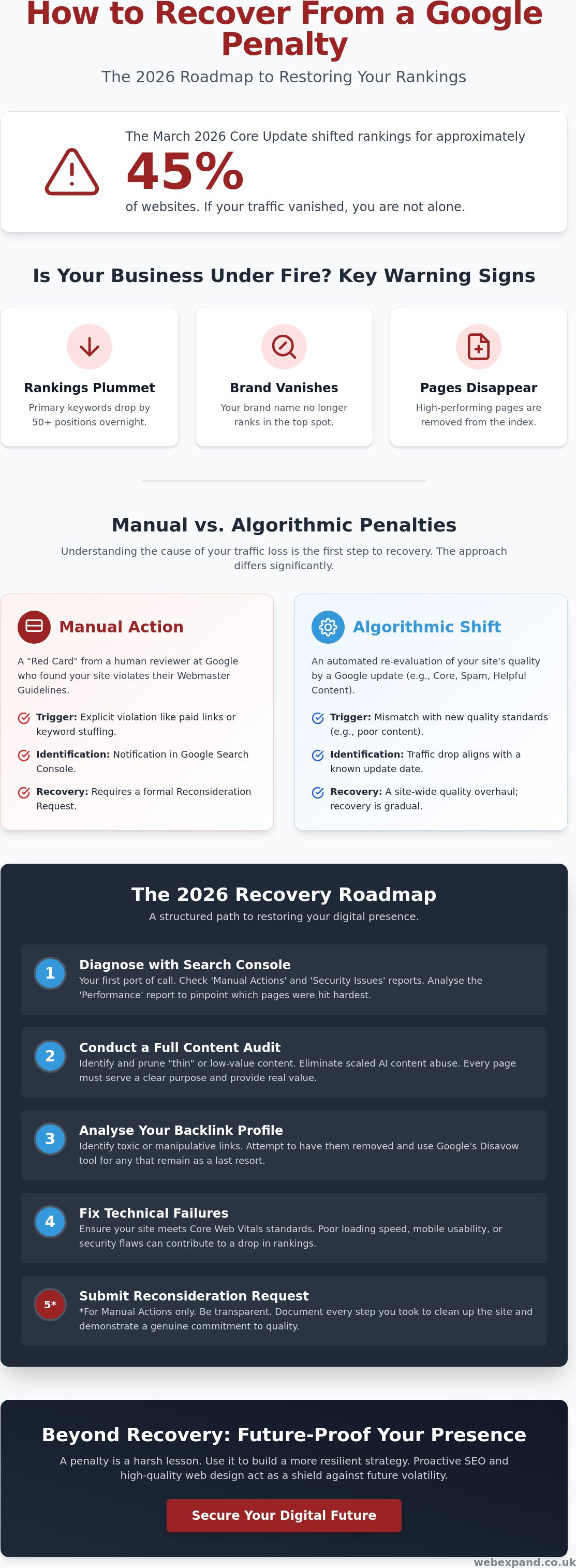
A sudden drop in organic traffic feels like the floor falling out from under your business. For UK companies reliant on digital leads, this isn’t just a technical glitch; it’s a commercial emergency. Whilst some fluctuations are normal, a true penalty is unmistakable. Common warning signs include:
- Your primary keyword rankings plummeting by 50 positions or more overnight.
- Your brand name failing to rank in the top spot for its own search terms.
- A total disappearance of specific high-performing pages from the search index.
If you’ve lost 80% of your traffic in 48 hours, you aren’t looking at a seasonal trend. You’re likely facing a direct intervention from Google. Approximately 45% of websites saw ranking changes following the March 2026 Core Update, but a penalty is often more targeted. Understanding how to recover from a google penalty starts with pinpointing exactly when the “disappearing act” began.
Manual Actions vs Algorithmic Adjustments
A Manual Action occurs when a human reviewer at Google determines that your site isn’t compliant with their quality guidelines. This is a “red card” scenario that requires a formal reconsideration request. In contrast, algorithmic adjustments are automated. The Google Penguin update, for instance, changed how the system identifies manipulative link-building by automating the process. Identifying the exact date of your traffic drop is the first step in learning how to recover from a google penalty. If your decline aligns with the May 21, 2026 Core Update, you’re dealing with an algorithmic shift rather than a manual flag. This requires a different, broader approach to content and technical quality.
The Search Console First Response
Your first port of call is Google Search Console. Navigate to the “Manual Actions” report under the Security & Manual Actions tab. If it says “No issues detected”, your site hasn’t been manually flagged by a reviewer. Next, check the “Security Issues” tab to rule out malware or hacked content that might have triggered a block. Finally, analyse the “Performance” report to see which specific pages were hit. If the loss is site-wide, it suggests a deeper structural or quality issue. For businesses looking to scale, a professional Google promotion and SEO audit can pinpoint these triggers. This data-backed approach ensures you aren’t guessing when it comes to restoring your digital presence.
Manual vs Algorithmic: The Jargon-Free Breakdown
Understanding the difference between a manual penalty and an algorithmic shift is the first step toward reclaiming your traffic. A manual penalty is effectively a “Red Card” issued by a human reviewer at Google. It means your site has been caught violating specific Webmaster Guidelines. Algorithmic shifts, however, are automated. These happen when Google updates its core software, like the March 2026 Spam Update, to better identify low-value content across the entire web. Whilst both result in a loss of visibility, the path to how to recover from a google penalty varies significantly depending on which one hit you.
In 2026, the triggers for these issues have become increasingly sophisticated. Google now uses advanced enforcement against scaled AI content abuse and site reputation manipulation. You might find that “black hat” tactics used years ago, such as hidden keyword stuffing or buying low-quality links, have suddenly triggered a flag. The system has a long memory. Industry experts suggest that successfully recovering from an SEO penalty involves a meticulous review of both your link profile and your content’s utility. If you’re unsure where to start, our team can help you audit your current digital strategy to identify these hidden risks.
Why Manual Actions Require a Reconsideration Request
If you’ve received a manual action notification, you can’t just fix the problem and wait. You must actively prove to Google that you’ve cleared the violation. This process involves submitting a formal reconsideration request. Transparency is your best asset here. Don’t try to hide previous errors; instead, document every step of your cleanup process. If you had 500 toxic backlinks, show that you’ve attempted to remove them or used the Disavow tool. A reviewer needs to see a genuine commitment to quality before they’ll lift the restriction.
Navigating Algorithmic Updates in 2026
Diagnosing the Damage: Content Quality vs Toxic Backlinks
Once you’ve identified that a drop has occurred, the next step is a forensic audit. You can’t fix what you haven’t diagnosed. Most penalties stem from two core areas: what you say on your pages and who vouches for you through backlinks. Recovery isn’t about making minor tweaks; it’s about a surgical removal of elements that Google deems manipulative or low-value.
“Thin content” remains a primary culprit for UK businesses. if your pages offer fewer than 300 words of unique value or simply repeat information found on other sites, Google views them as a liability. This is particularly common in local SEO strategies. Many firms have been caught out by “city-landing pages” that use identical content for different locations. Whether you are targeting Maidstone or London, each page must provide bespoke value. If the text is 90% the same across fifty pages, you’re inviting a “scaled content” flag.
The legacy of “SEO Cowboys” also looms large. These are agencies that promised rapid results using low-quality, automated link building. In 2026, Google’s ability to spot these manipulative patterns is sharper than ever. Over-optimisation, where you’ve tried too hard to force keywords into every heading and paragraph, now acts as a red flag rather than a ranking boost. Learning how to recover from a google penalty requires stripping back these artificial layers to reveal genuine expertise.
Auditing Your Content for Helpfulness
Start by pruning your site. Pages that don’t serve a clear purpose or answer a specific user query should be removed or consolidated. If a page is “keyword-heavy” and sounds like it was written for a search engine rather than a customer, it needs a total rewrite. Your bespoke website design should facilitate this by making content easy to read and navigate. High-quality Google promotion isn’t about volume; it’s about precision and satisfying user intent with original insights.
The Toxic Link Cleanup Process
Cleaning your link profile is delicate work. Some online forums suggest disavowing every low-authority link, but this reckless approach can actually destroy your remaining rankings. Use professional tools to identify truly spammy domains. The Disavow tool should be your last resort, reserved only for links you’ve failed to remove manually. In the current landscape, quality over quantity is the only sustainable strategy. A single link from a reputable UK industry body is worth more than a thousand from a link farm. This meticulous cleanup is a cornerstone of how to recover from a google penalty and ensures your digital foundation is built on trust.
The 2026 Recovery Roadmap: Step-by-Step Restoration
Restoring your search visibility requires a disciplined, data-backed approach. You’ve already diagnosed the issue; now you must execute the fix. This roadmap outlines exactly how to recover from a google penalty whilst ensuring your site emerges stronger than before. Recovery isn’t a race. It’s a meticulous process of cleaning your digital footprint and proving your value to the system once again.
- Step 1: Complete a comprehensive technical and content audit. Use your Search Console data to identify every page that has lost significant traffic. Check for broken links, slow loading times, and thin content that fails the latest helpfulness standards.
- Step 2: Remove or ‘NoIndex’ low-quality assets. If a page doesn’t provide unique value, delete it or use a ‘NoIndex’ tag to hide it from search engines. This prevents “quality rot” from dragging down your entire domain.
- Step 3: Document every action taken in a clear spreadsheet. Record the URLs you’ve fixed, the toxic links you’ve requested to be removed, and the dates of these changes. This log is your primary evidence if you’re facing a manual action.
- Step 4: Craft and submit a professional Reconsideration Request. For manual penalties, this is your opportunity to speak directly to a reviewer. Be transparent, thorough, and humble.
- Step 5: Monitor Search Console for updates. A ‘Manual Action Removed’ notification is the ultimate goal. For algorithmic drops, watch for a steady climb in impressions as Google re-indexes your improved content.
Drafting a Successful Reconsideration Request
When writing your request, avoid being defensive or argumentative. Google’s reviewers want to see that you’ve understood the violation and taken genuine steps to rectify it. Attach your documentation spreadsheet as proof of your link removal or content overhauls. To show you’ve grasped the core issue, include a clear summary: Our site previously utilised automated content generation without editorial oversight, which we have now replaced with expert-led, original reporting. This level of honesty builds trust and speeds up the review process.
Improving Site Authority Post-Fix
Once the penalty is lifted, your focus must shift to rebuilding authority. This involves creating high-quality, jargon-free content that serves your local audience and solves their specific problems. Focus on building genuine relationships with other UK businesses for natural, authoritative backlinks. If you want to ensure your site is built on a compliant, high-performance foundation, our SEO services Kent can help you rebuild correctly. We specialise in transforming penalised sites into industry leaders. If you’re ready to reclaim your rankings and dominate your sector, reach out to our strategic team today for a tailored recovery plan.
Beyond Recovery: Future-Proofing Your UK Digital Presence
Reaching the end of the recovery roadmap is a significant milestone for any business. However, the true objective isn’t just returning to where you were before the traffic drop. It’s about ensuring your organisation never faces this vulnerability again. Whilst learning how to recover from a google penalty is essential during a crisis, the most successful UK firms use this experience as a catalyst for a total digital transformation. You have the opportunity to rebuild on a foundation that is resilient, transparent, and designed for industry leadership.
Why Professional SEO Management Prevents Penalties
Proactive SEO management acts as an early warning system for your business. It involves continuous monitoring of your link profile and content health to identify potential issues before they escalate into penalties. Our team stays ahead of shifts like the May 2026 Core Update, allowing us to adjust your strategy in real-time. Understanding how technical design and search strategy intersect is vital for long-term stability. Choosing a Kent web design agency that integrates SEO into the very fabric of your site ensures you remain compliant with evolving standards whilst broadening your digital horizons.
Scaling After a Recovery
Once your site is “clean” and the penalty is removed, you have a pristine foundation for aggressive growth. Whether you are targeting local customers in Maidstone or expanding your reach across London, your restored authority allows you to compete for high-value keywords with confidence. This is the moment to invest in sophisticated e-commerce solutions that prioritise security and speed, as these metrics are now central to Google’s holistic scoring. Don’t settle for “quick-fix” providers who rely on shortcuts. Choose a strategic partner focused on measurable outcomes and sustainable development. Ready to restore your rankings and secure your future? Contact Webexpand for a professional SEO audit and begin your journey toward market dominance.
Reclaiming Your Industry Leadership
A Google penalty is a significant hurdle, but it doesn’t have to be the end of your digital story. By following a structured roadmap of technical audits and content refinement, you can restore your visibility and protect your revenue. The process of learning how to recover from a google penalty is ultimately about shifting your focus back to providing genuine value to your UK audience. This transformation ensures your digital presence is built on a foundation of trust and precision.
Established in 2004, Webexpand offers over 20 years of SEO expertise to help you navigate these complexities. We provide jargon-free advice tailored specifically for businesses in Kent and London, backed by a proven track record in Google promotion and bespoke web design. We don’t just aim for recovery; we aim for your long-term market dominance. Your previous rankings aren’t just a memory; they’re a baseline for your future growth. Take the first step toward broadening your digital horizons today.
Secure your business’s future with a professional SEO audit from Webexpand
Frequently Asked Questions
How long does it take to recover from a Google penalty?
Recovery from an algorithmic shift typically takes three to six months as Google needs to re-crawl your improved content and re-evaluate its utility. For manual actions, the timeline depends on the speed of the reconsideration review, which usually takes several weeks. Learning how to recover from a google penalty requires patience whilst you demonstrate a sustained commitment to quality and technical precision across your entire domain.
Can a website ever fully recover its previous rankings after a penalty?
A full recovery is entirely possible if you address the root cause of the decline and rebuild on a high-quality foundation. Many sites that undergo a rigorous cleanup of toxic links or thin content eventually exceed their previous visibility. This success depends on moving beyond “quick fixes” and building a digital presence that prioritises user intent, expertise, and a superior mobile experience.
What is the difference between a manual action and an algorithm update?
A manual action is a specific flag issued by a human reviewer at Google, appearing directly in your Search Console dashboard. In contrast, an algorithm update is an automated change to the search system that affects many sites simultaneously. Whilst a manual action requires a formal reconsideration request, algorithmic recovery happens automatically once the system recognizes your site’s improved quality and technical performance.
Will Google tell me exactly which links are causing the penalty?
Google does not provide a comprehensive list of every offending link. Instead, they typically offer a few examples in the manual action notification to guide your cleanup efforts. You must use professional SEO tools to audit your entire link profile and identify patterns of manipulative behaviour. This forensic approach ensures you catch all toxic backlinks that could hinder your progress and damage your authority.
Should I just start a new website if I get a severe Google penalty?
Starting a new domain is rarely the most efficient strategy for an established organisation. Your current domain likely has established brand equity, historical data, and legitimate backlinks that are worth preserving. Unless the penalty is so severe that the domain is permanently de-indexed, we recommend a strategic restoration. Fixing the original site is usually faster and more sustainable than building authority from scratch.
How much does it cost to hire an agency for penalty recovery in the UK?
Professional recovery services are priced according to the complexity of the audit and the extent of the cleanup required. UK agencies typically offer tailored solutions rather than standardised fees to ensure the approach matches your specific business needs and sector. Investing in an expert partner ensures the recovery is handled correctly the first time, protecting your long-term financial performance and digital reputation.
Can ‘negative SEO’ from a competitor cause a Google penalty?
Negative SEO, where a competitor points spammy links at your site, is a common fear but rarely successful in the current landscape. Google’s systems are now highly sophisticated at ignoring low-quality links automatically. However, if you suspect a targeted attack, a thorough audit can help you identify and disavow the specific domains involved. This proactive management protects your digital presence from external manipulation.
Is AI-generated content against Google’s guidelines in 2026?
AI-generated content is not inherently against guidelines, provided it offers genuine value and original reporting. However, the March 2026 Spam Update specifically targeted the “scaled abuse” of AI content that lacks human editorial oversight. To ensure you understand how to recover from a google penalty related to content, focus on E-E-A-T signals and ensure every page serves a clear, helpful purpose for your audience.