

Your DIY website was never meant to be your forever home; it was a launchpad that’s now becoming a restrictive ceiling. You likely chose a platform like Wix or Squarespace for its initial simplicity, but as your business scales, those drag-and-drop constraints often feel like a straightjacket. It’s frustrating when your vision for a professional digital presence is throttled by template limitations or slow loading speeds that turn away potential clients in Kent and London. Identifying exactly when to switch from a diy website builder is a strategic necessity for any organisation ready to lead its sector rather than just inhabit it.
We recognise the hesitation to move, especially whilst you’re focused on protecting the search rankings you’ve built. This article promises to reveal the critical indicators that your current site is limiting your revenue and show you how to transition to a bespoke solution that delivers measurable results. We’ll examine the hidden costs of “premium” plugins and provide a clear roadmap for achieving a high-performance site that commands authority in Maidstone and across the UK.
Key Takeaways
- Recognise the functional roadblocks and design limitations that prove your business has outgrown a standard template.
- Uncover the performance gaps caused by bloated code and limited Schema markup that hinder your visibility in local search results.
- Learn precisely when to switch from a diy website builder to ensure your digital presence scales alongside your organisational growth.
- Evaluate the strategic advantage of bespoke code ownership over the restrictive platform lock-in typical of subscription services.
- Gain a clear roadmap for a seamless migration process that preserves your hard-earned Google rankings through meticulous redirect mapping.
Understanding the DIY Ceiling: When Your Website Stops Serving Your Business
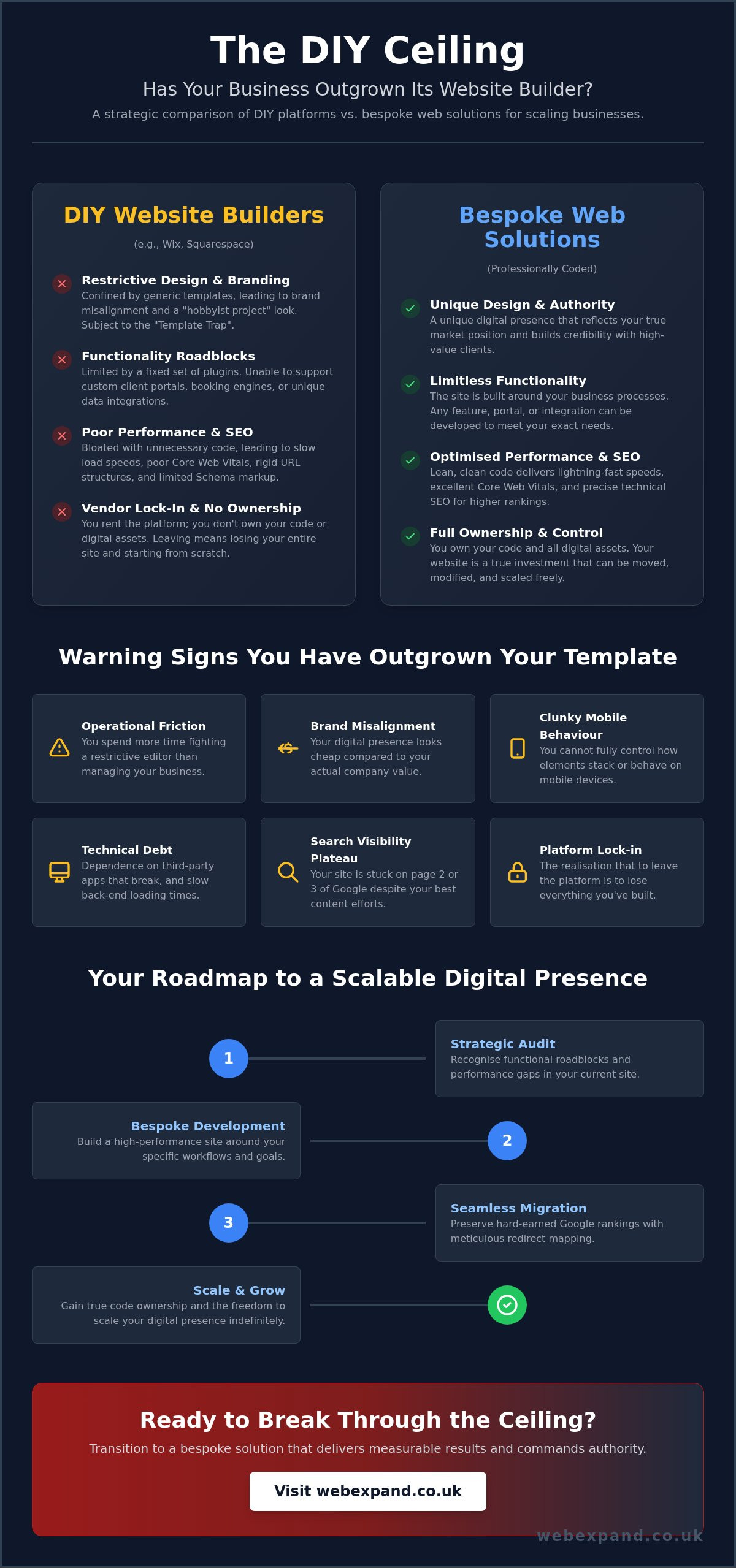
The DIY ceiling isn’t just a metaphor; it’s a measurable limit on your organisational growth. Whilst platforms like Wix and Squarespace provide an accessible entry point for startups, they eventually become a straightjacket for ambitious firms. You’ll know you’ve reached this limit when you spend more hours fighting a restrictive editor than you do managing your operations. This “frustration phase” is the clearest indicator of when to switch from a diy website builder to a professional, scalable solution.
Brand misalignment is a silent revenue killer. If your business has scaled to a £50,000+ turnover but your digital presence still looks like a £5,000 hobbyist project, you’re bleeding credibility. High-value clients in competitive markets expect authority. When you rely on generic templates, you fall into the “Template Trap”, where your professional identity looks identical to five other firms in the local area. Moving to web design in Maidstone that is bespoke ensures your site reflects your actual market position rather than a pre-packaged compromise.
Functionality roadblocks are equally damaging. You might need a specific client portal, a custom booking engine, or a unique data integration that a drag-and-drop builder simply cannot support. These technical ceilings force you to adapt your business processes to fit the software, which is the exact opposite of how a strategic asset should function. A bespoke site is built around your workflow, not the other way around.
Visual Signs You Have Outgrown Your Template
Clunky mobile behaviour is often the first sign of trouble. If you cannot customise how elements stack or load on a smartphone, you’re losing the majority of your audience. Limited font choices and rigid layout grids dilute your brand identity, making your business feel “off the shelf”. Perhaps most damaging is the “Built with Wix” footer baggage or generic favicon icons that scream amateur to every savvy visitor who lands on your page.
Operational Friction and Technical Debt
Performance often suffers as you add more content. You might notice slow back-end loading times whilst trying to update simple text, or a dependence on third-party “bolted-on” apps that frequently break your layout. This creates technical debt that hinders your agility. Crucially, DIY platforms create vendor lock-in. You don’t actually own your code; if you leave the platform, you lose the site. Transitioning to a bespoke build means you finally own your digital assets outright.
The Hidden Cost of “Easy”: SEO and Performance Limitations
Whilst the visual editor of a template builder feels intuitive, the underlying architecture often works against your search engine visibility. These platforms prioritise ease of use by loading massive JavaScript libraries and redundant CSS for every page, regardless of whether those features are actually being used. Understanding when to switch from a diy website builder becomes a priority when your search visibility plateaus despite your best content efforts. You might find your site stuck on page three of Google, invisible to the very clients you need to reach.
URL structure constraints and limited Schema markup often create an “invisible wall” for growing firms. Most DIY platforms impose rigid naming conventions on your pages, preventing you from fully optimising your site architecture for specific keywords. Without the ability to implement deep, custom Schema, you struggle to tell Google exactly what your Kent business does, which services you offer, and where you operate. This lack of precision makes it difficult for search crawlers to categorise your site correctly, leaving you at a disadvantage against competitors who use cleaner, bespoke code.
Core Web Vitals and the Google Ranking Factor
Google cares about speed. Your users care about speed. JavaScript-heavy builders frequently penalise your mobile user experience by forcing the browser to process unnecessary scripts before the page becomes interactive. This negatively impacts your “Largest Contentful Paint” (LCP) score, a critical Core Web Vital. When your site takes too long to render its main content, bounce rates soar. Bespoke coding results in leaner, faster pages that satisfy Google’s algorithms and keep potential leads engaged rather than frustrated.
Local SEO Challenges for Kent Businesses
Dominating search results in Sevenoaks or West Malling requires more than just a mention of the location in your footer. It demands high-performance local landing pages with precise technical signals that DIY tools often miss. A bespoke website design in Kent provides the granular control needed to outrank national competitors by tailoring every technical element to your specific region. Professional Google promotion and SEO requires an adaptable foundation that a template builder simply cannot provide. If you are ready to remove these technical barriers, you can speak with our team about a performance audit to identify exactly where your current platform is failing you.
DIY vs. Bespoke Web Design: A Strategic Comparison for 2026
Choosing between a template and a custom build isn’t merely a matter of aesthetics; it’s a fundamental decision about your company’s infrastructure. DIY platforms operate on a “walled garden” model. You pay a monthly fee to lease their tools, but you never actually own the underlying code. If you decide to move, you cannot simply pack up your site and leave. You have to start from scratch. In contrast, bespoke code is a tangible business asset. It belongs to you, providing the portability and security that a growing organisation requires.
Scalability often becomes the breaking point. Whilst DIY builders are sufficient for low-volume traffic, they frequently lag or crash when visitor numbers surge. This is because your site shares resources with thousands of others on the same server. A bespoke solution is engineered to grow. It handles complex data and high user volumes without compromising on speed or stability. This ensures your site remains a reliable revenue driver rather than a technical liability as you expand your reach. Determining when to switch from a diy website builder is ultimately a question of Total Cost of Ownership (TCO) and long-term viability.
Conversion engineering is where the ROI truly diverges. Most templates are designed to look “pretty” to the widest possible audience, but they aren’t optimised for your specific sales funnel. We focus on building sites that guide users toward a measurable outcome. Knowing when to switch from a diy website builder is often the moment you realise that a beautiful site is worthless if it doesn’t actually convert visitors into leads.
To better understand how professional architecture supports these goals, you can find out more about Web Development and Lead Generation and how custom solutions drive measurable growth for ambitious firms.
The ROI of Bespoke Development
Custom-built funnels significantly increase enquiry rates, particularly for local tradesmen who need to build trust quickly. By removing the need for expensive “premium” app subscriptions for basic features like advanced forms or review integration, you reduce your long-term operational costs. Bespoke design is a high-performance strategic asset that secures your firm’s digital future whilst providing total technical independence.
Security and Reliability
Platform-wide outages are a genuine risk when you rely on a single provider’s ecosystem. If their servers go down, your entire business goes dark. Professional website hosting provides superior security certificates and isolated environments that protect your data more effectively. You also gain access to direct, expert support instead of waiting in a queue for an automated help ticket. This level of reliability is essential for businesses that cannot afford even an hour of downtime.
Planning the Migration: How to Switch Without Losing Your Google Rankings
The fear of losing hard-earned search rankings is the primary reason many businesses delay their departure from a template platform. It’s a valid concern. If you move your content without a technical roadmap, you risk breaking the links that Google has already indexed. However, a transition to a bespoke site shouldn’t result in a ranking drop. If executed correctly, it acts as a catalyst for growth. Deciding when to switch from a diy website builder is only the first step; the execution determines your future visibility.
A meticulous 301 redirect map is the foundation of a successful move. This technical document ensures that every legacy link from your DIY site is permanently pointed to its new, high-performance equivalent. Without this mapping, you risk “404 Not Found” errors that frustrate users and signal to Google that your site is no longer reliable. We treat this process as a surgical procedure, preserving your existing authority whilst stripping away the technical debt that previously limited your performance.
Migration also provides the perfect opportunity for a comprehensive content audit. You don’t need to migrate every legacy page out of habit. Instead, identify which content drives value and which can be improved for 2026. We ensure your metadata migration is seamless, carrying over the “SEO juice” you’ve earned whilst optimising your site architecture. Once your domain is pointed to our secure servers, we use Google Search Console for post-launch monitoring to verify that every page is indexed correctly and performing as expected.
The Professional Migration Checklist
Our professional migration checklist focuses on protecting your visibility at every stage. We map every high-ranking page to prevent broken links and optimise all images and assets during the transfer. This results in significantly faster load speeds than your previous builder could ever achieve. For Maidstone businesses, Webexpand manages this entire transition with precision, ensuring your digital presence remains uninterrupted and ready to scale.
Communication During the Transition
Maintaining communication with your audience is vital whilst we build your new site. We utilise staging environments to test every button and form before the public launch. This allows us to ensure your e-commerce solutions remain live and secure throughout the process. Testing is rigorous. We verify that your transaction funnels and enquiry forms work perfectly before the switch goes live. If you are concerned about your current visibility, you can contact our migration experts for a consultation to protect your rankings.
Beyond the Builder: Scaling Your Digital Presence with Webexpand
Transitioning away from a template is a significant milestone in your business development. It marks the moment you stop settling for generic tools and start investing in a strategic asset. We don’t hide behind corporate jargon or complex technical excuses. Our approach is built on transparency and precision. We provide a collaborative path that moves your brand from the limitations of a starter site to an industry-leading platform. Deciding when to switch from a diy website builder is often the first step toward true digital independence.
Financial certainty is vital for any growing Kent firm. Unlike DIY platforms that lure you in with low entry prices only to surprise you with “premium” app fees and transaction costs, we operate with fixed-price fees. This ensures you can plan your budget with total confidence. We integrate Search Engine Optimisation (SEO) into the very foundation of your site from day one. It’s not a bolted-on afterthought; it’s the core engine that drives your visibility and ensures your bespoke investment pays dividends through increased enquiries and sales.
We see ourselves as your strategic partner, not just a service provider. Our team works closely with you to understand the human element of your business development. This ensures the final product isn’t just a website that “works,” but a high-performance growth engine that reflects your professional authority. Knowing when to switch from a diy website builder allows you to stop fighting software constraints and start dominating your sector.
Your Strategic Partner in Kent
We take pride in supporting the local economy, helping businesses in Maidstone, Sevenoaks, and across the UK reach their full potential. By combining bespoke website design with targeted Google promotion, we maximise your reach in the markets that matter most to your bottom line. We invite you to contact our team for a free site audit to discover the specific technical barriers currently holding your business back.
Future-Proofing Your Business
The digital landscape of 2026 moves quickly, and staying ahead of technological shifts is essential for protecting your interests. A bespoke site provides the agility to adapt to new industry trends without needing a total rebuild every few years. We are committed to broadening horizons for our clients, transforming their online presence into a powerful tool for long-term leadership. Your progress is the ultimate measure of our performance, and we are ready to build the foundation for your next stage of growth.
Secure Your Digital Future with a Bespoke Foundation
Transitioning from a template to a custom build is a strategic pivot that moves your business from leasing a digital presence to owning a high-performance asset. You’ve identified the technical ceilings and SEO limitations that once throttled your visibility. Recognising exactly when to switch from a diy website builder is the catalyst for your next phase of growth, ensuring your site finally reflects your professional authority and market position.
Since 2004, we’ve utilised our 20 years of expertise to help UK firms dominate their sectors through specialist local SEO and Google promotion. Our fixed-price website development eliminates hidden fees, providing the certainty you need to scale. Ready to outgrow your DIY site? Contact Webexpand for a bespoke Kent web design quote today. We’re excited to partner with you on this transformative journey toward industry leadership.
Frequently Asked Questions
Will I lose my Google rankings if I switch from Wix to a bespoke website?
You won’t lose your Google rankings if the transition is managed with technical precision. By implementing a comprehensive 301 redirect map, we ensure every legacy link points to its new, high-performance home. This preserves your existing authority whilst stripping away the bloated code that previously held you back. A professional migration actually provides a cleaner foundation for future growth, often resulting in improved visibility once Google indexes the faster, more efficient bespoke structure.
Is a bespoke website much more expensive than a DIY builder in the long run?
Bespoke solutions often prove more cost-effective when you factor in the total cost of ownership. Whilst DIY builders have low monthly fees, the cumulative cost of “premium” app subscriptions and transaction fees adds up quickly. A custom-built site is a fixed-price investment that you own entirely. Because it’s engineered for higher conversion rates and better performance, the return on investment typically far outweighs the ongoing leasing costs of a template platform.
How long does it take to migrate a DIY website to a professional platform?
A standard migration to a bespoke platform typically takes between four and eight weeks. This timeline allows for a thorough content audit, custom design phase, and rigorous testing on a staging server. We prioritise accuracy over speed to ensure your digital presence remains uninterrupted. The exact duration depends on the volume of your content and the complexity of the custom features required to meet your specific organisational goals and operational workflows.
Can I keep my existing domain name when I move away from a website builder?
You retain full ownership of your domain name and can seamlessly point it to our secure servers. Your domain is a separate asset from your website builder. During the migration, we manage the technical DNS updates to ensure your transition is smooth and your email services remain unaffected. This is a critical step in knowing when to switch from a diy website builder to a more robust, independent hosting environment that you control.
What are the main SEO benefits of a custom-coded website over a template?
Custom-coded websites offer superior SEO because they eliminate the bloated source code common in template builders. You gain granular control over Schema markup and URL structures, allowing you to send precise signals to Google about your Kent business. Faster loading speeds and better mobile behaviour also satisfy Core Web Vitals, which are essential ranking factors. These technical advantages provide a significant edge over competitors stuck within the rigid constraints of a generic DIY platform.
Do I need to be a tech expert to manage a bespoke business website?
You don’t need any technical expertise to manage your new bespoke site. We build our solutions with intuitive content management interfaces that make updating text, images, or blog posts as simple as using a standard word processor. We provide the training and ongoing support necessary to ensure you feel confident in your digital presence. This allows you to focus on running your business whilst we handle the complex technical infrastructure behind the scenes.
How do I know if my current website is actually hurting my business growth?
Your current site is likely hurting your growth if you notice high bounce rates or a plateau in your search rankings. If your design looks identical to local competitors or you can’t implement the specific features your customers need, you’ve reached the DIY ceiling. Recognising when to switch from a diy website builder is often a matter of identifying when your digital presence no longer reflects the professional authority and scale of your actual operations.
Can Webexpand help with e-commerce sites that have outgrown Shopify or Etsy?
We specialise in building scalable E-commerce Solutions for businesses that have reached the limits of platforms like Shopify or Etsy. If you’re frustrated by high transaction fees or restrictive checkout customisation, a bespoke store provides the flexibility you need to dominate your sector. We focus on creating high-performance shopping experiences that reduce cart abandonment and integrate seamlessly with your existing inventory management systems, providing a platform built for long-term financial performance.