

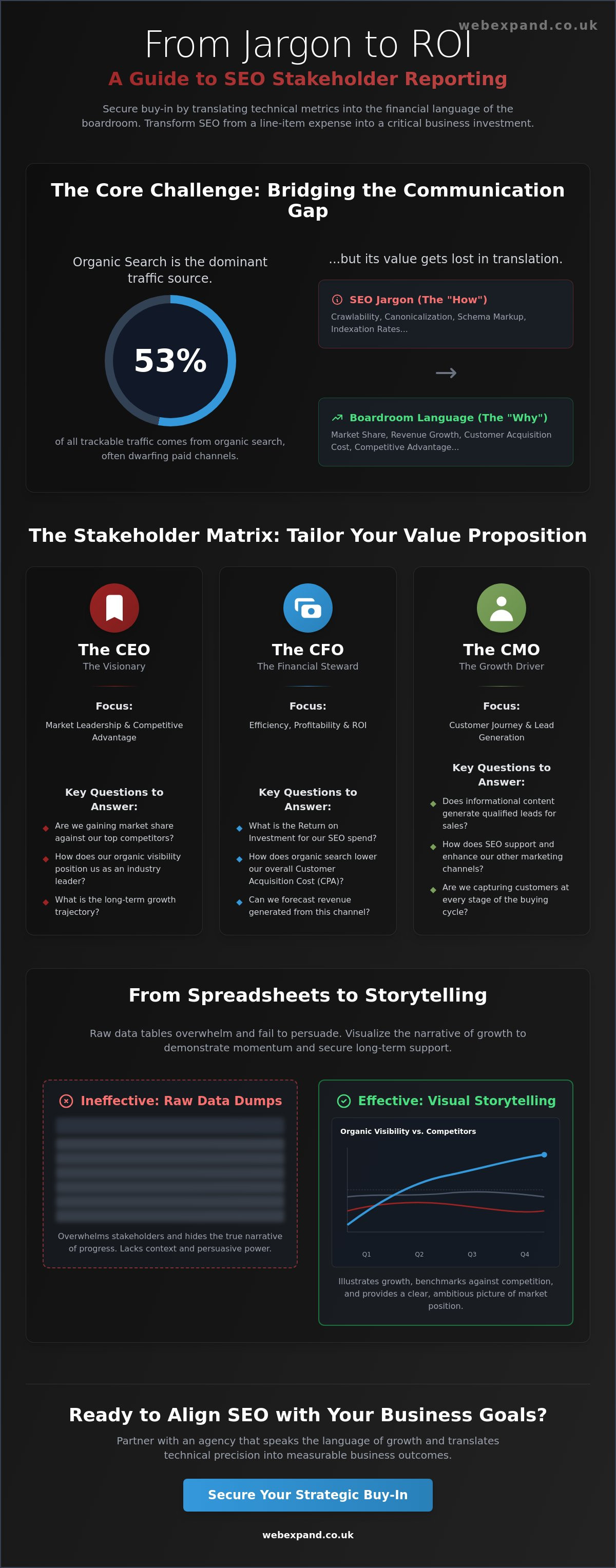
The most technically perfect SEO audit in the world is worth exactly zero if your board doesn’t understand why they’re paying for it. In a landscape where organic search accounts for 53% of all trackable traffic, it’s frustrating to watch vital technical budgets get slashed because stakeholders are chasing the immediate, albeit expensive, highs of PPC. You know that search performance is a transformative journey toward industry leadership, but your reports are likely getting lost in translation. Bridging this gap requires a shift from technical jargon to the financial language of the boardroom, focusing on setting realistic seo goals and kpis that mirror your company’s actual growth targets.
We understand that proving long term ROI is a challenge, especially with Google’s May 2026 Core Update shifting the ground beneath our feet. This guide will show you how to master the art of strategic buy-in, ensuring your SEO efforts are viewed as a critical business investment rather than a line-item expense. You’ll learn how to align organic performance with company-wide KPIs, establish a jargon-free reporting cadence, and secure the budget needed for high-performance technical infrastructure. We’ll move beyond vanity metrics to focus on measurable outcomes that broaden your business horizons and solidify your digital presence.
Key Takeaways
- Bridge the communication gap by replacing technical jargon with the financial language that commands executive attention.
- Tailor your value proposition to specific stakeholders, focusing on market leadership for the CEO and CPA reduction for the CFO.
- Master the art of setting realistic seo goals and kpis that connect organic search directly to your company’s revenue and growth targets.
- Move beyond simple attribution to show how informational content fuels the buying cycle and generates qualified leads.
- Align your technical SEO infrastructure with a results-driven reporting framework that secures long-term budget and strategic support.
The Jargon Trap: Why Traditional SEO Reporting Fails with Stakeholders
The “Jargon Trap” describes the profound disconnect between technical SEO execution and executive comprehension. It’s a common pitfall where experts present data that feels like a foreign language to those holding the purse strings. In the same way that English Explorer provides the tools for professionals to master language proficiency and overcome barriers, an SEO must find the right “dialect” for the boardroom. When you focus on “crawlability,” “canonicalisation,” or “schema markup,” you’re speaking to the engine, not the driver. For a UK business leader, these terms often sound like unnecessary complexity rather than strategic advantages. This creates a psychological barrier; stakeholders simply won’t fund what they don’t understand.
We must shift the narrative. Instead of obsessing over individual keyword rankings, we should highlight visibility and market share. Rankings are a means to an end, but market share is a business outcome. By setting realistic seo goals and kpis that align with broader organisational growth, you transform SEO from a mysterious technical expense into a transparent revenue driver. It’s about showing how organic search broadens your business horizons and positions you as a sector leader.
The Critical Difference Between Metrics and KPIs
Understanding the distinction between technical metrics and a Key Performance Indicator (KPI) is fundamental to securing buy-in. Metrics are the internal data points we use to measure technical health, such as “domain authority” or “indexation rates.” While these are vital for our team’s workflow, they rarely resonate in the boardroom. Executives are focused on growth data: metrics that impact the bottom line.
Successful reporting involves translating every technical metric into a tangible business benefit. Don’t just report that site speed has improved. Instead, explain that the technical optimisations have streamlined the user journey, resulting in a measurable increase in conversion rates. When you connect technical precision to financial performance, you demonstrate accountability and build the trust necessary for a long-term strategic partnership.
Visualising Value Beyond the Spreadsheet
Raw data tables often fail to convey the momentum of a campaign. A spreadsheet filled with thousands of rows of data is overwhelming and lacks a persuasive narrative. To truly engage stakeholders, we must move toward visual storytelling. Trend lines are far more effective than monthly snapshots because they illustrate the compounding nature of SEO growth over time. They show the “why” behind the investment and help in setting realistic seo goals and kpis for the future.
Competitive benchmarking is another powerful tool for visualising value. By mapping your organic visibility against your top three UK competitors, you provide a clear picture of the available market share. This approach triggers stakeholder ambition. It’s no longer just about technical maintenance; it’s about dominating the digital landscape and ensuring your brand is the first one customers see. This high-energy, data-backed approach ensures your value proposition is never lost in procedural complexity.
The Stakeholder Matrix: Tailoring Your Value Proposition
A fatal mistake in executive reporting is treating the board as a monolith. Your CEO, CFO, and CMO each view the company through a different lens, and a generic data dump will inevitably fail to inspire any of them. Securing long term buy-in requires a segmented approach to communication. You must translate your technical progress into three distinct business dialects: authority, efficiency, and synergy. By setting realistic seo goals and kpis that address these specific motivations, you transform a technical update into a high-stakes strategic briefing.
When you present to the board, structure your narrative to hit these three pillars in order. Start with the “big picture” for the CEO, move into the “financial mechanics” for the CFO, and conclude with the “customer journey” for the CMO. This layered approach ensures no one is left behind and reinforces the idea that organic search is a cross-departmental growth engine. Partnering with a strategic agency for Search Engine Optimisation ensures your data always translates into these high-level business outcomes.
The CEO Perspective: Dominating the Digital Landscape
Your CEO is focused on market leadership and competitive advantage. They don’t want to hear about meta descriptions; they want to know who is winning the national conversation. Frame SEO as a digital real estate play. In the UK market, appearing at the top of search results is a signal of brand authority and industry longevity. Use Share of Voice (SoV) metrics to demonstrate exactly how much of the digital market you currently own compared to your top three rivals. This competitive benchmarking is essential for setting SEO goals that connect to business outcomes like brand trust and sector dominance.
The CFO Perspective: SEO as Compound Interest
The CFO views the world through ROI and asset value. To win them over, you must contrast the “rented” traffic of PPC with the “owned” traffic of SEO. While PPC provides immediate visibility, it’s a variable expense that vanishes the moment the budget stops. SEO, however, is a capital investment in a digital asset. As your content and authority mature, your cost-per-lead naturally diminishes. Use predictive ROI modelling to show that while SEO takes 6 to 12 months to scale, the 91% ROI reported by marketers in 2026 proves it’s the most efficient way to broaden your financial horizons over time.
This shift toward viewing technology as a long-term asset mirrors the approach taken in enterprise IT; for instance, Kagool provides strategic frameworks for calculating the total cost of ownership for SAP, ensuring that complex infrastructure investments deliver measurable business value.
Your CMO, meanwhile, looks for synergy. They need to see how organic search captures users in the “messy middle” of the buying cycle, supporting brand awareness and multi-channel performance. When you show how SEO data informs better creative decisions and lowers overall customer acquisition costs, you secure the CMO as your strongest internal ally.
Quantifying the Unquantifiable: Connecting Organic Search to Revenue
Proving the financial impact of organic search is often the final hurdle in securing board-level approval. Most reporting fails because it relies on direct attribution; assuming a customer searches, clicks, and buys in a single session. This ignores the reality of the modern UK consumer journey. By setting realistic seo goals and kpis that account for assisted conversions, you provide a more accurate picture of how search actually fuels your bottom line. We move the conversation from “how many clicks did we get?” to “how much revenue did search influence?”
Informational content plays a massive role in what researchers call the “messy middle” of the buying cycle. A potential client might visit your site three times via different search queries before they ever reach out. We can quantify this value by calculating the PPC cost equivalent. If a specific high-intent keyword costs £4.50 per click in Google Ads, every organic visit for that term represents a direct saving in your acquisition budget. Tracking branded search volume also serves as a vital proxy for brand health; when more people search for you by name, your total marketing ecosystem is working.
Attribution Modelling for the Modern Stakeholder
Last Click attribution is a legacy model that significantly undervalues the contribution of SEO. It credits the final interaction, often a direct visit or a brand ad, while ignoring the organic content that introduced the user to your brand. To show the true top-of-funnel impact, we utilise First Touch and Linear models within Google Analytics 4. These paths allow us to visualise the complex national user journey, proving exactly how to track and prove SEO success across multiple sessions. This data-backed approach ensures your setting realistic seo goals and kpis is grounded in actual user behaviour rather than simplified assumptions.
The Asset Value of High-Quality Content
Unlike a social media post that disappears from a feed in hours, an SEO-optimised article is a long-term business asset. A bespoke website acts as a 24/7 sales representative, consistently bringing in qualified leads long after the initial investment. When you consider What Makes a Good Business Website?, the answer lies in its ability to convert traffic into revenue over years, not days. This shelf life creates a compounding effect on ROI that rented channels simply cannot match. By treating content as an asset rather than an expense, you shift the stakeholder mindset toward building lasting market authority.
The 2026 SEO Reporting Framework: Proving ROI in the Age of AI
Effective reporting in 2026 requires more than a simple export from search consoles. It demands a structured narrative that connects technical performance to financial outcomes. By following a rigorous five-step framework, you ensure that every update reinforces your position as a strategic partner in the company’s growth. This approach is essential for setting realistic seo goals and kpis that survive the scrutiny of a board meeting. We move from measuring activities to measuring impact.
- Step 1: Define the North Star Metric. Identify the single most important figure for the business, such as Organic Revenue or Marketing Qualified Leads (MQLs).
- Step 2: Establish a Baseline. Use national competitive benchmarking to see where you sit in the UK market following the May 2026 Core Update.
- Step 3: Track AI Visibility. Monitor your presence within Google’s AI Overviews and Search Generative Experience (SGE) to capture brand share in zero-click environments.
- Step 4: Connect Health to UX. Show how technical optimisations have improved site speed and navigation, directly influencing the 2.7% to 3.0% average organic conversion rate.
- Step 5: Provide a Strategic Roadmap. Detail the “What is Next” to maintain momentum and broaden your digital horizons.
If you are ready to transform your data into a powerful growth narrative, our expert team provides tailored Google Promotion strategies designed for UK market dominance.
Reporting on AI Search and Brand Citations
The search landscape has shifted; rankings are evolving into citations within AI-generated answers. While traditional clicks remain important, we now track brand mentions and sentiment as critical 2026-specific KPIs. A zero-click search where a user receives a recommendation for your brand from an AI summary still builds immense trust and preference. These citations are the new digital currency. By setting realistic seo goals and kpis around these AI-driven touchpoints, you prove that your brand is becoming an authoritative voice in your sector.
The Monthly Executive Summary Template
Executives have limited time; your reports must respect that. We recommend the “One Page Rule” for all board-level summaries. Use a simple traffic-light system (Red/Amber/Green) to report on technical health at a glance. This allows stakeholders to see that the infrastructure is stable without getting bogged down in server logs. Always lead with a “Win of the Month,” such as a successful competitive overtake or a significant lead generation milestone. This high-energy opening sets a positive tone for the rest of the financial discussion.
Strategic Partnership: How Webexpand Translates SEO into Growth
Webexpand isn’t just a service provider; we’re your strategic partner. We bridge the gap between technical execution and board-level understanding. Our focus remains on jargon-free, results-driven communication that empowers you to lead. By setting realistic seo goals and kpis, we ensure your organic strategy aligns perfectly with your company’s financial objectives. We don’t just report on data. We translate it into a narrative of expansion and market dominance that resonates with every stakeholder.
Choosing a national agency like Webexpand gives you access to a high-energy team with a personalised touch. We’ve helped numerous UK firms transform their digital presence from a burdensome technical expense into a primary revenue engine. For example, by shifting focus from vanity rankings to high-intent conversion paths, businesses can see the true value of their digital estate. This is the power of a data-backed solution that values the human element of business development alongside technical precision.
Bespoke Solutions for Ambitious Businesses
Template-based SEO fails because it ignores the unique nuances of your specific sector. It treats your business like a commodity rather than a market leader. We build custom reporting dashboards specifically for executive boards, highlighting the metrics that actually matter to your bottom line. This level of precision is why our SEO Services UK are trusted by firms ready to scale. We replace generic spreadsheets with clear, actionable insights that justify every penny of your investment.
Your Journey Toward Industry Leadership
Organic search is the foundation of any robust national digital marketing strategy. It isn’t a one-off project; it’s a transformative journey toward sector authority. By staying ahead of technological shifts, such as the May 2026 Core Update, we protect your investment from industry volatility. We help you broaden your horizons by ensuring your brand remains the most trusted voice in your niche. Our commitment to transparency means you’ll always know exactly how your progress is being measured against your ultimate business goals.
Ready to secure your place at the top of the UK search landscape? Book a Strategic SEO Consultation today and start setting realistic seo goals and kpis that drive genuine organisational growth and long-term success.
Transforming SEO from a Technical Expense into a Strategic Asset
Securing executive buy-in in 2026 requires a fundamental shift from reporting on technical activities to demonstrating financial impact. You’ve seen how bridging the jargon gap and tailoring your narrative to specific stakeholders can turn a routine update into a high-stakes business briefing. Success in this evolving landscape depends on setting realistic seo goals and kpis that account for both traditional search and the rise of AI-driven citations. By focusing on assisted conversions and the long-term value of digital assets, you position organic search as a core driver of organisational growth.
At Webexpand, we’ve spent over 20 years mastering the art of translating technical data into measurable business outcomes. Established in 2004, our team provides transparent monthly SEO management and fixed-price bespoke website design to ensure your digital presence is built for scale. We act as your expert guide, protecting your interests as search technology shifts and broadening your business horizons through precision and data.
Secure your business growth with a strategic SEO partner today. Your journey toward industry leadership starts with a single, data-backed decision.
Frequently Asked Questions
How do I explain that SEO takes 6 months to show results?
SEO isn’t an instant switch; it’s a validation process. Google’s algorithms require time to crawl and trust your content relative to established UK competitors. Most campaigns see initial movement within 6 months, but full ROI often materialises between 12 and 18 months. Explain this as a trust-building phase where your site proves its authority to earn a permanent place at the top of the rankings.
What is the best way to present SEO data to a CFO?
Present SEO as a financial efficiency play. Focus on the diminishing cost-per-acquisition (CPA) and the PPC cost equivalent of your organic traffic. A CFO wants to see how an investment today reduces marketing expenses next year. Show them that SEO is a capital asset that builds equity, unlike the variable expense of paid advertising which stops the moment you stop paying.
How does AI search change the way we measure SEO value in 2026?
AI search moves the goalposts from clicks to brand citations. In 2026, we measure success by how often your brand appears in AI Overviews and Search Generative Experience (SGE) summaries. Even if a user doesn’t click, being the cited source builds immense brand preference and trust. These zero-click interactions are a vital new KPI for measuring your total market influence and digital presence.
Should I compare SEO performance to PPC in stakeholder meetings?
Comparing the two is essential for showing cost-efficiency. Use PPC data to validate the monetary value of the keywords you’re targeting organically. This comparison helps in setting realistic seo goals and kpis by showing where organic search can eventually replace expensive paid spend. It highlights that SEO captures the same high-intent audience without the recurring per-click fee.
What are the most important SEO KPIs for a non-marketing CEO?
A CEO cares about market dominance and brand authority. Focus on Share of Voice (SoV) and how you’re performing against your top three national rivals. These metrics show who is winning the digital conversation. It’s about demonstrating that your brand is becoming the primary choice for UK customers in your sector, which directly correlates to long-term industry leadership.
How do I handle a drop in organic rankings during a stakeholder presentation?
Address volatility with data-backed context immediately. Explain that Google rolls out core updates multiple times a year, such as the one in May 2026, which can cause temporary market recalibrations. Pivot the conversation to conversion quality or lead volume. If your revenue remains steady despite a ranking drop, you’re still winning where it counts for the company’s bottom line.
Is organic traffic still the best metric for measuring success in 2026?
Raw traffic is a vanity metric; organic revenue is the real measure of success. In 2026, setting realistic seo goals and kpis requires looking at the 2.7% to 3.0% conversion rate baseline rather than just visit volume. High traffic that doesn’t lead to a sale is a technical success but a business failure. Focus on the quality of the audience you’re attracting to your bespoke website instead.
How can I prove that SEO content drives actual sales for a national business?
Use multi-touch attribution in GA4 to track the complete user journey. Show how a customer first discovered your brand through an informational guide before returning later to complete a purchase. This proves that your content acts as a digital consultant, nurturing leads through the messy middle of the buying cycle. It’s the most effective way to link content directly to the balance sheet.