

A beautiful website that destroys your search engine visibility is nothing more than an expensive digital paperweight. If your upcoming site launch feels more like a gamble than a strategic expansion, you’re likely missing the architectural foundation provided by a robust website redesign project plan template. Most business owners dread the redesign process, fearing that a fresh look will come at the cost of their hard-earned Google rankings or lead to ballooning costs. It’s a valid concern, especially when technical jargon makes it difficult to organise your project with confidence.
We’ve developed this roadmap to strip away the uncertainty and provide a clear, phase-based trajectory toward broadening your digital horizons. This framework ensures you protect your existing search authority whilst building a bespoke platform designed to generate leads, not just look pretty. We’ll guide you through every critical milestone, from the initial SEO audit to the final technical handover, ensuring your transition is seamless and your financial performance is protected.
Key Takeaways
- Conduct a comprehensive performance audit to identify high-performing assets and eliminate elements that hinder your conversion rates.
- Protect your hard-earned search authority by using a website redesign project plan template to map 301 redirects and architect an SEO-friendly sitemap.
- Prioritise a bespoke, mobile-first UX strategy to ensure your new site resonates with the specific browsing behaviours of UK web users.
- Execute a seamless technical transition with a structured testing phase that prevents “Page Not Found” errors and minimises launch-day disruption.
- Shift from viewing a redesign as a cosmetic cost to a strategic investment that scales your leads and broadens your digital horizons.
Phase 1: Discovery, Audit, and Strategic Goal Setting
Success starts with a cold, hard look at the data. You can’t broaden your horizons if you don’t know where you’re standing. A comprehensive website redesign project plan template begins with an audit that separates high-performing assets from the digital deadwood. We don’t just guess what’s working; we use data to prove it. This phase is about stripping back the ego and focusing on what actually drives your bottom line.
The Technical and Content Audit
We start by interrogating your Google Search Console data. It’s vital to identify which pages are currently driving your organic traffic so we can protect those rankings whilst transitioning to a new structure. We also analyse user behaviour patterns, such as session duration and conversion paths, to pinpoint exactly where visitors are losing interest. If your “Contact Us” page has a high bounce rate, it’s a conversion killer that needs fixing. This phase involves a deep dive into your technical health, ensuring your hosting environment is ready to support a high-performance site. Understanding fundamental Web design principles helps us ensure your content architecture is both user-friendly and crawlable for search engine bots.
Competitor and Market Analysis in Kent
Your business doesn’t exist in a vacuum. To dominate your sector, you need to understand the local landscape. We look at what your competitors in Kent and London are doing well, but more importantly, we look for what they’re missing. This isn’t about copying; it’s about outmanoeuvring them technically and creatively. We focus on:
- Identifying gaps in local search results amongst your competitors that haven’t been claimed yet.
- Evaluating the user experience of rival sites to set a higher benchmark for your own project.
- Refining your Unique Value Proposition (UVP) so it’s the centrepiece of your new design.
This market intelligence ensures your new site isn’t just another entry in the directory, but a dominant force in your industry.
Defining Strategic KPIs
A redesign without measurable goals is just a vanity project. We organise stakeholder interviews to align your new site with your 2026 business objectives. Are you looking for a 20% increase in qualified leads? Do you want to boost your average order value through better e-commerce logic? By setting these benchmarks early, we ensure every design choice serves a commercial purpose. This alignment prevents scope creep and ensures your website redesign project plan template remains a roadmap for growth rather than a list of aesthetic preferences. It also allows for a fixed-price approach, giving you financial certainty before a single line of code is written. Once the strategy is locked, we move to the structural blueprint of your site.
Phase 2: SEO Architecture and Content Mapping
Your new site’s visual appeal is irrelevant if your organic traffic vanishes overnight. A robust website redesign project plan template must prioritise SEO architecture above all else; this is the stage where you safeguard your digital equity. We don’t just build pages; we engineer a content ecosystem that Google understands and rewards. This phase ensures that your 2026 growth strategy is built on a foundation of data rather than aesthetic guesswork.
Protecting Your Google Rankings
Migration is the most dangerous phase of any project. To mitigate risk, we follow a rigorous three step process. First, we export every current URL and its traffic data to ensure nothing is left behind. Second, we identify your “power pages”, which are the high-authority URLs that drive your revenue. These must remain structurally intact to preserve link equity. Third, we draft new metadata that targets 2026 search intent. If you’re concerned about preserving your search presence, our SEO Services Kent team provides the technical oversight needed for a risk-free move.
Information Architecture and User Journeys
Logic drives conversions. We organise your services into a hierarchy that reduces the “clicks to conversion” ratio. Every bespoke web design we produce utilises SEO silos, which are clusters of related content that build topical authority. This structure ensures your primary navigation is intuitive for mobile users whilst providing clear signals to search engines. According to The Ultimate Guide to Website Redesign, poor navigation is a primary reason users abandon a site, so we focus on a “three-click” rule for all essential information. This balance of user experience and crawlability is what separates a pretty site from a high-performance business tool.
The final piece of this phase is the 301 redirect map. This document is a critical component of any website redesign project plan template; it tells search engines exactly where your old content has moved. Without it, you’ll face a wave of “Page Not Found” errors that will tank your rankings. We also perform a content gap analysis to identify keywords your competitors are currently winning, allowing us to build new landing pages into your roadmap. If you want to ensure your site structure is built for growth, reach out to our team for a strategic review of your current sitemap.
Phase 3: Bespoke Design and User Experience (UX)
Design is where your strategic goals become a tangible reality. It’s a common mistake to treat this phase as a mere beauty contest; in truth, aesthetics must always follow function. In your website redesign project plan template, this stage serves as the bridge between your SEO architecture and your conversion goals. We focus on creating a visual environment that doesn’t just look impressive but actively guides users through a logical journey toward your primary Call-to-Action (CTA).
Wireframing the Conversion Path
We begin with low-fidelity wireframes to strip away the distraction of colours and imagery. This allows us to focus entirely on the structural hierarchy and user flow. By testing how a visitor moves through your primary service pages or e-commerce checkout, we can eliminate friction before the high-fidelity design begins. It’s vital to ensure that your most persuasive information and primary CTAs are positioned “above the fold” to capture immediate attention. This disciplined approach to bespoke web design ensures that every pixel on the screen has a commercial reason for being there.
Visual Identity and Branding
Once the structure is locked, we move to the high-fidelity phase where your brand identity is brought to life. For businesses targeting Kent and London, your visual language must project authority and reliability. We move beyond generic stock photos, instead prioritising bespoke imagery that reflects the authentic human element of your business; you may discover Wat Media LLC for inspiration on how professional video can further elevate your digital presence. Our designers focus on:
- Typography and Colour: Selecting palettes that resonate with your specific sector whilst maintaining high readability.
- Brand Consistency: Ensuring every landing page template feels like a cohesive part of your broader digital presence.
- Mobile-First Logic: Designing for the smaller screen first to cater to the majority of UK web users who browse on the move.
Aesthetics must never compromise performance. A site that looks stunning but takes five seconds to load is a failure in the 2026 market. We balance the “wow factor” with functional simplicity, ensuring your site is fully accessible and compliant with current UK web standards. This commitment to precision is why our web design London services focus on custom-built solutions rather than restrictive templates. By sticking to a bespoke model, we maintain total control over the code, which directly impacts your site speed and future scalability. If you are ready to transform your brand’s digital presence, contact our team to discuss how we can align your design with your growth objectives.
With the visual blueprint approved, your website redesign project plan template moves into the technical phase. This is where your designs are translated into clean, responsive code that search engines will love.
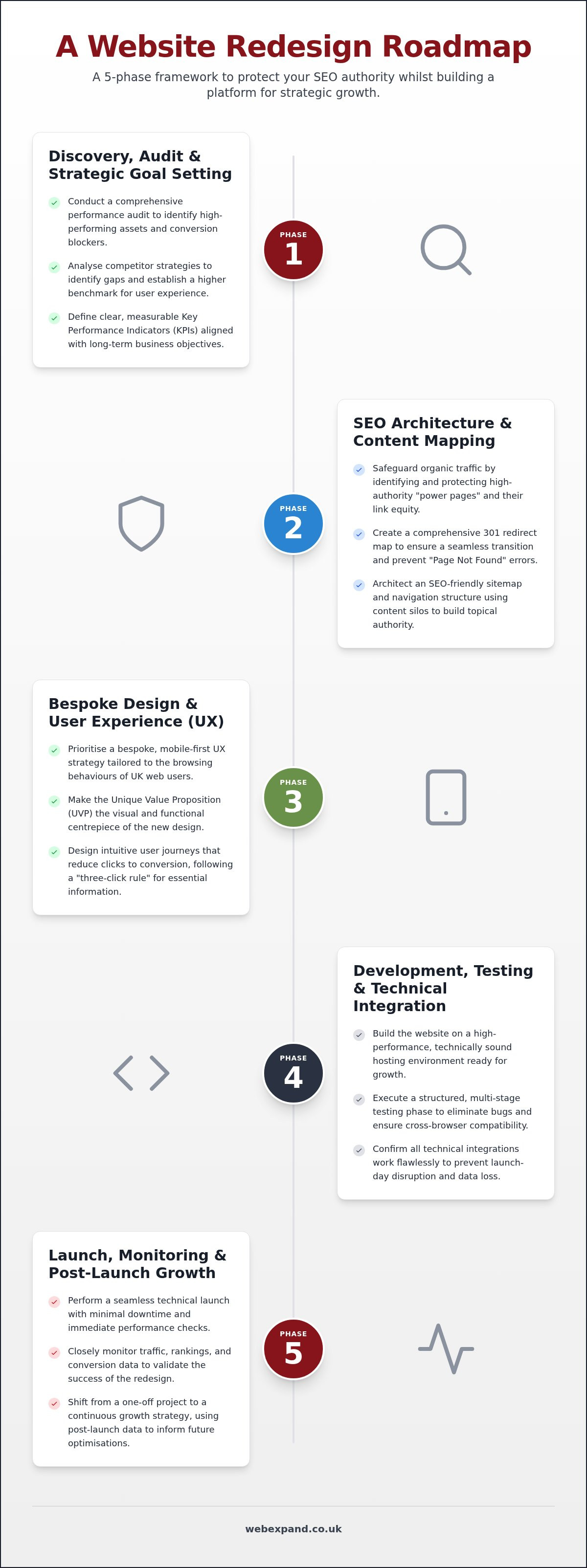
Phase 4: Development, Testing, and Technical Integration
Phase 4 is where the vision meets the machine. Translating your approved designs into clean, responsive code is a precision task that defines your site’s long-term viability. A high-performing website redesign project plan template must account for the technical rigour required to meet Google’s 2026 Core Web Vitals. We don’t just build for visual appeal; we build for speed, security, and search engine logic. This stage transforms static layouts into a dynamic business tool that’s ready to dominate your sector.
Bespoke Development vs. Templates
Generic templates often suffer from “plugin bloat”, which slows down your site and creates unnecessary security vulnerabilities. For ambitious firms, web design London requires a bespoke approach that prioritises performance. We write clean, custom code that eliminates redundant scripts, ensuring your site remains fast and maintainable. This method also allows us to integrate a user-friendly CMS tailored to your team’s specific requirements, making daily content updates effortless. By avoiding the constraints of off-the-shelf themes, we ensure your technical infrastructure is as unique as your business model.
Technical Integration and Automation
Your website should function as the central hub of your business operations. During this phase, we integrate essential third-party tools such as CRMs, email marketing platforms, and e-commerce engines. This ensures a seamless flow of data between your front-end interface and your back-office systems. By automating these connections, we help you scale your operations without increasing your administrative burden. We focus on precision during integration to prevent data silos and ensure your marketing stack is fully synchronised for the launch.
The Pre-Launch Testing Checklist
Rigorous testing is the only way to guarantee a flawless user experience across all devices. We execute a comprehensive checklist before any site goes live to ensure your financial performance isn’t compromised by technical glitches:
- Form Testing: We verify every lead capture point to ensure data is tracking correctly and reaching your sales team.
- Speed Optimisation: We use tools like PageSpeed Insights to refine every asset, targeting near-instant loading times for UK users.
- Security Audit: We implement robust firewall protections and SSL certificates to protect your stakeholders’ interests.
- Cross-Device Validation: We test functionality on everything from high-resolution desktops to the latest smartphones.
Our fixed-price model ensures that this exhaustive testing phase is included in your project scope, protecting you from the “cost creep” often associated with technical delays. If you want to ensure your technical foundation is built for industry leadership, contact our expert developers today to discuss your requirements.
Phase 5: Launch, Monitoring, and Post-Launch Growth
The final phase of your website redesign project plan template is often the most misunderstood. Launch day isn’t the end of the journey; it’s the precise moment your new strategic asset begins to work for you. We execute the technical transition during low-traffic periods, typically late at night or over a weekend, to ensure minimal disruption to your users and revenue. Once the switch is flipped, our team monitors real-time traffic for the first 48 hours to catch any edge-case bugs that only appear in a live environment. This high-energy oversight ensures your transition is as smooth as possible.
Post-Launch SEO and Technical SEO Validation
Immediately after launch, we submit your new sitemap to Google Search Console. This signals to search engines that your structure has changed and encourages immediate re-indexing. We then conduct a rigorous validation of your 301 redirect map, ensuring every legacy URL passes its authority to the correct new destination. If we detect sudden drops in keyword rankings or crawl errors, we move quickly to rectify them before they impact your visibility. This is also the time to update your Google Promotion strategy. Your new site structure likely offers fresh opportunities to target high-intent keywords that were previously out of reach, allowing you to capitalise on your improved technical foundation.
Continuous Improvement and Scaling
A bespoke website is a living organism. To maintain industry leadership in Kent and London, you must embrace a culture of continuous improvement. We use heatmaps to observe exactly how visitors navigate your new layout, identifying any remaining points of friction in the user journey. By A/B testing headers and Call-to-Action (CTA) buttons, we refine your conversion logic based on actual user behaviour rather than assumptions. This data-driven approach ensures your site continues to scale alongside your business objectives, protecting your stakeholders’ interests for years to come.
Scaling your digital presence requires a partner who understands the long-term nature of search authority and user experience. Our fixed-price model covers the transition from development to growth, providing you with a predictable roadmap for success without the fear of hidden costs. If you’re ready to broaden your horizons with a site built for the 2026 market, contact Webexpand for a bespoke project plan. We’ll help you navigate the complexities of the launch and ensure your new platform delivers measurable financial performance from day one.
Broaden Your Horizons with Strategic Design
A website redesign is a pivotal moment for any business ready to dominate its sector. It’s not merely about a fresh look; it’s about engineering a platform that converts traffic into revenue whilst protecting your hard-earned SEO authority. By implementing a comprehensive website redesign project plan template, you move from guesswork to precision. This ensures your 2026 roadmap is built on data and logical architecture. We’ve detailed how every phase, from the initial audit to the final technical validation, must align with your broader growth objectives.
As Kent-based bespoke experts established in 2004, we understand the unique challenges of the UK market. We provide jargon-free advice and fixed-price guarantees to ensure your project stays on track and within budget. Your progress is the ultimate measure of our performance. Take the first step toward a transformative digital journey and secure your competitive edge.
Book Your Strategic Redesign Consultation with Webexpand today and let’s build a website that delivers results.
Frequently Asked Questions
How long does a typical website redesign project plan take to execute?
A professional website redesign typically takes between 12 and 16 weeks to execute from discovery to launch. This timeline accounts for the deep audit, bespoke design, and rigorous technical testing required for a successful transition. Larger e-commerce projects or sites with extensive content archives may require additional time to ensure every 301 redirect is mapped correctly and user journeys are fully optimised.
Will a website redesign hurt my existing SEO rankings on Google?
A redesign will only damage your rankings if you fail to implement a technical migration strategy. By using a website redesign project plan template that prioritises SEO architecture, you can actually improve your visibility. We focus on mapping high-authority URLs and preserving link equity to ensure Google understands your new structure immediately. This proactive approach prevents the traffic drops that often plague poorly managed launches.
What is the difference between a website refresh and a full redesign?
A website refresh is a cosmetic update that focuses on visual elements like fonts and colours whilst keeping the underlying structure intact. In contrast, a full redesign involves a complete overhaul of the site’s architecture, user experience, and technical code. Redesigns are necessary when your current platform no longer supports your 2026 growth objectives or fails to meet modern Core Web Vitals standards.
How much should I budget for a professional website redesign in Kent?
Do I need to write all new content for my redesigned website?
You don’t necessarily need to rewrite everything; it’s more effective to conduct a content audit first. Identify your highest-performing pages and preserve the core information that search engines already reward. However, you should update your messaging to reflect current market conditions and fill any content gaps identified during your competitor analysis. This ensures your new site resonates with your 2026 audience.
How often should a business website be redesigned to stay competitive?
Most businesses should consider a full redesign every three to five years to remain competitive and technologically relevant. User behaviour and search engine algorithms evolve quickly; a site built five years ago likely lacks the mobile-first precision and speed required today. Regular updates ensure your digital presence continues to project an authoritative image and supports your long-term sector dominance.
What are the most common mistakes to avoid in a redesign project plan?
The most frequent errors include ignoring SEO until the final week and allowing project scope creep to inflate budgets. Many firms also fail to prioritise a mobile-first user experience, which is a critical ranking factor for UK search results. By following a structured website redesign project plan template, you can avoid these pitfalls and ensure your new site functions as a high-performance business tool from day one.
Can I manage a website redesign myself using a template?
You can certainly use a template to organise your initial thoughts, but executing a complex redesign requires technical expertise to protect your search authority. Professional management ensures that bespoke code, security protocols, and e-commerce integrations function seamlessly. Whilst a template provides the roadmap, an expert partner provides the precision needed to broaden your digital horizons and deliver a measurable return on investment.