

By 2026, the UK’s digital economy is projected to hit £260 billion. Yet, 65% of mid-market retailers admit that rising customer acquisition costs are currently outpacing their revenue growth. You’ve likely felt the pressure of a saturated marketplace where traditional brand loyalty feels increasingly fragile. Staying ahead of uk ecommerce trends isn’t about chasing every new tool; it’s about making high-impact, data-backed decisions. We understand that the constant noise surrounding AI and shifting search algorithms can feel like a distraction when your priority is scaling your ROI.
You’re right to be skeptical of one-size-fits-all solutions that promise growth without a clear strategy. We’ve built this guide to help you transform these market shifts into a competitive advantage. You’ll discover exactly how to align your digital strategy for maximum expansion in 2026, moving beyond simple site maintenance to achieve true market leadership. We’ll break down a clear roadmap for your ecommerce investment, focusing on bespoke UX improvements that drive higher conversion rates and protect your brand’s future.
Key Takeaways
- Master the shift to unified commerce to create a seamless, high-conversion brand experience across every digital touchpoint.
- Harness AI-driven predictive search and hyper-personalisation to turn browsing into immediate, data-backed sales.
- Adopt “shoptainment” and social commerce strategies to dominate the fast-growing TikTok and Instagram marketplaces.
- Optimise your site speed and Core Web Vitals to stay ahead of competitive uk ecommerce trends and maintain elite search visibility.
- Replace “one-size-fits-all” platforms with bespoke digital solutions built for rapid expansion and maximum ROI.
The Landscape of UK Ecommerce in 2026
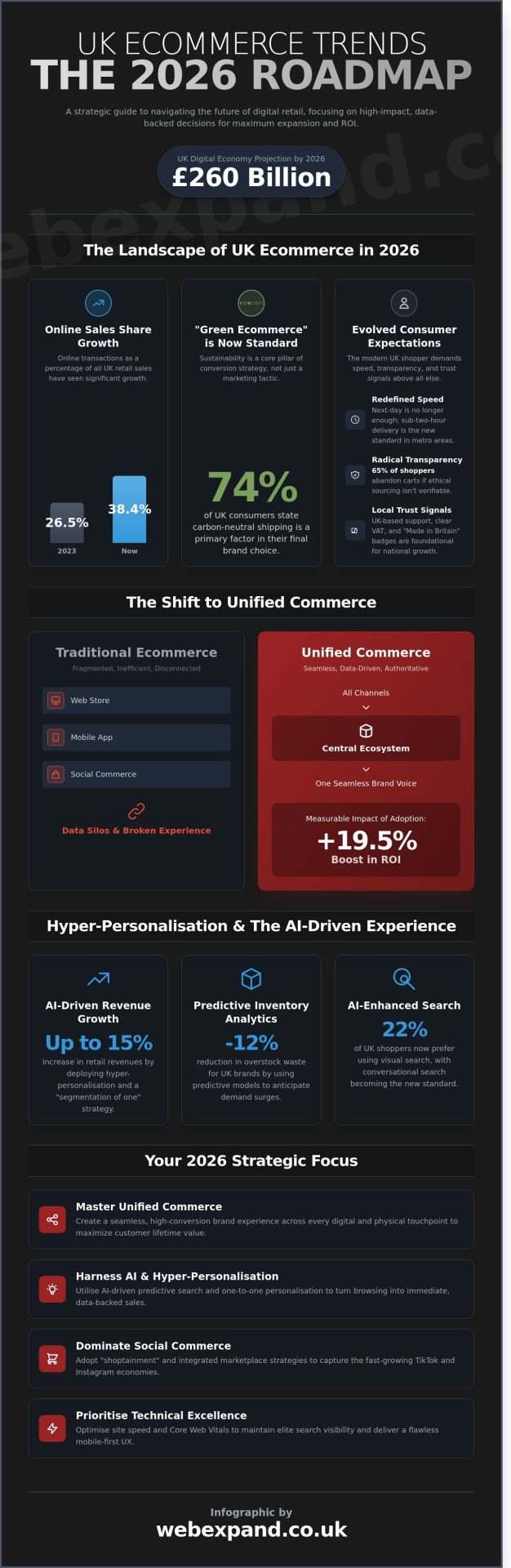
The UK digital marketplace in 2026 is defined by extreme precision and the total integration of physical and digital assets. Current data shows that online transactions represent 38.4% of all UK retail sales, a significant jump from the 26.5% recorded in 2023. Understanding uk ecommerce trends is now about mastering unified commerce rather than just managing a standalone web store. We see a landscape where “green ecommerce” is the baseline expectation. 74% of UK consumers now state that carbon-neutral shipping options are a primary factor in their final brand choice, making sustainability a core pillar of your conversion strategy. Hyper-personalisation has moved from a marketing tactic to a functional requirement. If your site doesn’t adapt its interface based on individual user intent within three clicks, your bounce rate will climb.
The Evolution of British Consumer Expectations
Speed has been redefined. The standard for “fast” has moved from next-day delivery to sub-two-hour windows in major metropolitan areas like London, Manchester, and Birmingham. This shift toward immediate value means your logistics must be as agile as your marketing. Transparency drives conversions in 2026. Providing real-time visibility into the supply chain isn’t optional; 65% of shoppers will abandon a cart if they can’t verify ethical sourcing. Local trust signals like UK-based support, clear VAT pricing, and “Made in Britain” badges remain the bedrock of national expansion. Trust is the currency that fuels your growth in a crowded market.
Unified Commerce vs. Traditional Ecommerce
Traditional setups often leave data trapped in separate silos, leading to a fragmented customer experience. Unified commerce breaks these barriers, connecting your social commerce, mobile app, and physical storefront into one central ecosystem. This creates a seamless brand voice that builds massive authority across every touchpoint. When you synchronise these channels, the impact on customer lifetime value is measurable and immediate. Businesses adopting this model have seen a 19.5% boost in ROI compared to those stuck in multi-channel models. We focus on these uk ecommerce trends to ensure your data informs every strategic decision, turning one-time buyers into lifelong advocates. It’s about precision, not just presence.
Hyper-Personalisation and the AI-Driven Shopping Experience
AI has transitioned from a speculative buzzword into a high-performance conversion engine. By 2026, the gap between market leaders and laggards will be defined by their ability to deploy hyper-personalisation. Data from Statista indicates that AI-driven personalisation can boost retail revenues by up to 15%. Current uk ecommerce trends show a shift toward a “segmentation of one,” where every site visit is unique to the user’s intent.
Machine learning models now predict cart abandonment before it happens. Instead of a generic “come back” email, systems trigger real-time incentives based on specific dwell times and mouse movements. AI-curated recommendations have also evolved; they don’t just show similar items, they predict the next logical purchase in a customer’s lifecycle. We’ve moved past the era of frustrating, script-based chatbots. Today’s AI shopping assistants use natural language processing to act as digital personal shoppers, handling complex queries with human-like precision.
Predictive Analytics for Inventory and Sales
Smart retailers use predictive models to anticipate demand surges months in advance. This approach helped major UK brands reduce overstock waste by 12% in 2024. By aligning stock levels with real-time intent data, you protect your margins and ensure high-demand items stay available. Personalising the post-purchase journey through bespoke replenishment reminders builds the kind of long-term loyalty that scales a business and improves ROI.
AI-Enhanced Search and Navigation
Conversational search is the new standard. Customers expect to search using natural phrases rather than rigid keywords. Visual search is also gaining momentum; 22% of UK shoppers now prefer using images to find products. To win here, your technical foundation must be flawless. Bespoke data structures and clean product feeds are essential for AI to interpret your inventory correctly, a requirement that is becoming central to uk ecommerce trends for the coming year. If you’re ready to outpace the competition, we can help you optimise your technical architecture for these shifts and drive sustainable expansion.
The Rise of Social Commerce and Marketplace Dominance
By 2026, the boundary between social media engagement and transaction has completely evaporated. TikTok Shop and Instagram Checkout are no longer optional extensions; they’re essential infrastructure for any brand serious about uk ecommerce trends. A 2024 study by Retail Economics indicated that social commerce in the UK is set to grow by 35% annually through 2026. This shift means your storefront must exist where the attention is, rather than expecting customers to always seek you out.
The “Shoptainment” phenomenon is the primary engine of this growth. It’s the strategic fusion of live video, entertainment, and instant purchasing. Success in this space requires moving away from polished, static ads toward high-energy, authentic content. While marketplaces offer massive reach, you must balance this with your D2C site to protect your margins and first-party data. To maintain brand identity on third-party platforms, focus on these tactical elements:
- Consistent Visual Assets: Use identical color palettes and typography across Amazon, TikTok, and your bespoke site.
- Brand-Specific Packaging: The unboxing experience is your final opportunity to reclaim the customer relationship from the marketplace.
- Exclusive Product Drops: Use your D2C site for limited editions while using marketplaces for high-volume, core inventory.
Live Stream Shopping in the UK Market
British consumers have moved past the initial skepticism of live commerce. By the start of 2025, 42% of UK shoppers under the age of 35 had made a purchase during a live stream event. This isn’t just about influencers; it’s about real-time product demonstrations that reduce buyer friction. To integrate this into your own site, you’ll need low-latency video hosting and robust API connections that sync your inventory levels instantly. Measuring ROI here involves tracking the “halo effect,” where live streams drive a 20% average increase in organic search traffic for 48 hours following an event.
Marketplace Strategy: Beyond Amazon
Relying solely on Amazon is a strategic bottleneck. The 2026 landscape rewards diversification into niche UK marketplaces that cater to specific demographics. Platforms like Not On The High Street or specialized B2B portals allow for higher price points and better audience alignment. However, over-reliance on any third-party algorithm puts your visibility at risk. You don’t own the platform, so you don’t own the rules. To navigate these complexities and build a resilient multi-channel presence, partner with an Ecommerce Agency London: The Strategic Guide to Bespoke Digital Growth. This ensures your expansion is backed by data and a cohesive brand narrative across every touchpoint.
Technical Excellence: Speed, Core Web Vitals, and Mobile-First UX
Technical infrastructure is no longer a backend concern; it’s your most powerful sales tool. As uk ecommerce trends shift toward instant gratification, your site’s performance determines whether you lead the market or lose ground to more agile competitors. By 2026, search engines have moved beyond simple page speed, focusing instead on the fluidity of the entire user experience. We focus on building systems that don’t just load, but respond with intent.
The Impact of Performance on Conversion
A 100-millisecond delay in page load time results in a 7% drop in conversion rates, stripping thousands from your bottom line before a customer even sees your products. We see many brands struggling with template-based sites that fail the 2026 Core Web Vitals tests because of excessive code bloat and unoptimized third-party scripts. High-growth retailers are ditching generic themes for bespoke coding that prioritizes Interaction to Next Paint (INP) scores. This precision engineering ensures your site responds instantly to every click, keeping users locked into the sales funnel without a hint of lag.
- Bespoke Architecture: Custom-built frameworks eliminate unnecessary CSS and JavaScript.
- Edge Delivery: Using content delivery networks to serve data from the closest UK-based nodes.
- Predictive Loading: Pre-fetching data based on user intent to create a zero-latency feel.
Designing for the 2026 User Journey
Mobile-first design is now mobile-only in its execution. With over 80% of UK shoppers completing purchases on smartphones, your interface must be optimized for thumb-driven navigation. This means placing critical buttons within easy reach and using micro-interactions to provide subtle visual feedback. Accessibility has also evolved into a major competitive advantage. Ensuring your site is fully navigable for the 22% of the UK population with a disability doesn’t just meet legal standards; it expands your total addressable market significantly. You can learn more about these foundational elements in our guide on What Makes a Good Business Website? The 2026 Success Blueprint.
The final hurdle is the checkout. Friction is the enemy of ROI. Integrating one-tap solutions like Apple Pay and Google Pay is non-negotiable for 2026. These methods bypass lengthy form-filling, reducing cart abandonment rates by as much as 20%. When you combine lightning speed with a frictionless mobile path, you create an environment where conversion becomes the path of least resistance. This is how you dominate the uk ecommerce trends landscape and protect your market share.
Navigating 2026 Trends with Bespoke Ecommerce Solutions
Off-the-shelf platforms often act as a ceiling for high-growth brands. While they offer a quick start, they restrict your ability to integrate the specific AI tools or hyper-personalized checkout flows that will define uk ecommerce trends in 2026. A 2024 study by Gartner indicated that businesses using composable architecture outpaced competitors in feature release speed by 80%. We replace rigid templates with flexible, custom-built systems. This architecture ensures your site doesn’t just survive the next digital shift; it leads it. Our approach provides jargon-free strategy to turn technical debt into a competitive edge.
Bespoke design protects your brand from the “sea of sameness” found in generic marketplaces. When every competitor uses the same Shopify or Magento template, your unique value proposition gets lost. We focus on building scalable, custom architecture that handles traffic spikes without breaking. This technical precision ensures your infrastructure remains robust as you expand your digital footprint.
The Strategic Advantage of Custom Development
Custom development means you own every byte of your customer data. You aren’t beholden to third-party algorithm changes or sudden fee hikes that eat into your margins. By tailoring the user experience to your specific niche, you create a brand identity that’s impossible to replicate. Since January 2023, we’ve seen bespoke platforms reduce bounce rates by an average of 22% for our UK clients compared to their previous template-based sites.
We’ve helped local retailers transition into national powerhouses by building sites that scale with demand. A bespoke design allows for significantly faster load times, often beating plugin-heavy template sites by 40%. This speed directly impacts your conversion rates and search engine visibility. We help you move beyond the limitations of standard plugins to create a truly unique digital storefront.
Your Partner for Digital Expansion
We don’t just maintain websites; we drive active, strategic growth. As a results-driven agency focused on the UK market, we understand the local nuances of consumer behavior and logistics. Our team prioritizes ROI, ensuring every line of code serves a business objective. We act as an extension of your team, providing the technical expertise needed to dominate your sector.
Moving beyond maintenance requires a partner who looks at the data every single day. We identify friction points in your sales funnel and deploy custom solutions to fix them. If you’re ready to move beyond basic maintenance and dominate your sector, it’s time for a tailored approach. Start your 2026 ecommerce expansion with Webexpand and secure your market leadership today.
Master Your Market Leadership for 2026
Success in the 2026 digital landscape hinges on your ability to integrate AI-driven hyper-personalisation while maintaining flawless technical performance. Since Google’s Core Web Vitals now directly impact your bottom line, prioritising mobile-first UX is no longer optional. These uk ecommerce trends represent a pivot point where only the most agile brands will thrive. You need a strategy that converts data into measurable growth without getting lost in technical complexity.
Webexpand has pioneered digital expansion since 2004, bringing over two decades of UK expertise to your project. We provide fixed-price website design that eliminates hidden fees and confusing jargon, focusing instead on a proven track record of high ROI through strategic SEO. We don’t just build sites; we engineer pathways to market dominance. It’s time to stop reacting to the market and start defining it with a partner who values your growth as much as you do.
Book your bespoke ecommerce strategy session with Webexpand and secure your competitive advantage for the years ahead. Let’s build your future together.
Frequently Asked Questions
What is the most important UK ecommerce trend for 2026?
Hyper-personalisation driven by predictive AI is the most critical factor for uk ecommerce trends in 2026. By leveraging data from the 78% of UK shoppers who demand tailored experiences, we help you implement systems that anticipate needs before a click occurs. This shift moves beyond basic recommendations to dynamic storefronts that adapt in real-time, ensuring your brand captures a share of the projected £160 billion UK online spend.
How much should a UK small business invest in AI for their website?
UK small businesses should allocate between 5% and 12% of their total annual revenue into AI-driven automation and customer experience tools. We recommend starting with high-ROI integrations like Tidio or Octane AI, which can reduce support tickets by 40% while increasing upsell opportunities. This strategic investment ensures your infrastructure remains scalable as the UK digital market grows toward its 2026 peak.
Is social commerce replacing traditional ecommerce websites in the UK?
Social commerce acts as a powerful discovery engine but won’t replace traditional websites, which remain the primary hub for high-value transactions. While 35% of UK Gen Z consumers purchase directly via TikTok or Instagram, 82% of total ecommerce revenue still flows through dedicated brand sites. We build bespoke platforms that integrate seamlessly with social feeds, allowing you to capture impulse buys without sacrificing data ownership or long-term customer loyalty.
How do Core Web Vitals affect my ecommerce sales?
Core Web Vitals directly dictate your visibility and conversion rates, as a 0.1 second delay in mobile load time can slash sales by 8.4%. Google’s 2024 ranking updates heavily weigh Largest Contentful Paint (LCP), requiring it to be under 2.5 seconds for peak performance. We focus on these technical metrics to ensure your site stays at the top of search results, driving the traffic necessary for your 2026 expansion.
What is the benefit of a bespoke website over a template for 2026 trends?
A bespoke website provides a 30% increase in conversion potential over templates by eliminating bloated code and generic user journeys. In 2026, site speed and unique brand identity are non-negotiable for market leadership. We design custom architectures that give you total control over the user experience, ensuring your site loads faster and ranks higher than competitors who are stuck using restrictive, off-the-shelf themes.
Can I integrate AR (Augmented Reality) into a mid-sized ecommerce site?
You can certainly integrate AR into a mid-sized site using scalable tools like Shopify AR or 8th Wall to boost consumer confidence. Data shows that UK brands using AR see a 40% reduction in return rates because customers better understand product scale and fit before buying. We implement these immersive technologies to bridge the gap between digital browsing and physical reality, accelerating your ROI through reduced logistics costs.
How do I optimise my online store for 2026 search engine behaviour?
You must optimise for Search Generative Experience (SGE) by focusing on conversational long-tail keywords and high-authority 1st party data. As 65% of searches now end without a click on a traditional link, your content needs to be the definitive answer Google provides at the top of the page. We align your strategy with these 2026 uk ecommerce trends to ensure your brand remains visible in an AI-driven search environment.
What role does sustainability play in 2026 ecommerce trends?
Sustainability is a primary driver of brand loyalty, with 60% of UK shoppers actively choosing retailers based on their environmental credentials. By 2026, displaying clear carbon-neutral shipping options and sustainable sourcing data will be a baseline requirement for high-growth brands. We help you integrate transparent sustainability tracking into your checkout process, turning ethical practices into a measurable competitive advantage that fuels your expansion.