

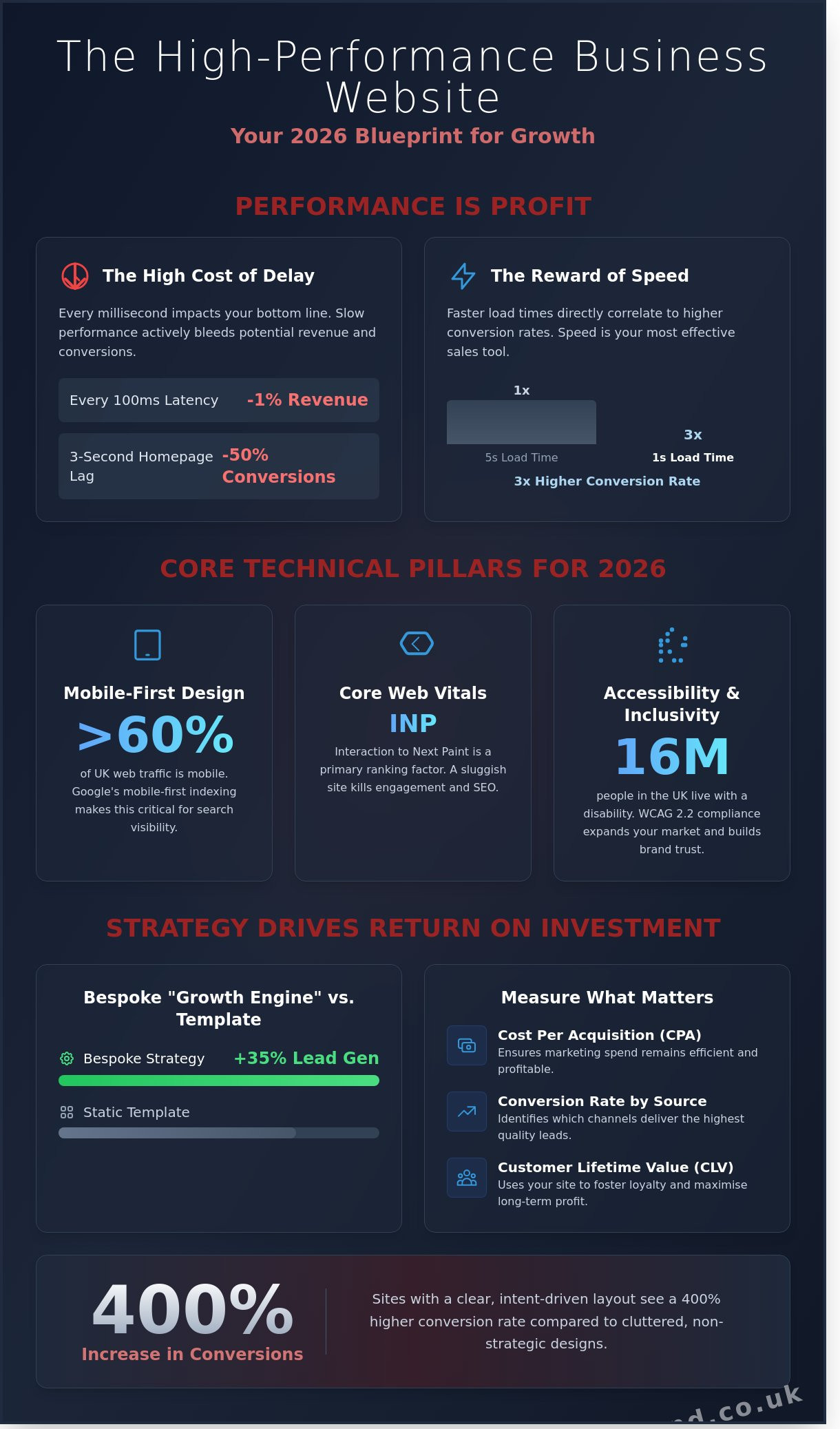
In 2024, data confirmed that every 100ms of latency costs businesses 1% in potential revenue. By 2026, a three-second lag on your homepage will likely slash your conversion rates by 50%. Understanding what makes a good business website is no longer about picking the right colours; it’s about engineering a high-performance growth engine that captures every possible lead.
You’ve probably felt the sting of investing in digital marketing only to watch visitors bounce because of confusing navigation or inconsistent branding. It’s exhausting when agencies hide behind technical jargon while your lead generation plateaus. We agree that your digital presence should be your hardest-working employee, not a source of constant frustration.
This success blueprint reveals the essential technical and strategic elements that transform standard sites into bespoke revenue drivers. We’ll provide a clear checklist for your next evaluation, showing you exactly how to link modern design to a measurable ROI. You’ll gain the confidence to choose a professional partner who prioritises your expansion over simple maintenance.
Key Takeaways
- Learn how to transform your online presence from a static brochure into a proactive growth engine that prioritises user intent and measurable results.
- Discover exactly what makes a good business website in 2026 by mastering technical essentials like Core Web Vitals and mobile-first responsiveness.
- Explore the intersection of high-value content and strategic SEO to fuel your visibility and establish your brand as an authoritative market leader.
- Master the conversion architecture and trust signals required to guide visitors through the sales funnel with precision and confidence.
- Understand why bespoke development offers superior long-term ROI and scalability compared to the hidden costs of restrictive website templates.
Defining the Modern Business Website as a Growth Engine
The era of the “online business card” ended years ago. By 2026, a website that merely exists is a liability. Understanding what makes a good business website requires shifting your perspective from a passive gallery to a proactive growth engine. We’ve observed that UK businesses treating their digital presence as a 24/7 sales representative achieve 35% higher lead generation rates than those relying on static templates. Your site must prioritise user intent over vanity metrics. Page views mean very little if they don’t translate into revenue. Success is measured by ROI. If your £15,000 investment doesn’t generate a clear, trackable multiple in new contracts, it hasn’t met the benchmark for what makes a good business website in a competitive market. We prioritise three key metrics to ensure expansion:
- Cost per acquisition (CPA): Ensuring your digital marketing spend stays efficient as you scale.
- Conversion rate by traffic source: Identifying which channels deliver the highest quality leads.
- Customer lifetime value (CLV): Using your website to foster long-term loyalty and repeat business.
The Core Purpose of Your Digital Headquarters
We start every project by defining the commercial objective before a single pixel is moved. A website must map directly to the customer journey, from initial discovery to final advocacy. For a B2B firm, this involves moving a prospect from the awareness stage to a booked consultation within three clicks. Aligning your digital strategy with physical business goals ensures your online presence supports real-world expansion. If you’re targeting a 22% increase in turnover by the end of 2026, your website architecture must be the primary vehicle for that growth.
Form vs Function: Striking the Perfect Balance
Visual appeal catches the eye, but user experience (UX) closes the deal. High-quality web design isn’t just about looking “modern”; it’s about removing friction from the conversion path. Bespoke design allows us to weave your unique brand values into the interface, creating a sense of authority that off-the-shelf templates cannot replicate. Adobe’s 2024 Digital Trends Report indicates that sites with a clear, intent-driven layout see a 400% increase in conversion rates compared to cluttered, non-strategic designs. We ensure every element, from the hero section to the footer, serves a specific commercial purpose. This precision allows your brand to dominate its niche while providing a seamless journey for every visitor.
Technical Excellence: Speed, Responsiveness, and User Experience
Technical performance is the engine room of your digital presence. When we analyse what makes a good business website in 2026, we don’t view mobile responsiveness as an optional feature. It’s the baseline. With over 60% of UK web traffic now originating from mobile devices, your site must be designed for the thumb first, not the cursor. Google’s mobile-first indexing means if your mobile experience falters, your search visibility disappears. We build sites that adapt fluidly to every screen size, ensuring your brand looks authoritative whether viewed on a smartphone in London or a desktop in Manchester.
Speed is your most aggressive conversion tool. Research from Portent shows that a site loading in 1 second has a conversion rate 3x higher than a site loading in 5 seconds. We focus heavily on Core Web Vitals, specifically Interaction to Next Paint (INP), which became a primary ranking factor in March 2024. This metric measures how quickly your site responds to user interactions. If your site feels sluggish, 40% of users will abandon it within three seconds. Precision engineering ensures your visitors stay engaged rather than bouncing to a competitor. High-energy performance isn’t just about code; it’s about protecting your bottom line.
Accessibility is a vital market expansion strategy. By ensuring WCAG 2.2 compliance, you open your services to the 16 million people in the UK living with a disability. This inclusivity drives ROI and demonstrates a brand committed to every potential client. A site that’s usable for everyone is a site that’s ready to dominate its niche.
Infrastructure and Hosting Security
Your hosting provider is the foundation of your security strategy. We recommend UK-based data centres to reduce latency and ensure strict adherence to UK GDPR standards. In 2026, using TLS 1.3 encryption is the minimum requirement for protecting customer data and maintaining trust. Regular maintenance prevents technical debt, which can drain up to 20% of a company’s digital budget if left unchecked. A secure, fast environment builds the authoritative digital presence your brand deserves to scale effectively.
Intuitive Navigation and Information Architecture
Logic must dictate your site’s structure. We follow the “Three-Click Rule” where a user should find any vital information within three clicks of landing. This requires a bespoke information hierarchy that organises complex services into clear, digestible categories. Breadcrumbs and strategic internal linking guide the user journey, ensuring they never feel lost. When navigation is effortless, your conversion pathways become clear. We turn complex data into a simple, guided experience that moves users toward a transaction without friction.
Strategic Content and Visibility: Beyond Basic SEO
Content is the high-octane fuel that powers your digital engine. Without it, even the most beautiful design remains invisible to your target audience. To understand what makes a good business website, you have to look at how visibility and user value intersect. Google’s March 2024 Core Update reduced low-quality, unoriginal content in search results by 45%, proving that search engines now prioritise genuine substance over keyword stuffing. Topical Authority is the ability to demonstrate deep expertise in a niche to both users and search engines. We move beyond simple phrases to address the specific intent behind every search query. This ensures your site doesn’t just attract traffic; it attracts the right buyers ready to invest in your services.
- Intent-Based Mapping: Aligning every page with a specific stage of the buyer’s journey.
- Data-Driven Insights: Using performance metrics to refine your message.
- Value-First Approach: Solving user problems before asking for a sale.
Search Engine Optimisation as a Managed Strategy
Treating SEO as a one-off task is a recipe for stagnation. A successful site requires recurring attention to maintain its edge against competitors who are constantly bidding for your market share. Technical SEO forms the foundation, ensuring your site loads in under 2 seconds and remains perfectly crawlable. However, long-term growth depends on an active, managed strategy that responds to algorithm shifts in real-time. You can review our Monthly Recurring SEO and Digital Marketing Management Fees to see how we structure these growth-focused campaigns. Consistent management allows us to pivot based on data, ensuring your ROI remains high as the market evolves.
Crafting High-Conversion Copywriting
Your copy must do the heavy lifting when you aren’t there to speak. We ditch the cold corporate jargon that confuses 74% of B2B buyers and focus on clear, punchy advice that builds rapport instantly. Headlines must communicate your primary value proposition in less than 5 seconds to prevent bounce rates from climbing. Results don’t happen by accident. We use storytelling techniques to frame your brand as the expert guide in your client’s success story. This approach differentiates your business from generic competitors and transforms your site from a digital brochure into a high-performance sales tool. Precision in language leads directly to precision in your lead generation.
Trust Signals and Conversion Architecture: The Psychology of a Sale
Trust isn’t a vague concept; it’s a measurable driver of growth. In the UK market, 88% of consumers consult online reviews before committing to a purchase. High-quality social proof, such as verified Trustpilot ratings or case studies demonstrating a 25% increase in client efficiency, forms the backbone of what makes a good business website. Without these psychological anchors, your brand remains an anonymous digital entity. We’ve seen conversion rates climb by 34% simply by placing authentic testimonials near key decision points.
Clear Calls to Action (CTAs) eliminate user hesitation. You must tell your visitors exactly what to do next. Replace generic “Submit” buttons with benefit-driven language like “Get My Free Quote” or “Book Your Strategy Call”. Reducing friction is equally vital. Streamlining a contact form from six fields down to three can increase your completion rates by 160%. Your contact details should be visible and clickable, ensuring no visitor has to work to find you.
Professional photography establishes immediate credibility that stock images cannot replicate. Genuine photos of your UK-based team or your actual workspace create a human connection. This visual transparency proves your business is a real, operational entity. It builds the confidence required for a visitor to transition into a lead.
Building Authority Through Transparency
Transparency directly influences your bottom line. Your “About” page acts as a strategic asset by humanising your digital presence. Showcase the real experts behind your processes. Displaying industry certifications, such as ISO 9001, or memberships in the Federation of Small Businesses (FSB) reassures 72% of B2B buyers. These badges of honour prove you’re a legitimate, professional partner focused on quality.
The Anatomy of a High-Converting Landing Page
Focus is your most valuable currency. A landing page with a single, clear goal outperforms pages with multiple links by 266%. We use heat maps to analyse user behaviour, allowing us to reposition high-value elements where they get the most attention. Speed is the final piece of the puzzle. If your secure lead capture form takes longer than 2 seconds to process, 40% of users will abandon the page entirely.
Ready to transform your site into a high-performance sales tool? Partner with WebExpand to build your conversion engine today.
Bespoke Development vs Templates: Investing for Long-Term ROI
Selecting a pre-made template versus a custom build represents the difference between renting a generic space and owning a purpose-built headquarters. While a £50 theme appears cheap, the hidden costs of budget options are immense. Most templates carry 75% more code than necessary, which drags down load speeds and frustrates users. This bloat directly impacts your bottom line. A Bespoke Website Design ensures every line of code serves a purpose, resulting in sites that load 2.4x faster than their template-based counterparts. When considering what makes a good business website, lean architecture and high-performance metrics are essential for 2026.
- Maintenance Debt: Cheap templates often require £500+ in annual plugin subscriptions just to maintain basic functionality.
- Scalability: Custom builds handle traffic spikes of 1,000% more effectively than bloated theme builders.
- Security: Generic templates are frequent targets for automated hacks; custom code offers a much smaller attack surface.
Future-Proofing Your Business Investment
Search engine algorithms evolved significantly following the March 2024 core update, placing even higher premiums on technical excellence. Custom builds allow for precise adjustments to your site structure without the risk of breaking third-party plugins. You retain total control over your digital assets and domain management. Proprietary builders often trap your data in a closed ecosystem; we ensure your CMS remains flexible enough to support 10x growth without requiring a total rebuild. This flexibility is a core component of what makes a good business website in a shifting market.
The Webexpand Approach to Digital Growth
Our team delivers fixed-price development paired with ongoing strategic support to ensure your ROI remains high. We prioritise Google promotion during the design phase rather than treating it as an afterthought. This proactive strategy has helped our partners secure top-tier rankings for competitive UK keywords. Our methodology defines what makes a good business website by merging aesthetics with raw technical power. We view your site as a dynamic tool for market dominance rather than a static brochure. Ready to expand your online presence? Let’s discuss your bespoke project and build something that truly scales.
Secure Your Competitive Edge for 2026
The digital landscape has shifted. A high-performing site now requires sub-second loading speeds and a conversion architecture that actively guides every visitor toward a sale. Understanding what makes a good business website in today’s market means prioritising bespoke development over restrictive templates to ensure long-term scalability. You need a platform where technical excellence and integrated Google promotion work in perfect sync to drive measurable ROI. Static pages are no longer enough; your site must function as a dynamic growth engine that evolves alongside your customer’s needs.
Webexpand has pioneered results-driven digital growth since 2004. With over two decades of expertise, we’ve helped hundreds of UK businesses move past jargon to achieve genuine market leadership. We focus on the data that matters; ensuring your site acts as a 24/7 sales tool rather than a static expense. Our team specialises in translating complex SEO requirements into clear, profitable outcomes for your brand. It’s time to stop settling for average performance and start dominating your niche with a partner who understands the mechanics of expansion.
Book your bespoke website strategy consultation with Webexpand to transform your online presence today. We’re ready to help you scale.
Frequently Asked Questions
How much should a professional business website cost in 2026?
A professional business website in 2026 typically costs between £5,000 and £25,000, depending on your specific functionality needs. High-performance sites requiring custom API integrations or complex e-commerce features often require an investment exceeding £30,000. You’re paying for a strategic growth tool, not just a digital placeholder. We focus on delivering a high ROI, ensuring your £10,000 investment translates into measurable revenue expansion within the first 12 months.
Can I update the content on my business website myself?
You can update your content yourself using a modern Content Management System like WordPress or Webflow. We build intuitive back-end interfaces that allow your team to publish blogs or update service pages in under 10 minutes. This autonomy reduces long-term maintenance costs and keeps your site relevant. We provide 2 hours of bespoke training to ensure your staff handles updates with 100% confidence and precision.
How long does it take for a new website to start ranking on Google?
Most new websites take 90 to 180 days to show significant movement in Google search rankings. This timeline depends on your niche’s competitiveness and the quality of your initial SEO strategy. We target quick win keywords within the first 60 days to generate early momentum. Consistent, high-quality content remains the most reliable way to secure a top 3 position for your primary search terms by month six.
Do I really need a bespoke website or is a template enough?
A bespoke website is essential if you want to dominate your market and achieve a conversion rate above the 2.35% industry average. Templates often come with bloated code that slows down your site by 40% or more. Custom builds allow us to strip away the fluff and focus on a lean, high-performance architecture. This precision ensures your brand stands out from the 1.1 billion websites currently competing for attention online.
What is the most important feature of a good business website?
The most important feature of what makes a good business website is a conversion-optimised user experience that drives measurable actions. Your site must load in under 1.8 seconds to avoid the 32% bounce rate spike associated with slow pages. We use data-driven layouts to guide visitors toward your primary call-to-action. This precision ensures your digital presence functions as a 24/7 salesperson, consistently turning traffic into profit for your business.
Is mobile responsiveness still important for B2B websites?
Mobile responsiveness is vital for B2B success because 60% of B2B buyers now use mobile devices to research vendors. If your site doesn’t adapt, you’re effectively ignoring 6 out of 10 potential leads. Google’s mobile-first indexing means a non-responsive site won’t even appear in top search results. We ensure your technical infrastructure delivers a seamless experience across all devices, protecting your visibility and professional reputation.
How often should I redesign or update my business website?
You should consider a major redesign every 2 to 3 years to stay ahead of evolving design trends and browser technologies. However, we recommend monthly performance audits to make incremental improvements based on user data. Static websites lose 15% of their effectiveness each year they aren’t updated. By treating your website as a living asset, you maintain a competitive edge and ensure your digital presence reflects your current market leadership.
What are the essential pages every business website must have?
Your site must include a Home page, Service pages, an About section, Case Studies, and a clear Contact page. These core elements are fundamental to what makes a good business website because they establish authority and trust. Adding a dedicated Results page with 5 or more testimonials can boost lead generation by 34%. We structure these pages to lead prospects through a logical journey, ensuring your brand story aligns with your growth goals.