

In 2026, SEO is no longer just a marketing channel; it is the process of building digital equity and brand authority that both AI models and customers trust. You have likely sat in boardrooms where technical talk of latency or schema is met with blank stares, leaving you to wonder why your strategic vision isn’t translating into financial support. It’s a common frustration to feel that your hard work is being viewed as an optional expense rather than a vital engine for growth, especially when you are trying to figure out how to explain SEO value to stakeholders who are laser-focused on immediate ROI.
We understand that bridging the gap between organic rankings and bottom-line revenue is the biggest hurdle you face. This guide promises to equip you with a clear framework to translate complex data into the language of business development, helping you protect your marketing budget and secure long-term buy-in. We will explore how to move beyond vanity metrics and demonstrate how building topical authority directly impacts your organisation’s financial performance. By the end of this article, you will have the tools to position SEO as a strategic business asset that drives measurable results whilst outperforming the competition.
Key Takeaways
- Identify why stakeholders often struggle to see “invisible” SEO progress and how to align technical milestones with their quarterly business objectives.
- Master how to explain seo value to stakeholders by shifting the conversation from abstract rankings to tangible market share and reductions in customer acquisition costs.
- Discover how to frame SEO as a long-term strategic asset that builds digital equity and trains modern AI models to recognise your brand’s authority.
- Learn to quantify the cost of inaction by calculating the revenue your local competitors in London or Kent are siphoning away through the “competitor gap.”
- Understand the importance of jargon-free, transparent reporting that positions your SEO efforts as a collaborative journey toward industry leadership.
Bridging the Communication Gap: Why Stakeholders Struggle with SEO
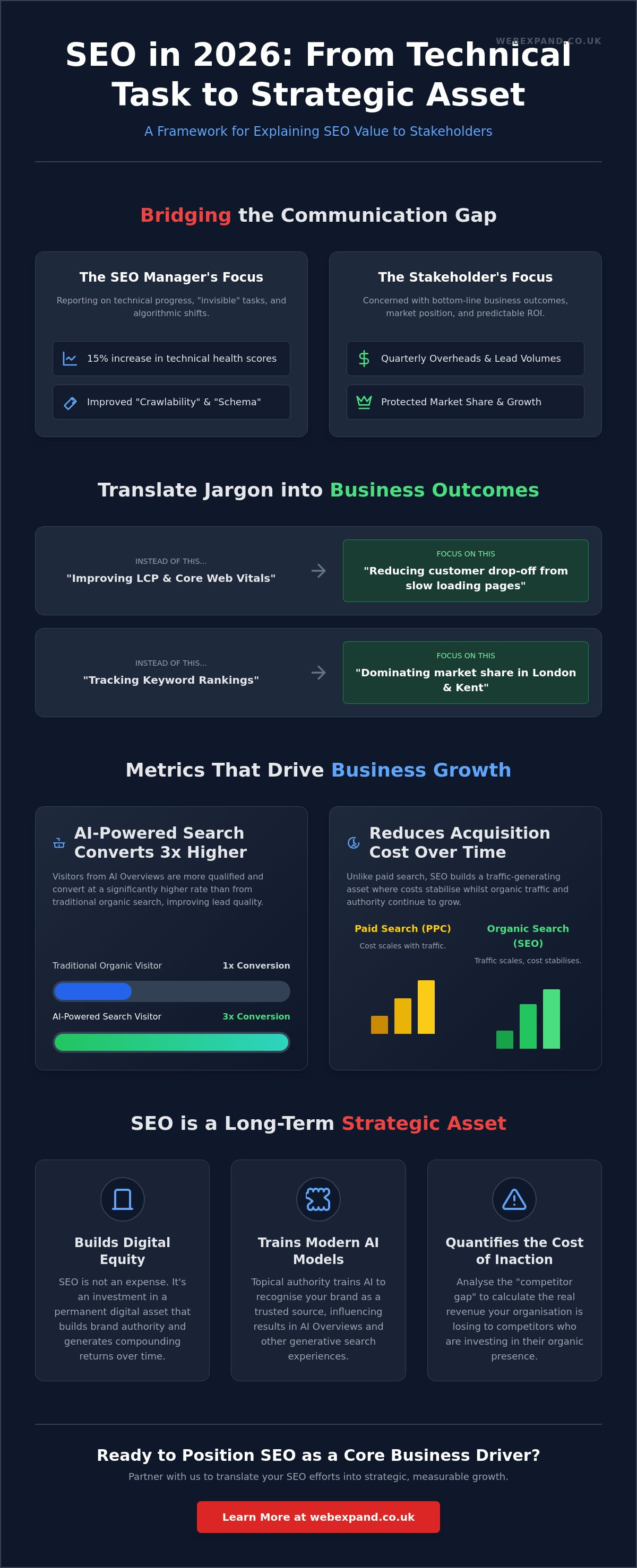
Stakeholders often view marketing through a lens of immediate accountability. Whilst a Head of SEO might celebrate a 15% increase in technical health scores, a Managing Director is looking at quarterly overheads and lead volumes. This mismatch creates a friction point where SEO work is perceived as an “invisible” cost rather than a strategic investment. To bridge this gap, you must stop reporting on tasks and start reporting on business outcomes.
Understanding What is Search Engine Optimization (SEO) from a commercial perspective is the first step. For a business owner in Maidstone or London, SEO is about securing a competitive advantage in a crowded digital marketplace. When you are tasked with how to explain seo value to stakeholders, your primary job is to provide security. They don’t want to hear about the intricacies of the latest algorithm update; they want to know that their market share is protected and their growth is predictable.
The Problem with Technical Jargon
Technical terms like “crawlability” and “canonicalisation” are the quickest way to lose a director’s attention. These words alienate decision-makers because they lack a clear commercial “so-what.” To build trust, every technical recommendation must be tied to a financial or strategic benefit. For example, instead of discussing “improving LCP,” explain that you’re “reducing the number of customers who leave the site because it’s too slow to load.” This shift in vocabulary moves you from being a service provider to a strategic partner.
Short-term Targets vs. Long-term Organic Growth
The 2026 search landscape requires a nuanced approach to timing. In the UK, the introduction of AI Overviews has been linked to an 86% decrease in organic traffic growth for some sectors, making the initial phase of any campaign appear slower than in previous years. Managing expectations is critical. You can’t promise instant results, but you can demonstrate compounding value through structured topical authority. For instance, a well-executed pillar-and-cluster model can generate over 2,200 impressions for core keywords within just a few weeks, providing the data-backed proof that your strategy is working.
Whilst traffic growth may feel slower, visitors from AI-powered search now convert at a rate three times higher than those from traditional organic search. Highlighting these incremental wins shows that the engine is warming up, even if the revenue hasn’t peaked yet. This approach builds the patience required for Google Promotion to deliver its full transformative potential. Focus on milestones that matter to the business:
- Growth in impressions for high-margin “pillar” content.
- Increased visibility for high-intent local searches in Kent.
- Improved lead quality from refined SERP features and AI citations.
Translating SEO Metrics into Business Outcomes
To move the needle in a board meeting, you must stop treating SEO as a technical project and start presenting it as a commercial engine. Rankings are merely a means to an end. What truly matters to a Director is market share. Instead of reporting on individual keyword positions, show how your brand dominates the digital landscape across London or Kent. This shift in perspective transforms a list of words into a map of territory you’ve successfully claimed from competitors.
When you are determining how to explain seo value to stakeholders, focus on the reduction in Customer Acquisition Cost (CAC). Unlike paid search, where every click carries a price tag, organic traffic scales without a linear increase in spend. You should also highlight that visitors from AI-powered search currently convert at a rate three times higher than those from traditional organic search. This data point alone changes the conversation from “how much traffic are we getting?” to “how much high-value revenue are we capturing?”.
Equally, it’s vital to connect technical elements like backlinks to broader business goals. A high-quality backlink profile isn’t just a ranking signal; it’s a digital endorsement that builds brand trust and industry authority. When other reputable organisations link to your site, they are effectively vouching for your expertise. This authority supports every other marketing channel, including your PPC campaigns, by lowering the overall blended Cost Per Acquisition (CPA) through improved brand recognition and trust. If you find it challenging to quantify these shifts, our team can help you align your reporting with your commercial goals.
The Revenue-First Reporting Framework
Lead every presentation with revenue or lead generation figures. Technical data should only serve as the “why” behind the financial “what.” Utilise “Assisted Conversions” to demonstrate how SEO often initiates a customer journey that might conclude through a direct visit or a paid ad. Another powerful metric is “Media Value.” Calculate what you would have to pay in Google Ads to receive the same volume of targeted traffic. This provides a clear, pound-for-pound comparison that any CFO will appreciate.
Visualising Value for the C-Suite
Trend lines are your best friend in 2026 reporting. A snapshot of a single month rarely tells the full story of organic growth. Show the trajectory of your progress over six to twelve months to highlight the compounding nature of the investment. Use competitor benchmarking to trigger a stakeholder’s natural competitive drive. Showing that a rival in Maidstone is siphoning away potential revenue because of a visibility gap is often the most persuasive argument for protecting or increasing your budget. Keep your dashboards simple, focusing on the three to five KPIs that actually impact your bottom line.
SEO as a Strategic Asset: Building Digital Equity in 2026
When you are deciding how to explain seo value to stakeholders, frame the conversation around capital rather than costs. In the current financial climate, savvy directors recognise the difference between renting an audience and owning one. Paid advertising is digital rent; the moment you stop paying, your visibility vanishes. Search Engine Optimisation, however, builds “Digital Real Estate.” It creates a permanent, high-value presence that sits on your company’s balance sheet as a strategic asset. A high-ranking website with deep topical authority significantly increases the overall valuation of a business, making it a more attractive prospect for investors or future acquisitions.
For firms looking to explore how these principles are applied internationally, you can discover Imdadullah Digital and their approach to advanced web development and search engine strategies.
Furthermore, observing international agencies such as eestrategias.com can provide valuable context on how digital equity is built and maintained in rapidly evolving global markets.
The role of SEO has evolved into a sophisticated method of training AI models to recognise your brand as a market leader. By 2026, search is no longer confined to a list of links; it is a distributed ecosystem where AI interfaces like Google’s Search Generative Experience (SGE) and ChatGPT synthesise information to provide direct answers. If your brand isn’t part of the underlying knowledge graph that feeds these models, you effectively don’t exist in the AI-driven discovery phase. Investing in Google Promotion ensures that your expertise is encoded into these systems, protecting your brand’s future relevance.
Winning in the Age of AI Search
SEO value has shifted from simply appearing in “blue links” to becoming the cited source within AI-generated answers. Whilst the introduction of AI Overviews in the UK has been linked to an 86% decrease in traditional organic traffic growth for some, the quality of that traffic has surged. Data shows that visitors from AI-powered search convert at a rate three times higher than those from traditional search. Stakeholders must realise that being the “trusted authority” cited by an AI is now the ultimate form of brand resilience. It ensures you remain visible even as the search landscape shifts beneath your feet.
The Compounding Interest of SEO
Paid ads offer linear growth; you get exactly what you pay for, and the costs often rise as competition intensifies. SEO offers exponential potential. The work you do today to build a “pillar and cluster” content model creates a foundation that continues to deliver leads years down the line. We recently saw this with a local Kent firm that moved away from heavy PPC reliance. By focusing on bespoke website design and authority-led content, they stopped “renting” their niche and started “owning” it. Within months, they achieved top-five rankings for core keywords, securing a sustainable stream of high-intent leads without the mounting pressure of rising ad spend. This compounding effect is the key to long-term sector dominance.
Quantifying the Risk: The Cost of Inaction
In a market as competitive as London or Kent, silence in the search results is a liability. When you are assessing how to explain seo value to stakeholders, you must highlight the “Competitor Gap.” Every day your brand isn’t visible for high-intent keywords, a local rival in Maidstone is siphoning away your potential revenue. This isn’t just a missed chance; it’s a direct transfer of market share to your competitors. Once a rival establishes topical authority, the financial cost to displace them increases exponentially. Search engines reward long-term consistency, meaning the price of catching up in two years’ time will be far higher than the investment required to maintain your lead today.
Brand erosion is another critical risk that often goes unmeasured until it’s too late. It occurs when customers can’t find you during their research phase. If they search for a solution you provide and only see your competitors, your brand’s perceived authority diminishes. In the 2026 landscape, where AI models synthesise information from the top-tier sources, being absent from these summaries means you’re effectively invisible to the most qualified leads. The May 2024 API leak confirmed that backlinks and authority signals remain significant ranking factors. If your rivals are building these digital endorsements whilst you remain inactive, they are cementing a lead that becomes harder to break every month.
The Competitor Takeover Scenario
Visualise your market share as a physical storefront. If you stop maintaining the building, customers naturally drift to the modern, well-lit shop next door. The same happens online. Google’s March 2024 Core Update proved that the algorithm prioritises helpful, high-quality content that demonstrates genuine expertise. If you stagnate, you aren’t just standing still; you’re actively losing ground to those who are consistently updating their digital presence. The Cost of Inaction is the cumulative loss of future revenue and brand trust that occurs when a business fails to defend its digital territory.
Protecting Your Digital Perimeter
SEO acts as a defensive perimeter. Relying solely on paid ads or social media is risky because those platforms can change their rules or pricing overnight. Organic visibility provides a stable foundation for any Kent business. It ensures that even if ad costs spike, your primary lead source remains secure. Organic search is the most resilient asset in your marketing mix, protecting your brand name and reputation from being overshadowed by aggressive competitors. Don’t wait until your rivals have dominated the first page to take action. You can speak with our team today to audit your current visibility and identify where your rivals are gaining an advantage.
How Webexpand Partners with Stakeholders for Strategic Growth
We believe that a strategic partnership is built on shared goals and absolute transparency. For businesses across Kent and London, the challenge isn’t just performing the work; it’s ensuring that the board understands the commercial impact of every action taken. We strip away the coldness of corporate jargon to provide reporting that focuses on organisational growth. Our team acts as an ambitious guide, moving quickly from identifying market challenges to presenting data-backed solutions that protect your interests.
Our monthly SEO management is never a static, box-ticking exercise. It’s a dynamic process designed to align with your long-term business expansion plans. We understand that your progress is the ultimate measure of our own performance. This is why we focus on how to explain seo value to stakeholders through the lens of financial performance and digital presence. By providing a clear, logical roadmap, we ensure the value proposition is never lost in procedural complexity, allowing you to dominate your sector with confidence.
We provide a bespoke, fixed-price approach to both bespoke website design and SEO integration. This eliminates the uncertainty of fluctuating costs and allows you to plan your marketing budget with precision. Whether you are a local firm in Maidstone or a larger organisation scaling nationally, our tailored solutions are grounded in traditional professional values like reliability and transparency. We don’t just maintain your site; we transform it into a high-performance asset that drives measurable outcomes.
Tailored Solutions for Local and National Growth
Our expertise extends across the region, supporting tradesmen and established firms in Sevenoaks, West Malling, and throughout the South East. We invite you to explore our SEO Services Kent to see how we drive strategic business expansion through authority-led content and technical precision. We focus on the outcomes that actually impact your bottom line, ensuring your brand remains a cited authority in an increasingly AI-driven search environment.
Next Steps: Securing Your 2026 Buy-In
Securing budget approval requires evidence that is both undeniable and easy to digest. We provide the data-backed insights you need to present a results-driven case to your board. Our free audit tool is designed to highlight the “Competitor Gap” and the “Opportunity Cost” we discussed earlier, giving you the ammunition to lead a transformative journey toward industry leadership. If you are ready to change how to explain seo value to stakeholders within your organisation, contact us today for a consultation. Let’s work together to broaden your horizons and secure your digital future.
Secure Your Strategic Advantage for 2026
Mastering the art of how to explain seo value to stakeholders is the definitive step toward transforming your marketing from a cost centre into a revenue engine. By shifting focus from abstract rankings to digital equity and market share, you align your strategy with the commercial objectives that directors value most. You now have the framework to demonstrate that organic visibility isn’t just about traffic; it’s about protecting your brand’s future in an AI-driven search ecosystem.
Webexpand has been a strategic partner for UK firms since 2004. With over two decades of expertise in Google promotion and bespoke Kent web design, we have a proven track record of delivering measurable revenue growth. We specialise in translating complex technical shifts into clear, results-driven pathways for our partners. This level of experience ensures that your digital presence is built on a foundation of reliability and precision.
Secure your 2026 digital growth — contact Webexpand for a jargon-free SEO strategy. Your journey toward industry leadership starts with a single, data-backed conversation. Let’s work together to broaden your horizons and dominate your sector.
Frequently Asked Questions
How do I explain SEO to someone who knows nothing about marketing?
Explain SEO using the analogy of a high-street storefront. If your business is the shop, SEO is the process of ensuring your building is located on the busiest road in town and that your windows clearly display exactly what customers are looking for. It’s about being the first solution people see when they have a problem to solve, ensuring you don’t lose potential custom to the shop next door.
What are the most important SEO KPIs for a business owner?
Business owners should focus on Qualified Leads, Market Share, and Customer Acquisition Cost (CAC) reductions. Whilst technical metrics matter to specialists, the most effective way of how to explain seo value to stakeholders is by demonstrating a lower blended Cost Per Acquisition compared to paid channels. Highlighting the growth in revenue from organic search provides the commercial proof that directors require to justify continued investment.
How long does it take to see the financial value of SEO?
Significant financial impact typically becomes visible between six and twelve months. Whilst you may see top-five rankings for specific content clusters within weeks, the compounding nature of organic growth requires time to influence the bottom line. It’s helpful to report on early indicators, such as increased impressions for high-margin services, to show that the engine is gaining momentum before the full revenue peak arrives.
Is SEO still worth it in 2026 with the rise of AI search?
SEO is more vital than ever because AI models like Google’s SGE and ChatGPT rely on authoritative sources to generate answers. Visitors from AI-powered search currently convert at a rate three times higher than those from traditional organic search. Being the cited authority in an AI overview is the new gold standard for brand resilience, ensuring your business remains visible even as search behaviours evolve.
How can I prove that SEO is more cost-effective than PPC?
Use the “Media Value” calculation to compare the two. Calculate what you would have to spend in Google Ads to receive the same volume of targeted traffic that your organic content provides for free. Unlike PPC, where every click carries a cost, SEO scales without a linear increase in spend. This makes it a more sustainable long-term strategy for protecting your margins whilst broadening your digital horizons.
What happens to our business if we stop doing SEO for six months?
Stopping SEO creates a “Competitor Gap” that rivals will quickly exploit. Your visibility won’t vanish overnight, but your topical authority will begin to erode as competitors continue to update their content and earn new backlinks. The cost of reclaiming lost rankings in the future is often significantly higher than the cost of maintaining them now, making consistency the most budget-friendly approach for any organisation.
How do I handle a stakeholder who says “we are already on page 1 for our brand name”?
Explain that ranking for your brand name only captures people who already know you exist. Real growth comes from non-branded search, which targets potential customers who are looking for a solution but haven’t chosen a provider yet. This is a crucial distinction when considering how to explain seo value to stakeholders, as it shifts the focus from brand maintenance to active market share acquisition.
Can SEO help with our recruitment or local reputation in Kent?
Yes, a strong organic presence builds trust with potential employees and local partners alike. When people in Maidstone or Sevenoaks search for industry leaders, appearing at the top of the results cements your reputation as an expert. High-quality content and case studies demonstrate your expertise and values, making your firm a more attractive prospect for top-tier talent whilst reinforcing your status as a pillar of the local business community.