
Forty percent of UK consumers currently refuse to trust brands with their personal data, marking the highest level of digital skepticism in the world as of early 2026. If you feel your exceptional service isn’t reflected in your online presence, you aren’t just losing clicks; you’re losing the credibility required to scale. Achieving a website design that builds customer trust is no longer about “looking professional” or using generic stock imagery. It’s about demonstrating technical precision and absolute transparency in an era of tightening regulations and high consumer expectations.
We understand the frustration of watching leads migrate to competitors with slicker interfaces, even when your offering is superior. You deserve a digital presence that justifies your premium pricing and acts as a 24/7 silent salesperson. This article reveals the technical and psychological frameworks that transform skeptical visitors into loyal, high-value partners. We’ll explore the impact of the Data (Use and Access) Act 2025, the necessity of TLS 1.3, and how to leverage the latest security standards to dominate your sector.
Key Takeaways
- Leverage the “Halo Effect” to ensure your visual interface subconsciously validates the high quality of your premium services.
- Identify the critical security and performance benchmarks, including TLS 1.3, that prevent “Not Secure” warnings from damaging your reputation.
- Implement website design that builds customer trust by refining UX architecture to act as an intuitive, 24/7 digital salesperson.
- Replace generic stock elements with authentic content and professional photography to establish a transparent, human connection with your audience.
- Transition from standardized templates to bespoke website design to achieve the precision and sector leadership required for long-term UK growth.
The Psychology of Digital Trust in 2026
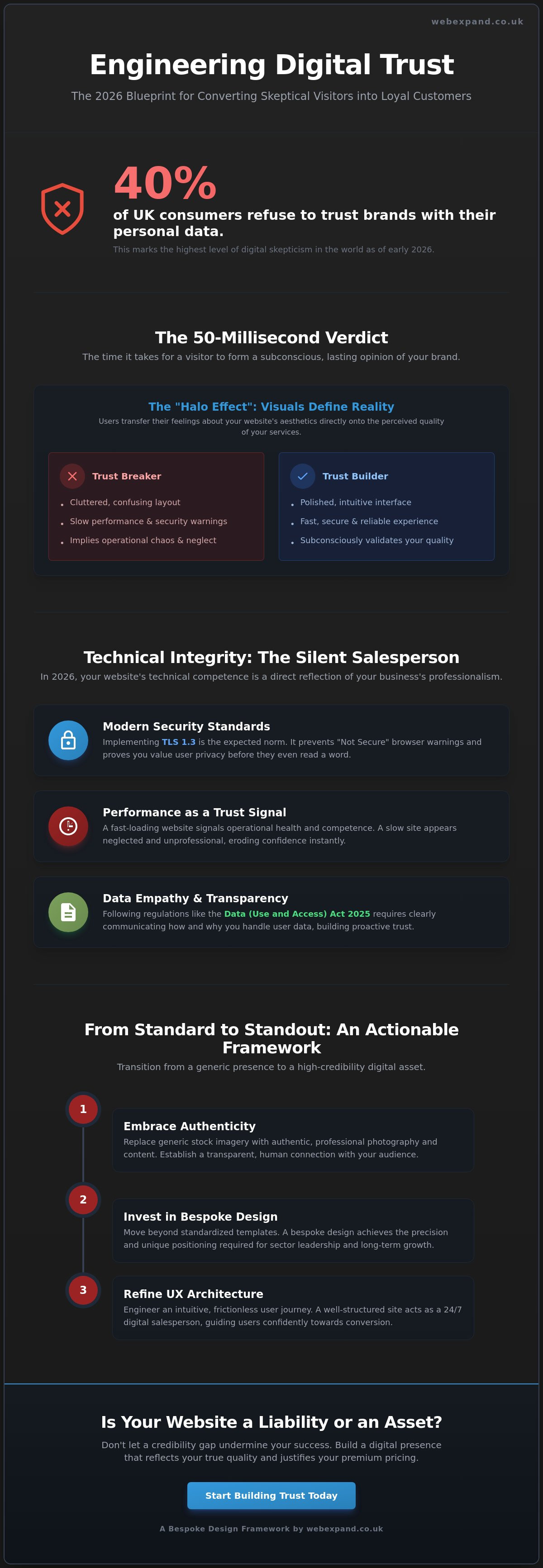
Digital trust isn’t a vague sentiment; it’s a cold, subconscious calculation of risk versus reward. When a visitor lands on your page, their brain immediately asks: “Is this business legitimate, or am I about to waste my time and data?” Understanding The Psychology of Digital Trust is the first step in engineering a platform that converts. In 2026, UK users are hyper-aware of their privacy rights and have a low tolerance for friction. If your site feels cluttered or outdated, the “Halo Effect” works against you. This psychological phenomenon means users transfer their feelings about your website aesthetics directly onto your actual services. A polished, intentional UI suggests a high-performance business. Conversely, a messy layout implies operational chaos, regardless of your real-world expertise.
We see trust as the essential bridge between your SEO traffic and your revenue conversion. You can rank at the top of Google, but if your landing page doesn’t instantly validate the user’s choice, they’ll bounce back to the search results. In a market where 40% of UK consumers don’t trust brands with their personal data, your website must work harder than ever to prove its integrity. This is why website design that builds customer trust is now a primary driver of financial performance rather than just a creative exercise.
The 50-Millisecond Verdict: Why Visual Hierarchy Matters
Research confirms it takes just 50 milliseconds for a user to form an opinion about your brand. During this window, the brain scans for familiar structures like the F-pattern for text-heavy pages or the Z-pattern for landing pages. If the eye cannot find a logical path, “visual noise” triggers a cognitive load that pushes visitors toward the exit. Simplicity is the ultimate sign of brand confidence; it proves you don’t need to shout to be heard. By implementing website design that builds customer trust, you remove the mental hurdles that cause high bounce rates and lost leads.
Trust as a Prerequisite for Strategic Growth
Ambitious firms cannot afford a “credibility tax.” This is the hidden cost of a website that fails to reflect your actual quality, forcing your sales team to work twice as hard to close every deal. A trust-centric approach is a core component of what makes a good business website in the current UK market. Beyond the initial click, trust dictates your customer lifetime value (LTV). When users feel secure, they spend more, share more data, and return more often. It’s the foundation of a digital presence that justifies premium pricing and dominates its sector.
Technical Foundations: Security and Performance as Trust Signals
Technical competence is the new benchmark for corporate professionalism. In 2026, a website that fails to load quickly or triggers security alerts doesn’t just look “unpolished”; it looks neglected. For UK businesses, website design that builds customer trust starts with the invisible architecture that protects user data. When a visitor sees a “Not Secure” warning, the psychological damage is immediate. It signals that you don’t value their privacy, which is a critical error when 40% of UK consumers already distrust brands with their personal information. High-performance hosting and robust security protocols are direct reflections of your operational health. If you can’t manage your digital storefront, prospects assume you can’t manage their high-value projects either.
We view security as a proactive commitment to your clients’ safety rather than a regulatory burden. By prioritising technical integrity, you position your brand as a reliable leader capable of protecting stakeholder interests. This technical foundation acts as a silent salesperson, proving your reliability before a user ever reads your first paragraph of copy.
Beyond the SSL: Advanced Security and Data Integrity
Moving past basic encryption is essential. In 2026, implementing the TLS 1.3 standard is the expected norm, while the Data (Use and Access) Act 2025 requires even greater transparency regarding data handling. We advocate for “Data Empathy,” a design philosophy where you clearly communicate how and why you handle user information. This includes using visible trust seals and UX Architecture for Building Confidence to guide users through secure payment gateways. When people feel safe, they complete transactions. It’s that simple. If you want to ensure your site meets these rigorous standards, our website hosting solutions provide the secure environment your growth requires.
Speed as a Proxy for Reliability
Speed is the ultimate silent trust signal. A lagging site suggests a lagging business. Modern UK consumers equate fast load times with efficiency and competence. If your pages stutter, you’re telling the world your infrastructure is outdated. This is where technical precision meets marketing; our SEO services Kent team focuses heavily on Core Web Vitals because these metrics directly influence user confidence. A site that responds instantly feels robust and dependable, justifying your position as a sector leader. Every millisecond shaved off your load time is an investment in your brand’s credibility and long-term financial performance.
UX Architecture: Reducing Friction to Build Confidence
User Experience (UX) is the digital equivalent of high-touch customer service. If a visitor struggles to find information, they feel ignored or, worse, misled. In 2026, website design that builds customer trust relies on removing every possible barrier between the user and their objective. Intuitive architecture proves you understand your client’s pain points before they even speak to you. When navigation feels effortless, it sends a subconscious signal that your business is organised, capable, and client-focused. Conversely, a confusing layout suggests that your internal processes might be just as chaotic as your digital presence.
We treat every click as a test of your brand’s integrity. By prioritising the user’s journey, you demonstrate a commitment to their success rather than just your own sales targets. This shift from “selling” to “guiding” is what separates sector leaders from the rest of the market. High-growth firms use UX to justify premium pricing by making the path to a solution feel inevitable and secure.
Intuitive Navigation and the “Logic of Reliability”
Anxiety rises when users cannot find their way. The “Three-Click Rule” remains a vital benchmark; if a solution is buried deeper than three clicks from the homepage, user confidence drops significantly. While some designers chase unconventional menu styles to look “edgy,” these often feel obstructive to a busy professional. A trust-first navigation menu must prioritise clarity over creativity. Ensure your menu includes descriptive labels that match user intent, a logical hierarchy, and a persistent search function. When your site follows established conventions, you’re telling the visitor that you value their time.
Responsive Design: Professionalism Across All Devices
With approximately 85% of the UK population engaging in online shopping, a broken mobile experience is a fatal flaw for any brand. Users expect “Device-Agnostic” authority. Your digital presence must feel just as robust on a smartphone as it does on a 27-inch desktop monitor. A site that fails to scale properly on mobile suggests a business that is out of touch with modern standards, immediately eroding national credibility. This is why we focus on bespoke web design Kent solutions. Unlike rigid templates, a tailored engine ensures your credibility remains intact across every touchpoint, allowing for the precise mobile optimisations that modern growth requires.
Accessibility is another critical marker of a forward-thinking brand. Conforming to WCAG 2.2 Level AA standards demonstrates that your business is ethical and inclusive. This is not just a regulatory hurdle; it is a clear signal that you respect all potential customers. In an era where 57% of consumers have experienced issues accessing websites in the past year, your commitment to a seamless, accessible experience provides a distinct competitive advantage.
Strategic Content and Validation: Proving Your Authority
Content is the voice of your digital presence. While technical foundations secure the site, your content secures the relationship. In 2026, website design that builds customer trust requires a narrative that prioritizes clarity over complexity. We see too many businesses hide behind industry jargon, thinking it projects expertise. In reality, jargon often acts as a barrier. “Jargon-free” doesn’t mean your message is simple; it means your message is clear. When you translate complex solutions into benefit-oriented explanations, you demonstrate a deep understanding of your client’s challenges. This clarity is the hallmark of a sector leader who doesn’t need to overcompensate with technical buzzwords.
Authenticity is another non-negotiable pillar of modern trust. Stock imagery is a relic of an era where generic corporate identities were the norm. Today, UK consumers are digitally sophisticated and can spot a staged photo in an instant. Professional photography that showcases your real team, your actual office, and your genuine work process creates an emotional bridge that pixels from a stock library cannot replicate. This visual honesty removes the “buyer’s remorse” factor before a purchase even occurs. By being transparent about who you are and how you work, you eliminate the uncertainty that often stalls high-value conversions.
Transparency as a Competitive Advantage
Your “About Us” page is rarely just a secondary resource; it’s often the second most visited page for users seeking to validate your credibility. People buy from people, especially in high-stakes professional sectors. Showing the faces behind the firm humanizes the digital interaction and transforms a cold screen into a collaborative partnership. We find that businesses that openly share their methodologies and process timelines see higher engagement rates. In a marketplace defined by skepticism, omitting key details about your operational process or team members is the fastest way to signal that you have something to hide.
Leveraging Third-Party Validation
Think of social proof as the evidence in your trust trial. Strategic placement of reviews, awards, and industry certifications provides the external validation necessary to close the deal. In 2026, video testimonials have become the gold standard of digital trust. They are far more difficult to fabricate than text-based quotes and carry significantly more emotional weight. We recommend integrating these elements into your UI with precision so they support the user journey without cluttering the interface. Every case study and review should act as a data-backed proof point for your claims of excellence.
Ready to elevate your authority and dominate your sector? Explore our bespoke website design solutions to build a platform that speaks with precision and earns every click.
Engineering Trust: The Webexpand Bespoke Design Framework
Trust isn’t a happy accident or a final coat of polish; it’s a strategic asset that we engineer into the very core of your digital architecture. While previous sections of this guide have detailed the components of security, UX, and content, the Webexpand framework synthesizes these elements into a unified growth engine. We don’t just build sites that look professional. We create platforms where data-backed design meets your specific commercial objectives. Transitioning from “having a website” to “owning a high-performance growth engine” is the defining shift for UK firms ready to dominate their sector in 2026. This approach ensures that every pixel justifies your premium pricing and every interaction moves the needle on your financial performance.
Implementing a website design that builds customer trust requires a departure from standardized, one-size-fits-all solutions. We view your digital presence as a transformative journey toward industry leadership. The long-term ROI of a trust-optimized platform isn’t just measured in higher conversion rates; it’s found in the reduced cost of customer acquisition and the increased lifetime value of clients who view your brand as the only reliable choice in a crowded market.
Moving Beyond Templates to Establish Market Authority
UK consumers are experiencing “Template Fatigue.” They can instinctively recognize generic, off-the-shelf layouts, and in 2026, this recognition often breeds skepticism. A template is like an off-the-shelf suit; it might function, but it rarely commands the room or reflects the unique contours of your business. Custom architecture allows us to integrate deeper trust-building features that templates simply cannot support, such as tailored data-handling transparency and specialized interactive tools that solve specific user pains. When your site is bespoke, you demonstrate a level of precision and investment that generic competitors cannot match. It signals that you’re a permanent, authoritative fixture in your industry rather than a transient player.
Integrating Trust into Your National Growth Strategy
We partner with ambitious UK firms to ensure their digital presence scales alongside their physical operations. There is a powerful synergy between website design that builds customer trust and your wider outreach efforts. Our approach aligns perfectly with digital marketing Kent strategies, ensuring that the traffic generated through search and promotion lands on a foundation capable of converting that interest into revenue. We invite you to evaluate your current digital performance and discover how a custom-engineered platform can redefine your market position. Reach out to our team to discuss your objectives and begin your journey toward sector dominance through digital precision.
Secure Your Future Through Digital Precision
Trust is no longer a static checkbox. It is a dynamic, technical, and psychological commitment to your audience. We’ve explored how a high-performance framework transforms skeptical visitors into high-value partners by eliminating friction and demonstrating absolute transparency. By prioritizing technical integrity and authentic content, you turn your digital presence into a robust engine for national expansion. This isn’t just about aesthetics; it’s about building a platform that justifies your premium pricing and reflects your true expertise.
Achieving a website design that builds customer trust requires a partner who understands the intersection of data and human behavior. Since 2004, we’ve specialized in bespoke high-performance design that removes the “credibility tax” from your growth strategy. We provide jargon-free strategic partnerships that allow you to focus on scaling while your website works as your most reliable salesperson. Broaden your horizons with a bespoke, trust-optimised website from Webexpand. You are ready to dominate your sector; let’s build the platform that proves it.
Frequently Asked Questions
Does website speed really affect customer trust?
Speed acts as a primary psychological trust signal because it demonstrates operational efficiency. When your pages load instantly, you’re telling the visitor that your business is well-managed and values their time. A lagging site suggests outdated infrastructure and neglect. In a fast-paced market, a slow platform creates friction that leads users to question your ability to deliver high-quality results in other areas of your business.
What are the most important trust signals for a UK business website in 2026?
The most critical signals include visible security indicators like HTTPS, clear data privacy disclosures, and authentic social proof. UK consumers expect transparency regarding how their data is handled under the latest 2025 regulations. Beyond technical markers, real team photography and third-party validation through video testimonials provide the emotional reassurance needed to justify premium pricing. These elements combine to create a comprehensive digital presence that validates your brand’s authority.
How can I show my website is secure without using technical jargon?
You can demonstrate security by using recognizable trust seals near sensitive areas like contact forms and checkout pages. Instead of explaining encryption protocols, use simple, reassuring language to describe your commitment to protecting client data. Providing a “plain English” summary of your privacy policy shows you have nothing to hide. This approach builds a website design that builds customer trust by prioritizing user comfort over technical complexity.
Why do generic website templates often fail to build brand authority?
Generic templates often feel “off-the-shelf” and lack the bespoke features that distinguish a market leader. Users can instinctively spot repetitive layouts, which may lead to skepticism regarding your brand’s authenticity. A template restricts your ability to implement custom trust-building features or specific UX optimizations tailored to your audience’s unique pain points. Owning a high-performance growth engine requires the precision that only a bespoke architectural approach can provide.
What role does professional copywriting play in establishing trust?
Professional copywriting acts as the voice of your brand, translating complex services into clear, persuasive narratives. It removes the ambiguity that often triggers “buyer’s remorse” before a purchase is even made. By avoiding heavy industry jargon and focusing on client outcomes, you demonstrate that you understand your audience’s needs. High-quality copy proves your expertise through clarity, making it easier for prospects to commit to a long-term strategic partnership.
How important is the “About Us” page for building credibility?
The “About Us” page is frequently the second most visited page on a corporate site because users want to verify the faces behind the firm. It humanizes your digital presence and transforms a cold transaction into a potential collaborative relationship. Sharing your team’s expertise, your company’s history, and your operational values provides the necessary context for users to feel secure in their choice to work with you.
Can a poor mobile experience damage my brand’s reputation nationally?
A broken or clunky mobile experience is a fatal flaw that immediately erodes national credibility. Since a vast majority of the UK population accesses the web via mobile devices, a site that doesn’t scale properly suggests a lack of investment in modern standards. This neglect can lead visitors to assume your physical services are equally outdated. Ensuring a seamless, device-agnostic experience is essential for maintaining a website design that builds customer trust in 2026.
How does professional web design impact my Google search rankings?
Professional design improves rankings by optimizing for Core Web Vitals and increasing user engagement. Google rewards sites that provide a fast, secure, and accessible experience because these factors indicate a high-quality resource. When your site is intuitively structured, users stay longer and bounce less often, sending positive signals to search engines. This technical precision ensures your brand remains visible to high-value leads looking for your specialized services.