

Securing your 2026 marketing funds isn’t a request for a handout. It’s an invitation for your board to invest in a verified growth engine. With global digital ad spend projected to surpass $1.02 trillion this year, getting buy-in for a digital marketing budget requires more than just a list of tactics. You’ve likely felt the frustration of budget cuts because the C-suite views marketing as a cost center rather than a revenue driver. We know how difficult it is to predict performance in a volatile market when technical jargon creates a disconnect with your financial director.
We’re here to help you bridge that gap. You’ll learn how to transform your marketing spend into a compelling business case that secures executive approval and drives measurable growth. This strategic guide offers a clear roadmap for expansion by speaking the language of ROI instead of vanity metrics. We’ll explore how to leverage authoritative SEO, bespoke website design, and strategic Google promotion to broaden your horizons and dominate your sector. It’s time to stop defending your spend and start leading your industry.
Key Takeaways
- Shift your internal communication from “cost-per-click” to “total revenue contribution” to bridge the gap between marketing and finance.
- Discover the exact financial metrics, such as Customer Lifetime Value (LTV), needed for getting buy-in for a digital marketing budget from the C-suite.
- Identify “leakage points” in your current digital presence through a gap analysis that proves the need for investment in bespoke website design.
- Frame your request as a solution to a business problem by utilizing the Three-Pillar strategy of foundation, engine, and fuel.
- Learn how to use external specialist authority to provide the credibility and price certainty required for immediate board-level approval.
The 2026 Digital Landscape: Why Traditional Budget Requests Fail
The traditional “request for funds” model is broken. Most marketing leaders fail at getting buy-in for a digital marketing budget because they speak a language the finance department doesn’t understand. This disconnect, often called the Marketing-Finance Gap, halts organizational growth. While you see a strategic campaign, your Financial Director sees an expense line that can be trimmed. To win in 2026, you must stop talking about cost-per-click and start demonstrating total-revenue-contribution models. You aren’t just buying traffic; you’re securing a future market share in an environment where organic visibility is scarcer and more valuable than ever before.
In the current landscape, digital marketing serves as both your primary defensive shield and your most aggressive offensive weapon. With AI-integrated search engines now dominating the user experience, the barrier to entry for new brands is higher. This complexity requires a sophisticated Digital Marketing Overview to understand how different channels interact. If you aren’t visible at the point of intent, your competitors are. They’re effectively stealing your future customers today. Transitioning your pitch from “spending money” to “investing in a revenue engine” is the only way to align with C-suite objectives.
The Evolution of Stakeholder Expectations in 2026
Vague concepts like “brand awareness” no longer hold weight in the boardroom. Your stakeholders now demand real-time data transparency and precise performance attribution. They want to see how a bespoke website design or a targeted SEO campaign directly impacts the bottom line. In 2026, the focus has shifted toward sustainable, long-term organic growth. Short-term ad spikes are seen as temporary fixes, whereas building digital authority is recognized as a permanent business asset. We’ve moved past the era of vanity metrics; today, it’s about how your digital presence supports the overall financial health of the company.
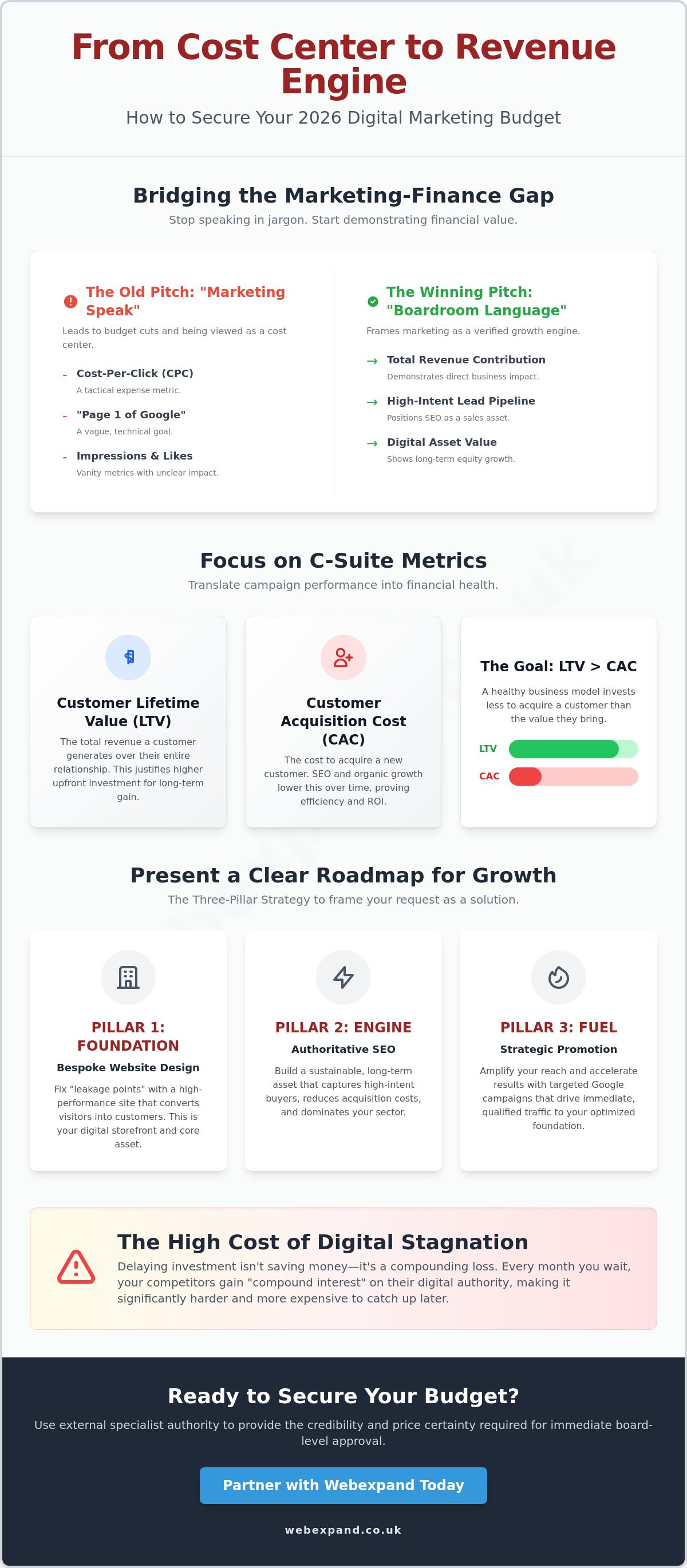
The High Cost of Digital Stagnation
Building the Business Case: Metrics that Resonate with the C-Suite
Executives don’t care about clicks; they care about capital. Successful marketing leaders realize that getting buy-in for a digital marketing budget hinges on their ability to translate campaign performance into financial health. You must move past vanity metrics like “likes” or “impressions” and focus on Customer Lifetime Value (LTV), Customer Acquisition Cost (CAC), and Monthly Recurring Revenue (MRR). When you present a budget, you’re essentially presenting a profit-and-loss forecast. If you can show that every pound invested in Search Engine Optimisation (SEO) lowers the long-term cost of acquisition, you’ve already won half the battle.
Calculating LTV is the cornerstone of this approach. It allows you to justify higher upfront costs by showing the total revenue a customer generates over their entire relationship with your brand. As you Plan Your Marketing Budget, use these figures to demonstrate how digital channels act as a multiplier for business value. Unlike traditional advertising, where visibility stops the moment you stop paying, organic growth through SEO builds equity. This turns your digital presence into a “Digital Asset Value” on the balance sheet, much like a physical storefront but with a global reach.
Translating Marketing Jargon into Financial Value
To communicate effectively with the C-suite, you need a translation layer. Stop reporting on conversion rates; start reporting on sales efficiency. Instead of describing “Page 1 of Google,” define it as a “High-Intent Lead Pipeline” that captures buyers at the peak of their decision-making process. High-performance bespoke web design is a prime example of this translation in action. It isn’t just a visual upgrade. It’s a strategic tool that reduces sales friction and shortens the sales cycle by guiding users toward a conversion with surgical precision.
Predictive ROI Modelling for 2026
Confidence in the boardroom comes from predictability. When getting buy-in for a digital marketing budget, present three growth scenarios: Conservative, Expected, and Aggressive. This shows you’ve considered market volatility and have a plan for varying conditions. Use historical data to forecast the impact of increased SEO management, but be honest about the “S-Curve” of organic growth. Results take time to compound; managing expectations about the initial ramp-up period is vital for maintaining long-term trust. If you’re looking for a partner to help model these outcomes, our team can help you scale your digital presence with data-backed strategies.
Auditing Performance to Uncover Untapped Growth Potential
Getting buy-in for a digital marketing budget is often easier when you stop looking at what you’ve spent and start looking at what you’ve missed. Most businesses focus on historical performance, but the real leverage lies in a comprehensive Gap Analysis. This method compares your current digital footprint against market leaders to reveal where your competitors are capturing demand that should be yours. By analyzing search data, we can prove that thousands of high-intent users are actively looking for your services but landing on competitor pages because of your current visibility gaps.
You must also identify “Leakage Points” within your existing infrastructure. Traffic is a wasted resource if your website acts like a leaky bucket. Technical health isn’t just about maintenance; it’s a fundamental barrier to scaling. If your platform can’t handle increased volume or fails to meet modern UX standards, your marketing spend will never achieve its full potential. By applying data-driven budgeting methods, you can quantify the exact revenue currently slipping through your fingers due to these technical inefficiencies.
Identifying Hidden Opportunity Costs
The cost of inaction is often higher than the cost of investment. You can calculate the value of lost leads by looking at the difference in click-through rates between your current search rankings and the top three positions. If you’re languishing on page two, you’re essentially handing market share to your rivals. An outdated or non-responsive site also causes “brand dilution,” where potential clients lose trust before they even speak to your sales team. It’s helpful to compare your current site against the standards of what makes a good business website to highlight where your deficiencies are costing you money.
Benchmarking Against National Industry Leaders
To trigger executive action, you need to present your findings as a competitive threat. Perform a “share of voice” analysis to show exactly how much of the digital conversation your competitors own compared to your brand. This benchmarking identifies the specific channels where rivals are out-investing you, whether that’s in Search Engine Optimisation (SEO) or aggressive Google Promotion. When the C-suite sees that their primary competitors are building long-term digital authority while your brand remains stagnant, the conversation shifts from “can we afford this?” to “can we afford to wait?”
The Pitch Strategy: Presenting Your Digital Roadmap for Approval
Successful pitching is the art of framing. When getting buy-in for a digital marketing budget, you aren’t asking for a favor or a handout. You’re presenting a tactical solution to a specific business problem, such as stagnant lead volume or losing market share to a local rival. We recommend using the “Three-Pillar” model to simplify the complexity of modern digital growth for your stakeholders. By breaking your strategy into manageable components, you make the investment feel logical and necessary rather than optional.
The first pillar is the Foundation: your bespoke website design. Without a high-performance, conversion-optimised site, every other penny you spend on traffic is effectively wasted. The second is the Engine: Search Engine Optimisation (SEO). This is your long-term growth driver that builds digital equity and authority over time. Finally, the Fuel: Google Promotion. This provides the immediate visibility and momentum needed to fund the rest of the journey. Presenting these as interconnected gears shows the board that you have a holistic plan for organizational growth.
Structuring the Presentation for Maximum Impact
Board members think in terms of business goals, not marketing tactics. Don’t start with keywords; start with revenue targets. Present the “Inaction Risk” before the “Action Reward.” Show them the data on how competitors are currently eroding your market share while you wait. This creates a sense of urgency that demands a decision. Keep the technical minutiae in an appendix. Your main slides should focus on outcomes, clear milestones, and “Proof of Concept” stages that reduce the board’s perceived risk of the investment.
Addressing Common Financial Objections
Expect pushback; it’s a sign of a healthy, engaged board. When they say it’s too expensive, reframe the conversation around “Cost per Acquisition Efficiency.” Show how a higher initial investment in SEO reduces the blended cost of a lead over the next twelve months. If they bring up past failures, explain the 2026 shift in digital marketing strategy. The landscape has changed, and old, siloed tactics no longer apply in an AI-driven search environment.
Securing Buy-in Through Strategic Partnership with Webexpand
Achieving your growth targets requires more than just a sound strategy; it requires the right allies. Partnering with Webexpand transforms your proposal from an internal request into a validated business case. When getting buy-in for a digital marketing budget, the presence of a specialist agency provides the external authority that boards often require. We act as a performance-based extension of your internal team, bringing over 20 years of historical data to the table. This ensures your projections are grounded in market reality rather than optimistic guesswork.
Stakeholders value certainty above all else. Our fixed-price models eliminate the budget creep that often terrifies financial directors. By providing a clear, predictable cost structure for bespoke website design and hosting, we remove the financial friction that stalls many digital initiatives. This transparency allows you to present a roadmap where every pound is accounted for and tied directly to a specific business outcome. You aren’t just pitching a service; you’re pitching a partnership designed to protect the company’s capital while maximizing its reach.
Leveraging Expert Authority for Board Approval
CFOs frequently view internal reports through a lens of skepticism, but third-party audits carry significant weight in the boardroom. We provide the objective data needed to verify your claims and identify the highest-impact opportunities for expansion. By using our extensive case studies as social proof, you can show the board exactly how similar strategies have allowed other businesses to dominate their sectors. Our communication style is intentionally jargon-free. We speak the language of profit, loss, and operational efficiency, ensuring your message resonates with executive sensibilities and professional values.
Constructing a Scalable Growth Engine
A truly effective digital presence isn’t built in silos. We combine our SEO services with bespoke website design to create a unified ROI engine. This integrated approach ensures that your technical foundation is as strong as your marketing momentum. Continuous management is essential to protect your initial investment; we stay ahead of technological shifts so your budget continues to deliver results long after the first campaign launches. This proactive stance prevents the technical debt mentioned earlier and keeps your brand at the forefront of your industry.
The journey toward industry leadership starts with a single strategic decision. If you’re ready to secure your 2026 budget and broaden your organizational horizons, contact us for a strategic consultation. Let’s build a business case that your board can’t ignore.
Secure Your Strategic Advantage for 2026
You now have the framework to bridge the gap between marketing tactics and financial performance. By focusing on high-impact metrics like LTV and identifying the technical leakage points holding your current site back, you transform a simple request into a compelling investment. Mastering the art of getting buy-in for a digital marketing budget is about proving that your roadmap is the fastest route to sector dominance. It’s time to stop defending your department and start leading your industry’s digital evolution.
At Webexpand, we’ve helped UK businesses scale since 2004. We provide the expert authority and 20+ years of performance data your board needs to see. With our fixed-price bespoke website design and transparent SEO management, you’ll eliminate budget uncertainty and focus on broadening your horizons. We’re specialists in building bespoke growth engines that deliver measurable results and long-term stability.
Book a Strategic Consultation to Build Your 2026 Business Case. Your journey toward industry leadership starts with a single, data-backed pitch. We’re ready to help you win it.
Frequently Asked Questions
What is the most important metric to show a CFO when asking for a marketing budget?
The most important metric to present is the ratio of Customer Lifetime Value (LTV) to Customer Acquisition Cost (CAC). This figure tells your CFO exactly how much profit each new customer generates relative to the cost of winning them. Focus on the “payback period,” which is the time it takes to recoup the initial marketing investment. This turns a budget request into a clear financial forecast that resonates with executive priorities.
How do I justify a budget for SEO when results take months to appear?
You justify SEO by framing it as a long-term business asset that builds compounding equity over time. Unlike paid ads that stop delivering the moment you stop paying, SEO creates a permanent lead pipeline. Explain that the “S-Curve” of growth requires an initial ramp-up to secure future market dominance. Getting buy-in for a digital marketing budget for SEO is easier when you demonstrate the high cost of waiting while competitors gain authority.
Should I ask for a monthly recurring budget or a one-off project fee?
A hybrid model is usually the most effective approach for organizational growth. Request a one-off project fee for your bespoke website design to establish a high-performance foundation. Follow this with a monthly recurring budget for Search Engine Optimisation and hosting. This structure provides the C-suite with clear upfront costs while ensuring the continuous management needed to protect and grow your digital market share throughout the year.
How can I prove that our current website is hurting our ROI?
You can prove your website is hurting ROI by highlighting “leakage points” where high-intent traffic fails to convert. Use conversion rate data to show the revenue lost at each stage of the user journey. If your current site fails to meet 2026 mobile-first standards or has slow load times, it’s actively driving potential customers to your competitors. Quantifying this lost opportunity makes a compelling case for a new bespoke design that captures every lead.
What percentage of revenue should a UK business spend on digital marketing in 2026?
UK businesses aiming for steady growth should typically allocate 7% to 10% of gross revenue to marketing. If you’re in a highly competitive sector or looking to scale rapidly, this figure often rises to 15%. The U.S. Small Business Administration recommends 7% to 8% for businesses under $5M revenue. Your specific allocation should depend on your industry’s average and your aggressive expansion targets for the year to ensure you dominate your sector.
How do I handle a budget cut mid-year without losing momentum?
Handle mid-year cuts by reallocating your remaining funds to high-ROI defensive channels like SEO. While you might reduce experimental spend, you must protect the “engine” of your digital presence. Present a “prioritized impact list” to stakeholders to show exactly which revenue-generating activities will stop if cuts go too deep. This transparency often helps you maintain the core budget needed to keep your market position and prevent long-term erosion of your digital authority.
Is it better to hire in-house or use an agency to get better buy-in?
Utilizing a specialist agency often provides higher board-level credibility due to their external authority and cross-industry data. An agency acts as a strategic partner that brings 20+ years of performance benchmarks to validate your projections. This reduces the board’s perceived risk compared to an unproven in-house team. A partnership with a firm like Webexpand offers the specialized expertise required to dominate a sector without the overhead of a full internal department.
How do I present a digital marketing budget if I do not have much historical data?
If you lack historical data, use industry benchmarks and competitive gap analysis to build your case. Show the board what your successful rivals are doing and quantify the “share of voice” you’re currently missing. Getting buy-in for a digital marketing budget without internal history requires leaning on external proof points and market trends. Use these third-party insights to create a “conservative” growth scenario that minimizes the fear of the unknown for your stakeholders.