

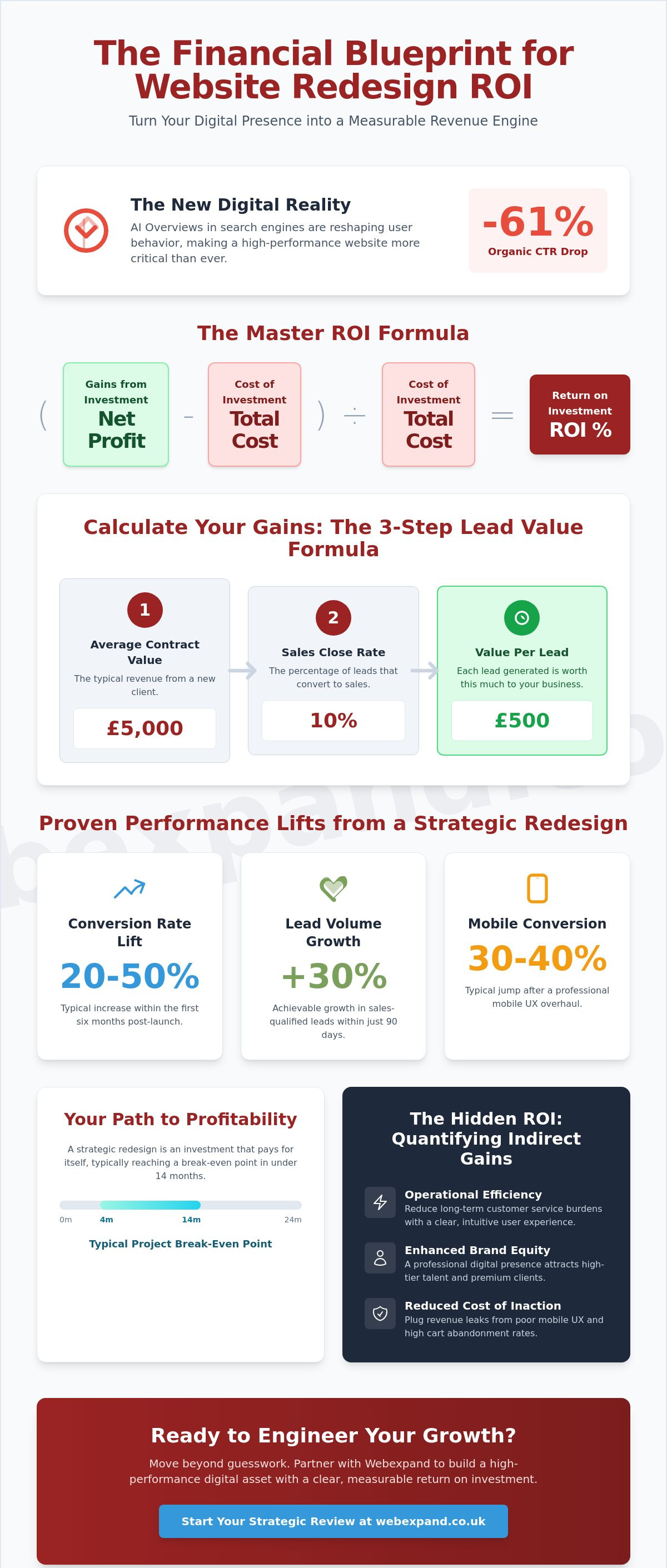
Did you know that AI Overviews in search engines have slashed organic click-through rates by as much as 61%? This shift makes your digital presence more critical than ever, yet most leaders still struggle with the fundamental question of how to measure website redesign roi effectively. You’ve likely faced pushback from financial departments who view a site update as a cost rather than a revenue driver. It’s a common pain point: knowing your brand deserves better while fearing that “vanity metrics” like traffic won’t lead to actual sales.
We understand that your goal isn’t just a prettier site; it’s about broadening your horizons and dominating your sector. This guide provides the technical expertise and strategic framework you need to turn a subjective design project into a calculated financial victory. You’ll master the specific formulas required to justify your investment and prove measurable growth. We’ll explore benchmarks for conversion lift, which typically ranges from 20% to 50% within six months of a launch, and provide a clear roadmap for tracking performance long after the project is complete.
Key Takeaways
- Master the master ROI formula to calculate the exact ratio of net profit against your total project expenditure.
- Learn how to measure website redesign roi by assigning precise dollar values to leads based on your specific sales close rates and average contract values.
- Quantify indirect gains like operational efficiency and brand equity, which reduce long-term customer service burdens and attract high-tier talent.
- Establish a rigorous measurement roadmap that captures critical baseline data before launch to ensure every performance shift is accurately documented.
- Discover how a bespoke approach to your digital presence moves your business beyond mere maintenance and toward true industry leadership.
Understanding Website Redesign ROI in the 2026 Digital Economy
At its core, the formula for Return on Investment (ROI) remains simple: it’s the ratio of net profit generated compared to the total cost of the project. However, in 2026, understanding how to measure website redesign roi requires looking far past the surface. A modern redesign isn’t a cosmetic facelift. It’s a piece of performance-driven digital engineering designed to achieve specific organizational growth. We don’t just build sites that look better. We build sites that work harder. Strategic alignment means every button, page, and line of code must mirror your wider business objectives. This might mean increasing lead quality, accelerating the sales cycle, or reducing the cost of customer acquisition.
The 2026 digital landscape is unforgiving. With AI and automation shifting how users interact with brands, a “standard” website is no longer enough to stay competitive. You need a platform that scales with your ambition. This requires a shift from viewing your website as a static brochure to seeing it as a dynamic engine for business development. We focus on precision and measurable outcomes because your progress is the ultimate measure of our performance.
The Difference Between Vanity Metrics and Revenue Drivers
Raw traffic numbers don’t pay the bills. In the current economy, page views and bounce rates have become secondary to actual conversion value. When you analyze how to measure website redesign roi, you must identify your “North Star” metric. For most of our partners, this is the total revenue generated per visitor or the specific volume of sales-qualified leads. User intent in 2026 is more fragmented than ever before. High engagement now means moving a user through a specific, tailored journey, not just keeping them on a page for three minutes. If your traffic isn’t converting into tangible business growth, it’s just noise.
The Strategic Value of a High-Performance Business Website
Think of your site as a 24/7 automated sales representative. It never sleeps, and it always delivers the perfect pitch to your ideal client. Investing in bespoke web design ensures your infrastructure can handle rapid growth as you dominate your sector. A high-performance business website is a living asset. Without regular updates and strategic technical maintenance, it becomes a depreciating liability that loses its edge against faster, more agile competitors. We treat your digital presence as a transformative journey toward industry leadership, ensuring your investment continues to pay dividends long after the initial launch.
The Financial Framework: Calculating Direct ROI and Payback Periods
Securing a budget for a digital overhaul requires more than just a vision. It demands a hard-data business case. The Master ROI Formula is your primary tool here: (Gains from Investment minus Cost of Investment) divided by the Cost of Investment. When calculating website redesign ROI, you must account for the Total Cost of Ownership (TCO). This includes not only the initial build but also long-term website hosting and ongoing performance maintenance. A successful project should aim for a break-even point within 4 to 14 months, according to data from Utsubo (February 2026). We focus on these precision metrics to ensure your digital presence is a measurable asset rather than a sunk cost.
To make these numbers concrete, you need to determine the “Value of a Lead.” If your sales team closes 10% of leads and your average contract value is £5,000, then every single lead your website generates is worth £500. By applying this logic, you can forecast exactly how a 30% increase in lead volume impacts your bottom line. Research from Rewebly Blog (February 2026) shows this level of growth is typical within 90 days of a redesign. It’s about moving beyond guesswork and into the certainty of data-backed financial performance.
Quantifying the Cost of Inaction (COI)
The biggest risk to your growth often isn’t the cost of a redesign, but the cost of doing nothing. Revenue leakage from poor mobile UX or high cart abandonment can quietly drain your resources for years. With mobile conversion rates often jumping 30% to 40% after a professional update (ACS Creative, December 2025), staying with an outdated site is an active financial loss. If your site’s load time lags, you’re potentially losing 7% in conversions for every single second of delay. Opportunity cost is equally vital. Every hour your team spends manually fixing errors or explaining poorly designed features to frustrated customers is time taken away from high-value business development. We help you identify these gaps to stop the bleed and start scaling with our bespoke e-commerce solutions and growth strategies.
Conversion Lift Benchmarks by Industry
While every business is unique, industry benchmarks provide a vital reality check for your projections. A focused redesign typically delivers a 20% to 50% relative improvement in conversion rates within the first six months. For e-commerce businesses, even a 1% increase in checkout efficiency can lead to exponential revenue growth over a fiscal year. B2B models require a different lens. They focus on longer sales cycles and multiple touchpoints, where the website acts as a trust-builder and lead-nurturing tool. Regardless of your sector, the goal remains the same: transforming your site into a high-performance engine that justifies every penny of the investment.
Quantifying Indirect Returns: Brand Equity and Operational Efficiency
While direct revenue is the most visible metric, ignoring the qualitative impact of a digital overhaul leaves money on the table. When you evaluate how to measure website redesign roi, you must account for the “trust premium.” A professional digital presence allows your business to command higher price points because customers perceive higher value in an expertly crafted brand. Research from Rewebly Blog (February 2026) indicates that 88% of users are unlikely to return to a website after a poor user experience. By eliminating these friction points, you aren’t just saving a single sale; you’re securing the lifetime value of a customer.
This perception is often driven by visual excellence, where a creative studio like Aperture.edit can assist by delivering high-end graphic design and multimedia assets that resonate with your target audience.
Operational ROI often manifests in the hours your team recovers. A site built with The Ultimate Guide to Website Redesign principles reduces the burden on your customer service department by providing clear, intuitive pathways to information. This is where technical ROI shines. A secure, fast-loading bespoke architecture correlates with a 7% increase in conversions for every second of load time saved. This efficiency extends to recruitment. Top-tier talent in 2026 expects to work for forward-thinking organizations, and your website is often their first point of contact with your corporate culture. Understanding how to measure website redesign roi also involves looking at the technical debt you shed during the process.
The SEO Multiplier: Long-Term Organic Growth
A primary goal of any redesign should be reducing your dependency on expensive paid advertising. Through strategic search engine optimisation, we transform your website into a compounding asset. The ROI of technical SEO is found in better crawlability and faster indexing, ensuring your brand stays ahead of technological shifts. When your educational content ranks high, it creates a “halo effect” that builds authority across your entire sector. This organic visibility is far more cost-effective than constant Google Promotion spending, offering a sustainable path to industry leadership.
Operational Savings Through Integration
Modern e-commerce solutions and business sites should act as the central nervous system of your company. By integrating your CRM and ERP systems directly into your website, you eliminate the need for manual data entry and the human errors that come with it. This reduction in “tech debt” is a significant financial win. We move you away from bloated, slow-loading templates that require constant patching and toward a streamlined, bespoke architecture. Self-service portals further amplify this effect. By allowing clients to handle their own inquiries or orders, you can quantify the exact number of support hours saved and redirected toward high-value business development.
Establishing Your Measurement Framework: A Step-by-Step Roadmap
You cannot improve what you do not measure. In the high-stakes environment of 2026, a “wait and see” approach to digital performance is a strategy for failure. Establishing a rigorous framework for how to measure website redesign roi begins long before the first wireframe is drawn. Without a documented “before” picture, your “after” results lack the context required to prove success to your financial department. We follow a precise, five-phase roadmap to ensure every project we undertake is a calculated step toward your industry leadership.
- Phase 1: Capturing Baselines. Document your performance for at least 30 to 90 days before the project begins. Key metrics include organic traffic, Core Web Vitals; and revenue per visitor.
- Phase 2: Setting SMART KPIs. Every goal must be Specific, Measurable, Achievable, Relevant, and Time-bound. Align these with your wider business objectives to ensure your site drives growth.
- Phase 3: Advanced Tracking. Implement GA4, heatmaps, and CRM tagging. This allows us to see exactly where users engage and where they drop off.
- Phase 4: The 90-Day Post-Launch Audit. This is the sweet spot for identifying performance shifts. We compare current data against your baselines to measure the initial conversion lift.
- Phase 5: Annual ROI Review. A website is a long-term asset. We track its appreciation over 12 months to ensure it continues to dominate your sector.
If you are ready to transform your digital presence into a measurable growth engine, explore our bespoke website design solutions today.
Setting Up the Right Analytics Stack
Modern measurement goes far beyond raw traffic. A well-designed user interface can increase conversion rates by up to 400%, but you need the right tools to prove it. For businesses targeting specific global hubs, working with a specialised 網頁設計公司 香港 can provide the UI/UX expertise needed to unlock this level of performance. We use heatmaps and session recordings to correlate UX changes with financial outcomes. Multi-touch attribution models are equally critical. They ensure your website gets the credit it deserves for every touchpoint in the sales funnel, from the initial search to the final close. Don’t ignore micro-conversions like newsletter signups or whitepaper downloads; these are the leading indicators of future revenue.
The 90-Day Post-Launch Report Structure
Your stakeholders care about revenue, not hits. When we deliver a 90-day report, we speak the language of the boardroom. We compare your post-launch performance directly against the pre-redesign benchmarks we established in Phase 1. This report identifies “quick wins” for further conversion rate optimisation, ensuring your site stays ahead of technological shifts. By focusing on precision and measurable outcomes, we turn your website into a transparent, high-performance engine for business development.
Partnering for Performance: How Webexpand Engineers Measurable Growth
Engineering a high-performance digital presence requires more than aesthetic intuition. It demands a technical partnership rooted in precision and accountability. We don’t just build websites; we develop growth engines tailored to your specific sector. Understanding how to measure website redesign roi is the first step, but executing a plan that delivers those numbers requires a deep investment in data-backed solutions. Our approach prioritises your bottom line, ensuring every design choice serves a measurable business objective. We avoid the coldness of corporate jargon, instead offering an approachable and collaborative style that positions us as your strategic partner.
A successful launch is only the beginning of your transformative journey toward industry leadership. To truly dominate your market, you need a comprehensive digital marketing strategy that funnels high-quality traffic to your new infrastructure. We provide the transparent, jargon-free advice you need to navigate technological shifts and protect your stakeholders’ interests. By aligning your digital presence with your wider organizational goals, we ensure your investment yields consistent, long-term returns. Our team remains deeply invested in your data while staying equally focused on the human element of business development.
Strategic Guidance for UK Businesses
We act as an ambitious guide for companies ready to scale and broaden their horizons. Our focus on bespoke development ensures your site isn’t limited by the constraints of standardized packages. We understand the importance of financial predictability, which is why we favour fixed-price development to protect your initial projections. This approach eliminates the risk of budget creep and ensures your calculated how to measure website redesign roi remains accurate. Beyond the build, we provide ongoing support and website hosting to ensure your platform remains fast, secure, and capable of delivering rapid results without sacrificing quality.
Take the Next Step Toward Industry Leadership
The fast-paced nature of the professional landscape doesn’t reward hesitation. Every day you wait is a day of lost revenue and ceded market share to more agile competitors. We’ve already explored how the cost of inaction is a tangible financial burden that compounds over time. Your progress is the ultimate measure of our own performance, and we’re ready to help you achieve the sector dominance your brand deserves. Don’t let an outdated digital presence hold your business back from its full potential. Contact Webexpand today for a strategic review of your current digital presence. Let’s transform your website into a revenue-generating asset and start your journey toward industry leadership together.
Transform Your Digital Presence into a Strategic Profit Engine
Your website is the cornerstone of your brand’s future. We’ve explored the transition from aesthetic updates to performance-driven engineering and the critical need for a hard-data measurement roadmap. By capturing baselines and quantifying the cost of inaction, you can finally prove the tangible value of your digital investment. Mastering how to measure website redesign roi allows you to move forward with the confidence of a market leader who understands that every click must contribute to the bottom line.
At Webexpand, we’ve been helping businesses scale since 2004. Our 20 years of expertise and fixed-price development fees provide the budget certainty you need to protect your financial projections. We take an authoritative, results-driven approach to every bespoke project we build, ensuring your site remains a high-performance engine for years to come. Ready to engineer a website that delivers measurable growth? Contact Webexpand today. The digital landscape is moving fast, but with the right framework, you’re ready to broaden your horizons and dominate your sector.
Frequently Asked Questions
What is a good ROI for a website redesign?
A 20% to 50% relative improvement in conversion rates within the first six months is considered a strong benchmark for a professional redesign. This lift directly impacts your bottom line by increasing the volume of leads or sales generated from your existing traffic. For businesses focused on sector dominance, a 10-point improvement in bounce rate typically correlates with a 5% to 15% lift in overall conversions, making it a reliable indicator of success.
How long does it take to see a return on investment from a new website?
Most organizations reach their break-even point between 4 and 14 months after the launch of a new site. This timeline depends on your industry’s sales cycle and the effectiveness of your initial data tracking. By establishing clear baselines before the project begins, you can document performance shifts immediately, though the most significant financial gains often materialize within the 90-day post-launch audit.
Can I measure ROI if I don’t sell products directly on my site?
Yes, you can calculate ROI by assigning a specific dollar value to your leads based on your average sales close rate. If your sales team closes 10% of leads and your average contract value is £5,000, then every lead is worth £500. This method allows service-based businesses to understand how to measure website redesign roi with the same financial precision as an e-commerce platform.
How do I calculate the “Cost of Inaction” for an old website?
The “Cost of Inaction” is measured by identifying the revenue lost due to poor performance, such as high cart abandonment or slow page load times. If your current site lags by three seconds, you’re potentially losing 21% in conversions based on the 7% per second rule. Aggregating these missed opportunities over a fiscal year reveals the significant financial drain of maintaining an outdated digital presence.
What are the most important KPIs to track after a redesign launch?
Focus on revenue-centric metrics like conversion rate, average order value, and lead quality rather than simple traffic volume. While organic sessions are important, they’re secondary to the total revenue generated per visitor or the cost per acquisition. We also track Core Web Vitals and mobile-specific bounce rates, as mobile-optimized redesigns often see bounce rate improvements of 20 to 30 points.
How does SEO impact the overall ROI of a web design project?
SEO acts as a force multiplier by reducing your long-term reliance on expensive paid advertising. When you integrate search engine optimisation into your bespoke design, you create a compounding asset that gains value over time through higher organic visibility. This organic growth lowers your blended customer acquisition cost, significantly boosting the overall profitability of the redesign project.
Should I include the cost of hosting and maintenance in my ROI calculation?
You should factor in the Total Cost of Ownership (TCO), which includes initial development, website hosting, and ongoing technical maintenance. A comprehensive ROI formula subtracts these recurring costs from the gains generated by the new site. This transparency ensures your financial department sees a realistic picture of the investment and its long-term impact on organizational growth.
How do I present a website ROI business case to my CFO?
Present your case using financial projections and revenue impact rather than subjective design improvements. CFOs respond to data regarding projected conversion lift, shortened payback periods, and the mitigation of technical debt. By showing how to measure website redesign roi using the Master ROI Formula, you position the project as a strategic business development initiative rather than a simple marketing expense.