

Did you know that whilst 49% of marketers identify organic search as their top ROI-driving channel, many UK business owners still struggle to understand how to measure seo roi in a way that makes sense for their bottom line? It’s frustrating to watch your marketing spend disappear into a cloud of jargon like “impressions” and “visibility” without seeing the pounds and pence at the end of the month. You’re likely tired of the guesswork and want to know if your digital presence is actually driving growth or just looking busy on a spreadsheet. We understand that skepticism, especially when organic results take time to mature amongst a sea of changing regulations like the Data (Use and Access) Act 2025.
This guide will strip away the complexity and show you the exact formulas that align with your 2026 financial goals. You’ll master the strategies needed to distinguish between vanity metrics and actual revenue, ensuring your marketing spend is a calculated investment rather than a leap of faith. We’ll break down the technical barriers and provide a clear roadmap to quantify your search engine optimisation, giving you the confidence to lead your industry and justify every penny of your budget. By the end of this article, you’ll have a data-backed solution to transform your SEO from a mysterious cost into a high-performance growth engine.
Key Takeaways
- Identify every component of your search investment, from monthly agency fees to specialist freelancer rates, to ensure your financial reporting remains transparent and precise.
- Master how to measure seo roi by moving beyond simple traffic numbers to track actual lead value and e-commerce revenue through integrated analytics.
- Navigate the 2026 search landscape by adjusting your attribution models to account for AI-driven “zero-click” results and multi-touch customer journeys.
- Learn how to translate technical SEO data into clear, jargon-free insights that demonstrate real-world impact to your stakeholders.
- Build a sustainable growth engine by prioritising high-performance web design as the primary driver for your organic search success.
Understanding SEO ROI: Why the Formula is Only the Start
SEO ROI is the measurable profit your business generates from organic search activities compared to the total cost of those efforts. While many agencies focus on ranking positions, a positive ROI remains the ultimate KPI for any serious business expansion strategy. If your search presence isn’t contributing to your bottom line, it’s merely a digital ornament. We view search engine optimisation as a primary driver for organisational growth, meaning every action we take must eventually map back to your financial performance.
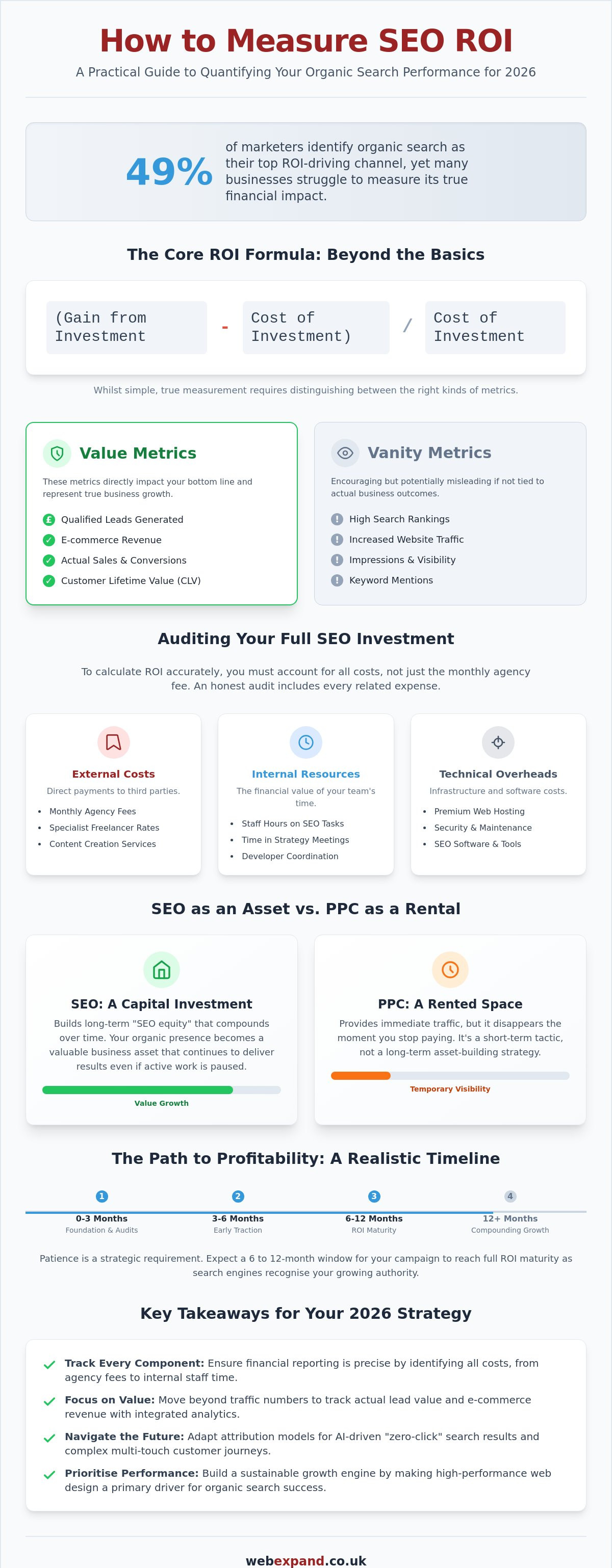
The basic formula for calculation is straightforward: (Gain from Investment – Cost of Investment) / Cost of Investment. However, understanding how to measure seo roi requires looking past this simple equation. You must distinguish between “vanity metrics” and “value metrics”. High rankings and increased traffic are encouraging, but they are vanity metrics if they don’t convert into sales. Value metrics, such as qualified leads and actual revenue, are what truly define success. We focus on these tangible outcomes because they represent the only data that impacts your bank balance and justifies your marketing spend.
The Distinction Between Short-term Gain and Long-term Asset
Think of Pay-Per-Click (PPC) as a rented space; the moment you stop paying the landlord, the traffic disappears. SEO is different. It’s a capital investment in your business infrastructure, much like investing in bespoke web design in Kent to build a high-performance growth engine. This strategy creates “SEO equity”. As your authority grows, the value of your organic presence compounds. Even if you pause active management, your established rankings continue to deliver results, protecting your digital presence whilst broadening your market horizons. It is a transformative journey toward industry leadership rather than a temporary fix.
Setting Realistic Benchmarks for 2026
Patience is a strategic requirement for success. You should typically expect a 6 to 12 month window before your campaign achieves full ROI maturity. This timeline isn’t arbitrary; it’s the period required for search engines to recognise your authority and for your content to gain momentum amongst competitors. Knowing how to measure seo roi effectively allows you to set these benchmarks with precision. Your location also plays a significant role. If you’re competing in high-density markets like London or Maidstone, your initial investment levels must reflect that intensity. We also look at your historical website performance, as a site with a solid foundation will often see faster returns than a brand-new domain starting from scratch.
Auditing Your SEO Investment: Beyond the Monthly Fee
To get an honest answer on how to measure seo roi, you must first account for every penny leaving your business. It’s easy to look at a monthly invoice and call that your total cost, but a precise audit goes much deeper. If you ignore the hidden expenses, your ROI figures will be inflated and misleading. We believe in transparency because a strategic partnership relies on accurate data to drive organisational growth and broaden your market horizons.
External costs are the most visible. These typically include monthly management fees from an seo agency kent or project rates for specialist freelancers. However, you must also calculate the value of your internal resources. Every hour your staff spends reviewing content, attending strategy meetings, or coordinating with developers has a financial weight. If your marketing manager spends five hours a week on SEO tasks, that’s a portion of their salary that must be added to your investment total. Knowing how to measure seo roi requires this level of granular detail to ensure your reporting is both professional and persuasive.
Technical overheads are equally vital. High-performance bespoke website design requires premium hosting and regular security updates to maintain its competitive edge. You might also pay for SEO-specific software or data tracking tools. By aggregating these costs, you move from a surface-level estimate to a professional financial audit that stakeholders can trust.
Agency Fees vs. In-house Resource Costs
Hiring an in-house specialist often seems attractive until you factor in the full scope of employment. Beyond the base salary, you’re responsible for National Insurance contributions, pension benefits, and the overhead of professional SEO tool suites. A specialist agency provides a team of experts whilst reducing your total labour cost. We offer fixed-price design and monthly recurring SEO management, which simplifies your “Cost” variable and makes your long-term financial forecasting much more reliable.
Content and Tech: The Fuel for Your Growth Engine
Content production is a significant investment. To satisfy Google’s 2026 EEAT guidelines, you need authoritative, well-researched material that genuinely helps your audience. This isn’t just about writing; it’s about strategic development. Technical maintenance is another non-negotiable factor. A slow site or broken links will sabotage your rankings and waste your marketing budget. Your website is the foundation of your digital presence. If you’re unsure if your current setup is helping or hindering your returns, you can speak with our strategic team for a clear assessment.
Quantifying the Return: From Organic Traffic to Lead Value
To truly understand how to measure seo roi, you must shift your focus from the quantity of clicks to the quality of conversions. While high traffic numbers look impressive in a monthly report, they are effectively meaningless if they don’t contribute to your organisational growth. Clicks are a precursor to success; conversions are the success itself. We prioritise tracking the actions that lead to revenue, ensuring your digital presence functions as a high-performance sales tool rather than just a source of information.
Tracking this return requires a robust technical setup using Google Analytics 4 (GA4) and Google Search Console. For e-commerce businesses, the path is direct, as you can track transaction values and purchase events back to specific organic landing pages. For service-based businesses in Kent or London, the process involves valuing non-transactional leads such as form fills, phone calls, or brochure downloads. Lead Value is the estimated revenue generated per organic enquiry based on historical close rates. By assigning a financial weight to every enquiry, you can quantify the exact impact of your search engine optimisation on your bottom line.
Calculating Lead Value for Service Businesses
E-commerce ROI: Direct Attribution and Assisted Paths
In the e-commerce sector, organic search is a powerhouse, accounting for approximately 43% of all traffic. While direct sales from a search landing page are easy to track, you must also account for “Assisted Conversions”. This occurs when a user first discovers your brand through a search query but returns later via a different channel to complete the purchase. By using multi-touch attribution models, you ensure that SEO receives its fair share of credit for initiating the customer journey. This comprehensive view is essential for broadening your horizons and justifying a continued investment in bespoke website design and search strategy.
Measuring Success in 2026: AI Overviews and Multi-Touch Attribution
AI Overviews have fundamentally altered the search behaviour of your customers. In 2026, the traditional path from a search query to a website click is no longer guaranteed. This has introduced the “Zero-Click” challenge, where users receive comprehensive answers directly on the search engine results page. To stay ahead, you must adapt your understanding of how to measure seo roi to include Brand Impression ROI. When your business is cited as a source in an AI summary, you aren’t just gaining a link; you’re gaining industry-leading authority.
Capturing the full value of these interactions requires a shift toward multi-touch attribution. A customer might discover your brand through an AI Overview whilst researching a problem in Maidstone, visit your site via a local map search two days later, and finally convert through a direct visit. If you only look at the final click, you miss the transformative impact of your initial search visibility. We focus on the entire journey to ensure every touchpoint is quantified and valued, helping you dominate your sector through data-backed insights.
Tracking Visibility in AI Search
With AI search traffic up 527% year over year, your visibility in these summaries is a primary indicator of digital dominance. It’s a stark reality that 26% of brands currently have zero mentions in AI Overviews, leaving a significant portion of the market open for more ambitious competitors. We track your presence as a cited source to measure your share of voice. This status as an expert guide provides high indirect ROI by building the trust necessary for high-value conversions. In this post-AI world, we prioritise the quality of these authoritative impressions over the raw quantity of traditional traffic.
The Role of Local SEO in the ROI Mix
Local intent continues to drive massive physical footfall, with 46% of all searches focused on local information. Effective google promotion in kent bridges the gap between digital visibility and offline revenue. Data shows that 88% of people who perform a local search will call or visit a business within 24 hours. By tracking “Get Directions” requests and map interactions, you can accurately attribute showroom visits or service calls to your SEO efforts. This level of precision is essential for how to measure seo roi in a way that satisfies stakeholders and justifies your marketing budget. To ensure your business isn’t part of the 26% missing out on AI visibility, contact our experts for a performance review.
Strategic SEO in Kent: Turning Data into Business Expansion
Understanding how to measure seo roi is the bridge between viewing digital marketing as an overhead and recognising it as a primary engine for organisational growth. We believe that data should never be a barrier to understanding. Instead, it should be the catalyst for your next phase of development. When we present reports to our partners in Maidstone and London, we strip away the technical noise. We focus on the financial metrics that resonate in the boardroom. This jargon-free approach ensures that every stakeholder understands exactly how search engine optimisation is broadening your market horizons.
The Webexpand Approach: Measurable Outcomes
Our fixed-price web design serves as the high-converting foundation for every successful campaign. A bespoke site ensures that the traffic we generate doesn’t just bounce; it engages and converts. We provide monthly reporting that speaks the language of business owners, focusing on tangible growth rather than abstract metrics. This commitment to transparency is why we’ve been a trusted strategic partner since 2004. We don’t just tick boxes. We deliver data-backed solutions that protect your interests and drive rapid results without sacrificing quality.
Next Steps for Your Business Growth
Start by conducting a basic ROI audit of your current digital presence. Compare your total marketing spend against the lead value we established in previous sections. Ask your current provider how they attribute “zero-click” AI impressions or assisted conversions. If they can’t give you a clear, revenue-focused answer, it’s time to rethink your strategy. Your progress is the ultimate measure of our performance. How to measure seo roi should be a transparent process that gives you absolute confidence in your digital presence. Ready to scale and dominate your sector? Contact Webexpand today for a results-driven SEO strategy.
Secure Your Competitive Edge Through Financial Precision
You now have the framework to move beyond surface-level traffic reports and start focusing on actual revenue. By auditing every hidden cost and valuing every organic lead, you’ve mastered how to measure seo roi with the precision required for the 2026 search landscape. This shift from “clicks” to “conversions” ensures your marketing budget is no longer a mystery, but a calculated engine for organisational growth. Your digital presence should be your most valuable asset, and you now possess the formulas to prove its worth.
Webexpand brings over 20 years of digital expertise to your strategy, offering jargon-free, results-oriented advice tailored for business growth in Kent and London. We’re ready to help you broaden your horizons and secure your place as an industry leader through bespoke solutions that prioritise your bottom line. Book your strategic SEO consultation with Webexpand today to align your digital presence with your long-term financial goals. The path to industry leadership is paved with accurate data; let’s build that foundation together.
Frequently Asked Questions
What is a good ROI for SEO in the UK?
A median ROI of approximately 748% is considered a strong benchmark for a well-executed SEO campaign. Whilst individual results vary by sector, 49% of marketers identify organic search as their top ROI-driving channel. You should aim for a return that significantly outpaces your initial investment after the maturity phase. We focus on these high-performance outcomes to ensure your search presence drives genuine organisational growth and broadens your market horizons.
How long does it take to see a positive return on SEO investment?
You should typically expect a 6 to 12 month window before your campaign achieves full ROI maturity. This period allows search engines to recognise your authority and for your content to gain momentum amongst competitors. Initial months focus on leading indicators like organic impressions and qualified lead volume. We track these early signals to ensure your strategy is on the right path toward delivering a measurable financial impact for your business.
Can I measure SEO ROI without expensive software?
You can absolutely track your performance using free tools like Google Analytics 4 and Google Search Console. These platforms provide the essential data needed to understand how to measure seo roi without requiring a massive software budget. By setting up conversion events and tracking lead values directly, you can quantify your financial returns with high precision. We prioritise these accessible, data-backed solutions to keep your reporting transparent and focused on growth.
How do I calculate the ROI of local SEO for my Kent business?
Calculate your local ROI by tracking “Get Directions” requests, map interactions, and phone calls originating from your local profile. With 46% of all Google searches seeking local information, these actions are direct precursors to showroom visits or service enquiries. Assign a lead value to these interactions based on your average close rate. This method allows businesses in Kent to attribute physical footfall and offline sales directly to their online search visibility.
What happens to my ROI if I stop investing in SEO?
Your ROI will likely diminish over time as competitors continue to optimise and displace your rankings. Unlike paid ads that stop instantly, SEO acts as a long-term asset that builds equity in your digital presence. However, search algorithms and user behaviours evolve rapidly. Without ongoing management, your site may fail to adapt to shifts like the Data (Use and Access) Act 2025 or new AI search patterns, eventually eroding your market share.
How do AI Overviews affect my SEO ROI tracking in 2026?
AI Overviews introduce zero-click interactions, meaning you must track brand citations and share of voice alongside traditional clicks. With AI search traffic up 527% year over year, appearing as a cited source in these summaries provides significant indirect ROI through brand authority. You should adjust your tracking to value these authoritative impressions. This ensures you capture the full customer journey even when users don’t visit your site immediately during their research phase.
Is SEO ROI higher than PPC ROI?
Organic search often delivers a higher long-term ROI because you aren’t paying for every individual click. SEO leads typically have a 14.6% close rate, which is significantly higher than the rates seen in many outbound or paid channels. Whilst PPC provides immediate visibility, SEO builds a compounding asset that reduces your cost-per-acquisition over time. We view SEO as a transformative journey that offers superior sustainability for businesses that are ready to scale and dominate their sector.
How do I track phone calls back to my SEO efforts?
You can track phone calls by using dynamic number insertion or by monitoring the call button clicks on your Google Business Profile. Dynamic number insertion swaps the phone number on your site based on the traffic source, allowing you to attribute specific enquiries to organic search. This data is essential for how to measure seo roi in service industries where the final sale happens over the phone. It provides the accountability needed to justify your marketing spend.