

What if the website you just spent months developing doesn’t actually belong to your company? It’s a valid concern for ambitious leaders who worry about being locked into a provider or blindsided by unexpected invoices. You want a high-performance digital presence that scales, yet the fear of hidden technicalities often creates hesitation. Understanding exactly what to look for in a web design contract is the first step toward securing a strategic blueprint for your brand’s industry leadership.
We agree that your focus should be on organizational growth, not deciphering dense legal jargon. This article provides the clarity you need to master the essential components of a modern agreement, from full intellectual property ownership to price certainty. You’ll gain a clear roadmap for project delivery that incorporates 2026 standards for ADA accessibility and CCPA data privacy. We will show you how to protect your investment and ensure your bespoke website design serves as a foundation for long-term financial performance and sector dominance.
Key Takeaways
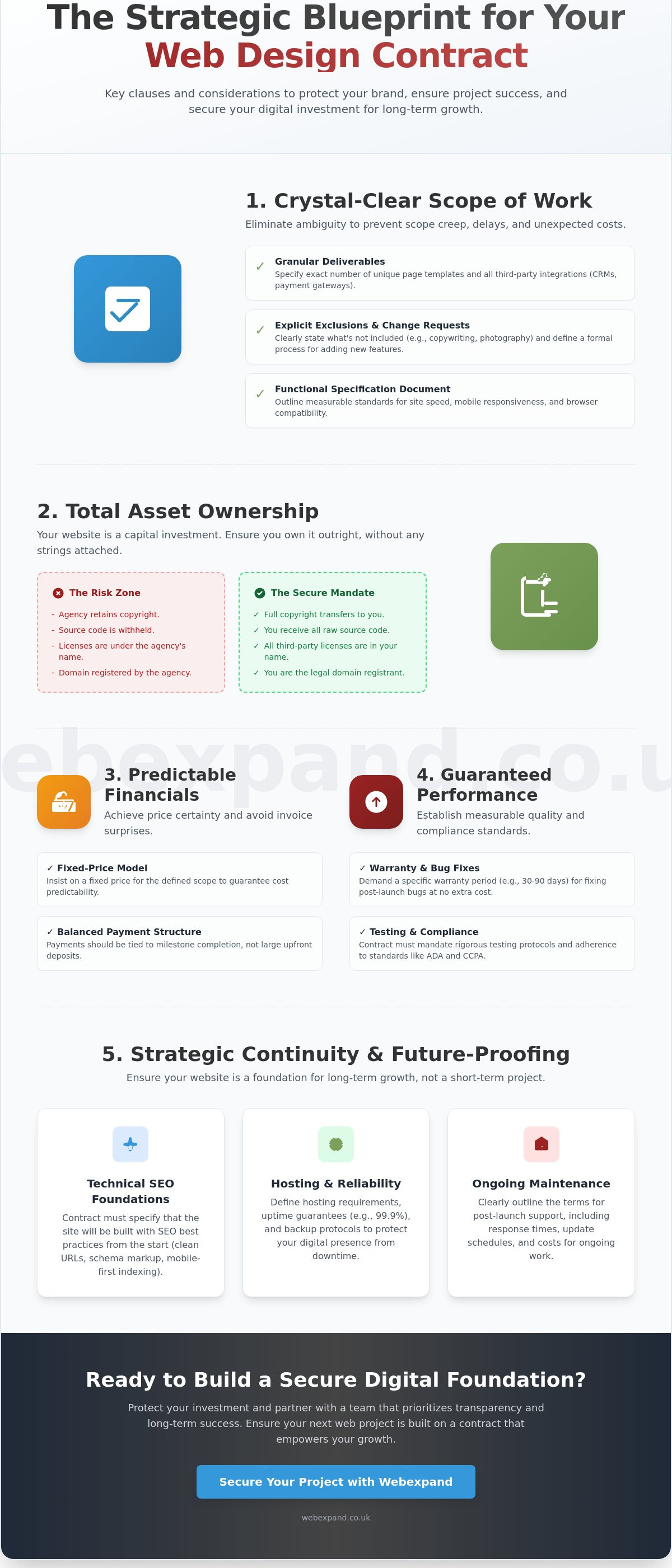
- Define clear project deliverables to eliminate scope creep and ensure every unique template and integration is strictly accounted for.
- Secure full legal ownership of your digital assets by ensuring copyright transfers and raw source code access are executed upon final payment.
- Understand exactly what to look for in a web design contract to achieve price certainty through fixed-price models and balanced deposit structures.
- Establish measurable performance standards with specific warranty periods for bug fixes and rigorous testing protocols across all modern devices.
- Protect your brand’s future by contractualising technical SEO foundations and hosting reliability to ensure a high-performance digital presence.
Scope of Work: Eliminating Ambiguity and Jargon
A vague agreement is a liability that invites project delays and financial friction. When evaluating what to look for in a web design contract, the scope of work stands as your primary defense against scope creep. It shouldn’t just summarize the project; it must provide a granular breakdown of every deliverable, from the exact number of unique page templates to specific third-party integrations like CRMs, payment gateways, or booking systems. This level of detail ensures that your investment aligns with the strategic principles of what makes a good business website.
Identifying what to look for in a web design contract also means searching for a robust “Exclusions” clause. This section explicitly states what the provider is not responsible for, such as copywriting, professional photography, or ongoing SEO management unless specified. To maintain momentum, your contract should include a clear procedure for change requests. This framework defines how new ideas or features are priced and approved. It prevents minor adjustments from turning into major invoice surprises. The most effective agreements utilize a formal Statement of Work to anchor expectations in technical reality rather than just creative vision.
The Functional Specification Document
Design is nothing without performance. Your contract must specify that the visual “look and feel” is backed by a functional specification document. This document sets measurable standards for site speed, mobile responsiveness, and core web vitals. It should also define browser and device compatibility requirements. This ensures your digital presence remains consistent for every user, regardless of their hardware. We focus on these technical foundations to ensure your site is built for measurable growth from day one.
Project Milestones and Timelines
Success depends on a synchronized timeline. A “Time is of the Essence” clause is vital if your launch is tied to a specific market event or product rollout. However, accountability goes both ways. The contract should identify client dependencies, such as the timely delivery of brand assets or content. Establishing a structured feedback loop for design revisions ensures that progress remains steady. It holds both parties to high standards of responsiveness and keeps the project on its transformative journey toward industry leadership.
Intellectual Property and Asset Ownership
Your website is a significant capital investment. You wouldn’t buy a building without receiving the deed, and your digital presence is no different. When determining what to look for in a web design contract, you must prioritize the absolute transfer of intellectual property rights. Without a specific clause stating that copyright transfers to you upon final payment, the agency might technically retain ownership of the creative work. In the UK, the “work for hire” principle doesn’t automatically apply to contractors in the same way it does to employees. You need an explicit assignment of rights to ensure you aren’t just licensing your own brand’s digital home.
While specific government regulations on intellectual property provide a framework for these rights, your contract must be the final word on your specific project. This includes securing the source code. You don’t just want the finished site; you need the raw, editable files. If your relationship with a provider ends, having these files ensures another developer can maintain the site without starting from scratch. We believe transparency in ownership is the only way to build a truly collaborative partnership.
Managing third-party licenses is another critical detail. Your site likely uses premium plugins, specialized fonts, or high-quality stock imagery. The contract must clarify who pays for these subscriptions and whose name the license is under. If the agency uses their own developer license for a plugin, you might lose access to security updates the moment you stop working with them. Insist that all recurring subscriptions are registered to your business to maintain total control over your digital infrastructure.
Securing Your Digital Identity
Never allow an agency to register your domain name or SSL certificates in their own name. This creates a bottleneck that can hold your business hostage during a transition. You should always be the legal registrant and administrative contact. Your agreement should also include an indemnity clause. This protects you if the designer accidentally uses third-party assets without the proper licenses. If you’re ready to build a secure foundation, our team at Webexpand can help you navigate these technical requirements.
Proprietary vs. Open Source CMS
The choice of platform dictates your long-term freedom. Proprietary CMS platforms often come with restrictive contracts that make it impossible to move your site to a different host. This is why bespoke web design should ideally utilize open-source frameworks or portable code. Knowing what to look for in a web design contract involves checking for portability clauses. You need the right to migrate your data and design to a new server whenever your business strategy evolves. Your digital growth should never be limited by a vendor’s software architecture.
Financial Terms: Fixed-Price vs. Hourly Models
Financial transparency is more than just a line item; it’s a reflection of project discipline. When vetting what to look for in a web design contract, the choice between fixed-price and hourly billing is your most significant decision. Hourly models often create a conflict of interest where the agency is rewarded for inefficiency. Conversely, a fixed-price model ensures that both parties are incentivized to reach the finish line quickly and accurately. This approach demands a rigorous initial specification, which ultimately protects your budget from the “bill shock” of unexpected hours.
Professional agreements should also provide absolute clarity on recurring costs. You need to know exactly what you’ll pay for Website Hosting and maintenance once the site is live. These aren’t just technical necessities; they’re ongoing investments in your site’s uptime and security. By establishing these costs upfront, you ensure that your digital growth remains sustainable and predictable. High-quality contracts avoid the coldness of corporate jargon and instead focus on measurable outcomes that support your organizational growth.
The Case for Fixed-Price Fees
Fixed pricing provides the budget predictability essential for scaling businesses. It forces a deep dive into the project’s requirements before a single line of code is written. This eliminates the grey areas that lead to disputes later. A solid contract will explicitly state that there are no hidden launch fees or deployment charges. While the initial setup for a fixed-price project takes more effort, the resulting clarity is invaluable. It mirrors the precision found in high-level standards like the Federal Acquisition Regulation on Intellectual Property, which emphasizes clear definitions of deliverables and value within professional agreements.
Payment Milestones and Acceptance
Don’t tie your payments to arbitrary calendar dates. Instead, link them to measurable project milestones. This structure ensures you only pay for work that meets your high standards. You should define Acceptance Criteria for every phase, from the initial wireframes to the final E-commerce Solution. What constitutes a finished site? Your contract must be specific about the testing and approval process.
We recommend a retention payment system. This involves holding back a final percentage of the project fee until a set period after launch. This gives you leverage to ensure that any post-launch bugs are cleared promptly. It transforms the final sign-off from a simple transaction into a rigorous quality check. Knowing what to look for in a web design contract allows you to build these financial safeguards into your agreement from the start, ensuring your new platform is ready to dominate your sector from the moment it goes live.
Performance, Testing, and Post-Launch Obligations
A visually stunning website is a liability if it fails to perform under pressure. Launching your platform is only one milestone in a transformative journey toward industry leadership. When evaluating what to look for in a web design contract, you must look beyond the “Go Live” date and focus on technical endurance. A robust agreement includes a defined Warranty Period, typically ranging from 30 to 90 days, during which the agency resolves any code-level bugs or functional errors at no additional cost. This ensures that the high-performance engine you’ve invested in operates flawlessly from day one.
Operational readiness also depends on your team’s ability to manage the new platform. The contract must clarify responsibility for content migration and provide dedicated training hours for your staff. Without this, you risk launch delays or a team that is unable to utilize the full power of your Bespoke Website Design. If you are ready to build a platform that meets these rigorous standards, explore our E-commerce Solutions to see how we prioritize performance and precision.
The Testing Protocol
Precision requires a structured environment for review. Your contract should specify the use of a “Staging Environment” where you can test every feature before it hits the live server. This phase includes User Acceptance Testing (UAT), which serves as your final checklist to ensure the site meets the functional specifications defined in the initial scope. Security testing is equally vital. The agreement must confirm that common vulnerabilities are addressed, protecting your brand’s reputation and customer data from the moment of deployment.
Post-Launch Support and SLAs
Success is sustained through reliable maintenance. You need a clear distinction between “Maintenance” and “New Features” to prevent budget friction. Service Level Agreements (SLAs) should define response times for critical security updates and urgent bug fixes. This level of accountability ensures your site remains a secure, high-speed asset that continues to scale with your business goals. By establishing these post-launch obligations early, you protect your long-term digital growth and maintain a decisive edge over your competitors.
Strategic Continuity: Hosting, SEO, and Growth
Your digital asset must be built for the long haul. A contract that only covers the initial build leaves your business vulnerable to stagnation. When you evaluate what to look for in a web design contract, you must prioritize clauses that bridge the gap between development and long-term performance. We believe a website should be a living engine of growth, not a static brochure. This requires contractualizing technical SEO as a core deliverable rather than an optional extra. By ensuring these foundations are built-in from day one, you prepare your brand for our SEO services to drive strategic business expansion and sector dominance.
Hosting reliability is another pillar of strategic continuity. Your agreement should specify Website Hosting uptime guarantees and physical server locations. A server located close to your primary audience reduces latency, which improves both user experience and search engine rankings. Precision is the baseline. Your contract must also define the developer’s role as a “Data Processor” to ensure compliance with GDPR and other data protection regulations. This clarity protects your business from legal risks while maintaining the integrity of your customer data.
Termination clauses are often overlooked but are vital for your freedom. You need a clear exit strategy that allows you to move your site without losing your investment. A fair agreement outlines how you can transition to a new provider and confirms your right to a full backup of all assets and databases. Knowing what to look for in a web design contract ensures you remain in control of your digital destiny, allowing you to scale without being held back by restrictive vendor locks.
SEO and Digital Marketing Integration
Technical SEO is a development requirement. It dictates how search engines crawl and understand your site. Your contract should mandate a site structure that fully supports future digital marketing efforts. This includes clean URL structures, schema markup, and optimized header hierarchies. We also recommend including a clause that grants access to third-party marketing auditors. This transparency ensures that your site remains an open, high-performance platform ready for any promotional strategy.
Exit Strategy and Data Portability
Accountability matters most when a partnership ends. Ensure your contract specifies reasonable notice periods for terminating hosting or maintenance services. The developer should have a contractual obligation to assist in a smooth transition to your next partner. This includes providing all necessary credentials and source files. You’ve invested in a transformative journey toward industry leadership; don’t let a poor exit clause derail your momentum. Secure your right to data portability and protect your assets from the very beginning.
Securing Your Foundation for Scalable Growth
A well-drafted agreement is more than a legal safety net. It is a strategic blueprint that ensures your digital assets remain under your total control while performing at the highest level. By prioritizing intellectual property ownership, demanding fixed-price transparency, and contractualizing technical SEO standards, you eliminate the risks that often stall organizational growth. Mastery of what to look for in a web design contract allows you to focus on dominating your sector rather than managing vendor disputes or navigating technical ambiguity.
Your journey toward industry leadership requires a partner who understands the balance between technical precision and commercial reality. Since 2004, our team has provided jargon-free advice tailored to the specific expansion goals of our clients. We eliminate financial uncertainty by offering fixed-price fees, ensuring your project stays on budget and on target. Partner with an agency that values transparency; get a fixed-price quote from Webexpand today. With over 20 years of expertise, we are ready to help you broaden your horizons and build a digital presence that delivers measurable results and long-term security.
Frequently Asked Questions
Do I own the website once the contract is signed?
Ownership typically transfers to you only after the final invoice is paid in full. Your agreement should include a clear assignment of copyright for all creative assets and code. Without this specific clause, the agency might technically retain the legal rights to the work they produced. Ensuring you receive the raw source files is a vital part of what to look for in a web design contract to guarantee your long-term independence.
What is scope creep, and how does a contract prevent it?
Scope creep occurs when additional features or changes are added to a project without adjusting the budget or timeline. A robust contract prevents this by including a granular Statement of Work that defines every deliverable. It should also outline a formal change request process. This ensures that any new ideas are properly evaluated, priced, and approved before work begins, which maintains total budget certainty for your business.
Should I pay the full amount for a web design project upfront?
You shouldn’t pay the entire project fee upfront. A professional structure usually involves an initial deposit followed by payments tied to specific milestones, such as wireframe approval or beta testing. This approach balances the agency’s risk with your own security. It ensures that capital is only released once measurable progress is made and verified against the agreed-upon functional standards, keeping the project moving with accountability.
What happens if my web designer goes out of business?
You protect yourself from this risk by securing full administrative access to your domain, hosting, and CMS from the start. Your contract should mandate that the agency provides regular backups and the raw source code. If a provider ceases operations, having these assets allows you to transition to a new partner without losing your investment. Portability is a non-negotiable requirement for any business ready to scale.
Does a web design contract include SEO and marketing?
A standard agreement covers the build, but ongoing Search Engine Optimisation (SEO) and marketing are usually separate services. However, technical SEO foundations should be a core development deliverable. When evaluating what to look for in a web design contract, ensure it specifies that the site structure is optimized for Google Promotion. This creates a solid foundation for future growth campaigns and helps you dominate your sector.
How long should a typical website warranty period last?
A typical warranty period for a professional website lasts between 30 and 90 days after the launch date. During this window, the agency is responsible for fixing any code-level bugs or functional errors at no extra cost. This period gives you time to identify issues that only emerge under real-world traffic. It is a critical safeguard for maintaining the performance and reliability of your new digital presence long after the initial launch.
What is the difference between a design contract and a hosting agreement?
A design contract covers the creation and launch of the site, while a hosting agreement governs the ongoing rental of server space. Think of the design contract as the deed to your digital home and the hosting agreement as the utility bill. While both are essential, they serve different purposes. Your hosting terms should include specific uptime guarantees and data processing roles to ensure your site remains a reliable asset for your customers.