

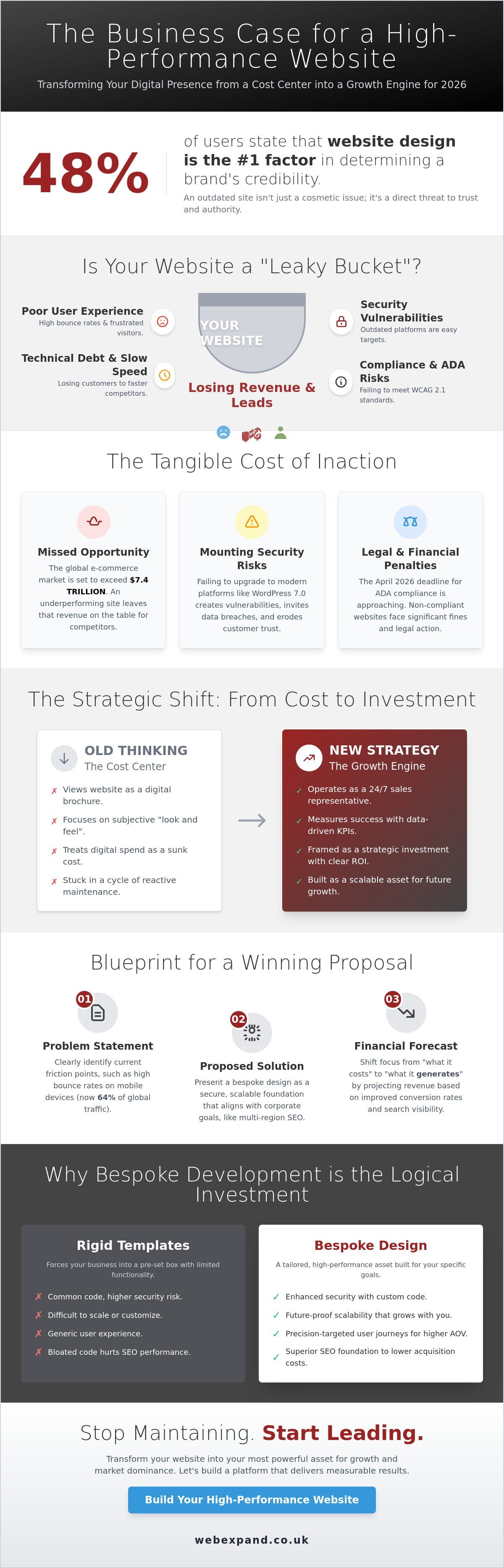
48% of users state that website design is the number one factor in determining a brand’s credibility. If your current site feels like a “leaky bucket” losing leads to faster competitors, you aren’t alone. Most leaders realize that making the business case for a new website is about more than just a fresh look; it’s about plugging those leaks and proving that digital spend is a strategic investment rather than a sunk cost. It’s natural to fear choosing a solution that might become obsolete, especially when the global e-commerce market is projected to exceed $7.4 trillion this year.
We’ll show you how to transform a standard web design project into a high-performance growth engine that secures immediate stakeholder approval and drives measurable ROI. This guide provides the data-backed framework you need to align your digital presence with 2026 standards. We will explore the impact of WordPress 7.0, the necessity of WCAG 2.1 accessibility compliance, and how bespoke website design creates the scalability your organization demands. It’s time to stop maintaining and start leading your sector with a platform built for precision and results.
Key Takeaways
- Transition from viewing your digital presence as a cost center to a high-performance asset that drives measurable organizational growth.
- Master the financial logic of making the business case for a new website by quantifying potential conversion rate improvements and long-term savings in acquisition costs.
- Uncover the “cost of inaction” by identifying how technical debt and poor user experience are currently leaking revenue from your sales pipeline.
- Follow a data-driven framework to audit your current performance and benchmark your brand against sector leaders to secure stakeholder buy-in.
- Discover why bespoke website design provides the most secure and scalable foundation for businesses ready to dominate their industry in 2026.
What is a Website Business Case and Why Does Your Strategy Need One?
A website business case is a formal justification for a capital investment. It’s the bridge between a technical need and a financial outcome. Successfully making the business case for a new website requires you to speak the language of the boardroom, moving away from subjective opinions and toward objective growth metrics. In the competitive landscape of 2026, a business case isn’t just a project request; it’s a roadmap for digital transformation that outlines how your online presence will drive revenue, reduce costs, and mitigate risk.
Stakeholders aren’t moved by the argument that a site looks old. In an era where the global e-commerce market is projected to exceed $7.4 trillion, your leadership team cares about performance, not just aesthetics. A technical specification might tell them you need WordPress 7.0 for its refreshed admin interface, but a strategic business case tells them that failing to upgrade will lead to security vulnerabilities and decreased operational efficiency. You must demonstrate that your current platform is a bottleneck for your organization’s ambition.
A well-crafted case aligns your digital spend with overarching corporate goals. If the company’s objective is to scale into new territories, your proposal should highlight how a bespoke architecture supports multi-region SEO and localized user experiences. By framing the project this way, you’re no longer asking for a “new website.” You’re proposing a high-performance asset that secures your market position and broadens your commercial horizons.
The Shift from Cosmetic Redesign to Strategic Investment
We’ve moved past the era where a website was merely a digital brochure. A successful business website acts as a 24/7 sales representative, constantly qualifying leads and moving them through the sales funnel. When you define your stakeholders, you’ll likely face a CFO focused on ROI and a CMO focused on brand authority. To convince them, you must pivot from “look and feel” to “performance and conversion.” Show them how a modern, accessible site reduces the risk of non-compliance with the April 2026 ADA regulations while simultaneously improving the user journey for your 2.86 billion global online shoppers.
The Core Components of a Winning Proposal
Your proposal needs a structure that commands attention and builds confidence. Start with an executive summary that functions as an elevator pitch for your digital expansion. This should be followed by a clear problem statement that identifies current friction points, such as high bounce rates on mobile devices, which now account for 64% of global traffic. Finally, include a financial forecast. Shift the conversation from “what this costs” to “what this generates” by projecting revenue increases based on improved conversion rates and better search visibility. This precision transforms your request into an undeniable opportunity for growth.
The Economic Foundation: Quantifying ROI and Scalable Growth
Quantifying the return on investment is the most critical hurdle when making the business case for a new website. You aren’t just buying a series of pages; you’re acquiring a performance engine designed to lower your overhead and amplify your revenue. Similar to how Green Compare helps organizations streamline their commercial utility and finance costs, a strategic digital overhaul identifies and removes hidden inefficiencies in your sales funnel. By forecasting lead volume increases based on improved technical performance, we can move the discussion from subjective preferences to objective financial outcomes. Stakeholders need to see that a modern platform isn’t a drain on resources but a catalyst for expansion.
Bespoke design plays a pivotal role in this economic shift. Unlike rigid templates that force your business into a pre-set box, custom builds allow you to tailor the user journey specifically to your highest-value customer segments. This precision often leads to a higher Average Order Value (AOV) or better lead quality because the interface removes the specific friction points that cause your prospects to bounce. When every element of the site aligns with your internal sales process, your digital presence becomes a scalable asset that grows alongside your company’s ambitions.
Reducing the Cost of Acquisition Through Organic Visibility
With global digital ad spend projected to reach $710 billion in 2026, relying solely on paid channels is becoming an increasingly expensive gamble. Strategic SEO services provide a sustainable alternative by reducing long-term Customer Acquisition Costs (CAC). While PPC provides immediate traffic, its value disappears the moment the budget runs dry. Organic search dominance functions as a balance-sheet asset that compounds over time. Securing a position on page one of Google creates a continuous stream of high-intent prospects that stabilizes your marketing overhead. If you want to build a resilient lead pipeline, it’s worth looking at how bespoke digital strategies can protect your margins.
The Conversion Equation: Turning Traffic into Revenue
Traffic alone is a vanity metric; conversion is what pays the bills. A mere 1% increase in your conversion rate can fundamentally transform your annual profitability without requiring a single extra visitor. This is where the link between page speed, user trust, and checkout completion becomes undeniable. By conducting a “payback period” analysis, you can demonstrate to stakeholders exactly how many months it will take for the revenue uplift from a high-performance site to cover the initial development investment. This data-backed approach makes the decision to upgrade a logical financial move rather than a creative luxury.
Identifying the ‘Cost of Inaction’ in Your Digital Infrastructure
Technical debt is the silent killer of organizational agility. It’s the accumulated cost of choosing easy, short-term fixes over scalable architecture. When you’re making the business case for a new website, you must highlight how this debt prevents your team from reacting to market shifts. If your current system can’t integrate with modern CRM tools or handle the latest WordPress 7.0 security protocols, you aren’t just standing still; you’re falling behind. This friction slows down every marketing initiative and ties up resources that should be focused on growth.
Quantifying lost opportunities is where the cost of inaction becomes visible. You never see the leads that leave because of a three-second lag or a broken contact form. With 2.86 billion online shoppers globally, even a tiny percentage of friction results in significant revenue leakage. Maintaining a legacy system often carries hidden fees in the form of specialized developer hours just to keep the “lights on.” In contrast, a modern bespoke solution is designed for efficiency from day one, removing the need for constant, expensive emergency repairs.
Risk assessment is the final piece of the inaction puzzle. Legacy platforms are prime targets for security vulnerabilities, and a single data breach can destroy years of built-up brand reputation. Beyond security, there’s the looming deadline of April 2026 for ADA compliance. Failing to meet WCAG 2.1 Level AA standards isn’t just a technical oversight; it’s a legal and financial liability that could cost your organization far more than the price of a proactive redesign.
The Erosion of Brand Equity and Market Position
Since mobile devices now drive 64% of global web traffic, a poor mobile experience is a direct invitation for customers to visit your competitors. Confusion is a conversion killer. If your navigation is jargon-heavy or unintuitive, you lose the psychological battle for trust within seconds. A stagnant website suggests your business is no longer innovating. This is a major red flag for high-value prospects who are looking for a confident and ambitious partner to help them dominate their sector.
Operational Inefficiencies and Manual Workarounds
Your team shouldn’t spend hours fighting an outdated CMS. Manual workarounds for simple tasks, like updating a product list or tracking a lead’s journey, represent a massive drain on productivity. “Patching” an old site is like repairing an engine that’s already reached its limit. It’s often more expensive to keep an obsolete platform on life support than it is to invest in a full rebuild that automates these processes and integrates seamlessly with your existing sales stack.
A Step-by-Step Framework for Making the Business Case for a New Website
Transitioning from concept to approval requires a structured approach that leaves no room for ambiguity. When making the business case for a new website, your first step is a rigorous audit of current performance. You need to move beyond vanity metrics and scrutinize bounce rates and conversion paths. This data provides the baseline against which all future success will be measured. It’s the foundation of your argument, proving exactly where the current site fails to support your commercial objectives.
Once you’ve established your baseline, benchmark your brand against industry leaders. If your competitors are leveraging modern architecture to deliver seamless user experiences, your legacy system is a liability. Define clear KPIs for the new site that align with corporate growth, such as a specific percentage increase in qualified leads or a reduction in support tickets. Finally, conduct a thorough analysis of bespoke vs. off-the-shelf options. While templates seem cheap initially, a custom solution offers the scalability needed to dominate your sector. Present this as a transparent, fixed-price investment model to build trust with financial stakeholders.
Data Gathering: Building Your Evidence Base
Objective evidence is your greatest ally. Use heatmaps and analytics to visualize where users are dropping off in the sales funnel. This isn’t just “technical noise”; it’s a map of lost revenue. Gather qualitative feedback from your sales and customer support teams to identify recurring pain points that your digital presence should solve. Pay close attention to technical bottlenecks like Core Web Vitals. These metrics directly impact your search visibility and user trust. If your site is slow, it’s effectively invisible to a large portion of your market.
Presentation: Winning Over the Boardroom
Success in the boardroom depends on your ability to translate technical features into business benefits. Don’t talk about “fast loading” when you can talk about “lower bounce rates” and “increased customer retention.” Visualize the growth trajectory of your company with and without this investment. When stakeholders ask “Why now?”, point to the 64% of global traffic coming from mobile devices and the imminent shift in user expectations. You can’t afford to wait while your competitors capture the $7.4 trillion e-commerce market. To start building your high-performance platform, partner with a strategic guide like Evolve Media who understands how to scale your vision.
Securing the Future: Why Bespoke Development is the Only Logical Investment
Choosing a template might seem like a shortcut to saving capital, but it’s often a detour into hidden expenses. When you’re making the business case for a new website, you must expose the fallacy of “cheap” initial costs. Templates frequently require a patchwork of third-party plugins just to meet basic operational needs. These plugins create security risks and performance bottlenecks that degrade your brand’s credibility. In contrast, bespoke web design is a scalable asset that eliminates these vulnerabilities from the start. It’s a platform built to grow with your company, ensuring you don’t outgrow your digital infrastructure in eighteen months.
Future-proofing is about more than just surviving the next year. With WordPress 7.0 having just launched in May 2026, your site must be ready to handle evolving core blocks and higher PHP requirements. A bespoke approach ensures your site remains high-performing in 2027 and beyond. By investing in custom architecture, you avoid the “technical debt” discussed earlier in this guide. Webexpand’s fixed-price model further strengthens your proposal by eliminating financial uncertainty. Stakeholders can approve the project with confidence, knowing the investment is protected from the “budget creep” common in less structured development environments.
Tailored Solutions vs. Standardised Limitations
Standardised templates are often weighed down by “code bloat,” which is a collection of unnecessary features that slow down your load times and hurt your SEO. Our bespoke solutions focus on precision. We build customised workflows that mirror your unique business processes, ensuring your digital presence works as hard as your sales team. This isn’t just about a pretty interface; it’s about owning your digital infrastructure rather than renting it from a template provider. Ownership gives you the flexibility to pivot as market trends shift, keeping you ahead of the competition.
The Partnership Advantage: Beyond the Launch
Making the business case for a new website is only the first step in a transformative journey toward industry leadership. A successful launch is the beginning of your growth, not the end. Protecting your investment requires ongoing SEO and Google Promotion to ensure your new platform consistently attracts high-intent traffic. We help you move from a “project” mindset to a “continuous growth” mindset. This collaborative approach ensures that every update and marketing push is backed by data and aligned with your long-term success. Ready to transform your digital presence into an elite growth engine? Discover how Webexpand can help you build your business case and dominate your sector today.
Transform Your Digital Presence Into a Strategic Growth Engine
Securing stakeholder approval requires a fundamental shift in perspective. You’ve seen that a high-performance platform isn’t a luxury; it’s a requirement for capturing a share of the $7.4 trillion e-commerce market. By quantifying ROI through improved conversion rates and identifying the hidden costs of legacy systems, you turn a technical request into a strategic mandate. Making the business case for a new website is about protecting your brand’s future while ensuring you remain compliant with the latest April 2026 accessibility standards.
We’ve been delivering expert bespoke website design and SEO services since 2004. Our team provides the authoritative, jargon-free advice you need to navigate the boardroom with confidence. We eliminate financial uncertainty with a fixed-price development model, giving you total budget certainty from day one. It’s time to stop managing technical debt and start broadening your commercial horizons with a partner as invested in your success as you are.
Book a strategic consultation to help build your business case and take the first step toward dominating your sector. Your journey toward industry leadership starts today.
Frequently Asked Questions
How do I calculate the ROI of a new website?
You calculate ROI by comparing the projected revenue increase from a higher conversion rate against the total development cost. Factor in the reduction in customer acquisition costs through organic search and the savings from reduced manual workarounds. This formula provides a clear percentage that proves the financial viability of the project. It moves the conversation from “what we are spending” to “what we are gaining.”
What is the most important metric to include in a website business case?
The conversion rate is the most critical metric for any digital expansion. While traffic volume matters, it doesn’t pay the bills. When you are making the business case for a new website, focus on how a small increase in conversion directly impacts the bottom line. This metric bridges the gap between marketing effort and commercial success, making it the most persuasive data point for stakeholders.
How long does it typically take for a new website to pay for itself?
Most high-performance sites pay for themselves within 6 to 18 months through increased lead volume and operational efficiency. The exact timeline depends on your current traffic levels and average lead value. High-growth sectors often see a faster return as the new platform captures high-intent prospects that the legacy system was previously losing. It’s a capital investment that builds a scalable asset for years to come.
Can we just improve our SEO without building a new website?
You can improve rankings on an old site, but technical debt often caps your potential. Search engines prioritize user experience and page speed. If your current infrastructure is slow or not mobile-first, your SEO efforts will struggle to deliver a significant return. A modern foundation ensures your content actually reaches the audience it deserves. Strategic Google promotion requires a platform that converts the traffic it attracts.
Why should we choose bespoke design over a cheaper template?
Bespoke design offers total control over your digital infrastructure and eliminates the code bloat found in templates. Custom solutions allow you to build workflows that match your specific sales process exactly. This results in faster load times and better search visibility. You own the asset rather than being tied to a third-party theme provider’s limitations, which protects your long-term interests and scalability.
What are the biggest risks of not updating our website in 2026?
The primary risks include revenue leakage through poor user experience and increased vulnerability to cyber threats. Beyond technical failure, your brand loses credibility if it looks stagnant compared to innovative competitors. You also face the risk of being unable to integrate with the latest marketing automation and CRM tools required for modern scaling. Staying on a legacy platform eventually costs more in lost opportunities than a redesign.
How do I convince my CFO that web design is a strategic investment?
Focus on risk mitigation and revenue projections rather than aesthetics when making the business case for a new website. Show your CFO how a new platform reduces manual workarounds for your team and lowers long-term customer acquisition costs. Frame the project as a capital investment that builds a scalable, high-performance asset. Use data to prove that the cost of doing nothing is higher than the investment itself.
What is the difference between a business case and a project plan?
A business case explains the “why” by focusing on the financial and strategic benefits of the investment. It’s designed to secure approval and budget from stakeholders. A project plan details the “how” by outlining timelines, resources, and specific milestones. You need the business case to win the support of the boardroom before the project plan can be executed. Both are essential for a successful transformation.