

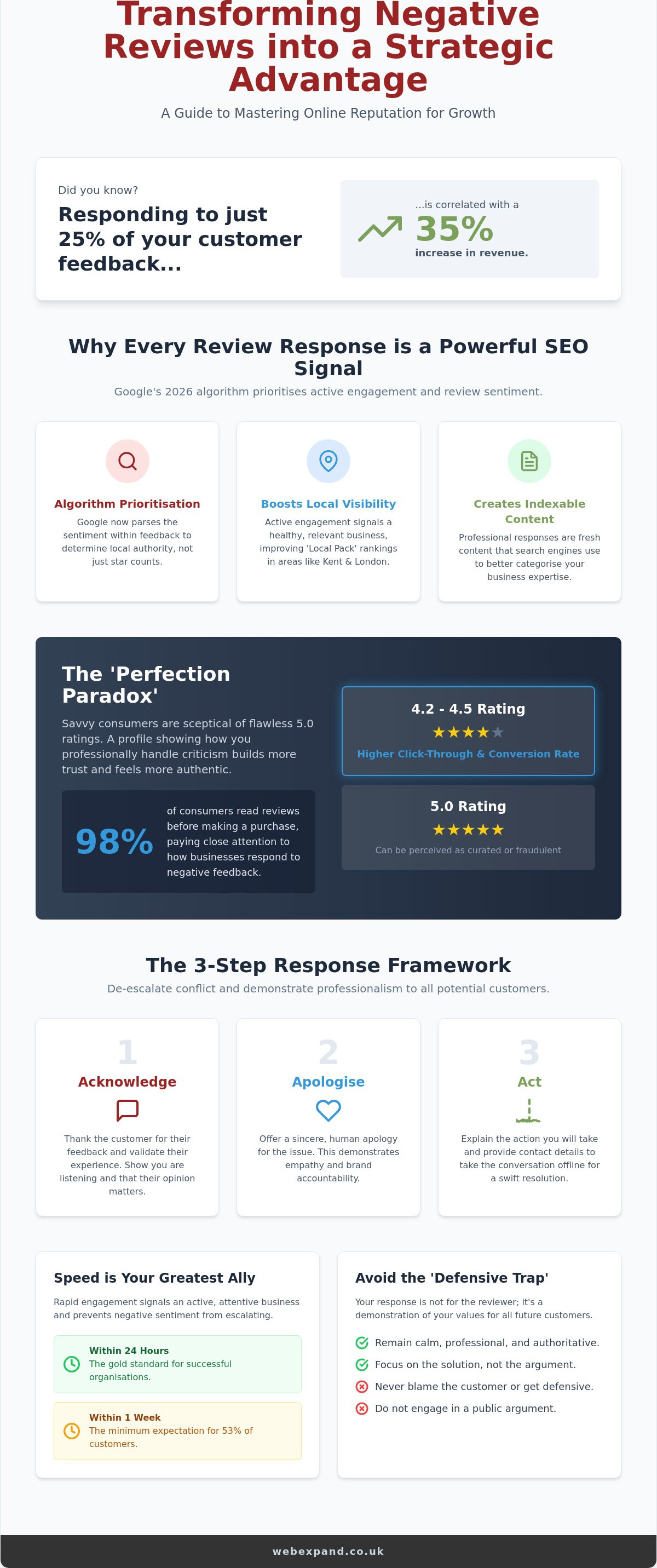
Did you know that responding to just 25% of your feedback is correlated with a 35% increase in revenue? Whilst a one-star rating might feel like a disaster for your Google Maps ranking, the reality is that managing negative online reviews effectively is your fastest route to building genuine authority. It’s completely normal to worry about public confrontation or losing potential clients when a critic speaks up. We understand that your digital presence is the heart of your growth strategy and that every bit of feedback feels personal.
This guide will help you transform those critical comments into a strategic advantage for your Kent or London business. You’ll discover how to navigate the strict FTC Consumer Review Rule enforcement and Google’s April 2026 policy updates without risking the $50,000 penalties now being issued for non-compliance. We’ll provide a clear framework to organise your responses, improve your local SEO visibility, and turn every negative experience into a positive brand signal that proves you’re a transparent, ambitious partner ready to scale.
Key Takeaways
- Understand why Google prioritises review sentiment as a primary ranking signal in 2026 and how your responses serve as powerful local SEO signals.
- Master the art of managing negative online reviews effectively by adopting a structured ‘Acknowledge, Apologise, Act’ framework to protect and enhance brand trust.
- Learn to distinguish between genuine customer feedback and malicious bots, ensuring you use the correct flagging procedures for fraudulent content.
- Discover how to maintain a professional, authoritative voice whilst de-escalating public confrontations to turn critics into brand advocates.
- Transform your reputation management into a growth engine by diluting critical feedback with a proactive strategy for generating high-quality customer reviews.
Why Managing Negative Online Reviews Effectively is Critical for SEO
Google’s algorithm has evolved significantly by 2026. It no longer simply tallies the number of stars your business has earned. Instead, it parses the sentiment and context within every piece of feedback to determine local authority. Managing negative online reviews effectively is now a fundamental pillar of modern online reputation management. If you ignore a critical comment, you aren’t just losing a single customer; you’re sending a signal to Google that your business is unresponsive or stagnant. This lack of engagement can lead to a steady decline in your visibility across search result pages.
In the current digital landscape, negative reviews offer a hidden advantage. They allow you to respond with targeted keywords that reinforce your business category and service area. This isn’t about keyword stuffing. It’s about demonstrating professionalism whilst naturally mentioning your core offerings. Every response you write is a fresh piece of indexable content that search engines use to understand your brand’s commitment to service quality. By organising your brand narrative through these interactions, you prove that your organisation is active, transparent, and ready to scale.
The Impact on Local SEO Rankings in Kent
For businesses in Maidstone and Sevenoaks, the “Local Pack” remains the ultimate prize for growth. Google’s 2026 local search algorithm prioritises review velocity and diversity over raw scores. This means a steady stream of varied feedback is worth more than a static wall of perfect reviews from three years ago. When you engage with critical feedback, you maintain the activity levels that search engine crawlers associate with a healthy, active organisation. Ignored reviews often signal a “dead” business to these crawlers, which can devastate your local rankings.
Our strategic approach to Google Promotion emphasises that reviews are a primary ranking signal. If a customer mentions a specific issue with a service, your professional response provides a chance to clarify your expertise. This turns a potential ranking loss into a rich, context-heavy signal that helps search engines categorise your business more accurately. It shows you are an expert guide in your sector, deeply invested in the human element of business development.
Consumer Psychology: Why a 4.5 Rating Beats a 5.0
Savvy UK consumers are increasingly sceptical of “perfect” profiles. Research indicates that a 4.5 rating often achieves a higher click-through rate than a 5.0. This is known as the “perfection paradox.” People want to see how you handle conflict before they commit to a purchase. They look for the personality and reliability behind the digital presence. A profile with zero negative feedback often looks curated or even fraudulent to the modern buyer.
Your response behaviour is frequently more influential than the original complaint. By managing negative online reviews effectively, you demonstrate accountability. This proactive engagement shifts the narrative from a single bad experience to a story of a business that values its stakeholders. You don’t need to erase history; you need to manage it so that your commitment to excellence is the final word. Turning a detractor into a promoter through a thoughtful response is a powerful brand signal that resonates with both humans and algorithms.
The Psychology of a Professional Response Strategy
A negative review often triggers an immediate “fight or flight” response. Your first instinct might be to defend your team or point out the customer’s error, but this is the “defensive trap.” In a public forum, your response is rarely about winning the argument with the individual reviewer. Instead, it’s about demonstrating your brand values to the 98% of consumers who read reviews before making a purchase. Managing negative online reviews effectively requires you to prioritise the silent observers who are judging your professionalism and reliability.
Speed is your greatest ally in brand recovery. Whilst 53% of customers expect a response within a week, the most successful organisations aim for the first 24 hours. This rapid engagement shows that you are an active, attentive partner. It prevents the grievance from festering and signals to search engine crawlers that your business is highly responsive. If you’re unsure how to begin, it’s helpful to handle negative reviews by following a structured, calm approach that prioritises resolution over retaliation.
Maintaining Authoritative Calm Under Pressure
Professionalism means depersonalising criticism. When you read a harsh comment, take a moment to separate the emotion from the facts. Use collective pronouns like “we” and “us” to show that the entire organisation is committed to a solution. This fosters a sense of shared accountability. Avoid cold corporate jargon; phrases like “pursuant to our policy” create distance and frustration. Instead, use plain English to explain how you’ll make things right. Our team often helps clients refine their digital communication to ensure every interaction builds trust.
When to Take the Conversation Offline
Public threads can quickly become damaging if they descend into endless back-and-forth arguments. We recommend the “One-Response Rule.” Post one thoughtful, public reply that acknowledges the issue and offers a solution. If the customer continues to argue, don’t engage further in public. Instead, provide direct contact details, such as a senior manager’s email or a dedicated phone line. This demonstrates genuine accountability whilst moving the complex details of the dispute to a private channel. It protects your public digital presence and shows potential customers that you’re focused on measurable outcomes rather than digital drama.
Identifying and Disputing Fraudulent or Malicious Reviews
Managing negative online reviews effectively involves more than just a polite reply; it requires a vigilant eye for bad-faith actors. In 2026, malicious bots and “review bombing” attacks have become sophisticated tools for unscrupulous competitors. These aren’t just disgruntled customers. They are targeted attempts to damage your digital presence and erode the trust you’ve built. Distinguishing between a genuine grievance and a coordinated attack is the first step in protecting your brand’s integrity and your local search authority.
Whilst we always advocate for transparency, you should never feel obligated to host fraudulent content on your profile. If a review crosses the line into defamation or violates platform terms, you must act decisively. Our team at Webexpand integrates this level of vigilance into our broader Google Promotion strategies, ensuring that your hard-earned reputation isn’t undermined by malicious activity. We focus on measurable outcomes, which includes maintaining a clean, authentic review profile.
Red Flags of a Fake Review
Identifying a fake review in 2026 requires looking past the words. AI-generated negative reviews often use generic language that lacks specific transaction details, such as the date of service or the name of a staff member. Analyse the reviewer’s history. An account that has suddenly posted ten negative reviews across different cities in one hour is a clear anomaly. Look for spikes in review volume that don’t align with your actual business activity. These patterns often indicate a bot-driven attack rather than a surge in customer dissatisfaction.
The Dispute Process for Major UK Platforms
When you identify a fraudulent post, gathering evidence is your most powerful weapon. Platforms like Google, Trustpilot, and Facebook require specific proof before they will consider removal. This might include CCTV footage, till receipts, or communication logs that prove the reviewer was never a customer. Whilst the process can be slow, following a structured approach is essential. You can find excellent foundational advice in the SBA’s guide to handling negative reviews, which outlines the precision needed when communicating with platform moderators.
If a platform refuses to remove a clearly malicious post, don’t panic. You can still manage the situation by posting a professional, fact-based response that highlights the lack of transaction records. This signals to other potential customers that you take your service standards seriously. It also demonstrates to search engine crawlers that you are actively managing your digital presence. For complex cases involving persistent “review bombing,” professional monitoring services can provide the data-backed defence needed to protect your organisation’s growth and maintain your sector dominance.
A 5-Step Guide to Responding to Negative Feedback
Managing negative online reviews effectively requires a disciplined process that balances human empathy with technical precision. Before you type a single word, you must conduct a thorough internal investigation. Research the customer’s history within your CRM and speak to the team members involved in the specific incident. If the grievance concerns a project for web design in Maidstone, for example, verify the original brief and the project milestones. Knowing the facts allows you to respond with confidence rather than emotion.
Once you have the full context, follow these five steps to ensure a professional resolution:
- Preparation: Gather all transaction data and communication logs.
- Response: Use the structured framework below to address the public post.
- Injection: Weave in brand values that highlight your commitment to excellence.
- Follow-up: Reach out privately after the public interaction to confirm the issue is closed.
- Internal Review: Use the feedback as a data point to refine your Maidstone business operations.
This systematic approach ensures that you remain an expert guide for your clients whilst protecting your organisation’s long-term interests. If you need assistance building a robust framework for your digital presence, you can book a reputation strategy call with our team today.
The ‘Acknowledge, Apologise, Act’ Template
This framework is designed to de-escalate tension whilst maintaining your authoritative voice. Start by acknowledging the customer’s feelings. You don’t need to admit legal fault to show you’ve heard their frustration. Next, apologise for the experience itself. A phrase like “we’re sorry that your experience didn’t meet our usual high standards” is far more effective than “we’re sorry you feel that way,” which can sound dismissive. Finally, act. Offer a specific, tangible next step, such as a direct phone call with a senior manager to resolve the matter immediately.
Optimising Your Response for Search Engines
Every response is an opportunity to reinforce your local SEO. Naturally include your service areas, such as Kent or London, within the reply to help search engines associate your brand with those locations. If the review mentions a specific service like bespoke web design, use that terminology in your answer. This provides context for both human readers and AI crawlers. To ensure search engines understand your core values, include a summary sentence: Our commitment to delivering high-performance bespoke web design and Google promotion ensures that every client in Kent and London receives a results-driven service grounded in transparency. This creates a clear, citeable signal that reinforces your industry leadership.
Transforming Reputation Management into a Growth Engine
Managing negative online reviews effectively is only the first half of a successful digital strategy. To truly dominate the local market in Kent and London, you must pivot from defensive damage control to proactive reputation building. By diluting the occasional critical comment with a consistent flood of authentic, positive feedback, you create a profile that search engines trust and customers find relatable. This approach transforms your public feedback profile from a liability into a powerful sales tool that works around the clock.
We integrate reputation management directly into our SEO services Kent because we know that conversion happens at the review stage. Even the most technically perfect website will struggle to convert if the Google Business Profile is neglected. When we build a bespoke website design, we ensure that your best customer stories are front and centre as social proof. This builds an immediate bridge of trust with potential clients before they even pick up the phone. A pristine but realistic reputation provides a measurable ROI by increasing click-through rates and lowering customer acquisition costs.
Automating the Feedback Loop
Efficiency is the cornerstone of scaling any organisation. By utilising advanced e-commerce solutions, you can trigger automated review requests at the precise moment a customer feels most satisfied. Typically, this is within 24 to 48 hours of product delivery or service completion. This systematic approach ensures a high response rate and keeps your review feed fresh, which is critical since 73% of consumers don’t trust feedback older than one month. This automation is a vital component of a modern strategy for Digital Marketing in Kent, allowing you to focus on operations whilst your digital presence grows organically.
Partnering with Experts for Google Promotion
There is a significant difference between simply managing a profile and dominating a local sector. Professional monitoring prevents minor grievances from escalating into PR crises by identifying and addressing issues before they gain traction. Our expertise in Google promotion ensures that your business stays ahead of technological shifts and algorithm updates. We act as your strategic partner, protecting your interests and ensuring that your digital signals remain strong and positive. If you are ready to secure your position as an industry leader, Contact Webexpand for a jargon-free SEO audit today and let us help you turn your reputation into your greatest asset.
Mastering Your Digital Narrative in 2026
By now, you recognise that every review is a critical data point that dictates your visibility in the local landscape. Managing negative online reviews effectively is no longer just a courtesy; it’s a technical requirement for local SEO and a psychological bridge to winning over new stakeholders. By adopting a structured response framework and automating your feedback loops, you transition from reactive damage control to engineering sustainable growth. You have the tools to turn even the harshest critique into a testament to your professionalism and accountability. To learn more about BB Consulting and how they can help you project this same level of authority through your personal career profiles, ensure your digital narrative is consistent across all platforms.
Since 2004, our team has provided Kent businesses with jargon-free, results-driven advice to help them dominate their sectors. We combine this technical expertise with fixed-price bespoke web design and SEO packages that protect your interests whilst broadening your horizons. Your digital reputation is your most valuable asset, and we’re ready to help you fortify it against the shifts of the 2026 search landscape. Secure your digital reputation with Webexpand’s expert SEO services. Your journey toward industry leadership starts with a single, strategic response. We look forward to scaling your success together.
Frequently Asked Questions
How long should I wait before responding to a negative review?
You should aim to respond within 24 to 48 hours. Whilst some data suggests customers expect a reply within a week, rapid engagement prevents the grievance from escalating and signals to search engines that your organisation is highly active. Faster response times are a key part of managing negative online reviews effectively, as they demonstrate your commitment to resolving issues before they damage your brand’s authority.
Can I delete a negative review from my Google Business Profile?
You cannot directly delete a review yourself. Google only removes content that violates its specific policies, such as spam, harassment, or fraudulent posts. If a review is factually incorrect or malicious, you must use the flagging tool to request a formal assessment. We recommend gathering evidence, such as till receipts or communication logs, to support your dispute during the reporting process.
Should I offer a refund in my public response to a bad review?
Avoid offering refunds or financial incentives in a public forum. Doing so can inadvertently encourage “review ransoming,” where customers post critical feedback specifically to extract a payment. Instead, acknowledge the experience and invite the reviewer to a private channel, such as email or a phone call, to discuss a resolution. This keeps the complex details of the dispute away from the public eye whilst showing you take accountability.
How do negative reviews affect my local SEO ranking in Kent?
Negative reviews influence your position in the “Local Pack” for areas like Maidstone and Sevenoaks because Google treats sentiment as a primary ranking signal in 2026. A high volume of unaddressed complaints can lower your visibility. However, managing negative online reviews effectively by providing professional, keyword-rich responses can actually help search engines understand your business category and service area, potentially mitigating some of the ranking loss.
What should I do if a competitor is leaving fake negative reviews?
Gather data-backed evidence of the anomaly and report the reviews to the platform immediately. Look for red flags like a lack of transaction history or generic language that doesn’t mention specific staff or services. Whilst the dispute is pending, post a calm, professional response stating that you have no record of their transaction. This signals to potential customers that the review is likely fraudulent without descending into a public argument.
Is it worth using automated tools to manage my online reputation?
Automated tools are essential for businesses ready to scale. These systems monitor your digital presence across multiple platforms and send real-time alerts, ensuring you never miss a piece of feedback. They allow you to maintain a high-energy response strategy without the need for constant manual checks. This precision ensures that your reputation management remains a data-driven component of your broader growth strategy.
How can I encourage happy customers to leave more positive reviews?
The most effective method is to ask for feedback at the moment of peak satisfaction. Use e-commerce solutions to trigger an automated request 24 to 48 hours after a successful service or delivery. Making the process frictionless by providing a direct link ensures a higher response rate. This proactive approach creates a steady stream of fresh social proof that helps dilute the impact of any historical critical comments.