

What if your high bounce rate isn’t actually a sign of failure, but a signal that your website is working exactly as intended? Many business owners in Kent and across the UK panic when they see their metrics climbing, but understanding what is a good bounce rate for a service business in 2026 requires a shift in perspective. Since the full adoption of Google Analytics 4, the way we measure engagement has fundamentally changed. A session is now only a “bounce” if the visitor fails to stay for 10 seconds, view a second page, or trigger a conversion event.
We understand the frustration of staring at complex GA4 dashboards while worrying that your marketing spend is disappearing into a digital void. It’s difficult to scale when technical jargon makes your own data feel like a foreign language. This article promises to demystify those numbers by providing the latest industry benchmarks and showing you how to transform your bounce rate into a precision tool for growth. We’ll explore the crucial difference between a visitor who finds your phone number and leaves satisfied versus one who exits in frustration, giving you a clear roadmap to improve engagement and broaden your horizons.
Key Takeaways
- Learn why Google Analytics 4 has completely redefined engagement and how to interpret your data without the confusion of technical jargon.
- Discover what is a good bounce rate for a service business in 2026 by exploring the specific benchmarks for trades versus professional firms.
- Identify the silent killers of user retention, from sluggish load speeds to poor mobile experiences that frustrate potential clients.
- Explore how bespoke website design establishes instant authority, helping you to lower bounce rates and broaden your digital horizons.
- Gain actionable strategies for optimising your “Above the Fold” content to turn casual visitors into high-value leads.
Understanding Bounce Rate in the GA4 Era
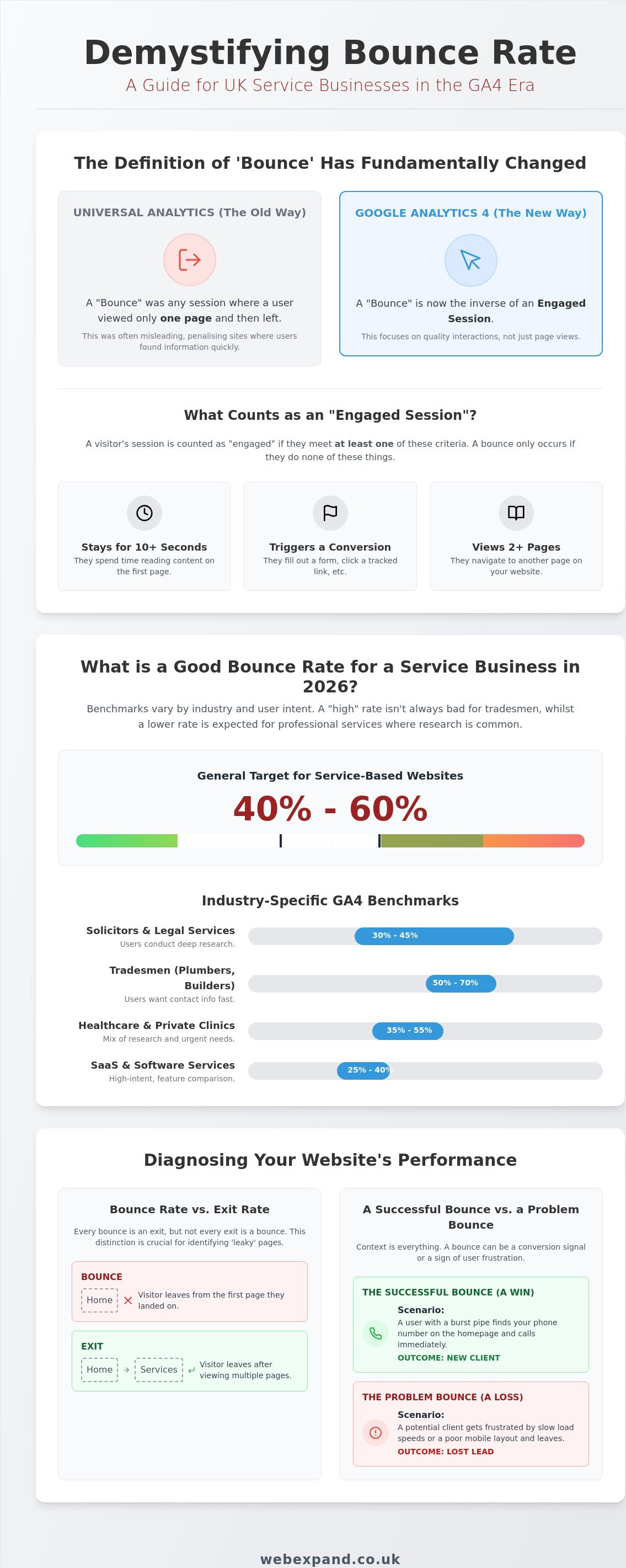
The metric we call Bounce rate has undergone a massive transformation. Under the old Universal Analytics regime, a bounce was a simple binary: a user arrived, did nothing, and left. This was often misleading. In 2026, Google Analytics 4 (GA4) uses a more nuanced calculation. It’s now the percentage of single-page sessions that were not “engaged.” This shift is vital for anyone asking what is a good bounce rate for a service business, because the numbers you see today aren’t comparable to those from the previous decade.
GA4 prioritises the Engagement Rate. Think of Bounce Rate as the inverse of your Engagement Rate. If your engagement is 60%, your bounce rate is 40%. For a service provider, this is revolutionary. It moves the focus from “who left” to “who actually interacted with my brand.” You should track both metrics to get a full picture of your digital presence. A high bounce rate might look concerning on paper, but if your conversion rate remains steady, you’re likely attracting the right people who simply find what they need quickly. Sometimes, a “bounce” is actually a win.
The GA4 Definition: What Counts as an “Engaged” Session?
Google defines an engaged session by three specific criteria. A visitor must stay on your site for more than 10 seconds, trigger a conversion event, or view at least two pages. Essentially, GA4 assumes that if someone stays for 11 seconds reading your service description, they’ve engaged with your content, even if they don’t click a second link. An engaged session proves your site provided value, regardless of whether the user journey continued to another page. This is why “Engagement Rate” is often a more positive and accurate metric for service providers to track when measuring growth.
Bounce Rate vs Exit Rate: Spotting the Difference
Precision is key when diagnosing site performance. Every bounce is an exit, but not every exit is a bounce. An exit occurs when a user leaves from a specific page, regardless of how many pages they visited before. If a potential client lands on your homepage, navigates to your blog, and then leaves, that’s an exit, not a bounce. You need to identify “leaky” pages where users drop off prematurely versus natural end-points. For instance, a “Thank You” page following a contact form submission should have a nearly 100% exit rate. That isn’t a failure; it’s a completed mission and a clear signal of success.
What is a Good Bounce Rate for a Service Business?
Determining what is a good bounce rate for a service business isn’t about chasing a zero. For most service-based websites in 2026, the golden range sits comfortably between 40% and 60%. This window suggests that whilst some visitors leave immediately, the majority find your content relevant enough to stick around or take action. Research from Plausible suggests a good bounce rate for a service business often falls between 50% and 70% depending on the specific sector and user intent.
| Industry Sector | Target Bounce Rate (GA4) |
|---|---|
| Solicitors & Legal Services | 30% – 45% |
| Tradesmen (Plumbers, Builders) | 50% – 70% |
| Healthcare & Private Clinics | 35% – 55% |
| SaaS & Software Services | 25% – 40% |
Professional B2B services usually enjoy lower bounce rates because their audience is often in a “research and compare” mindset, leading to deeper site exploration. In contrast, B2C trades often see higher rates. If a homeowner in Kent has a burst pipe, they want a phone number, not a five-page case study. If they find that number on your homepage and call you immediately, GA4 might record a bounce even though you’ve just won a new client. If you’re unsure how your specific metrics align with your growth goals, you can speak with our team for a performance review.
Industry-Specific Benchmarks for 2026
For professional services like legal, finance, or SEO, you should aim for a tighter range of 30% to 50%. These visitors require high levels of trust and typically view multiple pages to verify your expertise. This is why niche-focused digital marketing specialists in the marine sector, such as aquaticseo.com, prioritise deep user engagement to help their clients broaden their digital horizons. Local trades in Maidstone or London should expect 50% to 70%. This is largely due to “click-to-call” behaviour on mobile devices. Information-heavy pages, such as exhaustive guides on regulations, might even see 70% or higher. This is perfectly acceptable if the user spends three minutes reading every word before leaving satisfied.
The Impact of Traffic Source on Your Numbers
Your traffic source dictates the “warmth” of your visitor. Direct traffic usually boasts the lowest bounce rate because these users already know your brand and visit with high intent. Conversely, traffic from social media platforms like Facebook or LinkedIn often carries a “Social Media Penalty,” with higher bounce rates as users quickly return to their feeds. Paid Search (PPC) requires careful monitoring. If your bounce rate is high on paid landing pages, it usually signals a mismatch between your advert’s promise and the actual content on the page.
Why Service Websites Suffer from High Bounce Rates
High bounce rates aren’t accidental; they’re usually the result of friction. Even if you’ve established what is a good bounce rate for a service business, finding your own metrics exceeding 70% is a clear signal that your digital presence needs attention. Slow page load speed remains the most common offender. In the competitive UK market, users expect instant gratification. A three-second delay can double the likelihood of a bounce, turning a potential lead into a visitor for your competitor.
Technical performance and content clarity must work in tandem to keep a visitor engaged. If your site feels sluggish or confusing, you aren’t just losing a click; you’re losing revenue. We often see businesses fall into the “Jargon Trap,” where overly technical language alienates potential clients who are simply looking for a solution to their problem. When you combine complex language with weak or missing Calls to Action (CTAs), you create a path of least resistance that leads straight back to the search results.
Technical Performance and User Experience (UX)
Google’s Core Web Vitals have made technical excellence a non-negotiable requirement in 2026. If your site doesn’t meet these speed and stability metrics, potential clients in Maidstone or London won’t hesitate to leave. A mobile-first approach is equally critical for local service searches. Many Kent tradesmen lose valuable leads because their sites aren’t responsive, making it difficult for a user to find a phone number on a small screen. Simple issues like broken links or 404 errors act as digital dead ends, forcing visitors away before they’ve even seen your value proposition.
Content and Intent Mismatch
The “3-second rule” dictates that a visitor must understand what you do and how you can help them almost immediately. If there’s a mismatch between their search intent and your landing page, they’ll exit. This is where the danger of generic templates becomes apparent. One-size-fits-all layouts often fail to communicate a unique brand identity or build trust. In contrast, bespoke website design ensures every element is tailored to your specific audience’s needs. Local relevance is also a powerful tool; if someone searches for a service in their area, they expect to see local expertise that resonates with their specific location.
How to Optimise Your Service Site to Lower Bounces
Your website has roughly three seconds to prove its worth before a visitor decides to look elsewhere. Achieving what is a good bounce rate for a service business starts with a high-impact “Above the Fold” experience. This space must communicate your value proposition clearly and without ambiguity. We favour a jargon-free approach that prioritises clarity over cleverness, ensuring that potential clients understand exactly how you can solve their problems the moment the page loads. When your site provides immediate answers, the urge to click the “back” button vanishes.
Social proof is a vital component in maintaining engagement. When you showcase real-world results through reviews and case studies, you transform a static page into a persuasive narrative. Visitors stay on the page longer whilst they digest evidence of your success, which naturally signals to Google that your content is valuable. For businesses in Kent and London, this means moving beyond generic claims and presenting a portfolio that demonstrates industry leadership and measurable outcomes. A well-placed testimonial can be the difference between a bounce and a lead.
The Power of Internal Linking
A well-structured internal linking strategy acts as a roadmap for your visitors. Instead of leaving them to guess their next step, you should guide them from educational content toward a commercial enquiry. Strategically linking to your contact page at the moment of peak interest ensures the user journey doesn’t hit a dead end. We recommend using “Related Articles” to keep users within your digital ecosystem, encouraging them to broaden their horizons by exploring the full depth of your expertise. Linking from educational blog posts to commercial service pages creates a logical flow that rewards the visitor’s curiosity.
Building Trust with Local Signals
Validating your service area through local signals is a highly effective way to anchor your digital presence and improve retention. Including references to specific locations such as Maidstone or Sevenoaks confirms your physical relevance to regional searches. This local context, combined with a showcase of local projects, builds immediate rapport with your target audience. Local trust signals reduce immediate exits by confirming to the visitor that you are a legitimate, nearby provider capable of meeting their specific geographical needs. If you are ready to refine your user journey and improve your conversion metrics, get in touch with our team to discuss a bespoke strategy.
Transforming Your Digital Presence with Webexpand
Understanding what is a good bounce rate for a service business provides the necessary benchmark, but achieving those figures requires a strategic partner. At Webexpand, we believe your digital presence should be a growth engine rather than a source of technical frustration. Since 2004, we’ve helped Kent businesses move beyond generic templates that inflate bounce rates and stifle conversions. Our focus remains on precision, measurable outcomes, and the human element of business development.
We move beyond vanity metrics to focus on lead quality. A lower bounce rate is meaningless if the remaining visitors aren’t your target audience. Our data-driven approach to SEO and Google promotion in Kent and London ensures the traffic we drive to your site is primed for engagement. We align your content with the specific search behaviours of your local audience, creating a seamless transition from search results to your landing page. We provide jargon-free advice to ensure you’re always in control of your data, helping you dominate your local sector whilst broadening your professional horizons.
Bespoke Design vs Template Frustration
Off-the-shelf templates often lead to poor engagement because they lack the specificity required to build instant trust. These generic structures are frequently bloated with unnecessary code; this slows down your site and pushes your bounce rate higher. The Webexpand difference lies in our commitment to non-template, bespoke designs. By building a site tailored specifically to your Kent or London audience, we eliminate the friction that causes visitors to exit. Explore our Maidstone web design services to see how we create high-performance platforms that capture attention from the first second.
Take the Next Step Toward Industry Leadership
Are you ready to see what’s really happening under the bonnet of your website? Most business owners suspect their site could perform better but lack the technical roadmap to make it happen. Our recurring SEO management doesn’t just improve your rankings; it keeps your engagement rates high by constantly refining your user journey. We treat your progress as the ultimate measure of our own performance, positioning your brand as a transformative leader in your industry. Contact Webexpand today for an authoritative audit of your site performance and start your journey toward digital dominance.
Broadening Your Horizons with Data-Driven Growth
You now have the benchmarks to stop guessing and start growing. We’ve explored how the 40% to 60% golden range reflects healthy engagement in the GA4 era and why bespoke, non-template designs are essential for building immediate trust. Understanding what is a good bounce rate for a service business is the first step toward reclaiming your marketing budget and ensuring every visitor counts. It’s about moving beyond raw data to focus on the human element of business development and lead quality.
Since 2004, we’ve acted as a strategic partner for ambitious firms in Kent and London, providing the technical expertise needed to dominate local search. Don’t let technical jargon or slow load speeds stall your organisational progress. You can get a professional SEO audit from Webexpand to uncover exactly how our high-performance web design and tailored SEO solutions can drive your growth. We’re ready to help you transform your digital presence into a measurable, precision-engineered engine for success. Your journey toward industry leadership starts with a single, data-backed decision.
Frequently Asked Questions
Is a 70% bounce rate bad for a service business?
A 70% bounce rate isn’t universally negative but sits at the higher end of the industry average. For a local tradesman where users often seek a phone number quickly, this figure is quite common and often acceptable. However, for professional services like solicitors or financial advisors, we aim for a lower rate to ensure visitors are exploring your expertise and building trust.
How do I find my bounce rate in Google Analytics 4 (GA4)?
Bounce rate is not included in the default GA4 reports, so you must customise your view to see it. You can add the metric by clicking “Customise report” in any detail report or by creating a custom exploration in the “Explore” tab. Since GA4 focuses on engagement, you’ll find that bounce rate is simply the inverse of your engagement rate metric.
Does a high bounce rate affect my Google ranking in Kent?
Google doesn’t use bounce rate as a direct ranking factor, but it does monitor user satisfaction signals. If visitors consistently “pogo-stick” back to the search results, it suggests your site doesn’t satisfy their intent. This can indirectly suppress your visibility in local searches across Kent and London as Google prioritises sites that provide a better user experience.
Can a slow website cause a high bounce rate?
Sluggish load speeds are a primary cause of high bounce rates for modern service websites. In the competitive UK market, visitors expect a site to load in under three seconds on both desktop and mobile. If your technical infrastructure is outdated, potential clients will exit your site before your value proposition even has a chance to appear on their screens.
What is the difference between bounce rate and engagement rate?
Engagement rate measures the percentage of sessions that lasted longer than 10 seconds, had a conversion event, or viewed at least two pages. Bounce rate is the percentage of sessions that did not meet any of these criteria. Understanding what is a good bounce rate for a service business involves looking at both metrics to gauge whether your content actually resonates with your audience.
How can I reduce the bounce rate on my service landing pages?
You can reduce bounces by refining your “Above the Fold” content to establish instant trust and authority. Ensure your page answers the searcher’s primary question immediately and provides a clear path to the next step. Adding social proof, such as testimonials or case studies, also encourages visitors to stay on the page whilst they verify your credentials.
Should I worry if my blog posts have a higher bounce rate than my service pages?
It’s perfectly normal for blog posts to have a higher bounce rate, often between 70% and 90%, compared to commercial pages. Visitors typically arrive via search to find a specific piece of information, such as the detailed property guides produced by South Surveyors, and leave once they’ve consumed that content. As long as your core service pages maintain a healthy engagement level, a high-bounce blog isn’t a sign of failure.
Does mobile responsiveness impact bounce rate for local tradesmen?
Mobile responsiveness is critical for local tradesmen as the vast majority of their traffic originates from smartphones. If a potential client can’t easily find your contact details or navigate your site on a mobile device, they’ll bounce instantly. A seamless, mobile-first experience is essential for converting local searches into high-value enquiries and broadening your digital horizons.