

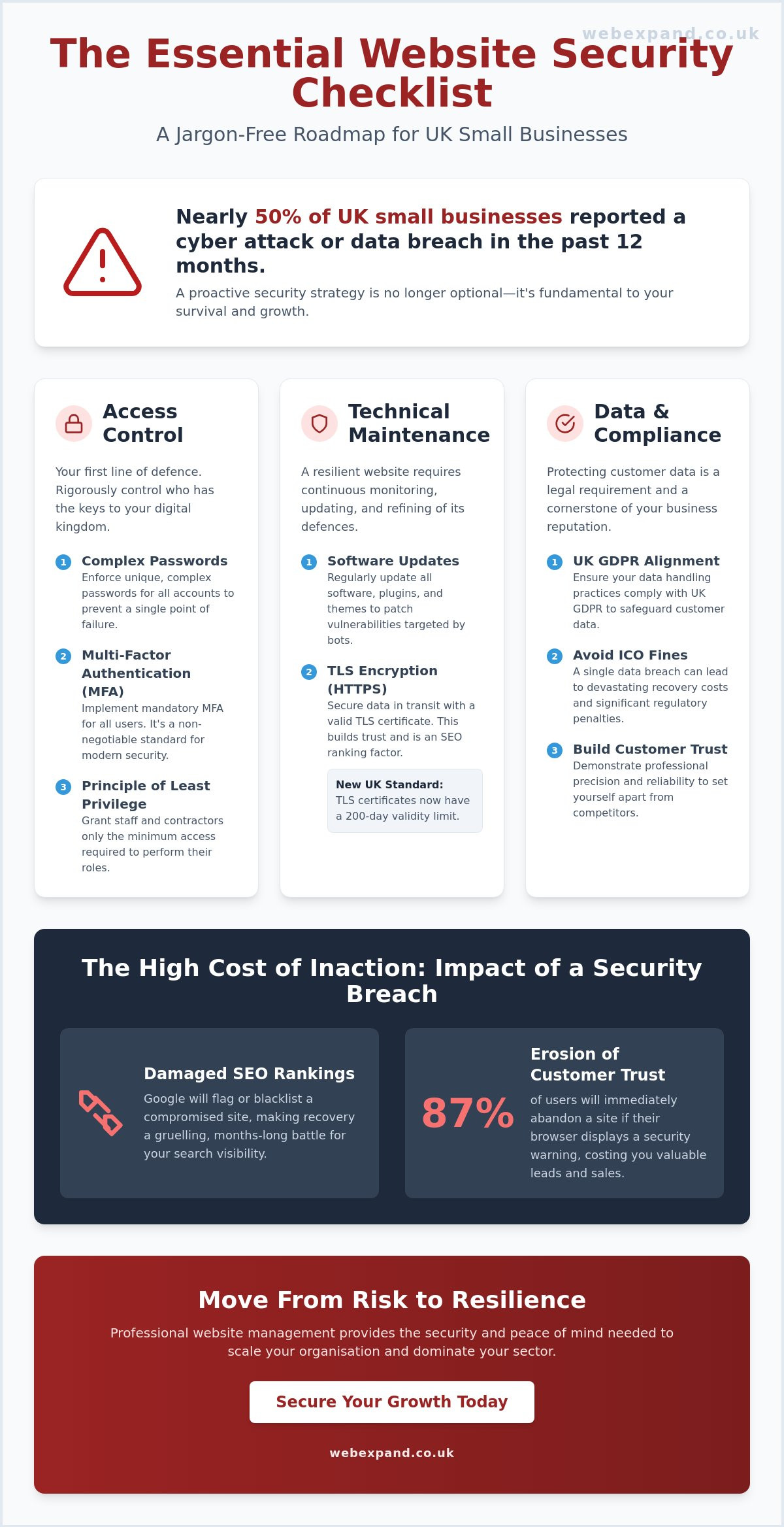
Approximately half of all small businesses in the UK reported experiencing a cyber attack or data breach in the past 12 months. This sobering statistic highlights why a robust website security checklist for small business owners is no longer optional; it’s a fundamental pillar of your digital strategy. We understand the pressure of protecting customer data whilst trying to decode complex terms like TLS 1.3 or MFA. You want to focus on scaling your organisation, not worrying about whether your site is vulnerable to the latest AI-driven phishing campaign or a significant ICO fine.
This guide provides a clear, jargon-free roadmap to ensure your digital presence is resilient against 2026 threats. We’ll walk you through the mandatory multi-factor authentication requirements and the new 200-day limit on TLS certificate validity that now defines the UK security landscape. By the end of this article, you’ll have a prioritised action plan that delivers peace of mind and protects your professional reputation. Let’s move from identifying risks to implementing data-backed solutions that secure your future and broaden your business horizons.
Key Takeaways
- Understand why hackers target smaller sites and how to transition to a proactive security strategy that protects your brand reputation.
- Secure your administrative access points by implementing complex password protocols and mandatory multi-factor authentication for all users.
- Use our authoritative website security checklist for small business owners to audit technical maintenance, including software updates and TLS encryption.
- Align your digital presence with UK GDPR requirements to safeguard customer data and avoid significant regulatory fines.
- Discover how professional website management provides the resilience needed to scale your organisation and dominate your sector.
Why Website Security is Non-Negotiable for Kent Small Businesses
Many business owners in Kent view website security as a technical hurdle to clear once and then forget. In reality, protecting your digital storefront is a continuous process of monitoring, updating, and refining your defences. It isn’t just about stopping a one-off attack; it’s about maintaining a resilient platform that supports your organisational growth. When you use a website security checklist for small business, you aren’t just ticking boxes. You’re building a foundation of trust that allows you to scale without the constant fear of a digital catastrophe.
There’s a dangerous myth that hackers only target global corporations. This couldn’t be further from the truth. Cybercriminals often prefer smaller sites because they typically have weaker defences and less oversight. Automated bots don’t care about your turnover; they look for unpatched software and easy entry points. If you’re building your presence through bespoke web design Kent, security must be baked into the architecture from day one. A secure site isn’t just a safe site; it’s a high-performance growth engine that protects your investment from lost revenue and damaged reputation.
Understanding Cybersecurity basics is the first step toward industry leadership. A single breach can lead to devastating financial consequences, including recovery costs and potential legal penalties. For a local firm, the loss of customer data isn’t just a line on a spreadsheet; it’s a breach of the personal trust you’ve worked years to establish with your community.
The Impact of a Hack on Your Local SEO
Google’s priority is providing a safe experience for its users. If your website is compromised, search engines will quickly flag it as dangerous or remove it from search results entirely to protect the public. Recovering your rankings once you’ve been blacklisted is a gruelling, uphill battle that can take months of technical auditing. This is why robust protection is a core component of professional SEO services Kent. We don’t just drive traffic; we ensure your site remains a credible, authoritative source that search engines feel confident recommending to local searchers.
Trust as a Currency in Maidstone and Beyond
In the competitive digital economy of Maidstone, trust is your most valuable currency. Modern consumers are savvy; they look for the padlock symbol and “https” prefix before they even consider filling out a contact form. If a browser throws up a security warning, 87% of users will abandon the site immediately. Website security is the digital equivalent of locking your physical shop front; just as you rely on specialists like London Locks – Locksmiths Keys and Fobs. to secure your premises, you must apply the same rigour to your online presence. By following a comprehensive website security checklist for small business, you project an image of reliability and professional precision that sets you apart from less diligent competitors.
Essential Access Control: The First Line of Defence
Access control serves as the digital equivalent of a high-security vault. It’s the primary barrier between your sensitive data and the sophisticated threats of the 2026 landscape. Any effective website security checklist for small business must begin with a rigorous evaluation of who holds the keys to your administrative backend. We often see organisations compromise their growth by using weak, recycled passwords across multiple platforms. This habit creates a single point of failure that can jeopardise your entire digital presence. You must implement a strict policy requiring unique, complex strings for every account, ensuring that a breach in one area doesn’t lead to a total system collapse.
Beyond passwords, you should adopt the Principle of Least Privilege. This strategy involves granting staff and contractors only the specific access level required to perform their roles. An editor doesn’t need full administrative rights to your hosting environment; a guest blogger doesn’t need access to your customer database. By restricting permissions, you limit the “blast radius” of a potential compromise. Regularly auditing these accounts is equally vital. You must have a clear process for removing access immediately when an employee leaves or a project with a third-party contractor concludes. If you’re unsure how to configure these permissions correctly, our team can help you secure your administrative backend.
Multi-Factor Authentication (MFA) Explained
Multi-factor authentication is no longer a best-practice suggestion; it’s a fundamental requirement for modern business resilience. The 2026 update to the Cyber Essentials scheme now makes MFA mandatory for all cloud services. This extra layer of verification stops the vast majority of automated account takeover attacks by requiring a second form of evidence, such as a code from an authenticator app or a physical security key. Whilst SMS codes are better than nothing, they are vulnerable to “SIM swapping” attacks. We recommend using dedicated apps like Microsoft Authenticator or hardware keys for higher security. Most major platforms, including WordPress and Shopify, offer native settings or reputable plugins to enforce this across your entire team. For more detailed technical steps, the NCSC small business guide provides an excellent framework for implementation.
Managing Credentials Safely amongst Your Team
Security is as much about human behaviour as it is about software. You should never share passwords via email, Slack, or other messaging platforms; these channels are frequently intercepted during a breach. Instead, use a business-grade password manager to keep your credentials organised and encrypted. This allows your team to share access to shared tools securely without ever seeing the actual password. Education is your final safeguard. With phishing remaining the most common attack vector, accounting for 51% of breaches, training your staff to recognise social engineering is critical. This is especially urgent considering that 57% of small business employees received no formal cybersecurity training in 2025. Investing in your team’s awareness is a key part of any website security checklist for small business, ensuring they become an active part of your defence rather than a vulnerability.
Technical Maintenance: Keeping Your Site Robust
Technical maintenance is the engine room of your digital presence. Whilst access controls lock the front door, maintenance ensures the structural walls remain solid. A comprehensive website security checklist for small business must prioritise the underlying infrastructure. This starts with selecting premium website hosting that provides proactive server-side security. High-quality hosting environments include firewalls and malware scanning that stop threats before they even reach your CMS, providing a vital layer of automated defence.
Equally critical is your backup strategy. You cannot rely on local backups stored on the same server as your website. If the server is compromised, your backups are likely to be compromised too. We recommend a strict, automated, off-site backup schedule. This ensures that even in a worst-case scenario, you can achieve rapid recovery and maintain service continuity. This level of resilience is a hallmark of an organisation ready to dominate its sector and protect its stakeholders’ interests.
The Danger of Outdated Plugins and Themes
Software developers constantly release patches to close security holes. When you ignore these updates, you leave your site exposed to malicious scripts that scan the web for known vulnerabilities. An unpatched plugin is like leaving a window unlatched in your office. It’s a silent invitation to intruders. Many small businesses fall into the “set and forget” trap, but a professional digital strategy requires regular audits of your CMS, themes, and plugins. Using outdated code creates easy entry points for automated attacks, which is why technical precision is non-negotiable for your growth.
SSL Certificates: More Than Just a Padlock
Encryption is the standard for modern web traffic. The current recommended standard is TLS 1.3, which secures the data moving between your server and your users. As of March 15, 2026, the maximum validity for a publicly trusted TLS certificate is 200 days. This shorter lifespan improves security by ensuring certificates are updated frequently with the latest encryption standards. It’s a fast-paced requirement that demands diligent management to avoid service interruptions.
Beyond privacy, SSL certificates are a vital component of your Google promotion Kent efforts. Search engines prioritise HTTPS sites, and failing to secure your domain can lead to “Not Secure” warnings that destroy user trust instantly. Whether you use a basic certificate or an extended validation option, ensuring your site uses HTTPS by default is a fundamental step in any website security checklist for small business. It protects user privacy and reinforces your reputation as a reliable, forward-thinking partner.
Protecting Customer Data and GDPR Compliance
Accountability is the cornerstone of UK GDPR. As a data controller, you carry the legal responsibility for every byte of personal information your website collects. This isn’t just about avoiding a fine; it’s about respecting the individuals who fuel your business growth. A robust website security checklist for small business must include a clear strategy for handling sensitive information, from simple contact form enquiries to complex e-commerce checkouts. If a breach occurs that risks the rights and freedoms of your users, you have a strict legal obligation to notify the Information Commissioner’s Office (ICO) within 72 hours. Failing to implement “appropriate technical and organisational measures” can lead to fines reaching up to £17.5 million or 4% of your global annual turnover, as demonstrated by the significant penalties issued to organisations like Capita and Reddit in late 2025 and early 2026.
Securing E-commerce Transactions
The transition period for the Payment Card Industry Data Security Standard (PCI DSS) v4.0 ended on 31 March 2025. All requirements that were previously considered best practices are now mandatory for any organisation handling payment card data. To protect your organisation, you should never store credit card details on your own server. Instead, use reputable payment gateways like Stripe or PayPal to offload the risk. These providers handle the heavy lifting of encryption and compliance, ensuring your ecommerce solutions remain secure and resilient. By integrating these strategic partners, you protect your customers’ financial data whilst focusing on your own market expansion.
Data Minimisation Strategies
Adopting a “less is more” philosophy is one of the most effective ways to reduce your risk profile. Data minimisation involves only collecting the specific information you need to fulfil an order or respond to an enquiry. If you don’t need a customer’s date of birth or home address for a digital newsletter, don’t ask for it. Regularly purging old customer data further limits the impact of a potential compromise. Clean data management doesn’t just satisfy regulators; it improves your overall digital marketing efficiency by ensuring your CRM only contains active, high-value leads. If you need help auditing your data collection processes, you can speak with our compliance specialists today to ensure your site meets the highest standards of protection.
Privacy Policies and Cookie Consent
Your Privacy Policy shouldn’t be a hidden document filled with legal jargon. It must be an accessible, transparent statement of how you collect, use, and protect data. In 2026, UK consumers are increasingly aware of their digital rights. A clear cookie consent banner that gives users genuine choice is a vital part of your website security checklist for small business. This transparency builds the kind of professional reputation that allows you to outperform competitors who take a more casual approach to user privacy. By being open about your data behaviour, you foster a sense of shared goals and mutual success with your audience.
Professional Website Management: Securing Your Growth
Scaling your organisation requires a shift in focus from daily maintenance to strategic expansion. Whilst many entrepreneurs begin with a DIY approach, the complexity of the modern threat landscape makes this a high-risk strategy. A single misconfiguration in your website security checklist for small business can lead to catastrophic downtime or a data breach that halts your momentum. Professional website management isn’t just a service; it’s a partnership that ensures your digital presence remains an asset rather than a liability. By delegating technical oversight to experts, you reclaim the time needed to dominate your sector and deliver value to your stakeholders.
Proactive monitoring allows us to identify and neutralise threats before they escalate into business-critical disasters. We provide the jargon-free advice you need to make informed decisions about your digital infrastructure. Whether you are operating in Maidstone or London, having a strategic partner who understands the local digital economy gives you a distinct competitive advantage. We move quickly from identifying market challenges to presenting data-backed solutions, ensuring your value proposition is never lost in procedural complexity.
Why Fixed-Price Support Beats Emergency Repairs
The financial logic is simple: preventative maintenance is far more cost-effective than emergency recovery. The cost of a hack goes beyond the immediate repair bill; it includes lost sales, SEO recovery time, and long-term reputational damage. Our website hosting and management packages provide Kent businesses with a resilient foundation. You gain the peace of mind that comes from knowing a team of experts is watching your site, ensuring your software is patched and your defences are current. This proactive stance transforms security from a source of anxiety into a pillar of your operational stability.
Broadening Your Horizons with a Secure Foundation
Industry leadership is built on reliability. When your site is secure, you can invest with confidence in aggressive Google promotion strategies, knowing your platform can handle the increased traffic and scrutiny. Security and growth are two sides of the same coin. A resilient website allows you to focus on broadening your horizons and reaching new markets without the distraction of digital firefighting. We view your digital presence as a transformative journey toward market dominance, not just a set of files on a server.
Your journey toward industry leadership begins with a robust defence. Contact Webexpand today for a comprehensive security audit or to discuss a bespoke, secure web design tailored to your 2026 growth objectives. Let’s work together to protect your interests and secure your future success.
Building a Resilient Foundation for Market Dominance
Securing your digital presence is a strategic investment in your organisation’s longevity. By implementing a rigorous website security checklist for small business owners, you move beyond basic protection and enter a phase of sustainable growth. You now understand how robust access controls, meticulous technical maintenance, and strict GDPR compliance work together to safeguard your reputation and customer trust. These elements aren’t just technical chores; they’re the pillars of a professional brand ready to lead its industry.
Since 2004, our team has helped businesses across Kent and London navigate the complexities of the digital landscape with jargon-free advice and bespoke, high-performance web design. We integrate technical security with strategic SEO to ensure your platform remains a powerful engine for expansion. Don’t leave your resilience to chance when you can partner with experts who are deeply invested in your long-term success. Secure your business growth; contact our Kent web design experts today. Your journey toward industry leadership starts with a single, decisive step toward better protection.
Frequently Asked Questions
Is my small business really a target for hackers in 2026?
Yes, small businesses are primary targets because they often lack the sophisticated defences of larger corporations. According to the 2025/2026 Cyber Security Breaches Survey, around half of all small UK businesses experienced a breach or attack in the last year. Hackers use automated scripts to scan thousands of sites for unpatched software; this makes your digital presence a target regardless of your company size or industry sector.
What is the most important item on a website security checklist?
Implementing multi-factor authentication (MFA) across all administrative logins is the most critical item on any website security checklist for small business owners. MFA creates a secondary barrier that stops nearly all automated account takeover attempts. As of the 2026 Cyber Essentials update, this is now a mandatory requirement for UK businesses seeking government-backed certification, reflecting its status as a fundamental defence.
Do I need a special security plugin for my WordPress site?
A dedicated security plugin can provide an essential layer of protection, but it shouldn’t be your only defence. These tools help by limiting login attempts and scanning for malicious code. However, they’re most effective when combined with high-quality website hosting that includes server-level firewalls. You must still prioritise regular updates for your CMS and themes to ensure your site remains resilient against evolving threats.
How often should I back up my business website?
You should back up your website at least once every 24 hours to ensure you can recover quickly from any technical failure. If you run an e-commerce platform with frequent transactions, real-time or hourly backups are more appropriate to prevent the loss of customer order data. Always store these backups in a secure, off-site location rather than on the same server as your website to ensure they remain untainted during a breach.
What should I do if I think my website has been hacked?
You must act immediately by taking your site offline to prevent further damage and changing every password associated with your hosting and CMS. Contact your web developer or hosting provider to perform a professional clean-up and vulnerability audit. If personal customer data was compromised, you’re legally required to assess the breach and may need to notify the ICO within 72 hours under UK GDPR rules.
Does having an SSL certificate make my website 100% secure?
No, an SSL/TLS certificate only encrypts the data travelling between your server and the user’s browser. Whilst it protects information like credit card details from being intercepted, it doesn’t stop hackers from exploiting a weak password or an unpatched plugin. A comprehensive website security checklist for small business includes SSL as one component of a much broader, multi-layered defence strategy that covers access and maintenance.