

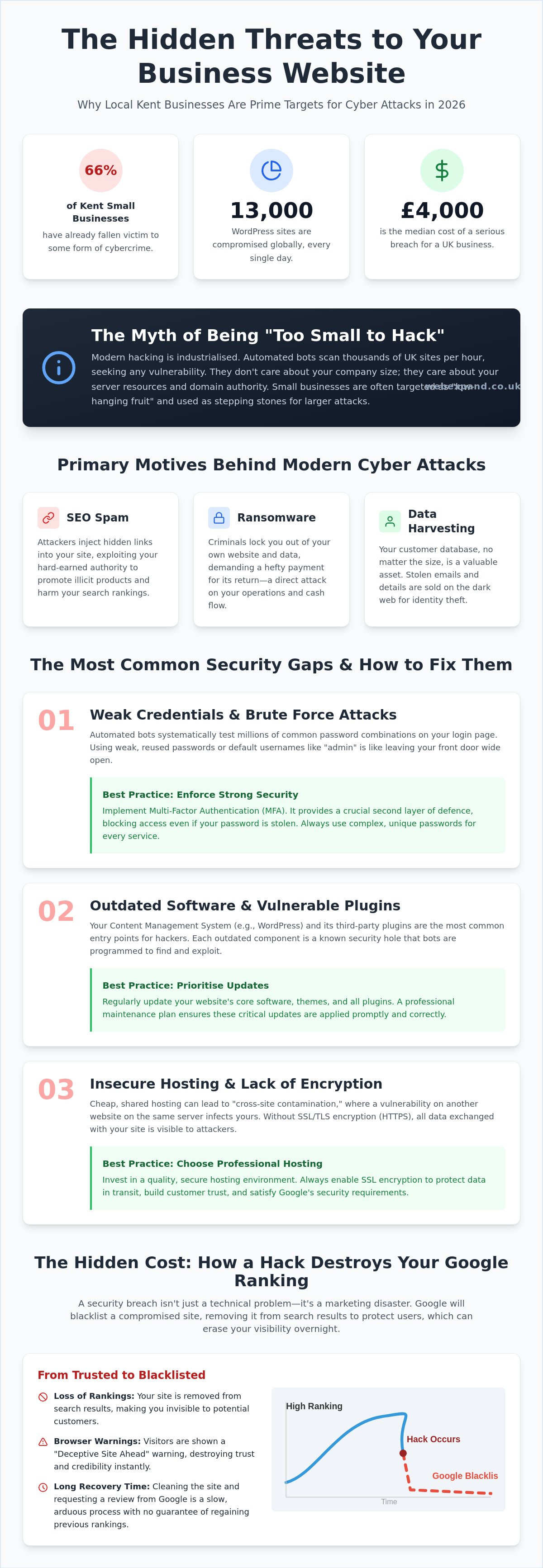
Did you know that 66% of small businesses in Kent have already fallen victim to cybercrime? With an average of 13,000 WordPress sites compromised every single day, the threat to your digital presence is more than just a theoretical risk. Understanding the common reasons websites get hacked is the first step toward transforming your site from a vulnerable target into a secure, authoritative asset that dominates your local market.
It’s natural to feel anxious about potential website downtime or the median £4,000 cost that a serious breach can inflict on a UK business. Whilst you’ve worked hard to build your brand, the thought of Google blacklisting your pages or losing customer trust is a burden no business owner should carry alone. We promise to strip away the technical jargon and provide a clear, data-backed strategy to protect your online interests. In this guide, we’ll examine the most critical vulnerabilities of 2026, from AI-powered phishing to the new requirements of the UK Cyber Security and Resilience Bill, ensuring you have the tools to scale your business with absolute confidence.
Key Takeaways
- Realise that cybercriminals use automated bots to harvest server resources, meaning your business size doesn’t protect you from being a target.
- Identify weak credentials and brute force attacks as the most common reasons websites get hacked and learn how to secure your entry points.
- Understand the vital link between outdated software and security gaps, prioritising regular updates to your CMS and third-party plugins.
- Protect your digital presence from cross-site contamination by choosing professional hosting environments and robust SSL encryption.
- Guard your hard-earned visibility by discovering how security breaches lead to Google blacklisting and devastating drops in your search rankings.
Why Hackers Target Kent Business Websites (It Is Not Just the Giants)
Many business owners in Maidstone, Canterbury, and across Kent believe they’re invisible to cybercriminals because they aren’t household names. This is a dangerous misconception. Modern hacking isn’t a personal vendetta carried out by a human sitting at a desk; it’s a highly industrialised, automated process. One of the most common reasons websites get hacked is the simple fact that they exist on a public server. Bots don’t care about your annual turnover or your brand’s heritage. They care about your server’s processing power and your domain’s reputation.
In the past, hacking was often about digital vandalism, such as defacing a homepage to prove a point. In 2026, the game has changed to silent data theft. Hackers want to slip into your system unnoticed and stay there for as long as possible. They use your “trusted” local domain to send out millions of spam emails or to host malicious files that infect your visitors. By the time you realise there’s a problem, your reputation might already be tarnished in the eyes of both your customers and search engines.
The Myth of Being “Too Small” to Hack
Automated scripts scan thousands of UK IP addresses every hour, looking for any crack in the armour. Local tradesmen and small firms are frequently targeted because they’re seen as “low-hanging fruit.” These businesses often lack the robust personal security practices required to keep sophisticated bots at bay. Beyond just stealing your data, criminals use small sites as “stepping stones.” By compromising a smaller, less secure site, they can launch more significant attacks on larger organisations or government networks, effectively using your business as a shield for their illicit activities.
The Motives Behind Modern Cyber Attacks
The goals of a 2026 cyber attack are almost always financial or strategic. Understanding these motives helps you prioritise your defence.
- SEO Spam: Attackers inject hidden links into your high-ranking Kent site to promote illicit products, piggybacking on your hard-earned authority to boost their own search results.
- Ransomware: This is a growing threat where criminals lock you out of your business tools and demand a fee. It’s a direct hit to your cash flow and operational capability.
- Data Harvesting: Even a small local database of customer emails is valuable. These details are sold on the dark web for identity theft and targeted phishing campaigns.
Securing your site isn’t just about technical maintenance; it’s about protecting the future of your firm. When we build bespoke website design solutions, we don’t just focus on the aesthetics. We build a fortress that ensures your growth isn’t interrupted by these faceless threats.
The Danger of Compromised Passwords and Weak Authentication
Your password is the primary gatekeeper of your digital assets. If that gate is flimsy, it won’t matter how beautiful your website looks or how well your SEO is performing. Weak or stolen credentials remain one of the most common reasons websites get hacked in 2026. Many business owners in Kent still rely on simple, memorable strings of text that a modern bot can crack in seconds. These automated scripts don’t guess; they calculate. They systematically test millions of combinations until they find the one that grants them unauthorised access to your dashboard.
Bots are particularly fond of “Brute Force” attacks. They target the login page and hammer it with common passwords. If your username is still “admin”, you’ve already finished half the hacker’s job for him. This default setting is the first thing any script will test. Beyond brute force, we’re seeing a rise in “Credential Stuffing.” This involves using vast databases of emails and passwords leaked from other major site breaches. If you use the same password for your website as you do for a personal social media account, you’re leaving your business vulnerable to a domino effect of security failures. Understanding these common website vulnerabilities is essential for any growth-minded organisation.
The Critical Need for Multi-Factor Authentication (MFA)
Multi-Factor Authentication is no longer an optional “extra”; it’s the single most effective deterrent available. Even if a criminal manages to steal your password through a phishing scam, MFA acts as a secondary wall they cannot easily climb. It requires a second form of verification, usually a code sent to your mobile device or an authenticator app. For WordPress users, tools like Wordfence or Google Authenticator provide robust, easy-to-implement layers of protection. It’s a small step that drastically reduces the likelihood of a successful breach.
Staff Behaviour and Password Hygiene
A significant risk factor is the human element within your office. Sharing logins amongst team members might feel efficient in a fast-paced Kent business, but it creates massive security gaps. If one employee’s device is compromised, your entire site is at risk. Using “favourite” pet names, birthdays, or the word “Password123” is an invitation for disaster. We strongly recommend the use of professional password managers. These tools generate and store complex, unique strings for every account, ensuring your team doesn’t have to remember dozens of difficult codes whilst maintaining a high security standard.
One often overlooked threat in 2026 is the “abandoned plugin” epidemic. Hackers are now specifically targeting older plugins that the original developers no longer support. These plugins often have hard-coded credentials or outdated authentication protocols that are easily bypassed. If your site relies on legacy code, you’re effectively leaving a back door wide open. If you’re concerned that your current setup is leaving you exposed, it may be time to get in touch with our team for a professional security audit.
Outdated Software and Vulnerable Third-Party Plugins
Hackers don’t need to be geniuses to find a way in. They use automated scripts to scan the web for sites running specific, outdated versions of popular tools. For example, in early 2026, versions of the Elementor plugin up to 3.35.7 were found to have information disclosure vulnerabilities. If you haven’t updated to the patched version, your site is essentially a sitting duck. Even more dangerous is the use of “nulled” or pirated themes. Small businesses are often tempted by free versions of premium software found on dodgy websites, but these files almost always contain pre-installed backdoors that grant attackers immediate, permanent access to your server.
The “Update Fatigue” Trap
Many Kent business owners fall into the trap of ignoring update notifications. The fear that a new version might “break” the site’s layout or functionality is real, but every day you delay is a window of opportunity for a cybercriminal. This procrastination is exactly what automated bots look for. To eliminate this risk without the technical headache, many firms now opt for professional website hosting and management. This allows experts to automate the update process, ensuring security patches are applied safely and instantly whilst you focus on scaling your operations.
Vetting Your Digital Tools
Precision in your choice of digital tools is vital for a secure presence. Before installing any new plugin, check its “Last Updated” date and user reviews to ensure it is still actively maintained by its developers. An abandoned plugin is a ticking time bomb because it will never receive the patches needed to fix new exploits. We always recommend a “less is more” approach; every additional plugin you install increases your attack surface. Vulnerability scanning is a proactive security measure that involves using specialised software to regularly check your site’s code for known weaknesses before they can be exploited by third parties.
By treating your website’s software with the same rigour as your financial accounts, you ensure your digital foundation remains solid. If your current site feels cluttered with old tools, it might be time to consider a fresh start with bespoke website design that prioritises clean, secure code from the ground up.
Insecure Hosting Environments and Lack of Encryption
Your choice of hosting is the digital foundation upon which your entire business sits. If that foundation is cracked, your site becomes an easy target for exploitation. Insecure hosting configurations and a lack of data encryption are amongst the most common reasons websites get hacked. Whilst a bargain monthly price might look attractive on a balance sheet, the hidden costs of a compromised server can be devastating. For a small business in Kent, the average cost of cybercrime has reached £3,000, making a secure hosting environment a vital investment rather than a luxury.
The Risk of Cheap Shared Hosting
Many entry-level hosting plans use a “shared” model where hundreds of sites live on a single server. The danger here is cross-site contamination. If a hacker exploits a vulnerability on a completely unrelated website sharing your server, they can often “bleed” through the file system to reach yours. It’s like living in an apartment block where one tenant leaves the front door wide open. Professional web design in Kent avoids this trap by utilising secure, isolated hosting environments. Managed hosting solutions provide proactive monitoring and server-level firewalls, whereas unmanaged DIY solutions leave the heavy lifting of security entirely on your shoulders, often with disastrous results.
Encryption and Trust Signals
Data in transit is just as vulnerable as data at rest. If your site doesn’t use an SSL certificate (HTTPS), every piece of information sent through your contact forms or e-commerce checkout is transmitted in plain text. This makes it trivial for attackers to intercept sensitive customer data. Beyond the security risk, a lack of encryption destroys your brand authority. Modern browsers now display a prominent “Insecure” warning to visitors, which instantly kills your conversion rate. SSL is now a mandatory ranking factor for Google in 2026, meaning an unencrypted site will struggle to maintain any visibility in search results.
Security extends to how you update your site. Using plain FTP (File Transfer Protocol) is a significant risk because it sends your login credentials over the internet without encryption. We always advocate for SFTP or SSH, which tunnel your data through a secure connection. Additionally, the new UK Cyber Security and Resilience Bill, set for Royal Assent in late 2026, enforces stricter incident reporting and higher penalties for data mismanagement. To remain compliant and ensure business continuity, you must maintain regular, off-site backups. If the worst happens, having a clean version of your site stored in a separate, secure location allows for rapid recovery without paying a ransom. If you’re unsure whether your current host meets these modern standards, contact our experts today to secure your digital presence.
The Hidden Cost: How a Hack Destroys Your Google Ranking
A website breach is more than a technical headache; it’s a commercial catastrophe that can erase years of digital growth in hours. When Google’s crawlers detect malicious code or suspicious activity, they act decisively to protect their users. Your site will likely be blacklisted, resulting in the dreaded “This site may be hacked” warning appearing directly in the search results. This label doesn’t just discourage clicks; it signals to your customers that your organisation is no longer a safe partner. Whilst we’ve discussed the technical vulnerabilities, understanding the common reasons websites get hacked helps you appreciate that your hard-earned SEO authority is often the primary prize for an attacker.
Hackers often use “cloaking” to hide their activity from you whilst showing it to Google. They might inject thousands of links to illicit gambling or pharmaceutical sites deep within your subfolders. Because these links are hidden from your standard view, they can drain your site’s authority for months without you noticing. This silent theft of your domain’s reputation is a devastating blow to your local visibility. Regaining your position in the SERPs is not a simple fix; it’s a long journey of rebuilding trust with an algorithm that now views your site as a potential threat.
SEO Spam and Keyword Injection
Criminals target Kent businesses because their sites often have established authority and clean reputations. By hiding illicit links within your pages, they piggyback on your trust to boost their own dodgy platforms. This is a primary reason why our SEO Services Kent specialists include security audits in their strategic expansion plans. If your local firm suddenly starts ranking for unrelated terms instead of your core services, you’ve likely been hit by a keyword injection attack that will eventually lead to a manual penalty from Google.
Regaining Your Position in the SERPs
Cleaning the malicious files is only half the battle. To restore your visibility, you must submit a formal review request via Google Search Console, proving that every trace of the exploit has been removed. You must also demonstrate that the common reasons websites get hacked, such as weak authentication or outdated plugins, have been permanently addressed. At WebExpand, we believe robust security is a core pillar of what makes a good business website. Our approach to Google promotion in Kent ensures that constant security monitoring is baked into your growth strategy, preventing these ranking disasters before they can take root.
Secure Your Digital Future and Dominate the Kent Market
Protecting your online presence in 2026 requires more than just reactive fixes; it demands a strategic, data-driven approach to security. We have explored how common reasons websites get hacked, such as weak authentication and outdated plugins, can devastate your Google rankings and brand reputation. By prioritising encrypted hosting and robust multi-factor authentication, you transform your site from a vulnerable target into a resilient platform for growth.
As a Kent-based team established in 2004, we bring over 20 years of web security expertise to businesses in Maidstone, Sevenoaks, and London. We specialise in high-performance, secure bespoke web design that protects your stakeholders’ interests whilst you scale your operations. Contact Webexpand today for a security audit and jargon-free advice on protecting your business.
You have built an ambitious brand; now is the time to ensure its foundation is as strong as your vision for the future. Let us help you broaden your horizons with a digital presence that is as secure as it is successful.
Frequently Asked Questions
How can I tell if my website has been hacked?
You can identify a breach by looking for unauthorised changes to your content, unexpected redirects to other domains, or new administrative users you didn’t create. A sudden, unexplained drop in search engine traffic or a “This site may be hacked” warning in Google results are also major red flags. If your hosting provider disables your account due to unusual resource usage, it’s highly likely that malicious scripts are running on your server.
Will a hacked website affect my business’s reputation in Kent?
A security breach directly damages your local brand authority and customer trust. When clients encounter security warnings or find their personal data has been compromised, they’ll likely move to a competitor who prioritises their safety. Rebuilding a professional reputation takes significantly longer than the technical cleanup itself. Proactive security is a vital component of maintaining your standing in the Kent business community.
Is WordPress less secure than other website builders?
WordPress isn’t inherently less secure than its competitors, but its massive market share makes it a primary target for automated attacks. Most vulnerabilities stem from poor maintenance rather than the core software. One of the common reasons websites get hacked is the failure to update third-party plugins, which are responsible for the vast majority of security gaps. Proper management and bespoke website design can make WordPress a fortress.
Can a hacker steal my customers’ credit card details from my site?
If you store payment data locally or use insecure, unencrypted forms, attackers can certainly intercept this sensitive information. However, most modern e-commerce solutions use secure, third-party gateways to ensure card details never actually touch your server. We always recommend bespoke e-commerce solutions that integrate professional processors to keep your customers’ financial data entirely isolated from potential site vulnerabilities.
How often should I update my website’s plugins and themes?
You should check for updates at least once a week, though critical security patches must be applied the moment they’re released. Delaying these updates creates a window of opportunity for hackers to exploit known weaknesses that have already been publicised. To eliminate this risk, many firms use professional website hosting services that automate the update process; you can learn more about WebNaTak and how their subscription model ensures your digital presence remains secure without requiring daily manual checks.
What should I do immediately if I suspect my site is compromised?
You must change all administrative passwords immediately and take the site offline to prevent further malware spread or data theft. Contact your hosting provider to alert them and seek a professional security audit to identify the entry point. Rapid action is essential to minimise the damage to your Google rankings. Once the site is clean, you’ll need to submit a review request through Google Search Console to restore your visibility.
Does having an SSL certificate prevent my site from being hacked?
An SSL certificate only encrypts the data travelling between your visitor’s browser and your server; it doesn’t protect the server itself from being breached. Whilst it stops hackers from “sniffing” data in transit, it won’t prevent common reasons websites get hacked such as brute force attacks or plugin exploits. You need a multi-layered defence strategy that includes firewalls and strong authentication alongside your SSL certificate.
Can Webexpand help me recover a hacked website and restore my rankings?
We provide comprehensive recovery services that go beyond simple malware removal. Our team specialises in Google Promotion and SEO, meaning we don’t just clean your files; we manage the complex process of regaining Google’s trust and restoring your lost search visibility. We’ll harden your site’s defences to prevent future attacks, ensuring your digital presence becomes a secure, high-performance asset that supports your long-term organisational growth.