

With the UK e-commerce market projected to reach a staggering £317.33 billion in 2026, simply having an online presence is no longer enough to guarantee sustainable growth. You need a robust uk e-commerce marketing plan template that turns market data into a genuine competitive advantage. You’ve likely felt the frustration of watching your ad spend vanish into low-converting traffic whilst you struggle to stay compliant with the latest Electronic Commerce Regulations. It’s a constant battle to maintain your bespoke brand identity in a market often dominated by faceless retail giants.
This guide provides a comprehensive blueprint designed to transform your digital presence into a high-performance growth engine. We’ll help you move past the complexity of GDPR and technical SEO hurdles to focus on what actually delivers measurable revenue and higher search rankings. You’ll gain a clear 12-month roadmap that organises your strategy and helps you maximise ROI across every channel. We’ll show you how to synchronise your bespoke web design and Google promotion tactics to ensure your business dominates the British digital landscape.
Key Takeaways
- Access a structured uk e-commerce marketing plan template to organise your strategy and align your business goals with the 2026 digital landscape.
- Conduct a British-specific SWOT analysis and define your target audience using precise demographic data to ensure your brand messaging resonates with UK consumers.
- Discover the “Three Pillars” of growth, covering Search, Social, and Retention, and understand why bespoke SEO management is essential for outperforming generic competitors.
- Master the UK retail calendar by mapping out high-impact activities for key dates like Black Friday and Boxing Day to capture peak seasonal demand.
- Learn how to allocate your marketing budget between fixed and variable costs whilst defining the KPIs that matter most for British e-commerce success.
What is a UK E-commerce Marketing Plan and Why Do You Need One?
A UK e-commerce marketing plan is your strategic blueprint for navigating a digital marketplace that is more crowded than ever. While many understand What is e-commerce? in a broad sense, few domestic retailers possess a documented strategy that bridges the gap between having a website and actually scaling a brand. This isn’t just a business plan; it’s a tactical growth engine. Unlike a general business plan that might focus on logistics or staffing, your uk e-commerce marketing plan template focuses entirely on how you’ll attract, convert, and retain British customers in a high-velocity digital environment.
For SMEs in Kent and London, a written plan is the difference between reactive survival and proactive dominance. You aren’t just competing with the shop down the road; you’re competing with global marketplaces that have bottomless budgets. To level the playing field, you need jargon-free goals that focus on precision rather than buzzwords. We believe in results-driven growth, where every objective is tied to a measurable financial outcome. If a goal isn’t clear enough for a stakeholder to understand in thirty seconds, it isn’t ready for your strategy.
The Core Components of a 2026 Strategy
Success in 2026 requires more than just a list of social media posts. Your strategy must include an executive summary that defines your mission amongst the UK digital noise. Why should a customer choose you over a giant? You also need a deep dive into the current British market situation, looking at shifting consumer behaviours and the 20% VAT landscape. Finally, your technology stack is paramount. We often see businesses held back by generic platforms. Choosing Bespoke Website Design provides the technical flexibility you need to outperform competitors using cookie-cutter templates.
The Risks of Operating Without a Plan
Operating without a documented strategy is a recipe for wasted capital. Without a structured uk e-commerce marketing plan template, your brand identity often becomes fragmented across various UK social and search channels, confusing your audience and diluting your authority. To maintain a cohesive presence, many businesses look to specialists like Welcome to manage their brand strategy and creative design, ensuring that multi-channel content production remains consistent and engaging. You’ll likely find your marketing budget is allocated inefficiently, with money pouring into low-converting traffic whilst high-intent keywords are ignored. Most critically, you risk missing the vital UK retail calendar. In a market where Black Friday, Boxing Day, and Mother’s Day drive billions in revenue, being unprepared means leaving your share of that growth to your competitors.
Phase 1: Market Research and the British Consumer Profile
Market research is the bedrock of any successful digital strategy. It informs every decision from site architecture to ad spend. To build an effective uk e-commerce marketing plan template, you must first understand the specific forces shaping the British retail sector. This phase requires moving beyond generalisations and diving into the hard data that defines how your domestic audience shops today.
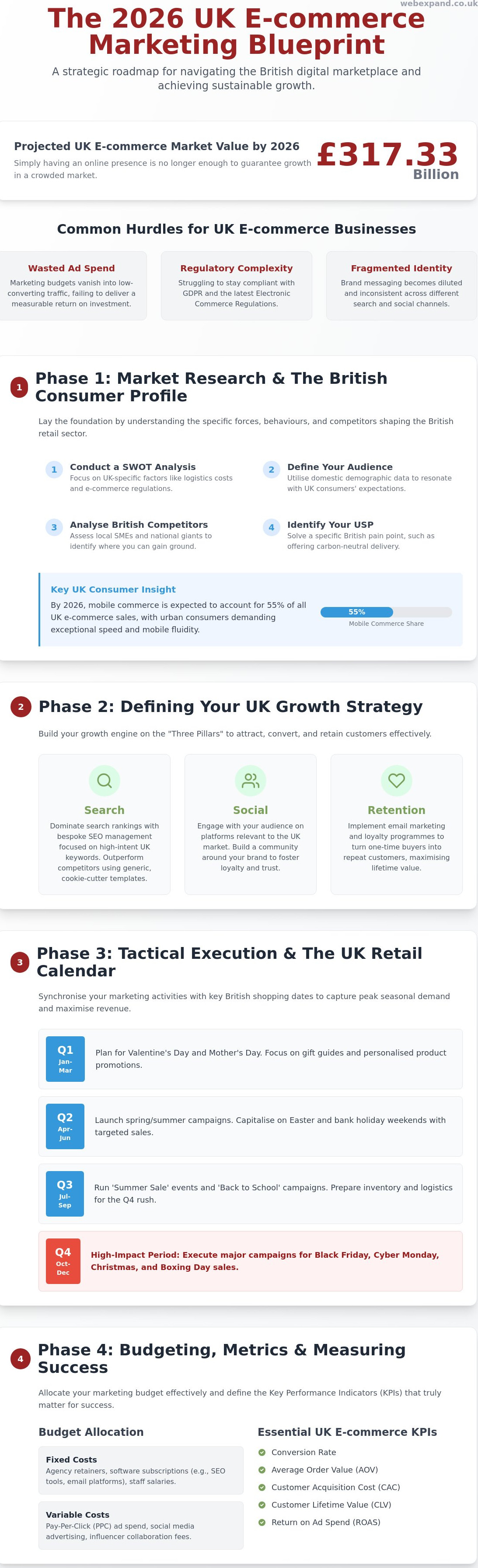
- Step 1: Conduct a SWOT Analysis: Focus on UK-specific factors. Your strengths might include a bespoke user experience, whilst threats could involve rising logistics costs or the latest Electronic Commerce Regulations 2026.
- Step 2: Define Your Audience: Use domestic demographic data. By 2026, mobile commerce is expected to account for 55% of all UK e-commerce purchases. If your audience is primarily in London or major urban hubs, their expectations for speed and mobile fluidity are even higher.
- Step 3: Analyse British Competitors: Look at both local Kent SMEs and national giants. Understand their share of voice in search results to identify where you can realistically gain ground.
- Step 4: Identify Your USP: Your Unique Selling Proposition must solve a specific British pain point. For example, offering carbon-neutral Royal Mail delivery could be your edge over a competitor using generic courier services.
A deep dive into the UK e-commerce market overview reveals that British consumers are amongst the most sophisticated in the world. They don’t just look for products; they look for reliability, transparency, and ethical alignment. If you’re unsure how your current presence measures up against these expectations, you might want to speak with a strategic partner who understands the local landscape.
Understanding UK Consumer Behaviour in 2026
Sustainability is no longer a niche preference. UK buyers increasingly favour brands that demonstrate environmentally friendly practices and transparent supply chains. Delivery expectations have also shifted. Whilst Royal Mail remains a trusted staple, the demand for precise hour-long delivery slots from couriers has become the standard in metropolitan areas. Conversion rates often hinge on whether you offer these flexible options at checkout. With mobile commerce exceeding £100 billion, your site must be designed for the thumb, not just the desktop.
Competitor Benchmarking
Tracking your UK search rankings and share of voice is essential to see where you’re losing ground. Many businesses fail because they try to compete using standard templates that lack the technical SEO foundations required to rank in competitive British niches. By analysing the “bespoke vs template” gap, you can identify where competitors are technically weak. Our bespoke e-commerce solutions provide a significant performance advantage over standard template-based competitors, ensuring you capture traffic that others lose to slow loading times and poor mobile layouts.
Phase 2: Defining Your UK Growth Strategy (SEO and Promotion)
Strategy is the point where your market research transforms into a tangible revenue stream. To scale effectively, your uk e-commerce marketing plan template should be organised around the “Three Pillars”: Search, Social, and Retention. Search builds long-term authority; social builds community engagement; and retention builds the lifetime value necessary for profitability. Without these three elements working in synchronisation, your growth will likely remain stagnant or inconsistent.
Professional SEO services in Kent provide the organic foundation required to capture high-intent buyers who are actively searching for your products. Official UK E-commerce Sales Data highlights that whilst digital spending continues to grow, the cost of acquisition is rising. This makes organic visibility more valuable than ever. However, SEO is a long-term play. To drive immediate traffic and test new product lines, Google Promotion acts as a high-velocity catalyst, putting your brand in front of ready-to-buy customers within hours.
Traffic alone isn’t the goal; conversion is. Traffic is a vanity metric if your site fails to turn visitors into customers. Integrating bespoke web design into your strategy ensures that your technical infrastructure is built to convert. Generic templates often suffer from bloated code and slow load times, which can alienate the time-poor British shopper. A bespoke approach allows for a streamlined user journey that reflects your unique brand values.
Search Engine Optimisation (SEO) Strategy
Effective keyword research in 2026 focuses on intent rather than just volume. You need to target UK-specific search terms that reflect how your audience actually speaks and shops. On-page optimisation involves more than just placing keywords; it’s about crafting content that resonates with British readers and answers their specific concerns. Technical SEO ensures that your site architecture is Google-friendly, allowing search engines to crawl and index your pages without friction. This technical health is the silent engine behind your search rankings.
Google Promotion and Paid Media
Managing a Google Ads budget in the competitive UK market requires precision and constant data analysis. You don’t want to waste spend on broad terms that don’t convert. Instead, focus on high-intent long-tail keywords that offer a better ROI. The design of your landing pages is critical here. In web design Maidstone contexts, we prioritise clear calls to action and fast loading speeds to reduce bounce rates. Finally, use retargeting strategies to capture the “window-shopping” consumer who didn’t buy on their first visit, keeping your brand top-of-mind until they’re ready to commit.
Phase 3: Tactical Execution and the UK Retail Calendar
Execution is the point where your uk e-commerce marketing plan template moves from theory into the high-stakes reality of the British retail market. You can’t afford a scattergun approach. Success in 2026 requires a disciplined 12-month calendar that aligns your promotional activity with the specific rhythms of UK consumer behaviour. By mapping your content and campaigns to the national calendar, you ensure your brand is present exactly when your customers are ready to spend, rather than shouting into the void during seasonal lulls.
The UK Seasonal Marketing Roadmap
- Q1: Post-Christmas Recovery: Focus on the “New Year, New Me” trend. Whilst many households tighten their belts after December, health, organisation, and home improvement niches often see a significant spike in interest.
- Q2: Spring and Preparation: This period is dominated by spring cleaning and early summer preparation. UK-specific dates like Mother’s Day and Father’s Day are critical milestones that require bespoke landing pages and targeted email sequences.
- Q3: The Transition: Focus shifts to “Back-to-School” campaigns in August, followed by early Christmas planning in September. This is the time to finalise your technical SEO and site performance before the year-end surge.
- Q4: The Golden Quarter: This is the most vital period for any British retailer. Black Friday, Cyber Monday, and Boxing Day sales drive a massive percentage of annual revenue, requiring a robust technology stack to handle the traffic.
Content marketing is your primary tool for building authority amongst your UK customer base. We recommend creating jargon-free product descriptions and guides that address the specific needs of British shoppers. This isn’t just about SEO; it’s about building trust. When you pair high-quality content with a targeted email marketing strategy, you create a retention loop that keeps customers coming back. British consumers value reliability, so your post-purchase email flows should be as polished as your initial sales pitch.
Bespoke Content and User Experience (UX)
Your technical execution must be flawless to survive the “Golden Quarter.” Our ecommerce website developers in London prioritise mobile speed because the modern shopper won’t wait for a slow-loading template. With mobile commerce expected to account for 55% of all UK e-commerce purchases by 2026, a mobile-first approach is no longer optional. UX design directly impacts your bottom line; even a one-second delay in page load time can lead to a significant drop in conversion rates amongst impatient mobile users. To ensure your site is ready for the 2026 peak, you can request a tactical audit of your e-commerce strategy to identify and fix performance bottlenecks before they cost you sales.
Phase 4: Budgeting, Metrics, and Measuring Success
Data is the heartbeat of any growth strategy. Without precise measurement, your uk e-commerce marketing plan template is merely a collection of assumptions. In 2026, UK SMEs must move beyond vanity metrics and focus on the financial outcomes that actually drive sector dominance. This phase requires a clear distinction between fixed operational costs and the variable spend used to scale your digital presence. We believe that every pound spent should be a calculated step toward broadening your horizons and securing a larger share of the British market.
Essential E-commerce KPIs
You must track Customer Acquisition Cost (CAC) with absolute precision. In a saturated British market, understanding exactly how much you spend to gain a single customer allows you to adjust your Google Promotion strategies in real-time. Average Order Value (AOV) is another critical metric; increasing this through better UX and strategic upselling can significantly boost your bottom line without increasing your ad spend. Finally, your Conversion Rate (CR) remains the ultimate measure of your digital marketing in Kent. If your site traffic isn’t turning into sales, you have a technical or messaging bottleneck that needs immediate attention.
Budgeting for Long-Term Growth
Balancing your budget is a delicate act. You need to fund immediate PPC wins whilst maintaining a consistent long-term SEO investment. Unlike competitors who focus solely on month-to-month gains, we view marketing as a transformative journey toward industry leadership. You must also account for UK-specific overheads, such as the 20% VAT rate and fluctuating Royal Mail or courier costs, which directly impact your net margins. These variables must be baked into your ROI calculations to ensure your growth remains profitable.
Securing Your Sector Dominance in 2026
Navigating the complex UK digital landscape requires more than just reactive tactics; it demands a synchronised strategy. By moving beyond generic templates and embracing a bespoke approach, you’ve already taken the most important step toward sustainable growth. We’ve explored how aligning your business with the British retail calendar and precise consumer data turns your website into a high-performance growth engine. Implementing a robust uk e-commerce marketing plan template isn’t just about organisation; it’s about ensuring every pound of your budget delivers measurable ROI and long-term authority.
Success in this fast-paced environment depends on having a partner who understands the technical and human elements of business development. At Webexpand, we bring over 20 years of UK digital expertise to every project. We’re specialists in jargon-free SEO and bespoke design, with a proven track record of helping businesses in Kent and London scale with confidence. Don’t leave your 2026 growth to chance. Request a Professional E-commerce Strategy Session with Webexpand today and let’s start broadening your horizons together. Your journey toward industry leadership begins with a single, data-backed decision.
Frequently Asked Questions
How much should a UK e-commerce business spend on marketing?
Most UK small to medium-sized enterprises in 2026 allocate between £1,500 and £5,000 per month on professional digital marketing services. This investment typically covers the management of your SEO and Google Promotion efforts but excludes your actual advertising spend. It is vital to balance this budget between immediate customer acquisition and the long-term technical improvements that protect your market share.
Do I need a different marketing plan for London vs the rest of the UK?
Your strategy should certainly account for regional nuances, especially if you are targeting the London market. Consumers in the capital often exhibit different shopping behaviours, such as a higher demand for same-day delivery and mobile-first interactions. Whilst your core uk e-commerce marketing plan template remains consistent, your tactical execution in London may require more aggressive bidding and localized messaging to cut through the noise.
How often should I update my e-commerce marketing plan?
You should perform a comprehensive review of your strategy every quarter to stay aligned with shifting market trends. Whilst your primary objectives might be set for the next 12 months, the fast-paced nature of the digital landscape requires monthly tactical adjustments. This ensures you are responding to real-time data and competitor movements rather than following a static, outdated document.
What are the most important UK retail dates for my marketing calendar?
The “Golden Quarter” encompassing Black Friday, Cyber Monday, and Boxing Day is the most critical period for revenue volume. You must also prioritise UK-specific milestones like Mother’s Day and Father’s Day, which fall on different dates than their international counterparts. Including the August “Back-to-School” period in your calendar ensures you maintain momentum and capture demand across the entire year.
Can I use a generic template for my bespoke e-commerce store?
A generic marketing template often fails to leverage the unique technical strengths of a bespoke website. Custom-built stores offer superior flexibility for SEO and conversion rate optimisation that cookie-cutter plans simply don’t address. Whilst a uk e-commerce marketing plan template provides a necessary structural foundation, your execution must be tailored to your site’s specific architecture to maximise your return on investment.
How do GDPR regulations affect my UK marketing plan?
GDPR and the Data Protection Act 2018 are fundamental to how you collect and process customer data for marketing purposes. Your plan must include strict protocols for email consent, data storage, and the use of tracking cookies. Maintaining high standards of data privacy isn’t just a legal requirement; it’s a critical component of building long-term trust with your British audience.
What is the difference between SEO and Google Promotion in the UK?
SEO is the process of building long-term organic authority to ensure your site ranks naturally for relevant search terms. Google Promotion involves paid advertising to secure immediate visibility at the top of search results. A successful strategy utilises both; SEO provides a sustainable foundation whilst Google Promotion acts as a high-velocity tool to drive traffic and test new product lines.
How long does it take to see results from a new marketing plan?
Paid media campaigns can deliver traffic and measurable sales within days of activation. However, organic growth through SEO and brand building typically requires three to six months to show significant momentum. This timeline allows search engines to recognise your site’s increased authority and enables your content strategy to begin resonating with your target audience.