

With approximately 60% of Google searches now resulting in no click, your traditional ranking reports aren’t just boring; they’re becoming obsolete. You’ve likely felt the frustration of watching a board member’s eyes glaze over while you explain Interaction to Next Paint (INP) or the nuances of the March 2026 Core Update. It’s exhausting to feel like your technical wins are undervalued because they don’t immediately look like revenue on a spreadsheet. You’re not alone in struggling with how to present seo results to management in a way that actually resonates with the C-suite.
We’re here to change that narrative. You’ll learn how to translate complex technical data into high-impact business stories that secure stakeholder buy-in and demonstrate clear ROI. We’ll show you how to frame topical authority as market leadership and turn technical precision into a strategic roadmap that secures your increased 2026 budget. It’s time to stop reporting on metrics and start leading the conversation on organizational growth. This guide provides the blueprint for transforming your data into a compelling story of expansion and sector dominance.
Key Takeaways
- Learn why technical jargon alienates executives and how to bridge the gap between technical wins and boardroom priorities.
- Discover how to identify your SEO “North Star Metric” to align search performance directly with revenue and lead quality.
- Master how to present seo results to management by using a three-step framework that balances industry narratives with data-backed future strategies.
- Understand why static executive summaries often outperform live dashboards when it comes to driving high-level decision-making.
- Shift your role from a technical service provider to a strategic partner by positioning SEO as a core driver of business growth.
The Translation Gap: Why Management Ignores Technical SEO Reports
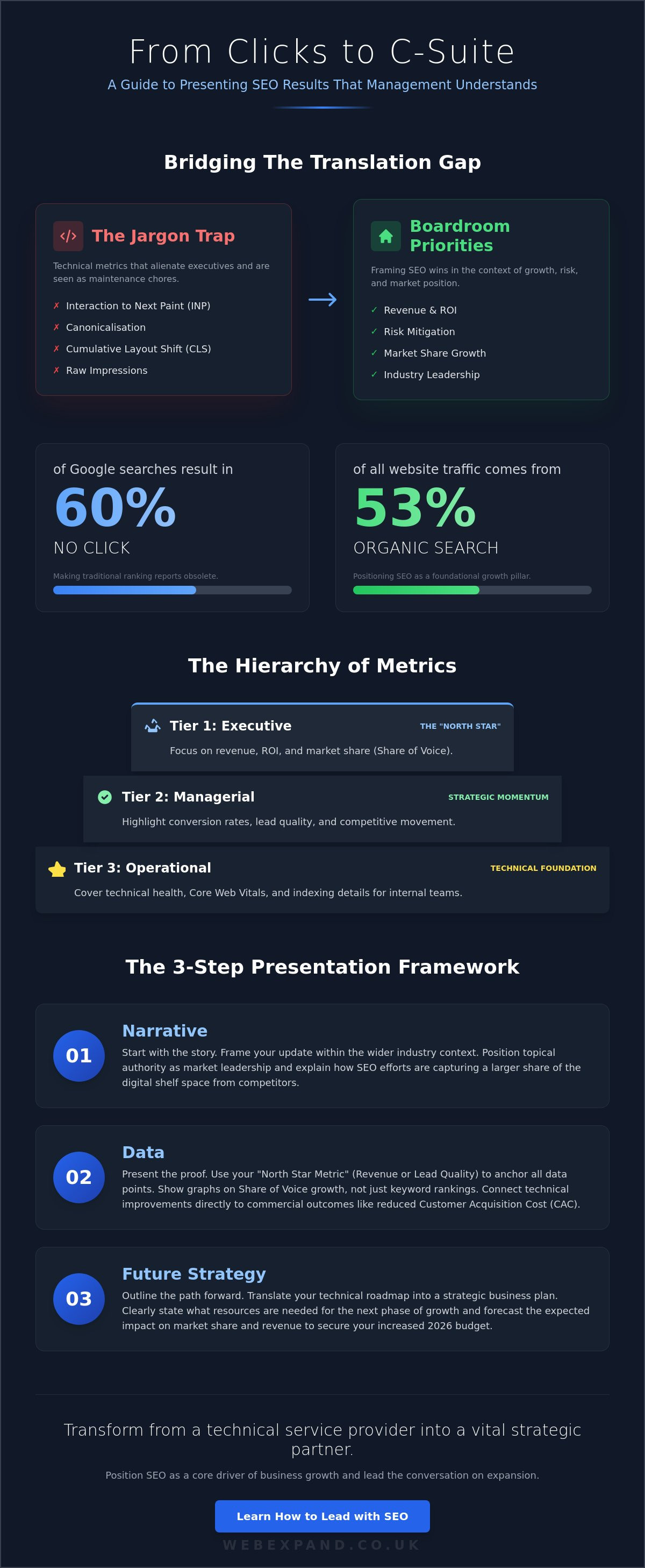
Management doesn’t ignore your reports because they don’t value your work. They ignore them because they don’t speak your language. When you walk into a boardroom and lead with Interaction to Next Paint (INP) or Cumulative Layout Shift (CLS), you’ve already lost the room. Most executives view technical reports as a list of maintenance chores rather than a strategic update on market expansion. To bridge this gap, you must stop thinking like a technician and start thinking like a shareholder. Learning how to present seo results to management effectively requires a total shift in perspective from technical “optimisation” to “digital market share.”
The “Jargon Trap” is the quickest way to kill executive interest. Terms like “canonicalisation” or “LCP” are essential for your daily workflow, but they’re noise to a CEO. While a foundational understanding of Search Engine Optimization (SEO) is useful, leadership prioritises outcomes over mechanics. They filter every update through three specific lenses:
- Risk: Is our digital presence protected from algorithm shifts or technical debt?
- Revenue: How is organic search contributing to the bottom line this quarter?
- Reputation: Does our search visibility reflect our status as industry leaders?
The Psychology of the C-Suite
Executives operate under the 30-second rule. If they can’t grasp the commercial value of a slide within half a minute, they’ll move on. This is why “vanity metrics” like raw impressions are so dangerous. A massive spike in impressions without a corresponding lift in lead quality or revenue looks like a waste of resources. It damages your credibility. Instead, position SEO as a strategic asset. It’s not a monthly technical expense; it’s a transformative journey toward dominating your sector and broadening your brand’s horizons.
The Cost of Miscommunication
Poor reporting does more than just cause boredom; it invites budget cuts. When management sees a line item they don’t understand, they view it as negotiable. This lack of clarity often forces teams into chasing “quick wins” that provide temporary spikes but fail to build long-term authority. The “Translation Gap” is the primary barrier to SEO scaling because it prevents leadership from seeing technical maintenance as a direct driver of financial performance. By mastering how to present seo results to management, you transform from a service provider into a vital strategic partner.
The Hierarchy of Metrics: Aligning Search Performance with Business Growth
Effective reporting starts with a “North Star Metric.” For most businesses, this is either direct revenue or high-quality lead generation. If you’re wondering how to present seo results to management, you must anchor every data point to these commercial outcomes. Management doesn’t want to hear about ranking movements in a vacuum. They want to see how organic search reduces Customer Acquisition Cost (CAC) and increases Lifetime Value (LTV). By mastering your SEO reporting, you can demonstrate that organic traffic isn’t just “free” traffic. It’s a high-intent channel that often converts at a lower cost than paid alternatives.
As of early 2026, organic traffic still accounts for 53% of all website traffic. This makes it a foundational pillar of your growth strategy. However, the way we measure success has shifted. Share of Voice (SoV) has emerged as the ultimate competitive metric. It calculates your brand’s visibility across the total search landscape compared to your competitors. It’s a more accurate reflection of market dominance than individual keyword rankings. When you show the board that your SoV has increased while a key rival’s has dipped, you’re speaking the language of industry leadership.
To keep your presentations focused, we recommend a three-tiered reporting structure:
- Executive Tier: Focuses on revenue, ROI, and market share.
- Managerial Tier: Highlights conversion rates, lead quality, and strategic momentum.
- Operational Tier: Covers technical health, Core Web Vitals, and indexing details.
Tier 1: High-Level Commercial Impact
Executives care about the bottom line. Report on Year-on-Year (YoY) revenue growth from organic channels to prove long-term value. You should also calculate the “Media Value” of your rankings. This shows management exactly how much they’d have to spend on Google Promotion to achieve the same visibility. It transforms SEO from a nebulous cost into a measurable financial asset that builds trust and brand authority.
Tier 2: Strategic Momentum Indicators
Managerial stakeholders need to see the “why” behind the numbers. Track conversion rate optimisation (CRO) improvements specifically within your SEO funnel. It’s vital to analyse the quality of traffic rather than just the volume. Use competitive benchmarking to show how you’re outperforming rivals. If you’re looking to dominate your sector, our Search Engine Optimisation services provide the precision needed to win.
Presentation Formats: Choosing Between Live Dashboards and Executive Summaries
Choosing the right medium for your report is as critical as the data itself. While automation is tempting, it often fails to provide the strategic nuance executives require. When you’re deciding how to present seo results to management, you must choose between the immediacy of a live dashboard and the narrative control of a curated summary. For most high-stakes meetings, a static executive summary is the superior choice. It forces you to distil complex shifts into a single page that busy directors can digest in seconds. This format ensures your technical wins don’t get lost in a sea of shifting graphs.
Your delivery method should mirror your organisational culture. Some boards prefer the transparency of a “Single Source of Truth” dashboard, while others value a monthly deck that explains the “why” behind the numbers. As noted in Bruce Clay’s guide on presenting SEO results to the board, the goal is always to translate technical metrics into business outcomes. Whether you use a slide deck or a digital portal, the focus must remain on how search performance is broadening your market reach.
The Case for Curated Monthly Decks
Monthly decks allow you to control the narrative. If a core update, like the March 2026 rollout, caused a temporary fluctuation in traffic, a slide deck gives you the space to explain the recalibration of ranking standards. You can use data storytelling to show that while raw volume dipped, the quality of traffic and topical authority increased. Use an appendix to house technical details like Interaction to Next Paint (INP) scores. This keeps your main presentation focused on growth while proving your technical rigour is still in place.
When to Use Real-Time Dashboards
Real-time tools like Google Looker Studio are perfect for the marketing department’s daily operations. However, when using them for management, you must aggressively filter the data. A dashboard for a CEO should only feature four or five key KPIs, such as organic revenue, share of voice, and lead quality. Avoid the temptation to show every available data point. A cluttered dashboard creates confusion, whereas a focused one builds confidence in your precision. When done correctly, a dashboard proves you are a digitally native partner committed to transparent, measurable results.
The 3-Step Presentation Framework: Narrative, Data, and Future Strategy
Great reporting isn’t about dumping data into a slide deck. It’s about leading a conversation. To master how to present seo results to management, you need a repeatable structure that moves from context to evidence and finally to action. We recommend a three-step framework that ensures your technical expertise is always tied to the board’s commercial objectives. This approach transforms a standard update into a high-stakes strategic briefing.
Step 1: Contextualising Performance
Start with the narrative. Before showing a single graph, explain what happened in the wider search landscape. If Google’s March 2026 Core Update shifted the industry’s focus toward information originality, say so. This frames your SEO efforts as a proactive response to market shifts rather than a reactive maintenance task. You must also address the common “ego ranking” objection. When management asks why you aren’t ranking first for a generic, high-volume term, explain that you’re prioritising high-intent keywords that drive actual revenue. Positioning SEO as a tool for market dominance helps them see the bigger picture.
Step 2: Visualising the ROI
Once the context is set, bring in the evidence. Use “Before and After” visuals to demonstrate how technical improvements have directly impacted user experience and conversion rates. A waterfall chart is particularly effective here. It allows you to show exactly how organic traffic flows through the funnel to become lead volume or sales revenue. Transparency builds trust, even when things don’t go as planned. Frame a failed test not as a loss, but as a strategic pivot that saved the budget from being wasted on a low-converting tactic. This level of honesty reinforces your position as a reliable partner.
Step 3: The Strategic Ask
Never end a presentation without a clear “Next Step.” The final phase of your framework should be the roadmap for broadening your brand’s horizons. Link future growth to specific resource requirements, whether that’s an increased budget for content or a technical overhaul. Present this roadmap as a journey toward industry leadership. If you’re ready to scale your digital presence with a data-backed strategy, explore our Search Engine Optimisation solutions to see how we can drive your 2026 growth. Every presentation must leave management with a choice: maintain the status quo or invest in the next phase of sector dominance.
Scaling Your Digital Presence: Moving from Reporting to Strategic Partnership
Trust isn’t built during a single quarterly review. It’s the cumulative result of consistent, high-quality interactions where data meets business logic. When you master how to present seo results to management, you stop being viewed as a technical cost centre. Instead, you become a strategic growth partner. This shift happens when your reports move beyond the “what” and start explaining the “so what.” By aligning your search data with the broader organisational goals, you position SEO as a foundational element of the company’s future rather than just a marketing tactic.
Building Long-Term Stakeholder Trust
Transparency is the bedrock of any professional partnership. This includes being upfront about “bad news.” If a specific strategy didn’t yield the expected ROI, present it as a data insight rather than a failure. Management values honesty because it proves you’re focused on precision and long-term sector dominance. Use these moments to educate your board gradually. You don’t need to be patronising; simply explain how market shifts, like the 2026 emphasis on topical coherence, necessitate a pivot. These insights shouldn’t stay in the marketing department. Search data reveals what your customers actually want, which can directly inform product development and overall business strategy.
The Webexpand Approach to Strategic SEO
We believe that every business deserves a bespoke roadmap. Our team provides SEO services kent that focus on measurable expansion and industry leadership. We don’t hide behind standardised packages or cold corporate jargon. Instead, we offer professional, jargon-free advice tailored to the unique needs of UK firms. We understand that your progress is the ultimate measure of our own performance. Our reporting is designed to be a transformative journey, turning technical data into a story of growth that even the most skeptical board member can get behind.
The landscape of 2026 requires more than just maintenance. It demands a forward-thinking partner who stays ahead of technological shifts to protect your interests. If you’re ready to dominate your sector and want to refine how to present seo results to management through a lens of true commercial impact, we’re here to guide you. Our focus on financial performance and digital presence ensures your value proposition is never lost. Ready to take the next step toward industry leadership? Contact us for a strategic audit and let’s start broadening your horizons together.
Transforming Search Data into Business Growth
Mastering the art of high-impact reporting is the final step in your journey from technical specialist to strategic partner. You’ve seen why bridging the translation gap is vital and how a structured three-step framework ensures your technical wins resonate with the board. By focusing on market share and commercial outcomes, you move beyond simple maintenance and begin to lead the conversation on organizational expansion. It’s about turning complex data into a clear roadmap that stakeholders can trust and support.
Understanding how to present seo results to management effectively allows you to secure the resources needed for long-term sector dominance. Established in 2004 with over 20 years of digital expertise, we specialise in bespoke, high-performance SEO strategies that drive measurable results. We provide professional, jargon-free advice tailored for UK business growth, ensuring your value proposition is never lost in technical complexity. Discover how our strategic SEO services can broaden your business horizons. Your data has a powerful story to tell; it’s time to lead that narrative with confidence and precision.
Frequently Asked Questions
What is the most important SEO metric for a CEO?
Revenue and lead quality are the most significant metrics for any CEO. While technical teams focus on clicks or impressions, leadership prioritises the bottom line. You should frame your success around how organic search reduces Customer Acquisition Cost (CAC) and contributes to the company’s total annual revenue.
How often should I present SEO results to my management team?
Monthly reporting is the industry standard for maintaining strategic momentum. When you’re learning how to present seo results to management, consistency helps build long-term trust. High-level monthly updates provide enough data to show meaningful trends without overwhelming the board, while quarterly sessions are better for discussing broader market expansion.
How do I explain an algorithm update to non-technical stakeholders?
Frame algorithm updates as a recalibration of search standards rather than a technical error. For example, explain the March 2026 Core Update as Google’s way of rewarding information originality and author expertise. This shifts the focus from “lost rankings” to a proactive strategy that evolves with the market’s requirements.
Should I include competitor data in my SEO reports?
Yes, including competitor data is essential for providing commercial context. Showing your “Share of Voice” compared to industry rivals transforms a standard report into a competitive briefing. It helps management see exactly where the business is gaining ground and identifies opportunities to dominate your sector.
How can I prove that SEO is better than PPC to my boss?
Compare the long-term Lifetime Value (LTV) of organic customers against the recurring costs of Google Promotion. SEO builds a permanent digital asset that delivers traffic without a per-click fee. Highlight that while PPC is great for immediate visibility, SEO often provides a superior ROI over a 12-month period.
What is the best way to handle a drop in organic rankings during a presentation?
Lead with transparency and provide an immediate action plan for recovery. Explain the cause, such as the rise in zero-click searches which now account for 60% of Google queries. Outlining technical fixes, like improving Interaction to Next Paint (INP) scores, shows you’re a proactive partner focused on precision.
How do I justify the cost of SEO when results are not immediate?
Explain that organic search has an average conversion lag of approximately 75 days from the first touchpoint. This data point helps management understand that SEO is a compounding investment. You can also calculate the “Media Value” of your current traffic to show the immediate financial benefit of your rankings.
Which tools are best for creating executive-level SEO reports?
Google Looker Studio and SEMrush are excellent for distilling complex data into clear business narratives. When considering how to present seo results to management, newer platforms like AIclicks are also useful for tracking visibility in AI-generated answers. Choose tools that emphasize visual storytelling and commercial impact over raw technical metrics.